This page is under construction
Our business-minded circus owner Thomas Askham applied to the Cambridgeshire Theatres Committee for a licence to perform stage plays in the Circus building on 27 March 1902. This was the start of a prolonged campaign by Askham on the one hand and the combined and vociferous forces of Church and University on the other, who felt the circus would demoralise the neighbourhood while encouraging weak-minded students to commit improprieties with those demoralised and loose characters. Perhaps anticipating problems, Askham presented a petition in support from 900 Barnwell residents, but his application failed and a verbal war went on until 1908. Read more on the great battle between the state and popular culture HERE.
The circus was dark until May in 1902 when it reopened for a short season under the management of Charles Grayson. In this year there were fewer reviews of the shows and the advertisements in the local press were minimal, just referring the public for further information to `the bills’. Perhaps Askham felt that distributing hand bills was cheaper. His major businesses – coach-makers, bicycle sales, Logan’s Boatyard – were not advertised in the press.
Charles Grayson had been a stage actor from the late 1870s, mostly in support and especially in humorous roles. Sometimes his children were in the cast, “Little Lottie” or “Little Gracie”, and one pantomime refers to ‘Mr Charles Grayson’s army of clever children’ (Era, 12 January 1895, p 18-20). After touring with a successful drama Two men and a woman, he must have decided to turn his hand to management but his time in Cambridge was short and there are no further references to him there after early June. His death ‘after four days illness’ is recorded on 16 October that year, aged 56, in Egham, ‘deeply mourned by his wife Maudie Grayson and Effie MacIntosh’, the latter appeared in the opening programme at Cambridge (Era, 18 October 1902, p 16).
(CDN, 7 May 1902, p 2)
The local press reviewer thought the circus was set to become more popular than ever, Charles Grayson had provided a programme `of the best’ and the audience was `very encouraging’ and a successful season was predicted (CDN, 13 May 1902, p 3).
The house opened with a burst of song and dance. On stage was Effie MacIntosh , a ‘dainty soubrette’ who was to become a comic actress in supporting roles, Miss Maude Burnell, and vivacious Miss Kitty Merrick with `an uncommonly sweet voice for a child of her age’. Returning from 1900 were the singing and dancing Felicia Sisters, now a duet not a trio, and the bright serio Miss Cissy Harcourt. Comic actor and comedian Eugene Brant `made a welcome reappearance’ from 1900 with old and new comic songs (CDN, 13 May 1902, p 3).
(CG, 27 October 1900, p 9)
And the responsibility for all this music was once more in the capable hands of W W Crouch. A local man and watchmaker, William Woodward Crouch, had been conductor at the Circus in 1901 and had previously been musical director at the Arcadia Music Hall.
The only act not to burst into song was Monsieur Moris, from Poland, a conjuror and chain-breaker.
An excellent exhibition of conjuring was given by Mons. Moris, some of his feats being really marvellous. Mons. Moris brought the programme to a close with his great chain-breaking set. Chains were broken in every conceivable way, and the last feat of breaking a chain presented by a member of the audience, heartily deserved the loud acclamations with which it was greeted.
(CDN, 13 May 1902, p 3).
(CDN, 17 May 1902, p 2)
Enters, pursued by a bear
Moris was newly returned from touring South Africa. On his previous visit to Britain in 1895 he had been involved in a dramatic incident when appearing at the Royal Aquarium, London. A Himalayan brown bear had escaped from its cage one morning and was wandering around the empty building, when he met the doorman, Gilder, who broke a chair over the bear’s head.
The bear then made for him; and Humphreys, a sweeper, ran from the stage-door across the Aquarium to assist Gilder. The bear instantly turned upon Humphreys, and seized him in such a manner that he was perfectly helpless. The animal then commenced to paw, hug, and tear him, and the frightful cries of Humphreys resounded through the building. It happened that Mr Moris, a Polish entertainer, had arrived unusually early to attend to matters in his dressing-room and he heard Humphreys’s cries. He thought the building must be on fire, and ran upon the stage. Looking round, he saw the man and the bear in the distance. He rushed across to them, but had no weapon. The women cleaners had all fled upstairs, but they threw him a broom, which proved a poor weapon, as its blows were useless. The cries of the poor fellow, powerless in the arms of the bear, were blood-curdling, as the animal seemed intent on choking him, and made frantic snaps at his throat. …Moris then left the building and went for his revolver.
(Era, 26 October 1895, p 1)
The animal trainer Mr Landermann, who knew the bear, was sent for and he managed to calm the animal and release Humphreys. He was taken to Westminster Hospital who later reported that Humphreys would recover from his injuries and be able to return to work in less than two weeks.
The following week in Cambridge the programme was little altered, Moris giving some excellent conjuring. On 20 May six of the singing ladies were retained as two new acts cancelled, but there were some newcomers: Pearl Jeffries `a charming vocalist’, the Australian comic singer Arthur Elvy ` a great success’ who `heartily deserved the vociferous applause awarded him’. But the best item was a miltary athletic act of swordsmanship by Profesor Wragg and Little Charlie.
`To split a potato resting on another man’s throat with a sword as keen as a razor is a feat which requires a good deal of nerve yet both father and son accomplished it with the utmost equanimity’ (CDN, 20 May 1902, p 3).
(CDN, 3 June 1902, p 2)
On Sunday 1 June the Boer War ended and the next day the Chief Constable announced that a celebratory bonfire could be lit on Midsummer Common but not on Market Hill. University students, lit a fire on Market Hill and it was soon densely packed with a surging and determined crowd. There was much destruction of hoardings, barriers, an underground lavatory and rockets were fired at houses and police were assaulted. Meanwhile hundreds of townspeople went to Midsummer Common. Fences, gates and hoarding in King Street were attacked in the search for fuel.
Skirmishers went out towards the Circus of Varieties, with a view to obtaining a hoarding there, but as this was well guarded, their run towards it developed into a walk, then into a halt, and soon most of the crowd were retracing their steps. A few of the bolder ones crossed the river and … returned with an eight-oar boat as a trophy. This was duly deposited on the fire amid great applause. Other boats followed, and then the fire was allowed to die down (CDN, 20 May 1902, p 3).
At least £500-600s worth of damage was done in the town, two undergraduates were fined for assaulting policemen and five townsmen were charged with wilful damage and one assault.
This Boer War memorial is a bronze plaque on the exterior of the east end of Great St Mary’s church in Cambridge, facing the Market Square.
The pre-armed circus seemed to have got away with only a (presumably) cancelled night’s programme, but two days later the following notice appeared in the local press. (CDN, 4 June 1902, p 2)
It seems unfair that the circus was being punished for the destruction and riot of the so-called “Peace Rag” wrought by the University’s students. The next day the following indignant letter appeared from Charles Grayson where he states he is at a loss to guess the reason for this prohibition. (CDN, 5 June 1902, p 3)
It had been two weeks since the University’s part in refusing Askham’s application for a theatre licence. Perhaps there was an element of vindictiveness on the University’s part, plus an attempt to divert blame from their rioting undergraduates. The CIP seems to think the former by prefacing the Vice-Chancellor’s proclamation with the following
(CIP, 6 June 1902, p 5)
The review of the circus the day before the Vice-Chancellor’s attack described an evening with an `exceptionally strong’ programme that seemed completely inoffensive and blameless. Professor George Deighton was a witty ventriloquist while Arthur George was specially commended for his card tricks and sleight of hand. The tramp musicians, the Vance Brothers, combined music on a variety of instruments with comic business. There was singing from the Sisters Mandeville, from Violet Wallace and from Effie Mackintosh, who `is a bigger star than ever’. And there was more comedy from Walter Gordon, the Moss Trio and a sketch from the Grayson Combination, with `excellent acting’ from Charles Grayson himself (CDN, 4 June 1902, p 2).
Grayson placed an advertisement in The Era on 12 June for more acts for June 16 to 23.
(Stage, 12 June 1902, p 20)
But we hear no more of him from then on until his sudden death in October. And there are no references to the circus in the local press at all for two weeks. On 20 June the CIP announced the arrival of Mr Bisini’s Continental Circus from 23 June `for the season’, under the management of Charles Dutrich.
(CIP, 20 June 1902, p 1)
Thomas Askham is listed as sole proprietor.
Romeo Bisini, born Rome circa 1875, began as a jeweller but, with his wife Mary Kling, became one of Italy’s major touring circus owners and directors, opening the Grand Continental Circus in 1909 with a 50-meter diameter tent housing 4,000 people. He spent 1902 and 1903 in Britain, beginning at the Royal Aquarium London in January with Arabian, Russian and Hungarian horses, boxing horses and the highest jumping horse in the world.
file:///D:/Data/Jim/Downloads/febbraio%202011-1.pdf article by Antonio Giarola called Il circo Bisini una grande impressa.
`An excellent entertainment, on purely travelling circus lines, has been provided by the company nightly’ (CIP, 27 June 1902, p 5) while the Era said `To a lover of horses the show is highly interesting all the animals being in splendid condition and in first class condition’, especially Bisini’s admirably obedient and highly trained perfectly-matched Arabian horses (Era, 28 June 1902, p 8).
Equestrians were Miss Eva and Mons. Billy, Miss Stella with her Arab stallion, and Mons. Gruber `who gives a scientific exposition of the art of manège riding’ with a `gallant grey’ and then with a pair of liberty horses.
“Captain” Maximilian Gruber was born in Austria and performed with his Italian wife Adelina until 1909, initially with horses and then had a very popular act with an elephant, Minnie, whom he had acquired in 1899, a horse and Shetland pony. They went to the USA in 1908 and remained there, performing in many circuses with elephant, a zebra and a Great Dane dog, Gruber dying in 1939.
(Era, 28 June 1902, p 8)
Miss Eva Powell, equestrienne, also from the Royal Aquarium show, gave a bar and hurdle act and then gave a double equestrian act with Mons. Billy. She may have been one of the famous Powell Family of riders. The review from the Aquarium said:
One of the most exhilarating is the performance by Mdlle. Powell of a vaulting horse act. This young lady is marvellously spirited and supple, and goes through her act with perfect intrepidity and a surprising amount of dash and activity. She careers around the ring on a saddleless steed; and it is apparently “all the same” to her, whether she stands on the bare back of the animal or swings herself up into the saddle while he leaps over obstacles.
(Era, 24 May 1902, p 21)
Non-equine acts were Mons. Recklar, juggling and on the rolling globe, the Phoenix Trio `marvellous pedestal equilibrists’, the acrobatic Elliott Troupe were back, with just the ladies this time, Comical Walker provided the clowning, and Professor Will Dewar brought his carefully trained dogs and cats.
(CIP, 20 June 1902, p 1)
George White The Human Trunk. Don’t know if we want to show this….
Midsummer Fair opened on Monday June 23 and the CIP was rather scathing about its offerings. `Cocoanuts, ice-creams, switchbacks, roundabouts, human freaks, living pictures, cheap-jacks, and glutinous sweetmeats’. `This fancy fair is not all fancy, as the attendant noise proves, nor is it all fair , at least so the losers in the cocoanut throwing appear to think’ (CIP, 27 June 1902, p 6).
But it remained very popular to the detriment of the circus. `an excellent entertainment, on purely travelling circus lines, has been provided by the company nightly, but doubtless owing to the fair and the sad national occurrence during the week,* the attendance had not been nearly as large as the entertainment deserved.
(CIP, 27 June 1902, p 5)
*The postponement of Edward VII’s coronation due to his appendicitis.
(CIP, 4 July 1902, p 1)
Bisini’s Continental Circus continued up to early July, but there were no reviews and the daily press advertisements were mininal with no acts listed. People were referred to the bills for further information.
(Era, 19 July 1902, p 7)
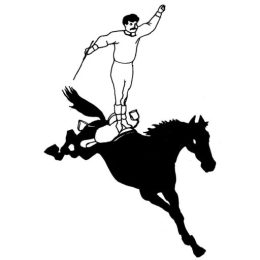
Thanks to the Era we have a brief glimpse of the programme on 19 July. Thomas Askham is listed as Proprietor with Mr Anthony Powell, this week, as manager, a task he combines with his riding act and `his marvellous boxing horses’ (Era, 19 July 1902, p 7). Son of John Powell, equestrian, he sometimes appeared with his siblings, so Mdlle Powell from the earlier programme is likely to be related.
These illustrations are taken from the Windsor Magazine, 1902, p 287-290, volume xvii, Dec 1902-May 1903.
https://www.victorianvoices.net/ARTICLES/Windsor/Windsor1903A/W1903A-BoxingHorses.pdf
He was to travel with his own circus before becoming a horse trainer in Norwich, but we will meet him again in Cambridge when he reopens our circus in February 1905.
Mons. Reklar is still balancing on the rolling globe, Miss Stella’s Arab stallion is put through his paces again, the Phoenix Trio balance on the pedestals, and Prof. Dewar’s dogs and cats perform their tricks. A new act is trapeze artist Miss Alice and Comical Walker has a fellow clown, Pipo.
[may not need this advert above?]
But in August reviews begin to appear again and perhaps there was little else to report as the summer vacation emptied the town. [Could use this quote below, or transcribe, or ignore?}
(CDN, 5 August 1902, p 2)
Visitors to the Auckland Road Circus certainly cannot complain of a lack of variety. “Turns” by smart up-to-date music hall artistes are varied with items by performers who bear the stamp of the old-fashioned and real circus entertainers. … Both succeeded in giving a large amount of pleasure, and both were awarded a great deal of applause by the crowded audience.
(CDN, 5 August 1902, p 2)
The four-legged acts were Mdlle Eva’s steeplechase act, smart horse-riding by Master Harry and Professor Anthony Powell’s boxing horses. Two-legged singing and dancing was provided by The Two Rubies and by James May, a stalwart of comic theatricals, pantomime and variety who `created roars of laughter‘ with his comic songs (CDN, 5 August 1902, p 2).
The show ended with a display of `Living Pictures’. Mr J Brandon Medland, from Lambeth, optician, photographer and scientific instrument maker, was a regular exhibitor of moving pictures on his `Grand original Vitascope, invented and made by him in 1896’ (Era, 19 May 1900, p 25). He also used a `Wonderful Desseinatograph, which produces the most Perfect and Beautiful Lace-like Designs and Extraordinary Shapes before the audience’ in colour (Era, 17 April 1897, p 24).
Hepworth, T C. The book of the Lantern. London, Wyman & Sions, 1888. P 248.
In 1905 he was advertising `the Liquid Mystic Air Kettle’ (Era, 13 May 1905, p 29). Sadly the Cambridge audience had to be content with an `very interesting’ review of the Colonial Troops by the Queen and the Prince of Wales, though Coronation pictures were promised on 11 August.
The coronation of Edward VII had been postponed from 26 June because of his serious illness with appendicitis just a few days before. Cambridge and the surrounding villages had found themselves with losses as fresh food for the feasts had to been given away. The rescheduled date of 9 August meant more muted celebrations with less `picturesque pageantry’ (CDN, 5 August 1902, p 2) and the children’s tea postponed to September.
On the day the rain cleared away and Cambridge celebrated with decorations, church services particularly at Kings, bell ringing, a procession, daylight fireworks on Parker’s Piece, bands playing and concerts in the Guildhall and on Christ’s Pieces and Parkers’ Piece with fairy lamps and Chinese lanterns.
Commemorative medal distributed by the City to schools in September 1902.
The venerable University town can have rarely witnessed such a scene of animated gaiety. Street after street was bright with flags and blazing in a brave show of scarlet and white and blue. Flags were everywhere ; they waved singly from isolated windows, flapped and fluttered in massed groups over shop fronts, stretched in seemingly endless profusion from side to side of the streets.
…[text not included]
The procession was an unqualified success ; the daylight fireworks a novelty that could not fail to please ; the balloon ascent was watched by thousands ; the illuminations were a charm which lasted until they flickered to extinction. The day may be written down a success.
(CDN 11 August 1902, p 2)
We don’t know how the circus manged with this competition but within two days the pictures of the Coronation in London were being shown by Brandon Medland.
(CDN, 5 August 1902, p 2)
The next week’s programme was divided between horse riders and comics under the name Edwards’ Grand Continental Company though most of the acts were the same as before. With Mdlle Eva, Professor Powell and Mons. Billy with horses, and comedy from the newcomers the Lesmores (“Will and Bob”) and from Rick and Bell comedians and `lightning painters.’
James May and Maggie Keith continued their `funniosities’ while May and Huntly had a laughable sketch The manic child.
The last item of the programme, and probably the best, the animated pictures of London’s Coronation Procession, was shown by Brandon’s Original Vitascope. The pictures were excellent reproductions, and a pleasant evening’s entertainment was brought to a close by the singing of the National Anthem. (CDN, 12 August 1902, p 3).
The audience was promised an amateur bicycle contest with valuable prizes for ladies on the following Wednesday and gentlemen on Friday.
The excellent and attractive programme of the next week gave the CDN reviewer a very pleasant evening with the equine acts of Professor Powell, Eva Powell and Billy and James May and Huntley’s new and amusing comic sketch Timid’s Troubles. There was a clown, Merry May and a comedy musical act by droll eccentrics Owen and Moore (Walter and Nellie).
Taken from in https://fragmentsof-history.com/2017/12/02/bro-gustave-fasola-1875-1929/
[Two more colour pictures follow – choose whichever are easiest ]
The best acts were the illusionists Edith Lyle and Gustave Fasola. He was born Fergus O’Connor Greenwood (1875-1929). His sleight-of-hand was so good that, while still a teenager and touring as a magician, he spent a month in prison for making valuable items `disappear’ and not paying his bills. He started assisting Miss Lyle, though he began to take a more leading role, with her sometimes assisting him. By 1902 he was describing himself as Sahib Gustave Fasola `the Famous Indian Fakir and Marvellous Oriental Wonder-Worker’ (Era, 26 July 1902, p 27). For Cambridge the two `illusions’ turns were the most enjoyable acts of the evening.
The first is given by Gustave Fasola, and some of his feats are marvellous. A large bowl with a live duck in it is produced from under an ordinary tablecloth, and many more bewildering feats are performed. Miss Edith Lyne is responsible for the second item, and her locked and corded box illusion and cabinet séance leave everybody puzzling at so “how it is done”’ (CDN, 19 August 1902, p 2).
And next week was even better
The last item, and undoubtedly the best, was that where Gustave Fasola, the magician and illusionist, presented some new and amazing tricks. His contribution is well worth seeing ; it is more than equal to that of the previous week, when he created a grand impression on the audience. (CDN, 26 August 1902, p 3)
After a year touring abroad our Fakir returned with his marvellous Indian Kettle trick and continued performing for many years in the UK and abroad. While in Melbourne, Australia, Fasola was performing his turning a lady-into-a-lion trick, using a real lion, Wallace, from Melbourne Zoo. Wallace escaped, walked across the stage to the audience’s consternation, and then strolled out of the theatre into the Melbourne streets, eventually entering the building of the Temperance and General Mutual Life Society, before being recaptured and returned
to the zoo. For more on this story see https://blogs.slv.vic.gov.au/our-stories/ask-a-librarian/lion-at-large-on-little-collins/
For the story of this colourful character see Bro. ‘GUSTAVE FASOLA’ 1875-1929, by Peter Reeve and Mike Neville December 2017 in https://fragmentsof-history.com/2017/12/02/bro-gustave-fasola-1875-1929/
The following poster needs permission from the Davenport Collection
After all that excitement the Cambridge audience’s appetites were whetted by the promise of a ladies decorated bicycle competition and an undecorated bike competition for the gents.
Professor Powell had trotted off with his horses and apart from Fasola and Owen and Moore, the programme for the end of August was all newcomers.
Miss Lulu Eynte (previously Lulu Belmore who performed with James May’s company), a serio and comic dancer and burlesque actress, sang `three grand songs’. More music was delivered by Mons. Ureka a singing ventriloquist who `created a favourable impression’. The `excellent and appreciative audience’ `loudly applauded’ the feats of Max Merlin, the Human Crocodile, or Osteological Paradox. `The shapes and forms he put himself into were remarkable’ (CDN, 26 August 1902, p 3).
But the Kametaros’ double ladder performance was sensational (Era, 30 August 1902, p 8). Frank Fukada Kametaro was born in Japan in 1875 but came to the UK in 1895 with the Japanese Ando Troupe and made his life here as acrobat, juggler, manager and translator, marrying a British woman and raising a family in Yorkshire. He appeared in Cambridge with another performer in the double ladder act and `Their contribution was exceedingly good, requiring as it did the greatest pluck and nerve’. They then appeared as the Royal Japanese Acrobats when `Both performers were seen to great advantage in the able rendering of their parts’ (CDN, 26 August 1902, p 3).
He acted as manager for the American magician Chung Ling Soo who unfortunately died on stage as part of his Catching the Bullet act. For more on Kametaro’s life see https://ninjin.co.uk/frank-fukada-kametaro/
[There is a colour poster of Japanese acrobats from library of Congress on Ninjin website showing the ladder act https://ninjin.co.uk/1900s/]
The press pronounced `This week’s performance should not be missed, and evening’s entertainment of the highest quality being provided’ (CDN, 26 August 1902, p 3).
September, under Askham’s proprietorship, opened with Ecnarf who `gave a good account of himself on the tight wire’ (Era, 6 September 1902, p 8). As his odd name spells France backwards, we could surmise a connection between him and the Brothers France, or France Trio who performed smart acrobatics the next week, and who are related to Sam France, the clown who clowned and was ring master at Cambridge June to July 1900. Ecnarf and the Frances appeared together in later weeks.
Returning from 1907 were the Korosko Bale sisters, `Japanese’ double jugglers, and song and dance was provided by the Rosaires Sisters, with Babette Rose, and another return act from 1896-7 was clown Pete Simple. The great attraction was Miss Daniels, (surely our equestrian Becky Daniels, stalwart of Tudor’s circus 1895-1899), in her great steeplechase act, `remarkably clever as a bareback rider’ (Era, 6 September, 1902, p 2).
Mid-September they were joined by those singing and high-kicking dances the Graham Sisters, their third appearance at the circus. [Could repeat one of our many pix of them] Du Blake and La Marie gave a clever show with a very neat version of the handcuff trick.
A newcomer joined the stock company of Daniels, Simple and the France Brothers. He was the clever comedian and singers of comic songs, Charles Bradford, who proved popular with the audience. But the big act was the two Marvellous Meteors who had appeared at Tudor’s Circus in the temporary building on Midsummer Common in September 1893 on trapeze and high wire with rolling globe.
(CDN, 20 September 1902, p 1)
The Meteors are two in number, and their performance consists of novel and sensational flights. The last leap is very dangerous. One of the men is blindfolded, and he not only swings off a trapeze and is caught by his companion, but returns to his own trapeze on the next swing. The storm of applause which marked the conclusion of their performance was certainly well-deserved.
(CDN, 16 October 1902, p 3)
Billed as `The Heroes of Tientsin’ they took an active part in defending the Siege of Tientsin in the recent Boxer War in China and were thanked by the British Government for their bravery. On the Friday evening they were to appear in the costumes that they wore in the siege.
We know that a circus was in Tientsin (Tienjing) at the time as Johnny Sharman and his performing dogs with his juggler wife Rosina, were besieged, acted in the defence (including the dogs) and all had very dramatic escapes back to Britain, but sadly we have found nothing further on the Meteors’ role. [Jim, lots of cuttings on Sharman etc saved below for your edification. Do delete if of no interest]
(CDN, 23 September 1902, p 1)
The `enthusiastic audience’ gave `a great reception’ to the ‘very diversified’ Sisters Claribell (Edi and Flo). Their abundant versatility included concertina and guitar and `musette’ playing, piping, clog and step dancing, burlesque acting, musical sketches and pantomime, in addition to the skills advertised below. (CDN, 23 September, 1902, p 3)
(Era, 21 September 1902, p 23)
They sang `charming melodies, and prove themselves adepts in the manipulations of various musical instruments’, and appeared later in the programme with a display of top boot dancing’(CDN, 23 September, 1902, p 3). Always well-reviewed, the Claribells played variety, theatre and music hall throughout the 1890s up to 1904.
Back after two years exactly was Cleopatra with her pythons and crocodile [Link to 1990 September on Cleopatra?] This time the reviewer was somewhat apprehensive.
Cleopatra gives a weird performance with pythons, boa constrictors, and last, though by no means least, two crocodiles. The performer was very graceful in her movements, and seemed to have the reptiles under perfect control, although the attitude of the crocodiles was not such to inspire confidence in any would be amateur’s heart. (CDN, 23 September 1902, p 3)
One wonders whether her Cambridge landlady felt the same, or perhaps the reptiles were kept in the stabling area under the circus balcony along with, but as far as possible away from Becky Daniels’s horses.
[Jim, Pictures of Cleo below not used yet from file in performers biog.]
Talking of whom, a kind word was said of Becky and her old colleague Pete from Tudor’s Circus days.
A special word of praise to [sic] due to Miss Daniels, who, besides displaying much skill on horseback, contributes an extra number by dancing the hornpipe. Miss Daniels’s engagement concludes this week. Pete Simple remains the clown, and his fooling is entirely free from vulgarity. (CDN, 23 September 1902, p 3)
From the end of September the circus was taken over by a completely different entertainment, H. Litho’s Pierrot Group, until 18 October. H. Litho had been advertising for acts to join his group of five Pierrots at Cambridge. The Era thought the company good with capital songs and instrumental selections (Era, 4 October 1902, p 8).
[author Lidington, Tony. Don’t forget the pierrots! The complete history of British pierrot troupes & concert parties. London, Routledge, 2022. This is in bibliography at end of 1902 and general bibliography]
Credit Tony Lidington as agreed in correspondence stored in Performers/Litho and let him see it.
Pierrot concert party groups began in Britain in 1891 and were to become a staple of seaside entertainment up to WWII. Litho’s Pierrots performed in the traditional white clown-like costume with black buttons and conical hat, and were to perform approximately from 1904 to 1907 at Felixstowe in a stage tent on near the Pier pavilion.
The first week in Cambridge was very enjoyable. The songs of D Armstrong, W Owen, G Snow and Harry Litho, accompanied by very accomplished Miss Redfern, and their `instrumental selections richly deserve the applause awarded them, whilst their funny sayings and comic entrees never failed to produce roars of laughter’. As well as conjuring and cartooning there was a farcical sketch The Photographer’s Trouble. (CDN, 30 September 1902, p 3).
The next week their reception was as hearty as the previous, and their comedy produced roars of laughter, with Mr Owen’s very nice voice particularly praised in his Tyrolean song. There would be a new farcical sketch every night of the week and lots of competitions for the audience.
(CDN, 7 October 1902, p 3)
And next week there were more competitions with `liberal offers’ of prizes, including a silver-mounted walking stick for a football-kicking competition, the most sentimental singing would win a silk handkerchief, a purse of silver for `target pointing’, the best waltzing couple would win an umbrella and a ring, while the winner of a running race would win a pair of hand-made trousers by Messrs Gamlen and Co. At the Friday performance `a sheep, given by Messrs W. and R. Fletcher Ltd., will be distributed in joints’ though we don’t know to whom and how it was distributed! (CDN, 14 October 1902, p 3).
Talented Little Cyril, the Boy Wonder, met with much applause as female Impersonator and soprano, and the two Musical La Belles, Victor and Vera, with their clever manipulation of the banjo, mandolin and guitar gave a very creditable performance. The Pierrots’ sketch was much enjoyed and it was felt the troupe had forged an excellent reputation.
The last week of October the Pierrots continued with the assistance of the Sisters Rubies and the minimal advertisement in the CDN still announced performances every night but on Monday October 25 the circus was hired for something completely different and appeared not to reopen till 4 November.
(CDN, 27 October 1902, p 2)
It was feared that the visit of the Boer Generals on a fund-raising lecture tour, could cause disturbances in Cambridge. Two pieces in the CDN stressed resentment against the Boers, so recently `our active enemies’ in the city, where it would be felt with `unnatural keenness’. Their talk at the beginning of the October term was `singularly ill-timed’ (CDN, 25 October 1902, p 2 and 3).
The arrival of the Prince of Wales on the same train as the Generals distracted the crowd at the railway station so the Generals arrived at the Castel Hotel [sic], 38 St Andrew’s Street, without mishap.
Well before 8 pm a considerable crowd was in front of the Auckland Road circus though the building was not full.
Wikipedia, also onhttps://www.gutenberg.org/files/16463/16463-h/16463-h.htm
The crowd outside began to give evidence of bellicose intentions. Crashes resounded through the Circus as bricks and stones were hurled upon the roof, a zinc one, which seemed incapable of standing a great deal of such bombardment. Hooting and shouting mingled with the other noises. Inside all was orderly until the crowd made a rush up the gallery staircase. Breaking through all opposition about thirty people rushed into the Circus. Whether they paid is problematical. (CDN, 28 October 1902, p 3)
The national Anthem was played and the lectures began, with the speakers talking of their war experiences, and stressing their pacific roles as British subjects. Ex-Commandant Fouche concluded
He was no more an enemy and was ready to offer the hand of friendship. (Applause.) they intended to promote and keep the peace which had been concluded. As British subjects they wanted to share in all the privileges and liberties which British subjects shared. (Applause.) As they were very poor now in consequence of the war, they trusted the new government would give them a start. He believed there was a glorious future for South Africa. (CDN, 28 October 1902, p 3)
At the end the audience besieged the stage with good will, and hands were shaken all round, an attitude contrasting with the scenes outside. Here a second reporter described the very mixed gathering, many were those `whose political horizon is limited’, mostly `town youths’. Students generally preserved a `neutral attitude’ though some Freshers `paraded arm-in-arm in a would-be belligerent fashion’. Now and then a half-brick would be pitched onto on the roof, and shouts filled the air.
Some folk there were who seemed to honestly think they had a grievance. “On the make, are they? Ho! Wot do they want us to pay their debts for?” demanded an aggressive young man’ (CDN, 28 October 1902, p 3).
The arrival of the bus for the Castel Hotel caused excitement but with a heavy police escort two of the generals boarded safely with the CDN and Manchester Guardian reporters, all of them hissed and shouted at.
The horse was whipped up, and galloped up the road, followed by the protecting police with truncheons drawn, and a number of people yelling at they knew not what. General Kritzinger, the biggest of the hunted game, was still in the building, and made his way to the hotel with no worse adventure than having to scale a wall. Meanwhile the ‘bus, going at a good pace, out-distanced all but a few of the fleetest and best-conditioned of its pursuers. Nevertheless there were some who would have followed into the Castel yard but for the fact that the gates were smartly thrown together and the police stood on guard without.
(CDN, 28 October 1902, p 3)
A question about the Cambridge disorders was asked in the House of Commons the next day. We do not know whether Askham intended the circus to be closed for the rest of the week, or whether there was damage to the building but the next more traditional performance was the arrival of songs and comedy on November 4.
REFERENCES (CDN, 25 October 1902, p 2 and 3)
(CDN, 28 October 1902, p 3)
(CIP, 31 October, 1904, p 4)
(CDN, 4 November 1902, p 2)
`Now that the excitement of the Boer Generals visit has died down Auckland-road Circus has settled down to an ordinary routine, and the programme presented on Monday evening was received with much favour’ (CDN, 4 November 1902, p 2).
There was much comedy, perhaps to cheer the audience after the Boer debacle of the previous week. Fred Hallam comic songs. Harry Clyo and Rose Rochelle combined witticisms, comic sketches, humorous antics, smart tumbling feats (from Harry) and song and dance from Rose (Era, 6 February 1904, p 25).
Some very clever cartoons were sketched by Bert Kemp. Grapho, another cartoonist, had performed in Cambridge 1899 but by now was appearing with Jackson, as character comedians, with comic songs and sketches. At this time they appeared regularly at Hartlepool theatre of Varieties but also put on concerts on Hartlepool Pavilion on the promenade in the summer.
Mr Tom Johnstone sang well, particularly the song Reign, Edward reign by Bowker Andrews, as did May Gilson.
And then it all stopped. Askham advertised both in the local press for tenants for the Grand Circus, and in the trade press that the Grand Circus and Music Hall was for sale or rent. He had failed to get his licence for plays, company managers had come and gone, he had powerful enemies in the local church and university, there had been threats to the building, perhaps the Boer generals’ fiasco was the last straw.
(CDN, 24 November 1902, p 1)
(Era, 22 November 1902, p34)
And then on 23 December two enigmatic advertisements appear on the front page of the CDN.
(CDN, 23 December 1902, p 1)
(CDN, 23 December 1902, p 1)
Then the circus reopened under a new manager and director, Mr M Dakota, and a new name The Empire Circus of Varieties.
(CDN, 27 December 1902, p 2)
(CDN, 30 December 1902, p 2)
The circus was back to music hall and it opened with an overture ably conducted by Herr Hengler, perhaps playing music by J P Sousa. A good band was needed as nearly all the turns were singers. There was George Egerton, and Master Alexander, boy soprano. Evea Merry sang well, as did Little Blanche.
Miss Minnie Ray, who `sings in a fine manner, using her sweet voice to advantage, and is accorded deserved applause’ is quite likely to be the Champion Ladies Clog Dancer of the World from 1898 to 1902, from Manchester, also a comedienne and vocalist. She had just lost her title on 27 December to 14-year-old Bertha Winder so perhaps felt it was time to concentrate on her other skills.
[Could use advert in cuttings below instead]
One of the best turns of the evening was the new manager, The Great Dakota, an `American necromancer’, making his first appearance in Cambridge. His `original stage illusions’ kept the audience `in excitement and laughter from start to finish. His abilities are excellent, and the tricks he accomplished are not far short of marvellous. His effort is rewarded with loud applause’ (CDN, 30 December 1902, p 3).
In a seasonal moment of generosity the inhabitants of the Chesterton and Cambridge workhouses were invited to the circus on New Year’s Eve, each man being given a cigar and each woman and child oranges and sweets by Mr M Dakota.
And the following week it was promised that a grand new company would change the programme ` which will include a water carnival and pantomime’ (CDN, 30 December 1902, p 3). So despite the erratic and controversial year for the circus, it looked as though 1903 was off to a good start.
Bibliography: Lidlington, Tony. Don’t forget the pierrots! The complete history of British pierrot troupes & concert parties. London, Routledge, 2022.
STOP HERE
CUTTINGS
4
The Optical Magic Lantern Journal, p 82
P 2
END OF PIECE