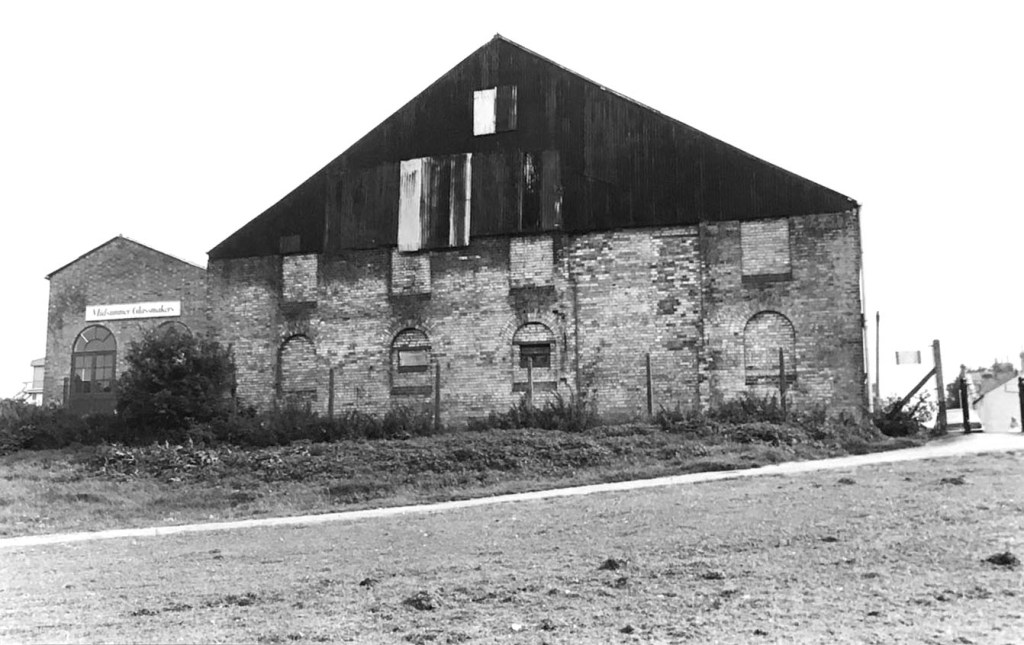
Tudor’s New Circus, seen from Midsummer Common in the 1980s, with Auckland Road on the right.
(Cambridgeshire Collection, Cambridge Central Library)
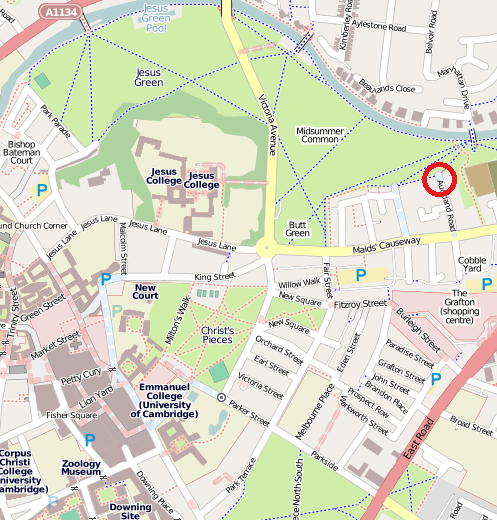
The site of Tudor’s Circus, at the north end of Auckland Road, Cambridge
On 1 August 1896 an advertisement appeared on the front page of the Cambridge Daily News announcing the opening of Tudor’s New Circus two days thence with a ‘talented company’ of singers, performers, ‘Funniosities by the best of clowns’ and a ‘splendid stud of horses and ponies.’ The proprietor was Mr William Tudor. This was not a tented, travelling circus, nor was it a temporary wooden building like those Tudor ran on Midsummer Common in 1888, 1893 and 1895, but a purpose-built, permanent circus next to the common in Auckland Road, Cambridge.
A chance encounter when researching early British cinema had led us to an advertisement for this new circus in October 1896, when Robert W Paul’s Cinematographe was tucked away on the bill between Pete Simple and Petite Florrie. This led us to ask: Who was William Tudor? What happened to the circus in Auckland Road? And: Who was Flo Everette with her clever Parisian Pets?*
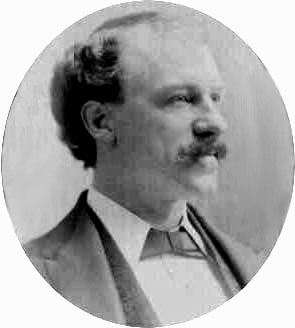
William Tudor, 1853–1940, pictured in 1894 (Northumberland Archives)
So began our travels in the realms of gold that are the Cambridgeshire Archives, the Cambridgeshire Collection, UK censuses, the British Newspaper Archive, Northumberland Archives, Cambridge University Library, the Squire Law Library, and countless pages on the World Wide Web. New stars swam into our ken: Charlie Keith, clown and portable-circus designer; Evetta the first female clown; Cassie Walmer the variety artist; Oscar Dubourg the Man Fish (not to mention Lolla the Mermaid); Funny Fred Hall the clown who died; the Cookes; the Newsomes; Pongo the Man Monkey; Nita Palmyra the noted equestrienne; Leoni Clarke and his parachuting cats; and William Tudor and his horses.
Little did we realise that the circuses, merging into music hall, variety shows, and cinema, were such a popular form that depended on thousands of different entertainers continuously touring Britain and abroad. And it turns out that many of them turned up in little circuses on Midsummer Common and in Auckland Road where full houses of 1,400 people roared them on.
What follows is the story of William Tudor, his career, his temporary wooden circuses, the circus he built in Cambridge in 1896 and ran for four seasons, and of the stream of wonderful acts he put on for the public. And it’s the story of a building that kept changing its identity, that by 1917 was a railway company garage and later a warehouse and which had a brief renaissance in the 1980s as a glass-art studio before demolition in the 1990s. There will be thrills and spills along the way – and no safety net.
*That turned out to be a difficult question to answer, but you can find her here.
Erica McDonald and Jim Smith
Cambridge, July 2024
Next section: Early fairs and circuses in Cambridge
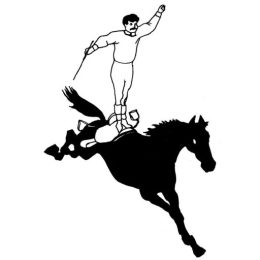
 William Tudor's Circus