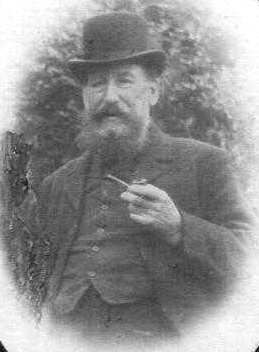
Thomas Askham (contributed by the children of Joan Audrey Beatrice
Askham Hulm, Albert Askham’s daughter and Thomas Askham’s grand-
daughter)
Mr Askham was a man of remarkable virility . . . one of those men of ability and determination who rise from the ranks, and when they succeed beyond their fellows are proud to call themselves self-made men . . . A skillful man, and astute in business. Mr Askham was exceedingly successful.
Cambridge Daily News, 16 January 1912, page 3
Early life, a business career, and a property portfolio
In 1896, William Tudor built his circus in Auckland Road on land owned by Thomas Askham, a successful, self-made business and family man, coach builder, publican, boatyard owner, innovator, entrepreneur, alleged plagiarist, property developer, would-be local politician, serial legal defendant or plaintiff, juror, and scourge of the Barnwell clergy. Askham was born in Cambridge on 14 July 1837 (birth certificate, General Record Office) to Henry Askham, a labourer, and his wife Ann. He died in Chesterton on 14 January 1912 (death certificate, General Record Office), with both certificate and gravestone, in the New Cemetery in Newmarket Road, recording his age as 78.
In 1841 Thomas was living in King Street with his parents, two sisters and two brothers. Ten years later the family were still at 80 King Street and Thomas was a painter.
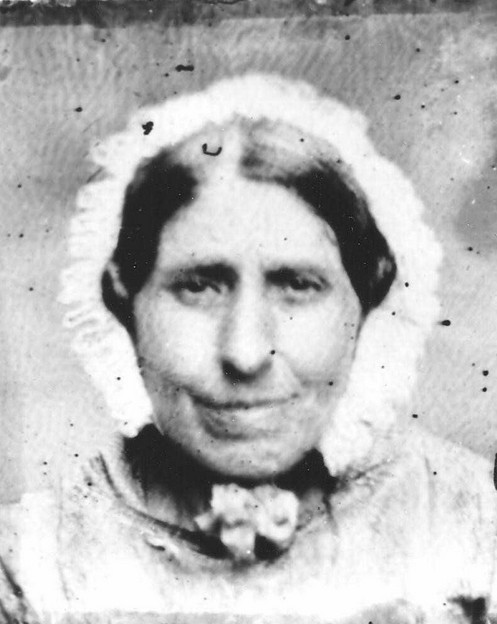
Mary Ann Empson, date unknown (contributed by the children of Joan Audrey Beatrice Askham Hulm, Albert Askham’s daughter and Thomas Askham’s grand-daughter)
In June 1857 he married Mary Ann Empson, from Stibbard in Norfolk. He was 23 on the marriage certificate but was actually a few weeks short of 20, an anomaly that followed him to his grave. She was 27, last glimpsed in the 1901 census aged 69 despite having been 62 ten years before, and she died, apparently aged 70, in 1906. The present writers have learned not to worry about such matters! By 1861 their household at 12 Prospect Row included two-year-old Ellen and baby Arthur. Thomas was then a coach painter, presumably working for the Hunnybuns. Another son, George, was born in 1864, but died in 1870.
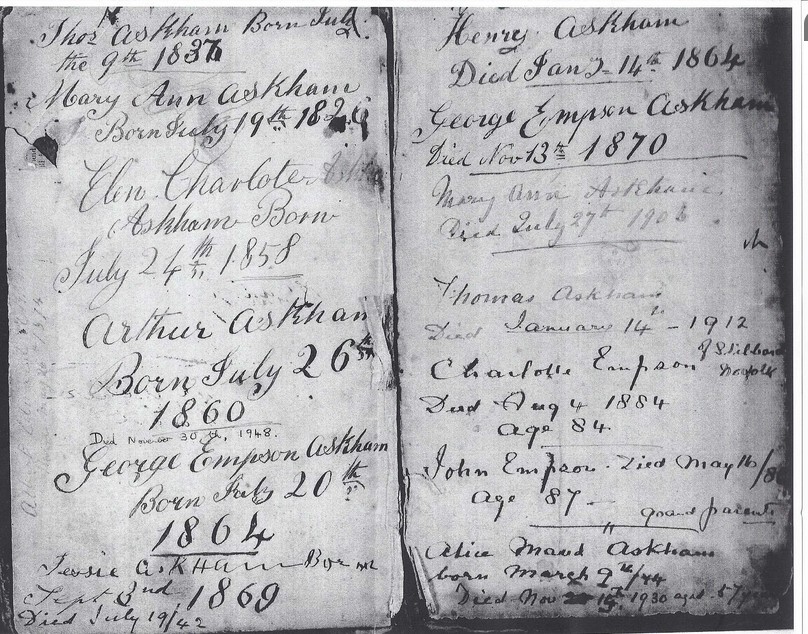
The Askhams’ Bible, inscribed with the family names and dates of birth and death (contributed by the children of Joan Audrey Beatrice Askham Hulm, Albert Askham’s daughter and Thomas Askham’s grand-daughter)
Thomas is listed in the 1869 street directory at 28 Newmarket Road but in 1871 the family were living at The Salmon in Sun Street and now had a new daughter, Jessie, aged one, and they were doing well enough to have a servant, Eliza Osborne. Thomas was a coach painter and publican, and Mary Ann was a shopkeeper, but by 1879 he had become a carriage builder with his own business, having worked for ‘Many Years with Hunnybun and Son’ in Bridge Street.
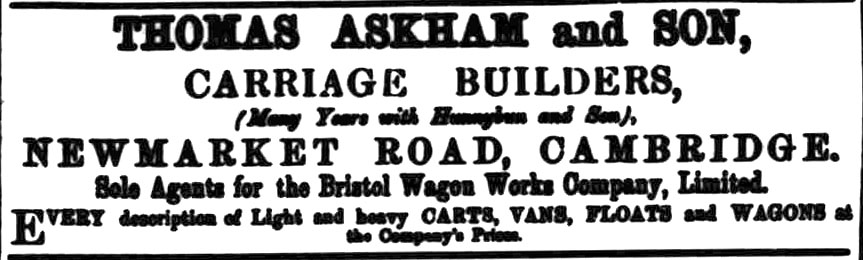
Cambridge Chronicle 25 October 1879 page 1

Who could afford to commission a Pair Horse Landau for £100 in 1879 (£11,000 in 2025, according to the Bank of England inflation calculator)? Possibly John Mortlock of Melbourn, a ‘Gentleman Landed Proprietor’ according to the 1881 census. (Cambridgeshire County Archives, K509/7/2/3/24 e)
In 1881 Askham was at 233 Newmarket Road (later renumbered as 77), the Woodman’s Arms, with Mary Ann and four children. The youngest was Albert, aged six while Arthur, now 21, was a coach builder like his father. The census of that year describes Thomas as ‘Coachbuilder (Master [?]) employs 5 men and 1 boy & publican’. From the same year, there are details in Cambridgeshire Archives of an application for a seven-year coach-building apprenticeship with Askham for William Lewis (CB/10/2/6/1/110).
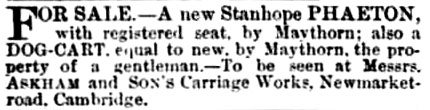
Cambridge Independent Press, 4 June 1881, p 4
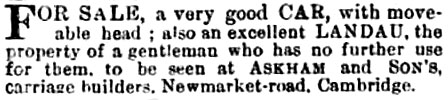
Cambridge Independent Press, 23 June 1883, p 4
Business seems to have flourished as in 1883 he contributed 10 shillings to the fund for the widow of Alfred Langford who lost his life in the August Bank Holiday Ditton ferry disaster (CIP, 20 October 1883, p 4). In July 1886 Thomas mounted an exhibition of carriages at the Cambridgeshire and Isle of Ely Agricultural Show at Royston. In September he seems to have started buying property: York House, a substantial residence with seven bedrooms and four reception rooms close to the Woodman’s Arms in Newmarket Road, was on the market, and this was probably when Thomas Askham bought it — he certainly owned it by 1889 (CDN, 21 October 1889, p 2).
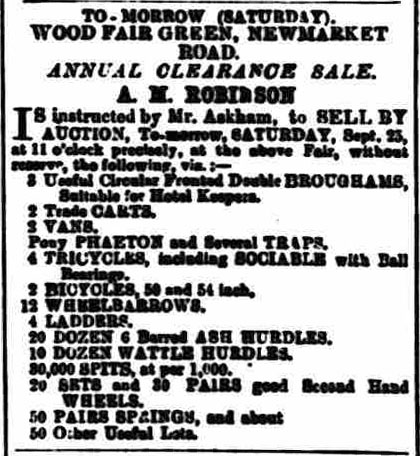
Cambridge Chronicle, 24 September 1886, p 4
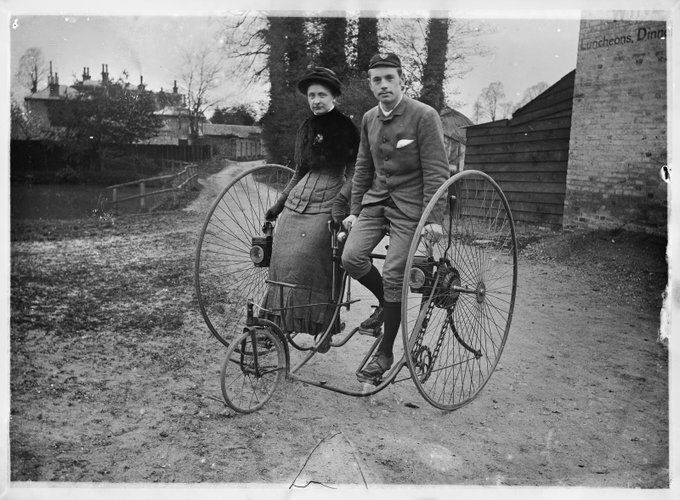
A sociable tricycle, around 1890. Askham had one for sale (‘with Ball Bearings’) in September 1886. (Historic England, OFH01/01/02/055)
The well-known citizen
Askham made regular appearances in the local press. In the 1880s this was because he was in court several times, for various reasons, including acting as a public-spirited witness in 1887 an unpleasant assault case. Harry Newman (43) was convicted of assaulting William Henry Bullock (aged 8) in Parsonage Street:

(CIP, 12 February 1887, p 8).
Later the same year Thomas reported to the police a man who was trying to sell him a tricycle for £2 when its value, according to Askham, was £8 (CIP, 1 October 1887, p 5).
In 1889 Thomas was sued twice, first for £7 by the owner of a double set of silver-plated harness, who alleged Askham had damaged it (CIP, 29 March 1889, p 5). E. W. Steadman of Fordham sued him for supplying a pair of defective wheels, not the pair he had chosen, and claimed, to the mirth of the court, that ‘one of the wheels was “egg shaped”’ (CIP, 28 September 1889, p 5). Askham won both cases.
As a well-known businessman and property owner, Thomas Askham aspired to public service. His political career, however, never got off the ground: at the town council elections in November 1890 he was rejected as an Independent candidate for Trinity Ward, as he had only seven assentors instead of the necessary eight (CIP, 1 November 1890, p 8).
Ownership and post-Tudor management of the Auckland Road building under its many names also brought Thomas into the public arena . Despite his October 1908 conviction for presenting plays without a theatre licence in what was then the Hippodrome, his fourth application for such a licence succeeded where those from 1902, 1903 and 1906 had failed. An account of those proceedings is to be found here. [Create hyperlink]
Askham’s properties in Barnwell – and expanding across the river
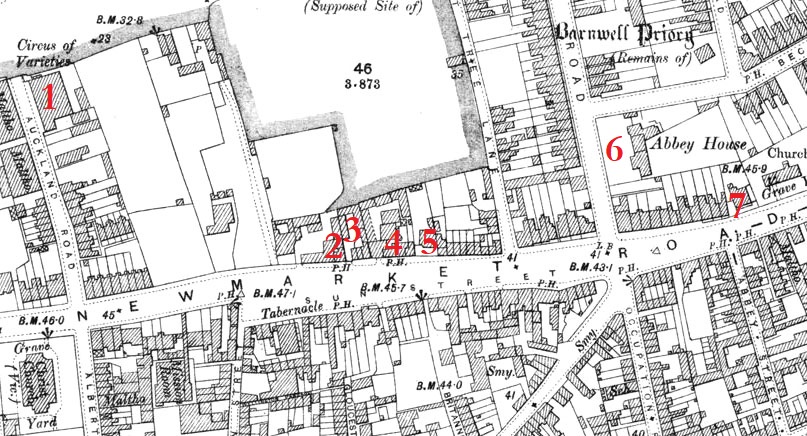
From the circus in Auckland Road (number 1, far left), via his carriage works (3), the Bird in Hand (4), York House (5), and Abbey House (6), to the detached house in Newmarket Road known as ‘By the Church’ next to the St Andrew the Less Grave Yard (number 7, far right), Askham owned a number of properties in this part of Barnwell. He did not own the Priory Tap (2) which was between the entrance to the carriage works and the Priory Brewery. The Woodman’s Arms, where the Askham family lived and Thomas was the licensee, was next door to the Bird In Hand and belonged to Jesus College. Daughter Jessie Askham was an active member of the congregation at the Primitive Methodist Tabernacle in Sun Street, across the road from the family home. (Ordnance Survey, 1901)
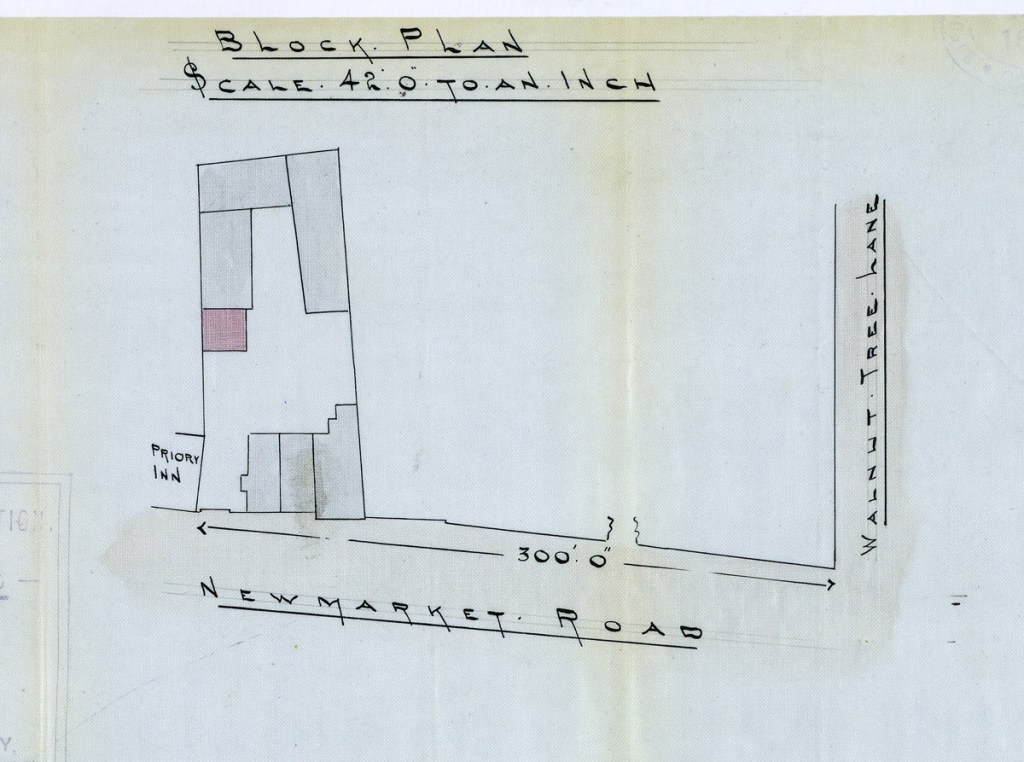
This November 1900 planning application for a new carriage shed helps us locate Askham’s carriage works at point 3 on the Ordnance Survey map above. Most of Walnut Tree Lane (later Walnut Tree Avenue) survives to this day as the slope down to the river Cam next to the Elizabeth Bridge. (Cambridgeshire County Archives, KCB/2/SE/3/9/1739)
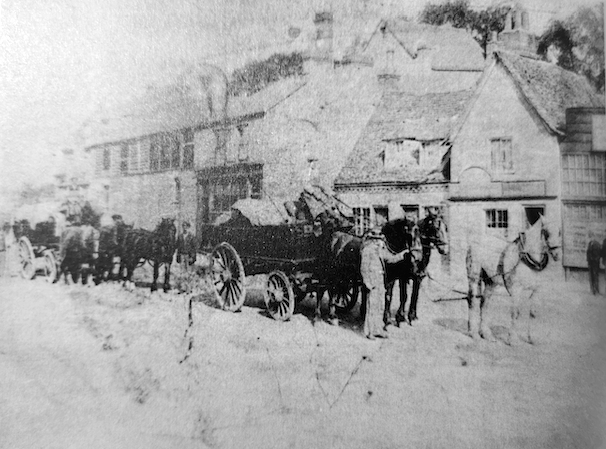
The Priory Brewery and the Priory Tap in about 1900. The entrance to Askham’s carriage works was just to the right. (Capturing Cambridge)
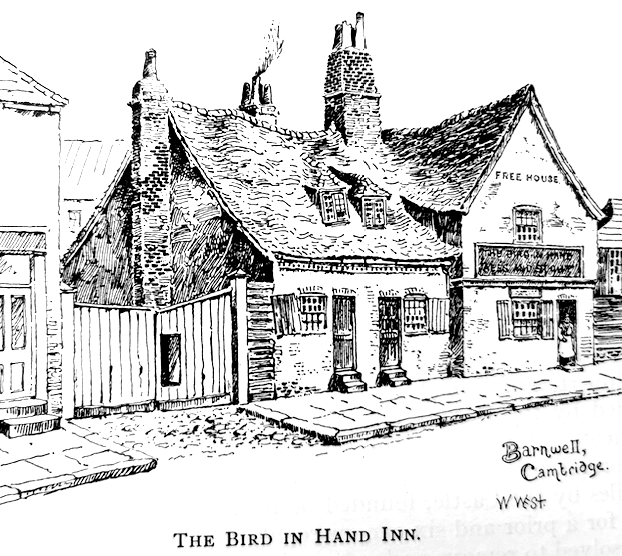
The Bird In Hand. Although Thomas Askham owned this pub, he and his family lived next door at the Woodman’s Arms, where he was the tenant/licensee. (Capturing Cambridge)
Thomas was the tenant of four pieces of land in Auckland Road that came up for sale in April 1892 and he snapped them up. The Circus was built there four years later and the land and building are described here.
Askham bought Abbey House, behind Newmarket Road, in 1898 (see map above). This sizeable building was ‘divided into three dwelling-houses, and, in addition, has gardens, and a plot of pasture land adjoining. The lot was knocked down to Mr Thomas Askham for £1,200’ (CIP, 23 December 1898, p 5). He did not occupy the house, and must have let it, although in 1922 his son Arthur did move in. Abbey House is Tudor, has an interesting history, and may be visited on Open Cambridge heritage days.
By 1899 Askham had taken over Logan’s Boatyard in Chesterton, 100 yards upstream from Victoria Bridge, where he also owned the adjacent house at 22 Chesterton Road. We learn from the following notice that there was a second carriage works, next to Downing College in Regent Street, where in 1900 he was offering to let a yard and good stabling for 20 horses (CDN, 24 March 1900, p 1.)

CDN 12 July 1899, p 1
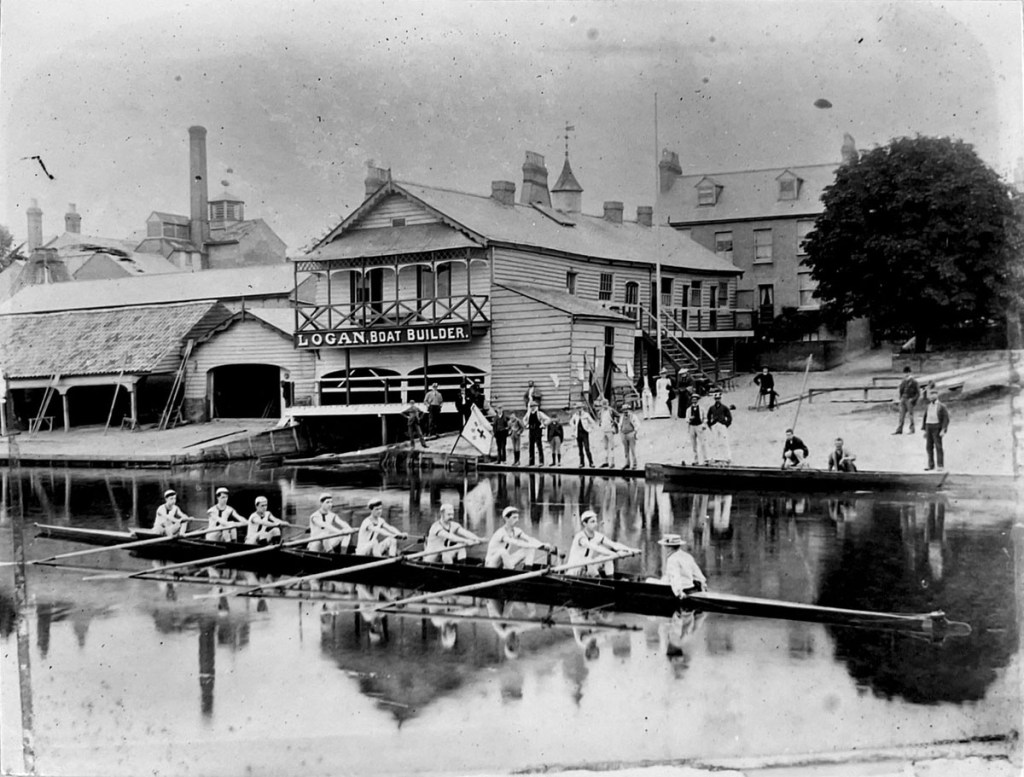
Logan’s (later Askham’s) boatyard in 1885, with the Spring Brewery (later replaced by the Tivoli cinema) on the left, 20 and 22 Chesterton Road on the right next to the tree, and a college eight coiled ready to spring at the cox’s call (Cambridgeshire Collection, Cambridge Central Library). The location is clear to see on the following 1901 Ordnance Survey map.
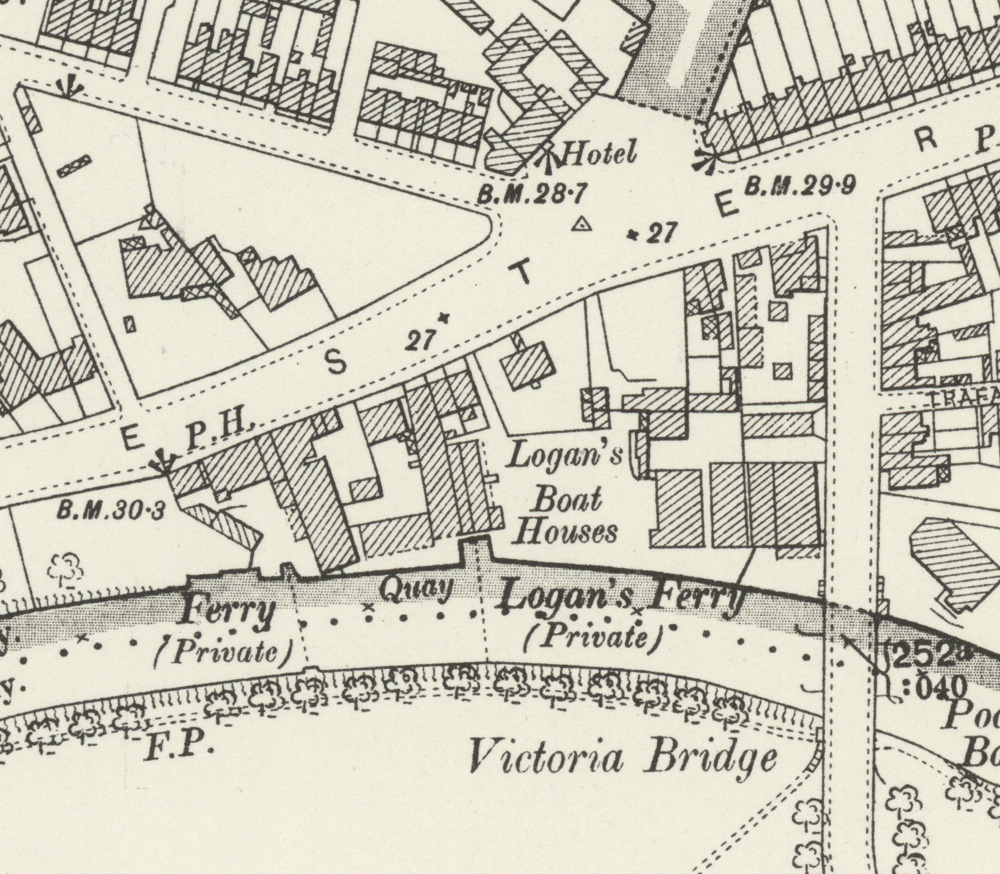
These were not the only other properties in Askham’s portfolio: the Cambridgeshire Archives hold the documents from planning applications and conveyances for a number of smaller properties around Barnwell, Chesterton and Romsey from the late 1880s to the 1900s.
In the meantime, in the 1891 census, the Askham family were still at the Woodman’s Arms and Thomas (apparent age 52) describes himself as a coach and carriage builder. His daughter Ellen, now 31, is a carriage lining maker, Arthur is a carriage maker and daughter Jessie is a teacher of music, while Albert at 16 is an apprentice carriage maker.
Thomas seems to have come a long way and had ensured his children were all doing well too. Jessie was to give many song and piano performances at the Tabernacle (across the road from the family home in Newmarket Road), at the Cambridge Working Men’s Liberal Club, and at a concert at King’s College Chapel. In 1900 she was elected one of two vice-presidents of the Young People’s Society of Christian Endeavour at the Tabernacle.
Property continued to be a source of income for Thomas as in 1894 he sold number 26 Argyle Street, Mill Road, for £90 (CCJ, 28 September 1894, p 8) and in 1896 bought ‘The full-licensed, old-established, freehold public-house and premises, known as the Ram Inn, situate in Ram Yard, Bridge Street. ‘Bidding started at £500, and rose to £1,400, at which it fell to Mr. T. Askham’ (CCJ, 17 April 1896, p 8). Two years later Thomas was granted planning permission for a house in Paradise Street (CIP, 14 October 1898, p 8).
So we know that, if you wanted a wagon, a stable for your horse, a trip in a steam launch, a house to rent, or a drink, then Thomas Askham was the man to go to.
More public duty, more property deals, more litigation – and a new circus career
In 1898 and 1899 Askham was a committee member of the Cambridge Ratepayers Protection Association. He was back in court, this time as foreman of the jury at an inquest held at the Hare and Hounds, Newmarket Road on Tuesday 5 September 1899. There are long reports of a sensational, drunken and tragic ‘riverside affray’ and drowning in the local press. Homeward bound from a pub crawl, two friends fought over money lent by one to the other and both ended up in the river Cam between the pumping station and Stourbridge Common. One survived but the other, probably the perpetrator, did not, despite bystanders’ attempts to save him. On the coroner’s advice, Askham delivered the jury’s verdict: ‘as they did not think he intended to drown himself . . . they returned an open verdict. He hoped that would satisfy his friends’ (CIP, 8 September 1899, p 6).
In 1900 Askham added another string to his bow by taking over when William Tudor gave up the management of his circus. The circus, still Tudor’s Circus in the Cambridge Graphic for the first two weeks, reopened on 28 May. On 16 June it was advertised in the Graphic as the Circus of Varieties, the new name by which it appears on the 1901 Ordnance Survey map, and the first of several as it kept changing its identify over the next 14 years.
It wasn’t long before Askham was sued in the County Court by Arthur Henry Foulger, of the Brewer’s Arms, Gwydir Street. Foulger alleged non-payment of a £17 bill to hire his string band: Askham lost. There’s more about it in our page about the 1900 circus season (CIP, 20 July 1900, p 6) and it’s an early indication that Thomas Askham lacked the contacts, interpersonal skills, experience, and expertise of circus man William Tudor.
In September Askham announced himself as sole proprietor and manager of the circus, which was now the Grand Circus of Varieties but managing it brought its own problems – not that he ever seemed to mind. He seems to have relished fighting clergy and local authorities over theatre licensing from 1902 to 1908 and was sued in 1907 (another lost case) for failing to pay for the 1902 plans. But he never gave up the building and after his death in 1912 son Arthur continued as proprietor until the start of the First World War. For more on Askham and the circus see various sections with hyperlinks to be completed.
He seems to have relished his day in court, whatever his role, and presented a bankruptcy petition against Henry and Sarah Sexton of 13 Norwich Street at the County Court on 21 June 1900. Sexton was a fly proprietor, and unfortunately for his creditors, he absconded, perhaps in his own fly – a two-wheeled, fast and light horse-carriage (CDN, 21 June 1900, p 2; 23 July 1900, p 2).
In the 1901 census little had changed on the domestic front. Thomas and Mary Ann were still at the Woodman’s Arms, 233 Newmarket Road and he is still listed as coachbuilder and publican. Arthur (39) is still at home, a coachbuilder, and only Ellen (40) of the other children is still there, the others having flown the nest. They seem never to have moved into anything grander than the Woodman’s Arms, convenient as it was for the carriage works.
The hire boat business seemed to be doing well, as several descriptions of jolly ‘water parties’ show.
Water Party. – About twenty-five members of the Cycling Club and Choir connected with the Congregational Church participated in a successful water party yesterday. The company journeyed to Clayhithe in one of Askham’s party boats, and there had tea and played various games. Cambridge was reached again about half-past nine.
(CIP, 16 August 1901, p 5)
Rob Roy Water Party. – Despite the variable meteoreological [sic] conditions, the annual water party of the Rob Roy Boat Club was attended with quite as much success yesterday as on previous occasions. About 120 members and friends spent a most enjoyable time at Clayhithe. The journey was made in one of Askham’s large party boats, which had been artistically adorned for the occasion.
(CIP, 16 August 1901, p 5)
The following year at the Cam Sailing Club’s evening flotilla concert, brightly lit and decorated boats processed up and down the Cam near Victoria Bridge and the Fort St George to mark the Coronation. Askham’s boatyard was decorated in red, white and blue (CIP, 11 July 1902, p 7).
In 1902 a lease was drawn up between the city authorities and Askham for an isolation home in a building he owned nearby. This large house, called By the Church, Newmarket Road, next to St Andrew the Less, was sold by auction on August 8 1900, (CDN, 1 August 1900, p 2, CCJ, 27 July 1900, p 5) and probably was bought by Askham then. It had been rented from at least April 1901 to house those who may have been infected by diptheria in a recent outbreak (Cambridgeshire County Archives KCB/2/CL/17/15/Pages 279 and 434; CDN, March 20 1902, p 3 and other local press references in 1903, 1904 and 1906).
A smallpox outbreak in early 1903 reached Cambridge in July, initially thought to be chicken pox. There were soon over 100 cases and over 20 deaths. Measures were taken such as vaccinations, disinfection of premises, burning all borrowed library books, closing some places of entertainment, and following a local superstition a goat was taken through various houses in Newmarket Road as it was thought this prevented the disease (CDN, 22 July 1903, p 3). By the end of August the epidemic was over.
Water parties departing from the boat house in Chesterton continued. The Chesterton Providence Lodge from the Congregational Church hired Askham’s houseboat for their annual party to Bottisham lock on August Bank Holiday 1904, with games, tea and a musical concert on the way home (CIP, 5 August 1904, p 8). The Rob Roy Boat Club were back again with a trip to Clayhithe with tea provided at Bridge House, sports and games, and dancing to a piano on both journeys, the boat returning at midnight (CIP, 12 August 1904, p 8).
Two years later rather more disorderly fun was had by the university undergraduates’ Rag Week on November 4 to 9, when compensation was paid for damage to property to 18 individuals and businesses including T Askham and Sons who received £27 (CIP, 26 January 1906, p 5).
Widowhood, back in court again, a second marriage, and the end of an era
Mary Ann, Thomas Askham’s ‘beloved wife’ of 49 years died on 27 July 1906 and was buried in the New Cemetery, Newmarket Road (CDN, 30 July 1906 p 3) but as far as we can tell Thomas’s life carried on much as before. Under the terms of the Licensing Act 1904 he received £20 compensation when the licence for the Woodman’s Arms was withdrawn in 1907 (CIP, 6 December 1907, p 2). This was part of a national drive to reduce the number of licensed premises in areas where there were many public houses: Barnwell was clearly one such area.
The following year, Askham was back in court when surveyor G J Smith sued him over non-payment for plans for the dressing rooms at the circus that he had drawn up in 1902. Askham lost, or rather gave up in exasperation, saying: ‘I don’t want to occupy your Lordship’s time. I don‘t want to hear any more about it. I’ll leave it in the hands of your Lordship’. His Honor Judge Wheeler KC duly found for Mr Smith, with costs (CIP, 24 May 1907, p 7). In 1908, the long-running dispute with the Barnwell clergy and the local authorities over theatre licensing finally came to an end. This controversy is described in detail here. [insert hyperlink]
1909 was another busy year for Thomas. His plans for a lock-up shop in Fitzroy Street were turned down as not being in accordance with the byelaws (CDN, 24 March 1909, p 3) and a case in Chancery about properties in Regent Street that he co-owned had been bubbling away since at least 1905. The case was resolved (Broad v Askham [1909] WN 236 Chancery Division) and six properties at 20 to 30 Regent Street, including shops, workshops, yards, offices and commercial premises were put up for sale (CIP, 23 April 1909, p 1; CDN, 20 May 1909, p 3).
And then, early in 1910, Thomas acquired a new family. At the age of 72 (probably) he married Kate Clews, née Wilson, a widow half his age from Coventry, Warwickshire, who had two daughters (Marriage Index, January-March 1910). In the 1911 census he and Kate (36), had been married for one year and were living at 79 Newmarket Road with Kate’s two daughters, Florence (16) and Beatrice (14).
The marriage was short lived as Thomas died at 22 Chesterton Road on 14 January 1912, from cirrhosis of the liver and uraemia. His death certificate says he was 78. On 18 January he was buried next to first wife Mary Ann in the New Cemetery in Newmarket Road. The Cambridge Daily News paid tribute (16 January 1912, page 3) and described his funeral (18 January 1912, page 3):
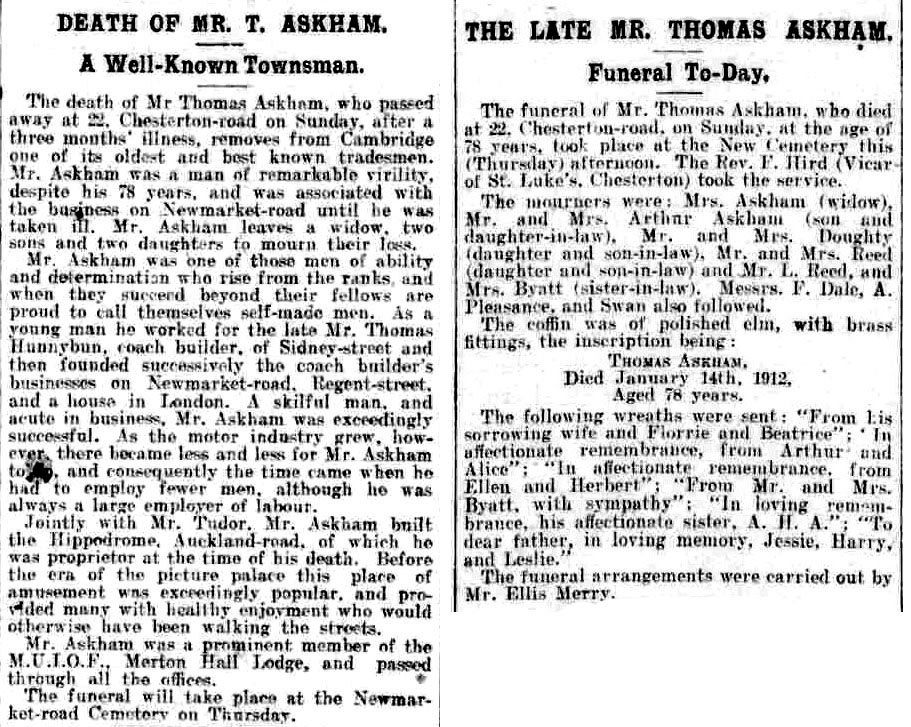
Albert and his wife Florence, who had emigrated to Canada the previous year were absent, as were the two teenage step-daughters, although their names appeared on a wreath along with that of their mother. The account from undertaker Ellis Merry has survived:
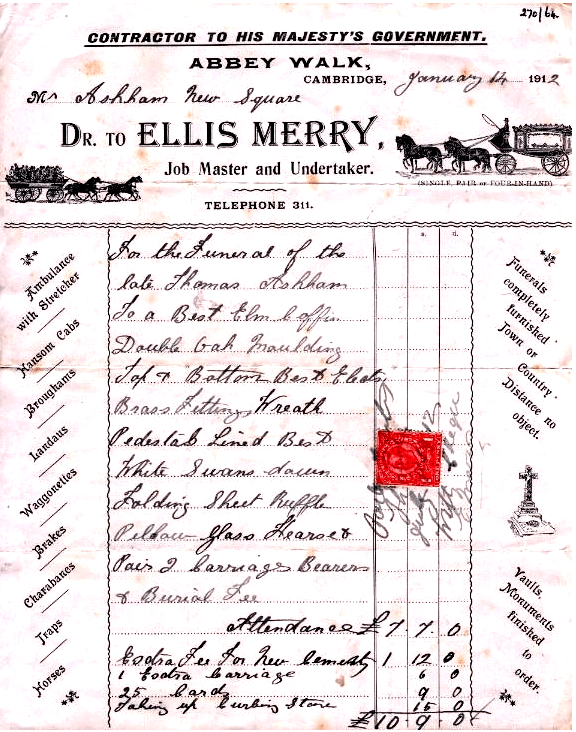
Mr Merry had a range of vehicles at his disposal: we might guess that at least some were supplied by Askham (Capturing Cambridge)
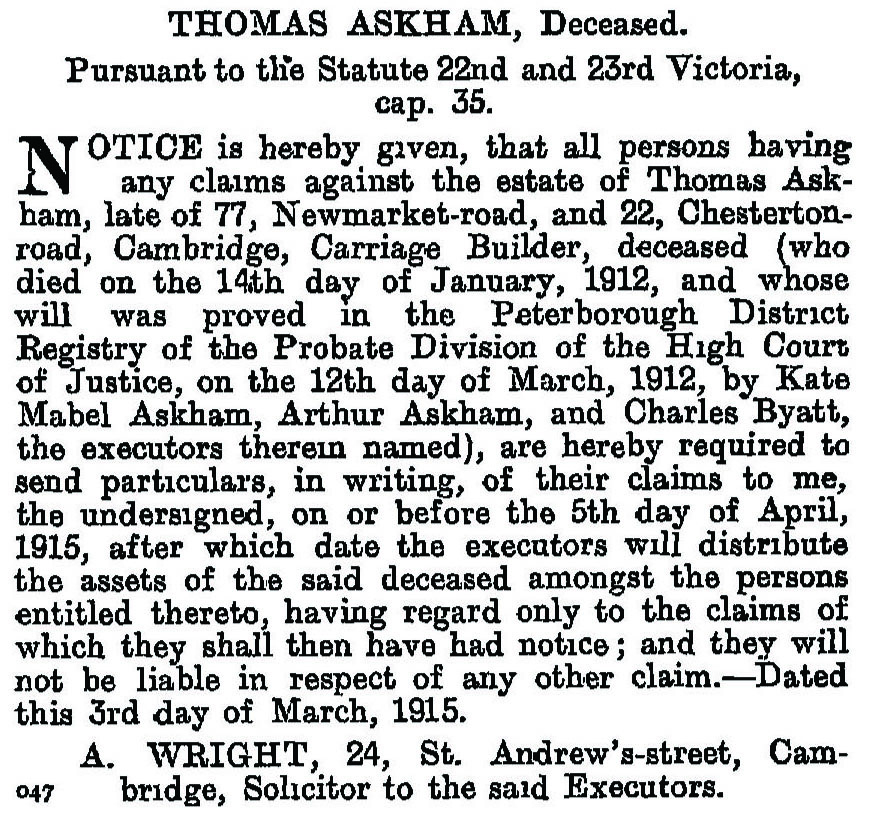
Arthur Askham was co-executor of Thomas’s will with step-mother Kate and Charles Byatt, licensee of the Bird in Hand. Probate was granted on 12 March with effects of £12,010, 18 shillings and sixpence. The Bank of England’s inflation calculator tells us that £12,000 pounds in 1912 would buy goods and services worth £1,151,442 in 2024.
Kate Askham
After Thomas’s death Kate continued to live at 22 Chesterton Road, which backed on to the river and boatyard. In 1919 she upheld the family tradition of appearing in court:
Kate Askham, 22 Chesterton Road was summoned for keeping on June 17th, a dangerous dog, which was still not under proper control. – Prisoner pleaded guilty. – P.C. Wright said he had received a complaint from a Mr. Cole that he had been bitten by defendant’s bull terrier. Witness interviewed Mrs. Askham, who promised to have the dog destroyed. This was done last Friday. – On the suggestion of the Chief Constable the case was withdrawn on payment of costs.
CDN, 25 June 1919, p 4.
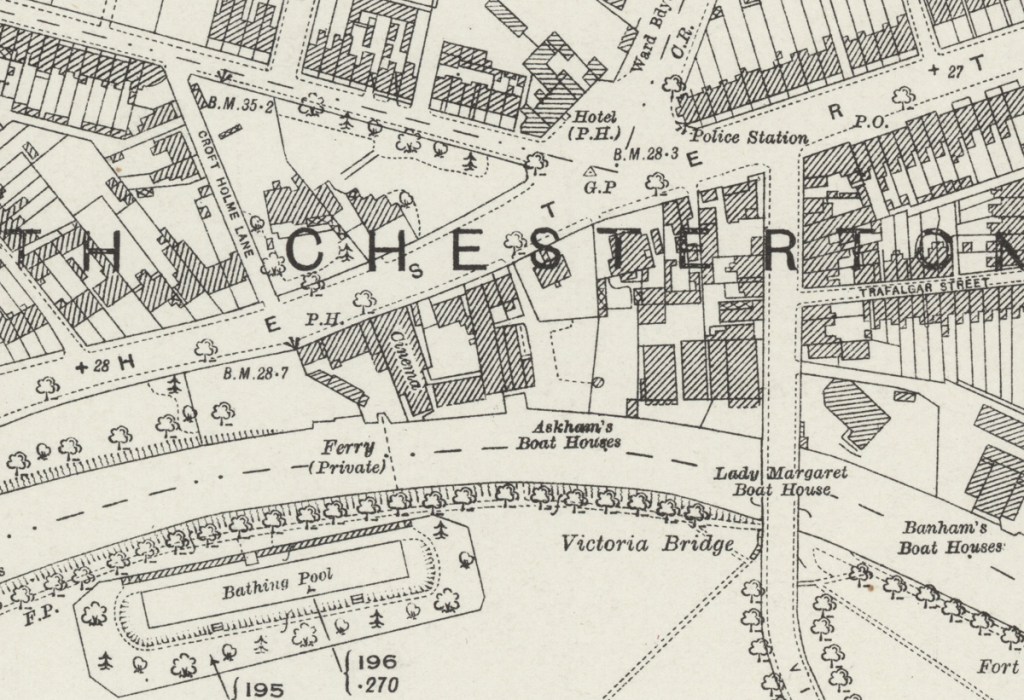
Askham’s boatyard is named on this 1925 Ordnance Survey map, which also shows the new Jesus Green swimming pool, the Tivoli cinema in place of the Spring Brewery, and Mr Mitcham’s shop on its corner at the junction of Victoria Avenue and Chesterton Road.
Kate was still living at 22 Chesterton Road in 1921. She died in 1931.
Arthur Askham’s story
Arthur appeared to have been the dutiful son, remaining at home and single and helping run the family business for many years. We have found little information on his early years, though he was interested in birds and dogs, entering his collie in a show at The Corn Exchange (CIP, 3 November 1899, p 7) and a bulldog in the Cambridge Canine Society’s sixth Annual Show (CDN, 27 November 1902, p 3). He even travelled as far as Swindon for a dog show where his collie White Perfection won two firsts and a special award (CDN, 6 October 1900, p 2). He is recorded as a Member of the Grand Jury at the Cambridge Borough Quarter Sessions (CIP, 4 July 1902, p 3). There was no crime that session so the jury were thanked and dismissed.
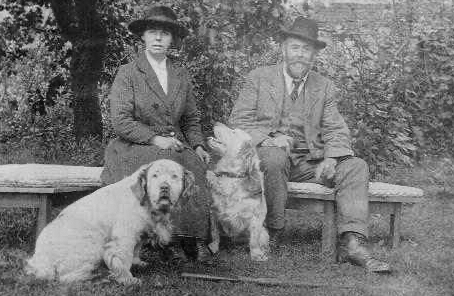
Alice, Arthur, and their Clumber Spaniels (Contributed by the children of Joan Audrey Beatrice Askham Hulm, Albert Askham’s daughter and Thomas Askham’s grand-daughter)
In 1910 Arthur, then 50, married Alice Panting (37) and finally left home, the couple moving into 33 New Square where they are listed in the following year’s census.
On his father Thomas’s death, he swung into action and advertised for the coachbuilding business’s debtors and creditors to come forward:

Cambridge Daily News, 22 January 1912, p 2
A few weeks later, Arthur advertised for rent a `large brick building, suitable garage or factory, near town’ (CDN, 8 March 1912, p 1), which seems to describe the Auckland Road circus, but may have been a shed at the carriage works. The next day he announced a clearance sale of `New and Second-hand Vehicles, all sizes; Dressed Spokes, Felloes, Wheels, Springs and Axles’ (CDN, 9 March 1912, p 1). Two more sales followed that spring:
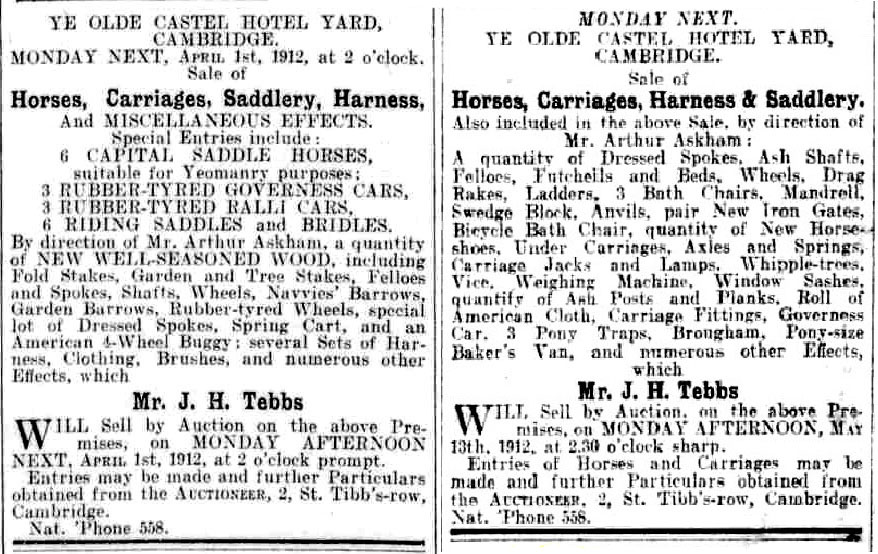
Cambridge Daily News, 28 March 1912, p 2 (left), 9 May 1912, p 2 (right)
Arthur was clearly dismantling his father’s coach-building and stabling business, which never diversified into motor vehicles. He was still selling off the ‘Stock-in-Trade & Utensils of a Coachbuilder and Shoeing Smith’ in December the same year.
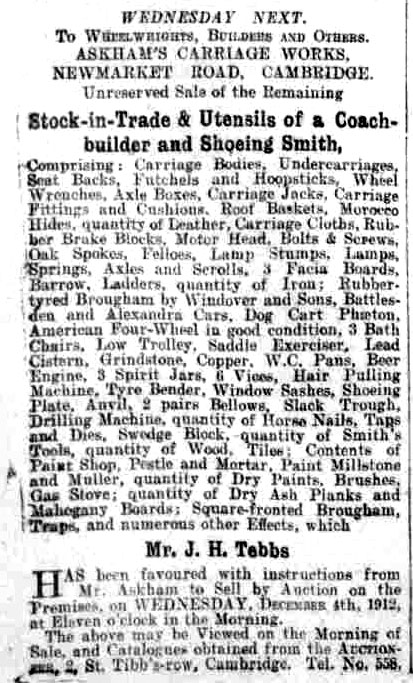
Cambridge Daily News, 3 December 1912, p 2
But the circus was another matter and he tried to sell it in The Era, the trade magazine.
WANTED, to Sell or Let, Large Hall; licensed Pictures and Variety; holds 1,200. Apply (principals only), Arthur Askham, Proprietor, 33 New-square, Cambridge
The Era, 7 September 1912, p 32
But the building struggled on as an entertainment venue until 1914. Arthur may have seen the way the circus and music hall world was changing because in early November 1912 he applied to the Theatre Committee of the Council for a ‘licence for the public performance of stage plays at the Hippodrome’ for 12 months from December (CDN, 1 November 1912, p 4). The Committee hesitated over a requested extra period from 17 October to 30 November but granted it so long as Askham did not apply for an excise licence. On 18 December he was advertising for a pianist for Christmas week, a lady or gent would do (CDN, 18 December 1912, p 5) and then ‘the Hippodrome, under the management of Mr. Arthur Askham, will reopen with Miss Tullock’s talented company in popular drama’ (CDN, 21 December 1912, p 5). Mindful of public relations, Arthur offered the Hippodrome as a venue in case of bad weather for the Cambridge Silver band Charity Concert on Christ’s Pieces (CDN, 11 March 1913, p 3).
The Theatres Committee were still hesitating in 1913 because the licence could only be granted to the ‘responsible manager’ and not to Askham himself. That meant the representative of the Eastern Counties Cinema Company, the company that rented and ran the building as the Gaiety Theatre from October 1913. That venture always operated at a loss, despite the appearance in November 1913 of William and Edith Tudor and their clever ponies, and the company went into voluntary liquidation in July 1914.
The building found a new purpose during the First World War. In the following article from the Cambridge Daily News (20 January 1916, page 3) we learn that it was ‘a military messing hall’ and that the people of Barnwell were going hungry:
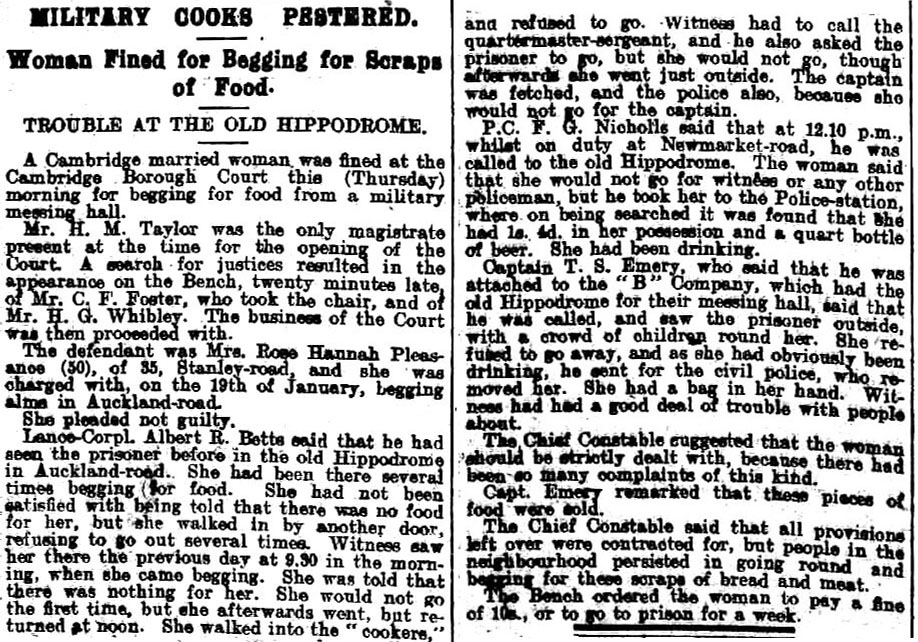
In November 1916 Arthur announced the sale by auction of the fixtures and fittings of the circus building to clear it for its new function. We learn from the advertisement below that Arthur or his father had installed an ‘iron cinematograph house’. Nitrate film is notoriously flammable and this must have been a fire-proof projection booth, as required by the Cinematograph Act 1909.
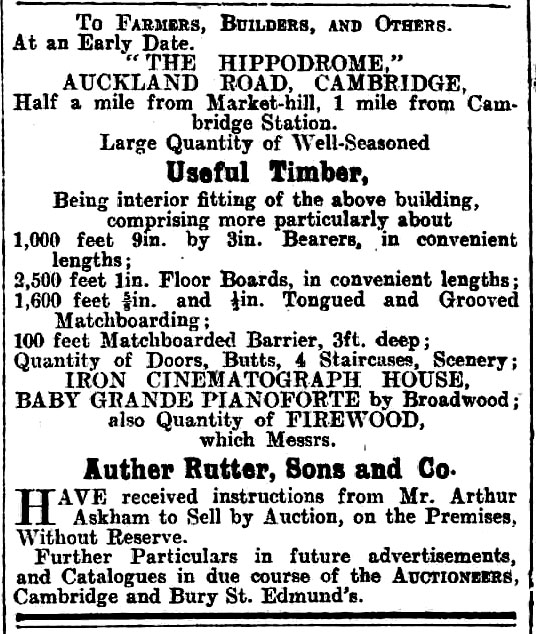
CDN, 9 November 1916, p 2
And then we learn that the old Hippodrome became an entertainment venue again: in 1973, Cambridge Evening News reader R. B. Morley reminisced about the circus during the First World War (29 June, 1973, page 20):
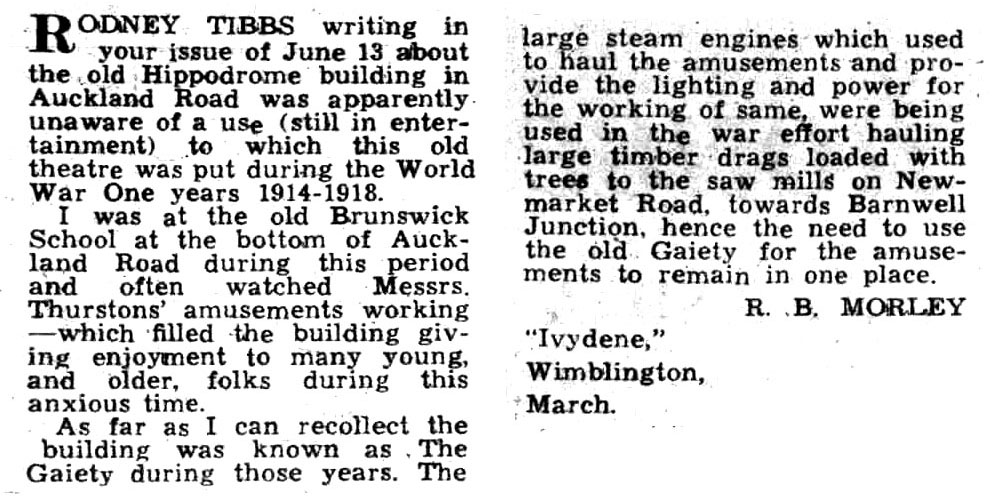
CEN 29 June 1973, page 20
R.B. Morley’s memories appear to be confirmed by the following advertisements from the winter of 1916 to 1917, the first and last on the subject that we have found:
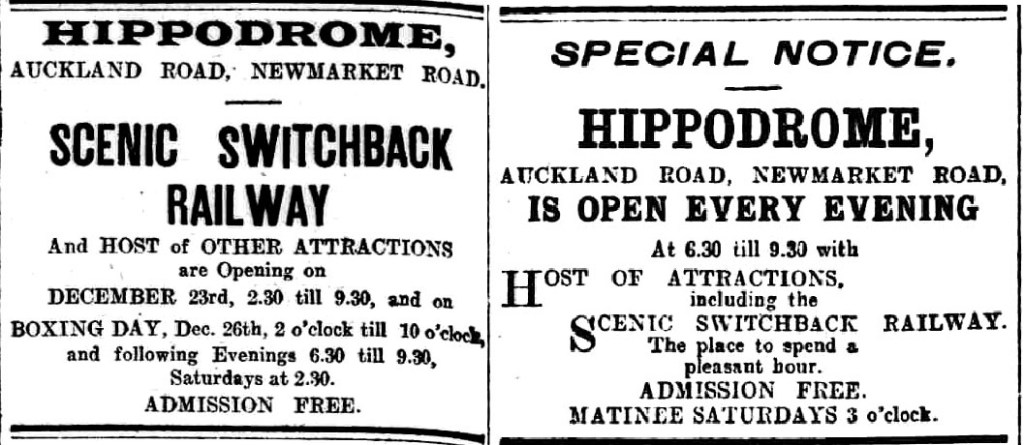
Cambridge Daily News, 15 December 1916, page 2 (left) and 8 March 1917, page 1 (right).
Meanwhile, in early 1917, the County Council granted Arthur a cinematograph licence, but is not clear that he ever used it (CDN, 2 February 1917, p 3): the projection booth must have failed to find a buyer the previous autumn.
Back to business and further diversification of trade was apparent when an advertisement appeared for ‘PIGS.—YOUNG STORES for sale.—Apply, Arthur Askham, 33, New Square, Cambridge’ (CDN, 6 June 1918, p1). The following month he was advertising stabling in the old carriage works in Newmarket Road (CDN, 29 July 1918, page 1): we assume the pigs were there and not in the house at New Square.
He still followed his father’s practice of remembering poorer people, as he ‘generously sent a Christmas cake’ to the 15 children at the Newmarket Road Children’s Home (CDN, 27 December 1917, p 4). As we saw above, Thomas had bought York House in 1889. Arthur probably still owned it when the Chesterton Guardians decided to rent it as a children’s home for the 16 children remaining in the Chesterton workhouse (CIP, September 4 1914, p 2). The Cambridge Daily News reported a jolly Christmas 1918 at the home and we can see that the Askhams still had a connection:
York House, Newmarket Road
Christmas was celebrated with the usual jollity at York House, Newmarket Road, the Children’s Home connected with Chesterton Workhouse. The children were up early prying into well-filled stockings. The dinner consisted of roast pork, potatoes and parsnips, plum pudding and oranges and sweets. The afternoon was spent in games and romping until tea-time, when the children made short work of the cake and pastries, and amused themselves with the contents of the bon-bons.
During the afternoon the Mayor and Mayoress paid a visit, and the children were delighted at meeting his Worship in his robes. On being shown round the home, the Mayor expressed great pleasure at all he saw, and recorded in the Visitors’ Book that he “found the children very happy and was much struck with the home life of the institution”.
The Mayor sent honey and 10s for oranges, Dr. B.E. Fordyce sent sweets, and crackers, Mrs Hermna gave toys and crackers, Mr. and Mrs. Askham gave Christmas puddings and fancy cakes, Mrs. Smith (Ickleton) gave gave Santa Claus stockings, Mrs. Manning gave evergreens, and Miss Towns gave story books. The building was tastefully decorated by the Matron (Miss A. Spender) and staff.
CDN, December 27 1918, p 4.
A year later Arthur and his sister Jessie Reed and her husband provided Christmas puddings, sweets and shortbread for the children (CDN, 29 December 1919, p 3) and the home closed a year later, just after Christmas 1920 (CIP, 31 December 1920, page 9). In the meantime, the boatyard at 22 Chesterton Road was available to rent: ‘TO LET, BOATYARD, BUILDINGS AND DOCK, close to Victoria Bridge’ (CDN, 5 March 1919, p 1).
In the 1921 census Arthur (Carriage Builder, retired) and Alice were still living at 33 New Square but the following year’s electoral roll has them at Abbey House, which Thomas had bought in 1898. After that we hear little more. Alice died in November 1930 and Arthur lived until 1948, dying in a Red Cross home at 9 Chaucer Road, Cambridge, leaving £2,522.
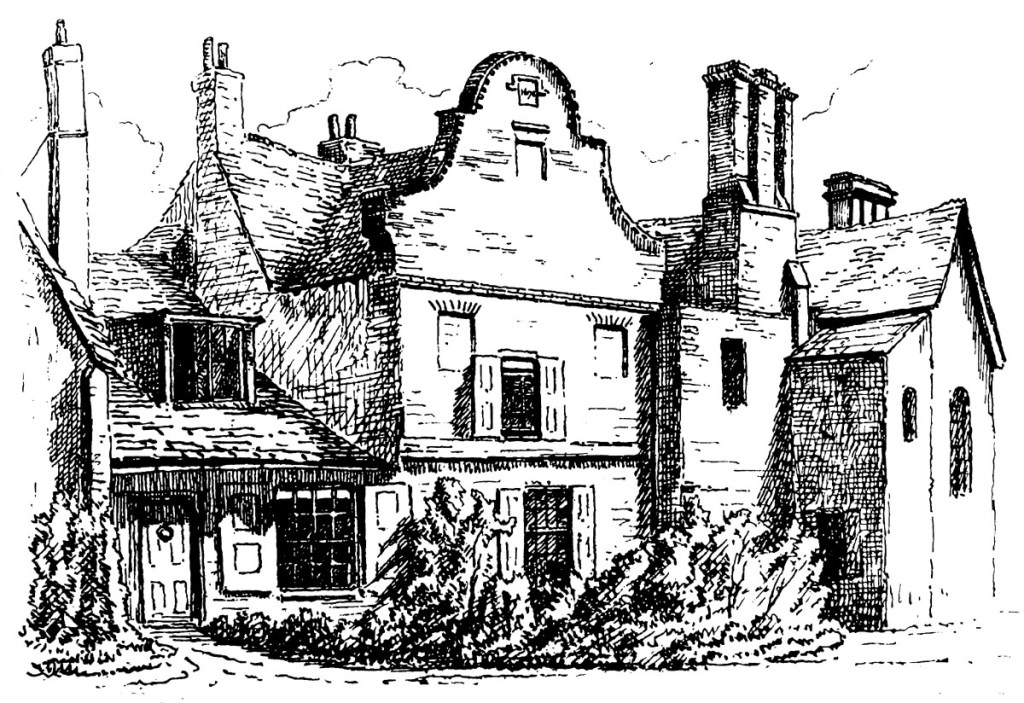
In 1978 two articles appeared in the Cambridge Daily News, reminiscences of Arthur in the 1940s.
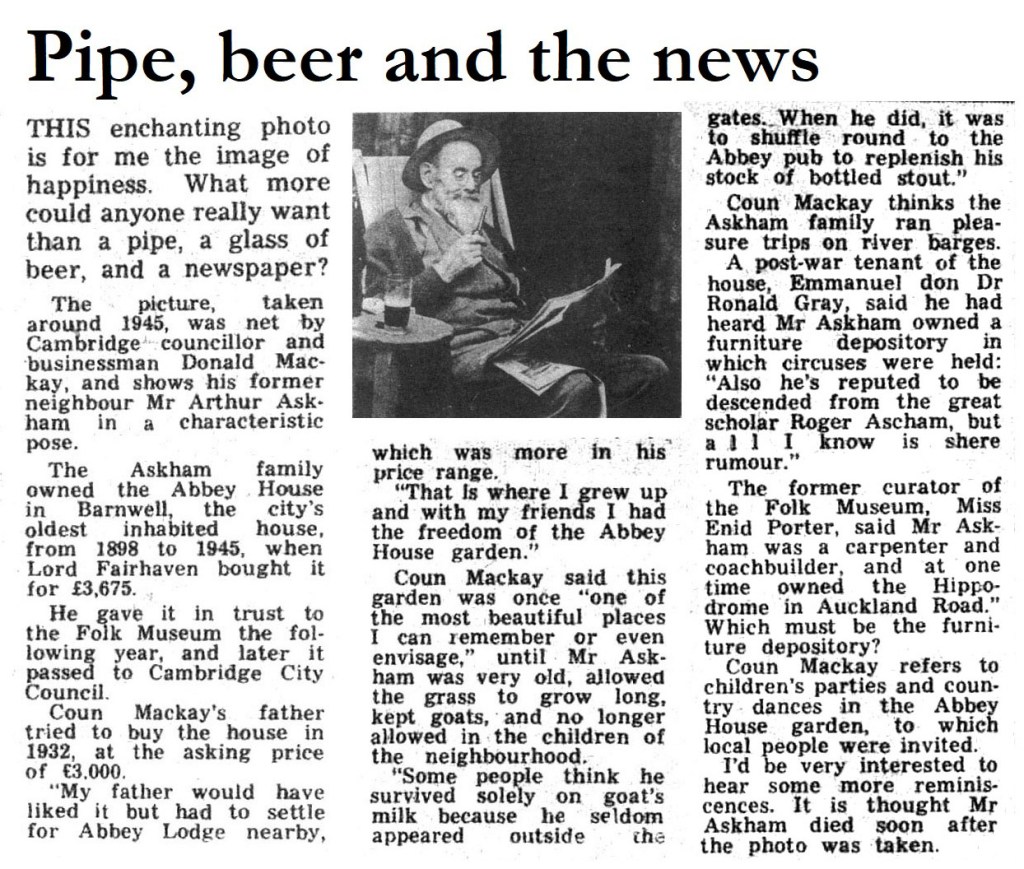
We have cut and pasted this news cutting (Cambridge Evening News, 27 January 1978, p 20) to achieve a better fit on our webpage. There were some responses published the following week.
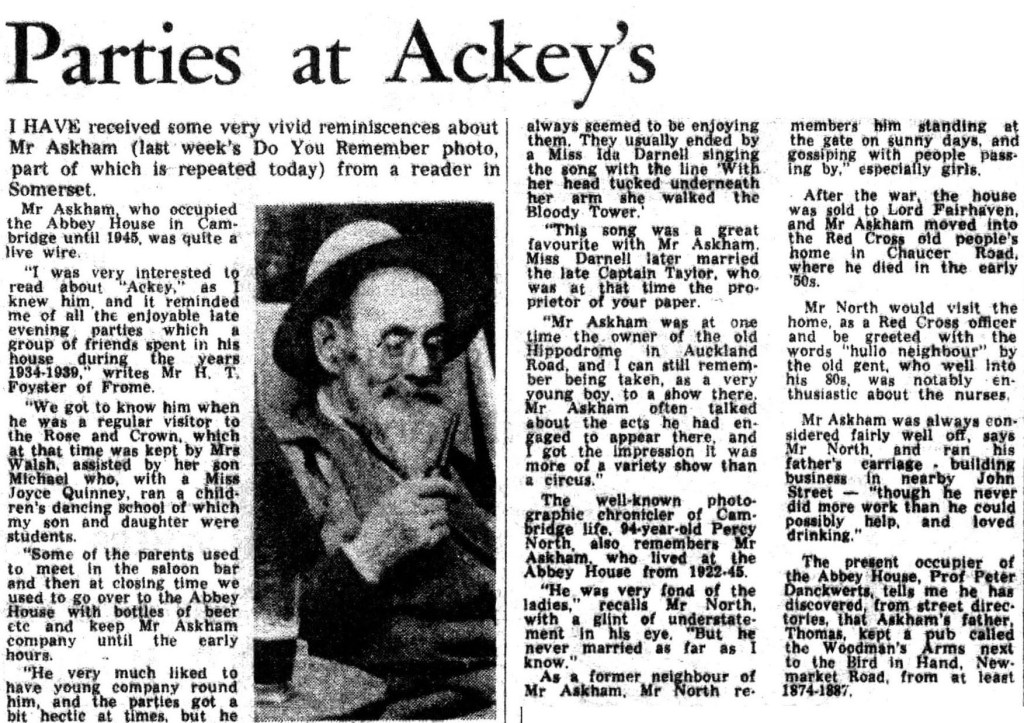
The following week’s cutting, reformatted to fit (Cambridge Evening News), 3 February 1978, p 17
Ellen Askham
We left Ellen in 1901 still at home aged 40, but she did make her escape finally when she married Norfolk-born widower Herbert Doughty in 1909 and became stepmother to his seven children. Their mother Mary had died aged 45 in 1908. Ellen moved into the family home in north Kensington, London, where she and Herbert are to be found in 1911 with six of the children: William, (23), Henry (21), Ellen (18), Sidney (15), Frank (13) and Horace (11), daughter Lily (17) having already left home. Herbert is variously described as coach-smith, blacksmith and wheelwright, occupations that must have connected him to Ellen, who died in north Kensington in July 1938.
Jessie Askham
Jessie married Henry Thurlow Reed in late 1893. He had been manager at Grundy’s, a hatter and hosier near Hyde Park Corner (Cambridge’s Catholic church junction) and took over the business in 1893 (CCJ, 7 April 1893, p 5). We find him in 1900 giving a reading at an evening ‘lantern service’ at the Primitive Methodist Tabernacle entitled ‘In His Steps; or, What would Jesus do?’ (CIP, 12 January 1900, p 6) and he was on the committee of the Cambridge Choral Society in 1904 (CIP, 14 October 1904, p 8). Perhaps this had been how he met Jessie, playing and singing at the Tabernacle or perhaps she bought a hat at Grundy’s. They had one child, a son, Leslie, born in 1898. In 1901 Jessie, Henry and Leslie were living at 35 Regent Street with a boarder and a servant. In 1911 they were all at 149 City Road, Birmingham with a local servant and Henry is listed as a commercial traveller in straw hats.
A notice in the CIP in 1920 announced the death of ‘REED.—On the 13th inst., at 149, City Road, Edgbaston, Birmingham, Harry T. Reed, the beloved husband of Jessie Reed (née Askham), also loving father of Leslie M. Reed’ (31 December 1920, p 12).
In 1939 Jessie was listed again at 35 Regent Street in Cambridge with Leslie. She ran a university lodging house, with four lodgers – one married couple, one male research worker, and one single female, a clerical officer in the Ministry of Labour. Leslie was a driver-salesman in foodstuffs, and Jessie died in July 1942.
Albert Askham
Albert’s story is quite different from those of his conventional, home-based siblings. He certainly worked for his father as in 1901 he was was summoned for wilfully damaging the soil on Midsummer Common, by replacing the posts that marked the boundary with the circus. hyperlink to 1901 report. In 1898 Albert married Florence Parker (born 1878 in Willingham) and in 1901 they were living at 19 Belvoir Road in Chesterton with one-year-old daughter Madeline. Albert is described as a coach builder and trimmer worker.
In 1909 Florence advertised twice for a live-in servant and so we learn that the family had moved to 22 Chesterton Road, next to the boatyard which Albert was managing:
Wanted, a young girl, about 15, to live in. – Mrs Askham, 22, Chesterton-Road, Cambridge
(Cambridge Daily News, 16 January 1909, p 1)
Wanted, respectable Girl, about 14; country preferred. – Mrs Askham, 22, Chesterton-Road, Cambridge
(Cambridge Daily News,15 May 1909, p 1)
Two years later, in the 1911 census, Albert and Florence and their two daughters Madelene (11) and Mary (2 ½) are visitors at 176 Histon Road with Florence’s parents and Albert describes himself as the manager of a boat business. But it may be that they were no longer at 22 Chesterton Road because they were leaving Cambridge:

Cambridge Daily News, 24 March 1911, p 2
Was he disaffected by his father’s remarriage? We know that Thomas did not include Albert in his will, though his two children were included. 1911, the year after Thomas married Kate, was the year that Arthur was in New Square, Jessie had moved to Birmingham, Ellen had been in London for three years – and then Albert and his family emigrated to Canada. This emigration, we are told on good authority, was the cause of Albert’s exclusion from his father’s will. He and Florence sold the contents of 22 Chesterton Road (above) and off they went, arriving at St John’s on 19 April 1911. They settled in Toronto, but the emigration was not a success, as we discover below.
We do not know exactly what happened to the family in the next five years, but we do do know that Albert volunteered for the Canadian Overseas Expeditionary Force in Toronto in March 1916 and was assigned to the Canadian Army Service Corps. He arrived in England on 29 April and after a few months at the army camp at Shorncliffe near Folkestone he was transferred to London where he worked as storeman, a role he appears to have performed until discharge in September 1920. Was this a way of escaping what he later claimed in court was an unhappy marriage? He certainly had no intention of returning to Florence, and his discharge address was sister Ellen’s home in north Kensington, but it looks as though he was really living in Brixton Road.
Florence didn’t just accept this desertion and was back in England in 1920, having sailed from Canada on 24 April to seek a divorce and financial support:

Cambridge Independent Press, 29 October, 1920, page 8
And so we learn that Albert ‘had transferred his affections to another woman since he came to this country’. His new partner was Beatrice Spring, whose home was near the ASC depot referred to in the story above. Albert and Beatrice Askham, married, of 89 Brixton Road, London, are to be found in the 1921 census at what appears to be a boarding house at 19 New Steine, Brighton. Beatrice was 23, while Albert claimed to be 38 (he was 46). They actually married in 1924 and appear in the electoral roll at 89 Brixton Road for a number of years. Albert ran a motor-cycle business in Camberwell and was the proud owner of an Indian motorbike, a brand from the United States of America.
Florence sailed back to Canada on 21 April 1923, and married England-born barber Ernest Tinkler in Cleveland, Ohio in July 1924. In 1931 she was back in Toronto, listed in the census as Florence Askham, divorced, living with daughter Mary, but passenger lists showed that she visited Cambridge between July that year and March 1932. Then she was married again in 1941 in Toronto, to Sidney Perry, a painter, and we know no more.
Albert is listed at Abbey House in Cambridge in the 1939 wartime register, alongside older brother Arthur, but his death certificate shows that he was living at sister Ellen’s old address before he died in Hammersmith Hospital in 1947. He seems to have moved there in 1945, when Arthur sold Abbey House to Lord Fairhaven. His daughter Joan, who was living in Newmarket Road, Cambridge, close to Abbey House, registered his death:

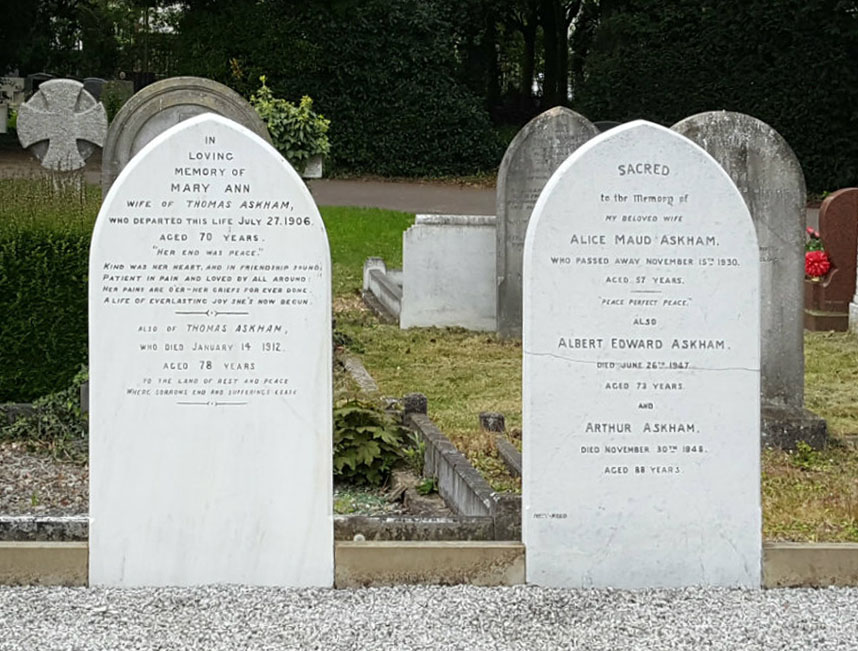
Thomas and Mary Ann, Arthur and Alice, and Albert are buried in the New Cemetery, Newmarket Road, Cambridge (Find a Grave)
 William Tudor's Circus