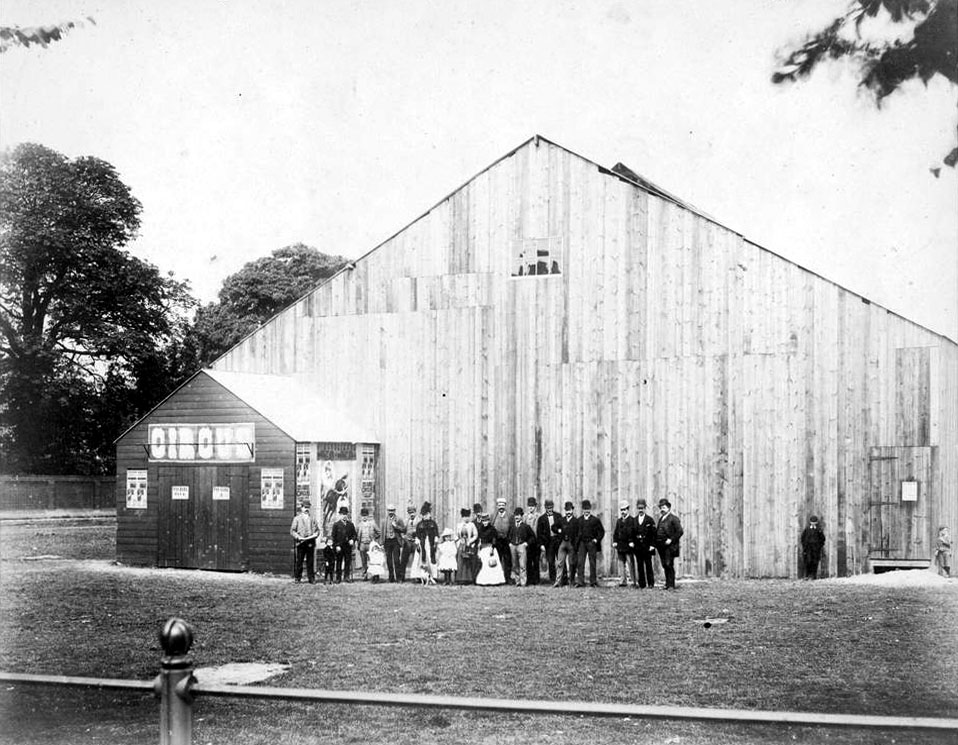
Charlie Keith and Mr Palmyra’s 1890 Cambridge building. Its location on Butt Green / Midsummer Common is discussed below (David Fitzroy / Victoria & Albert Museum)
Amphitheatres and tents
Philip Astley (1742 to 1814) is generally regarded as the creator of the modern circus. He and his wife Patty established their open-air riding school in Lambeth in 1768 and are credited with setting approximately 42 feet as the optimum diameter of a ring for horse-back acrobatics. By 1780 Astley had a building with a roof and after a fire in 1795 he built the Royal Amphitheatre. Twice more burned down and rebuilt, Astley’s was finally demolished in 1893.
Early on, therefore, we have the concept of a permanent circus building, now represented in the UK only by Blackpool Tower and Great Yarmouth Hippodrome. As Speaight points out, ‘It is not sufficiently realized that for a large part of its history Circus took place in circus buildings rather than in tents’ and goes on to say ‘the first substantial use of a tent for circuses in England came from America,’ brought by Richard Sands in 1842. There were temporary and portable wooden buildings, too (Speaight, 1980, pp 42-43).
Equestrian James Newsome (1825 to 1912) built 60 wooden circuses that seated 2,000 to 3,000 people (McMillan, 2022). His Alhambra Circus was at Burrell’s Bowling Green, Newmarket Road, coinciding with Stourbridge Fair, in September 1861 (CIP, 21 September 1861, p8). This may have been at or near George Burrell’s pub, The Bell, near Coldham’s Lane (UK Census, 1861). The Alhambra Circus appeared again in June 1862, this time on Butt Green, and William Tudor hired Newsome for his equestrian skills for the 1896 season in Auckland Road. He returned to Cambridge in 1901 after Tudor had left.
Charlie Keith did have a tent (Fitzroy, 1998, p 49) but he was clearly proud of his many wooden structures. His first was in Exeter in 1868 (Fitzroy, p 43) and by the late 1870s his circuses included Bradford, Halifax, Douglas, Derby, Dewsbury, Manchester, Portsmouth, Southport, and Wigan (The Era 10 March 1878; Assael, 1998, p 301). As we have seen, after their 1888 Midsummer Common season, Keith and Tudor went on tour, building temporary cicuses as they went, and then Keith was back in Cambridge with Palmyra in August 1890. Returning again for the next two summers, he proclaimed that his 1891 and 1892 buildings on Midsummer Common were his 56th and 59th. But ten years earlier he had patented and toured with a portable wooden circus. It never came to Cambridge but it is worth our curiosity as an innovation, and because William Tudor was with him.
Charlie Keith’s patent carriage circus
David Fitzroy (1998, p 208 onwards) quotes extensively from Keith’s 1882 patent, number 753, A New Travelling Building for a Circus:
The said invention has for object, the construction of a travelling building forming a circus, whereby the circus when not in use may be separated into sections forming vehicles which can be taken from place to place either by horses or other means, and formed into a building for a circus in a short time . . .
Ten of these vehicles are employed and placed in a circle of eighty-five feet in diameter . . . the front doors . . . of the vehicles are lowered and brought into a slanting position which brings the seats . . . into position for the use of the public . . .
In The Era of 25 February 1882 the language of Keith’s advertisement was less technical and more like that of the showman he was:
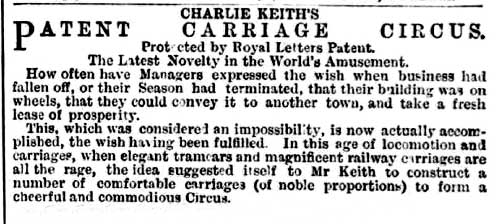
The advertisement goes on to announce ‘. . . Mr Keith, after many years of experience and study, has Designed, Invented, and Legally Protected, a . . . ’
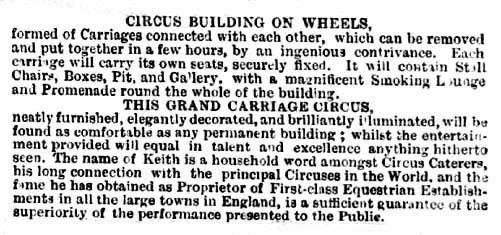
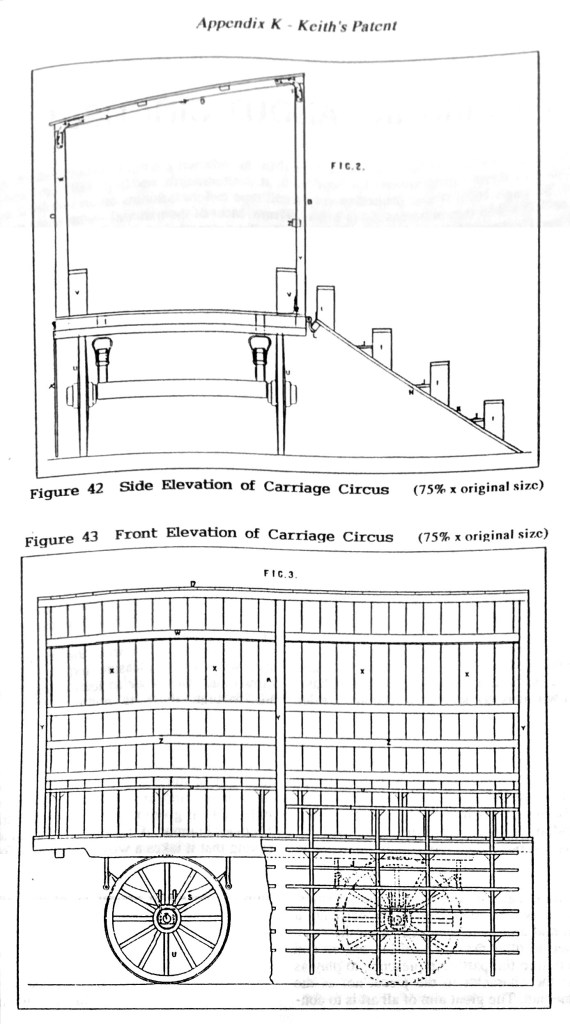
Charlie Keith’s Carriage Circus design – ten carriages with fold-out benches were arranged in a circle (Fitzroy 1998, p 211)
The Carriage Circus Tour of 1882
In the same advertisement, Keith announced his plans to tour the principal towns of Yorkshire, starting at Easter and staying two or three weeks in each place. He was looking for equestrians, clowns and ‘big speciallities . . . Only A1 Talent Need Apply.’ Having run a season in his permanent building in Bradford which finished on 15 April (Tudor was on the bill), Keith began his tour two days later with two weeks in Huddersfield and then went well beyond the bounds of Yorkshire. It being England in the springtime, an advertisement in the Huddersfield press proclaimed: ‘THE CIRCUS IS ENTIRELY WATERPROOF’ – we know that it had a canvas roof – and ‘The Circus will be brilliantly illuminated with 500 jets of gas.’ It was constructed by Huddersfield joiners Dawson & Jones (Fitzroy, p 122).
The (not necessarily comprehensive) itinerary that we have compiled from local press reports and advertisements was: Huddersfield, Rochdale, Altrincham, Ramsbottom (possibly), Hyde, Buxton, Shrewsbury, Wellington, Stourbridge, and Warrington. Keith was back on solid ground in Bradford on 6 November (Bradford Observer, 2 November 1882, p 1).
The following March, Charlie was in Sheffield, offering the carriage circus to let:
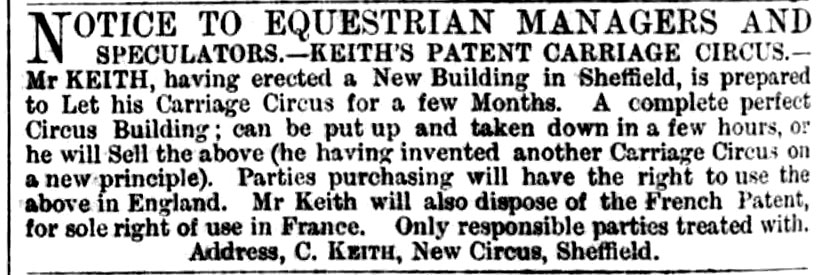
The Era, 10 3 1883
Apart from visits to Glossop and Altrincham in June 1883, we have found no further trace of the carriage circus in the British Newspaper Archive until . . .
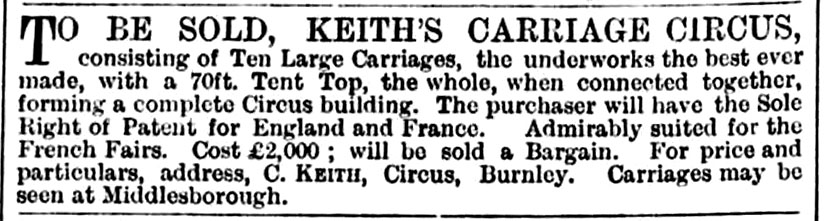
The Era, 10 November 1883
. . . and that seems to be it.
Where were the circuses on Midsummer Common?
We know exactly where Charlie Keith built his circus in 1892 because we have his agreement with Cambridge Borough which includes a plan. It was near the bend in Victoria Avenue, close to the corner of the Jesus College grounds. One can stand there today and imagine it in position when one follows the footpath from the Fort St George to the point on Victoria Avenue opposite the end of Jesus Ditch.
The previous year, Keith and Tudor had applied separately to Cambridge Borough for permission to build a temporary circus on Midsummer Common. The Commons Committee decided in favour of Keith but specified that the circus should be built away from Jesus Lane and east of Victoria Avenue. While we only have decisive evidence for the 1892 location, we think it reasonable to deduce that in 1891 Keith, and in 1893 and 1895 Tudor, were on the same site near the corner of Jesus Close and the end of Jesus Ditch.

(Cambridgeshire County Archive CB/2/CL/17/14/Page 23)
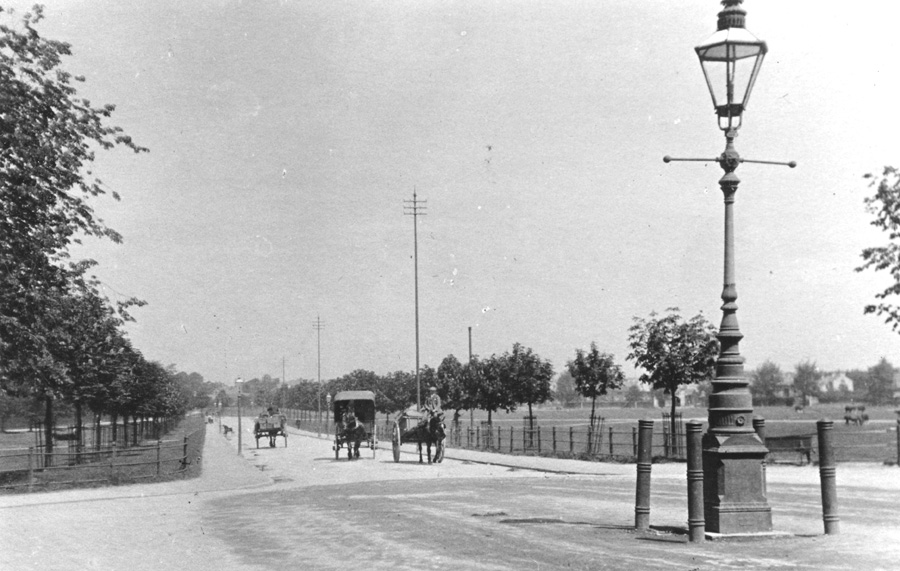
In 1890, Victoria Avenue was laid out across Butt Green from the Four Lamps junction, where Jesus Lane meets Maids Causeway, King Street and Short Street, to Victoria Bridge and Chesterton Road. In this very early view the sliver of land on the left, almost certainly the site of Charlie Keith’s 1890 circus, is clearly seen. It was made over to Jesus College in 1930. Animals, whether bovine or equine it is hard to tell, are seen grazing on the common on the right. (Cambridgeshire Collection, Cambridge Central Library)
Tudor’s Temporary Circuses
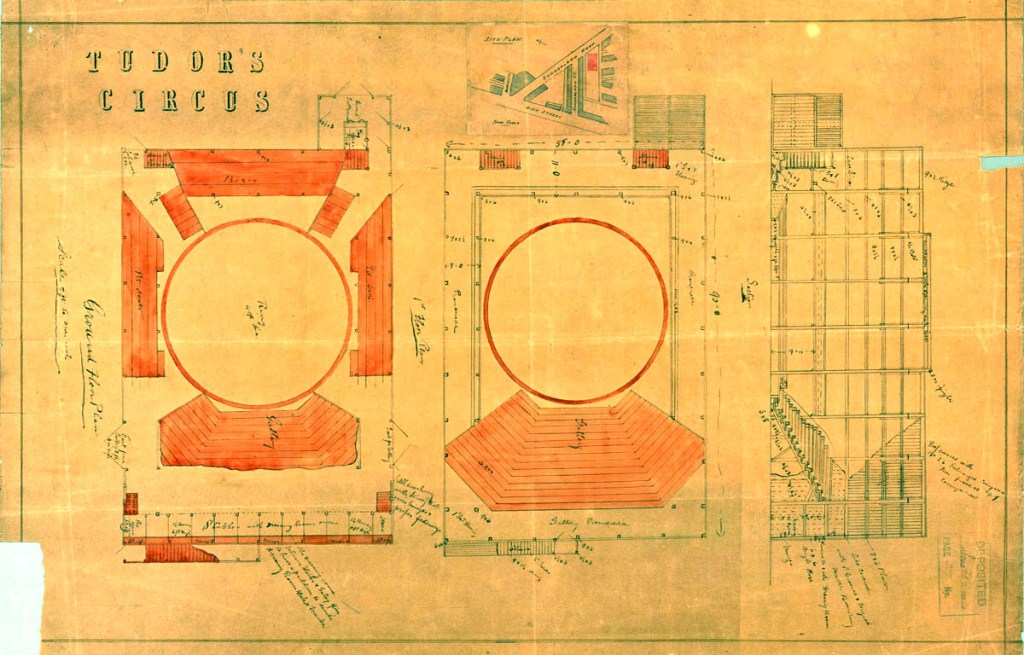
We have an excellent description of one of Tudor’s wooden circuses in Ipswich. We believe it is a standard design that he and he and Charlie Keith had been using in Cambridge and elsewhere. Certainly the materials, dimensions and seating capacity match the temporary buildings erected in other towns. The 1896 brick building in Auckland Road broadly conforms to the plan.
Mr Tudor said that he interior measures 90ft. by 60ft., and will accommodate 1,400 people . . . The walls are of 1½-inch ‘tongued-grooved’ boards, and the roof of corrugated iron. On three sides a promenade balcony is carried up on substantial supports, and on the fourth the seats of the gallery rise tier above tier to a great height, there being room for 600 people in this part of the house alone.
The principal approach is by two doors from the main road. One opens directly into the ‘boxes’, or reserved enclosure which has been nicely decorated; the other leads through a broad vestibule into pit and balcony. These two parts of the house are in communication, and the latter will doubtless prove, as usual, the popular smoking promenade.
The entrance to the gallery, which from any point gives a fine view of the ring, is at the far end of the building. Special attention was drawn to the precautions taken with regard to emergency exits. ‘A packed house could clear out in two minutes,’ said Mr Tudor, and, looking to the number of doors, all opening outwards, this statement was apparently well justified. The stabling is at the rear, under the gallery . . .
(Ipswich Evening Star, 21 February 1897, p 5)
Some indication of how much time was needed to put up a temporary wooden circus is given by the fact that in 1893 and 1895 Tudor rented the land he needed on Midsummer Common in Cambridge two or three weeks before his opening performances.
The circus in Gateshead
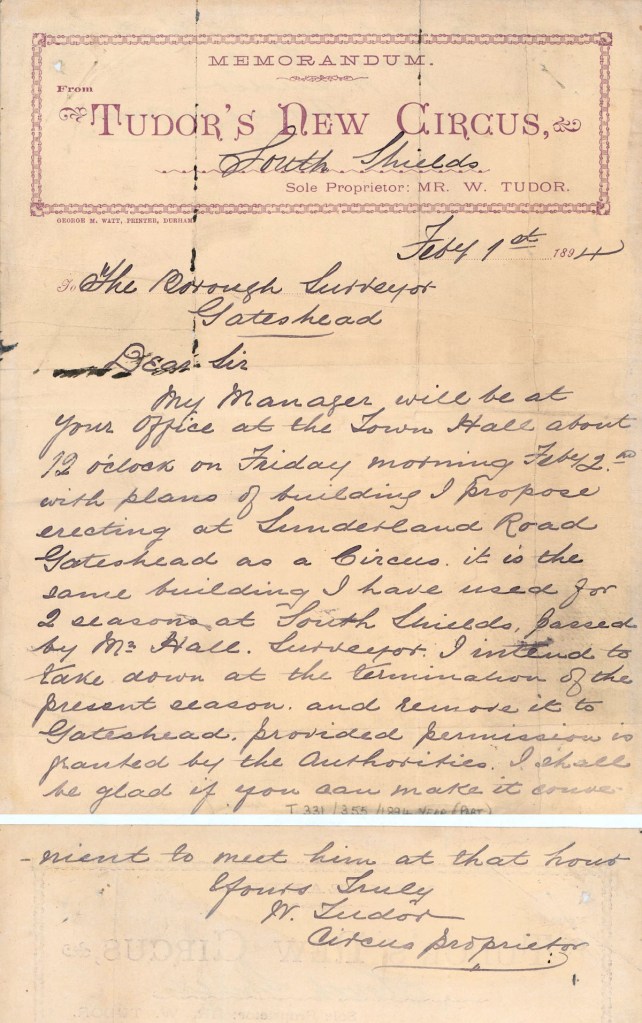
On 1 February 1894, Tudor wrote to the Gateshead Borough Surveyor to ask him to meet his manager (presumably Henry Bucknall) to discuss moving the South Shields Circus building to Gateshead. The plan and his April advertisement seeking estimates for the cost of moving the building show that it was a typical Tudor wooden building – 90 feet by 60, with a corrugated iron roof.

Newcastle Daily Chronicle, 6 April 1894, p 2
 William Tudor's Circus