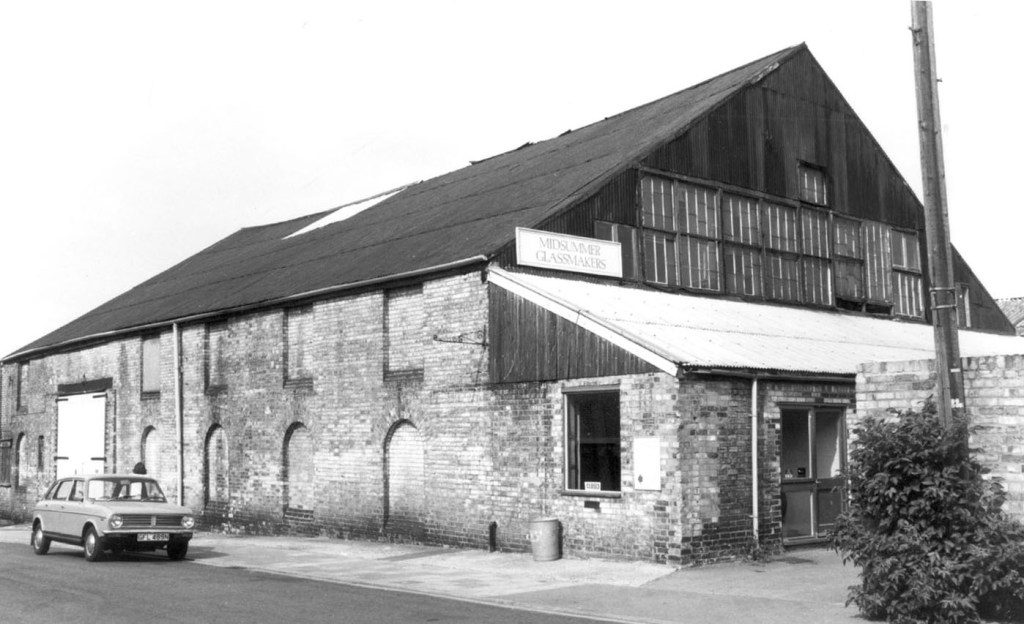
William Tudor’s 1896 circus building at the bottom of Auckland Road. Midsummer Glassmakers, whose sign is visible above the lean-to, was in the annexe behind from 1982 to 1987. The circus was demolished and Auckland Court was built in 1993. (Cambridgeshire Collection, Cambridge Central Library)
The 1896 Brick Circus
William Tudor’s experience of Cambridge in the temporary buildings of 1888, 1893 and 1895 was clearly positive enough for him to think a permanent building a good idea. In April 1892, local coachbuilder and publican Thomas Askham had bought a piece of ‘valuable’ and ‘excellent’ freehold building land that had a frontage to Auckland Road of 187 feet and a depth varying from 90 feet next to Midsummer Common to 103 feet (Cambridge University Library Map Room sales particulars). This land had been allocated to James Burleigh when the Barnwell fields were enclosed in 1811 (Barnwell Enclosure map, Cambridgeshire County Archives, K124/P/34).
This advertisement (Cambridge Chronicle, 15 April 1892, p 5) shows that Askham was renting and sub-letting the site:

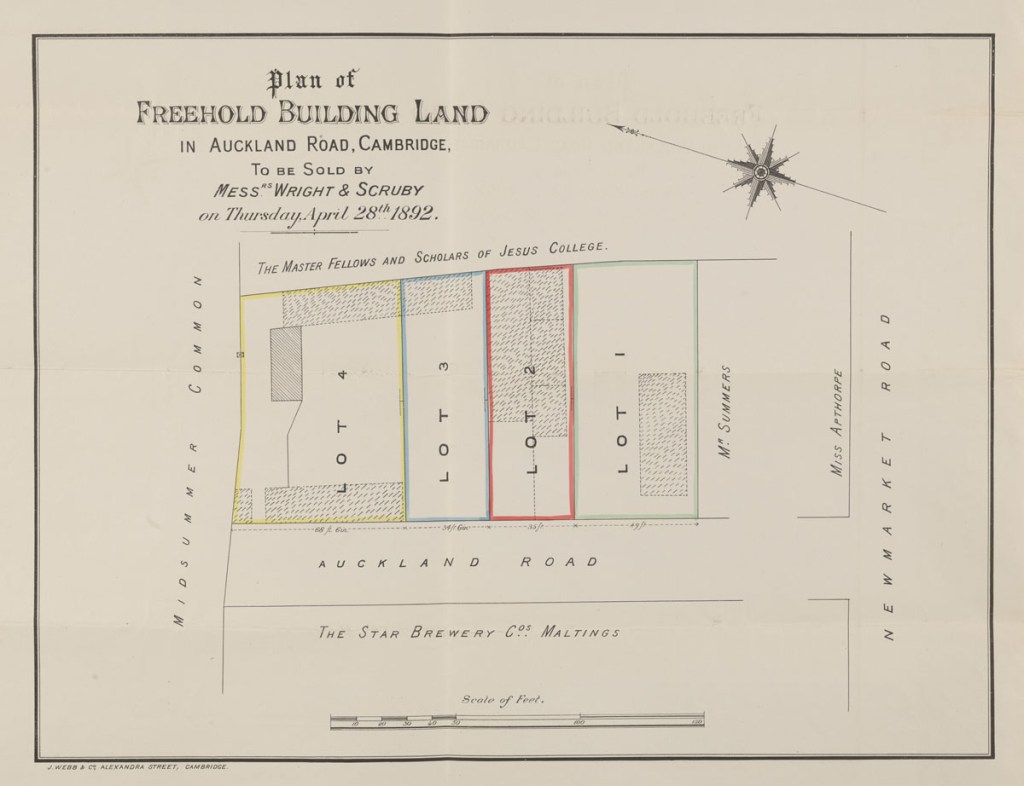
The plan that accompanies the sales particulars for the land in Auckland Road, purchased by Thomas Askham in April 1892 (Cambridge University Library Map Room, PSQ 18.630)
It was Askham himself who bought the four pieces. We learn this from the sales particulars (Cambridge University Library Map Room, PSQ 18.630) which are annotated with his name and the price he paid for each lot: £125, £95, £95, and £190. We don’t know what Askham did with all the land in the next four years but we do know that in 1896 William Tudor took a lease on about three fifths of lots 3 and 4, next to Auckland Road and built his 90-foot by 58-foot New Circus .
Askham, we presume, must have been discussing a lease with Tudor in October 1895 when the latter made his failed planning application to build a permanent circus: according to the report on Askham’s death in 1912, ‘Jointly with Mr Tudor, Mr Askham built the Hippodrome, Auckland-road, of which he was proprietor at the time of his death’ (Cambridge Daily News, 16 January 1912, p 3). Why did Tudor build in brick when all his other circus buildings, some relatively long-lived, were of wood? We do not know, but if this was a joint enterprise then perhaps Askham had an eye to the future and wanted a more permanent structure.
Tudor tried again in the spring of 1896 and the Cambridge Chronicle (17 April) reported tersely in its list of buildings approved by Cambridge Borough the day before: ‘Circus, Auckland-road, W. Tudor Hall, Macclesfield’. The Chronicle (7 August, page 4) also informs us that Tudor’s lease on the land was for ten years. Luckily for us, the plans survived in the Cambridgeshire County Archive (CB/2/SE/3/9/1012). It was surely an attractive site as it was not far from the familiar location on Butt Green or his lodgings in Maids’ Causeway, close to town, and well away from the kill-joys in Jesus College.
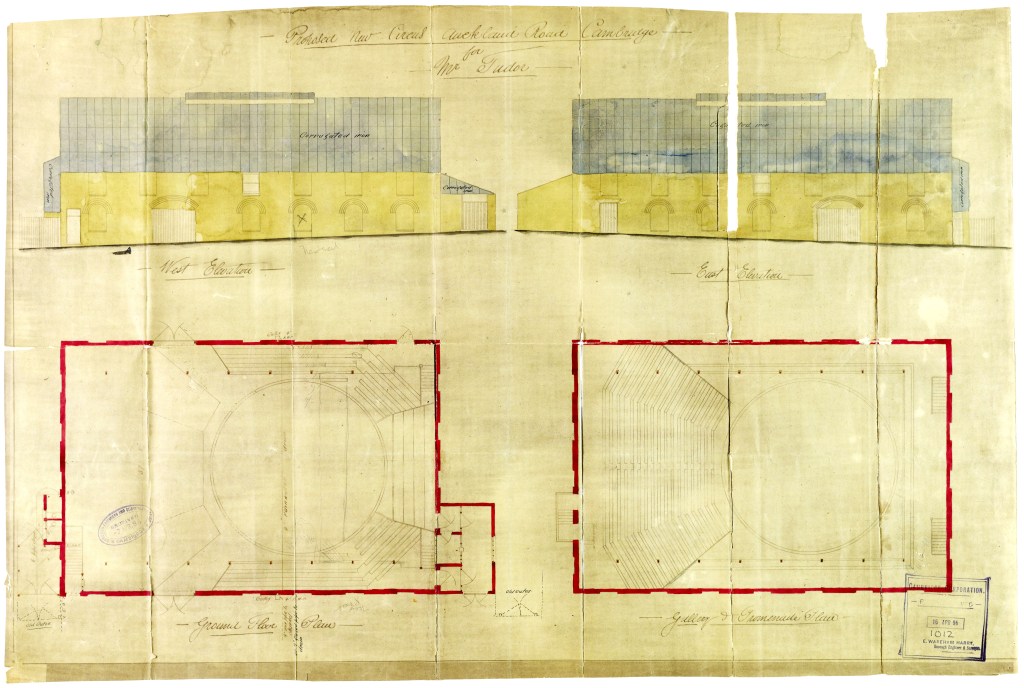

Roger Rudderham (1987) tells us that the building was similar in size to its wooden predecessors – 90 feet by 58 feet. It could seat 700 in the pit, 100 around the 40-foot ring and another 700 in the gallery. It had six emergency exits. Cambridge builder Francis Thoday (who certainly built Charlie Keith’s Cambridge circuses and so quite probably Tudor’s in 1893 and 1895) had the gas-lit, brick-walled, iron-roofed building ready for Tudor’s opening on 3 August, Bank Holiday Monday.
The exterior dimensions of the new circus are the same as those of the wooden building on Midsummer Common last year, and there is again a 40ft ring. There is accommodation for 1,500 people, – 700 in the gallery and 700 in the pit and promenade. The chairs near the front entrance number about 100. The walls are of brick and the roof of corrugated iron. There are six exits, through which the building could be cleared in a very short time, and the building is well ventilated. Though the general interior arrangements are similar to those of its predecessor, much more has been done in the matter of decoration and the place thereby made more attractive. The inside of the roof is painted with broad stripes of red and white, and the beams supporting it are painted dark blue. Outside there are large lamps at the front and the back. The new building has been erected by Messrs Thoday and Co., and the ground is taken by Mr Tudor on a ten years’ lease.
(CDN, 4 August 1896, p 2)
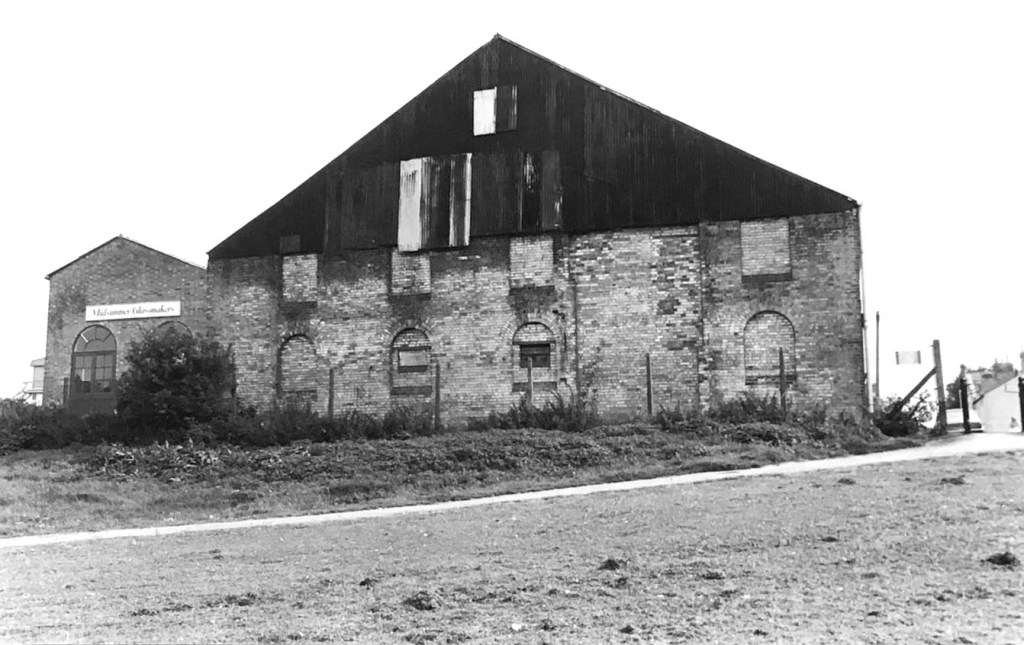
The view of the circus on the approach across Midsummer Common from Cutter Ferry to Auckland Road (Cambridgeshire Collection, Cambridge Central Library)
Post-Tudor – the Askham Era
After Tudor’s 1899 season the building went through various name changes as an entertainment venue. Successively the Circus of Varieties, the New Grand Circus, the Hippodrome, and the Gaiety Theatre (which failed in 1914) it then survived until 1993 as a garage, a warehouse and (occupying a newer annexe at the side) the home of Cambridge Glassmakers and Midsummer Glassmakers.
In 1902, at around the time of his first application for a theatre licence, Thomas Askham submitted plans to build a stage and to extend the lean-to at the south end of the building to incorporate dressing rooms. The planning application succeeded, but the licence application [insert hyperlink here] did not, so Askham did not build the extension. Not until the fourth, finally successful, theatre licence application in 1908 was the extension built, to a slightly modified plan.
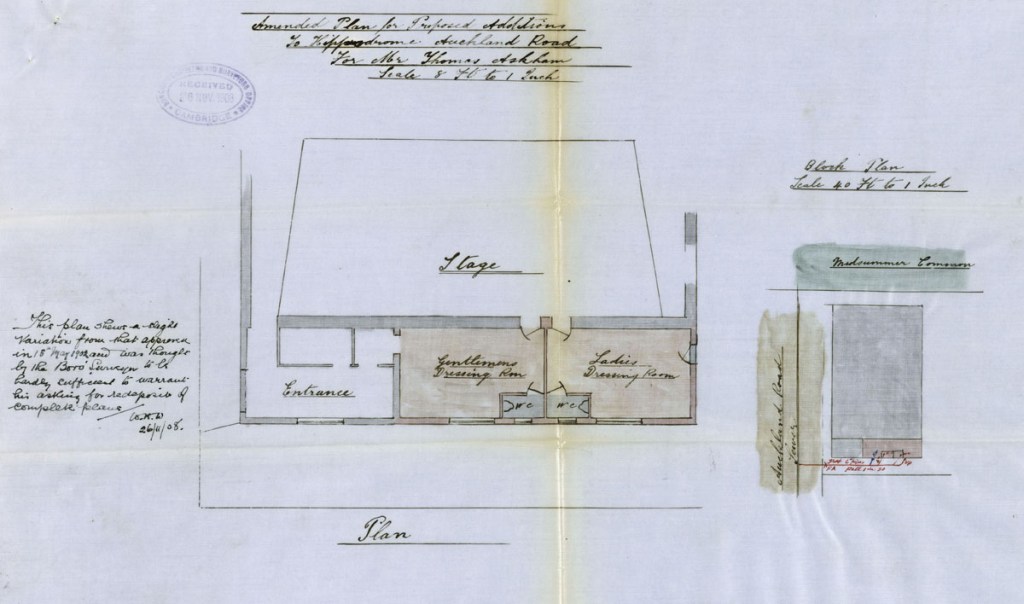
The November 1908 plan, showing men’s and women’s dressing rooms (Cambridgeshire County Archives, KCB/2/SE/3/9/1972)
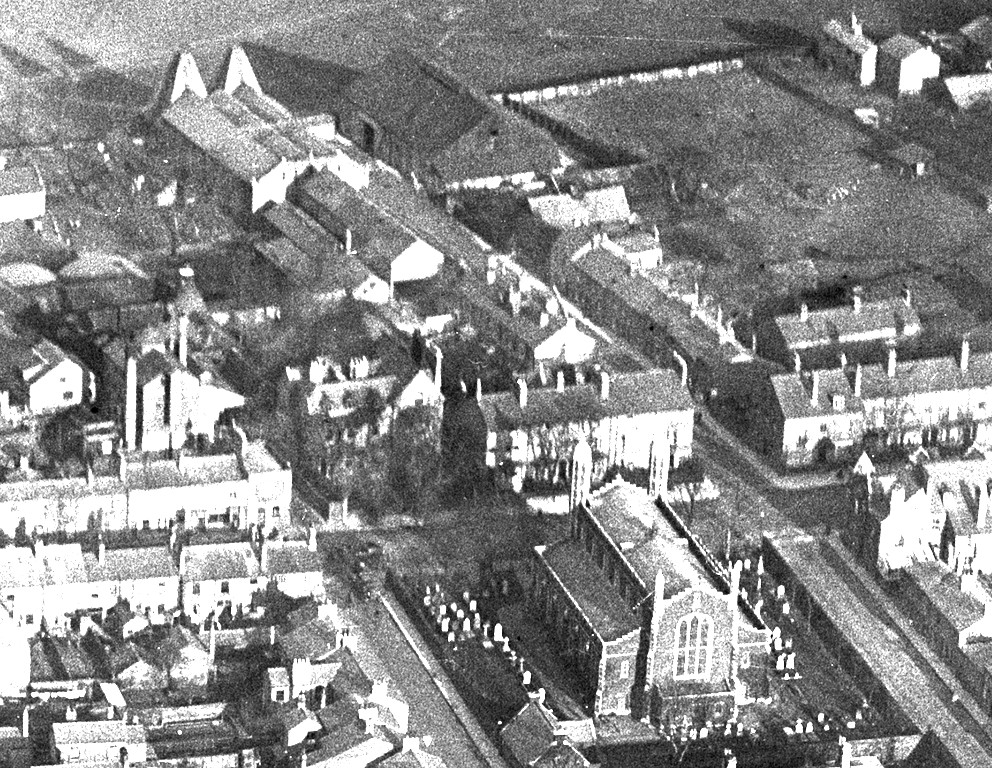
An aerial view of Auckland Road in 1920. At the top, the circus is the large, dark building to the right of the sunlit malthouse-kiln roofs. At the bottom, facing Newmarket Road, Christ Church is still a 21st-century landmark. (Historic England)
 William Tudor's Circus