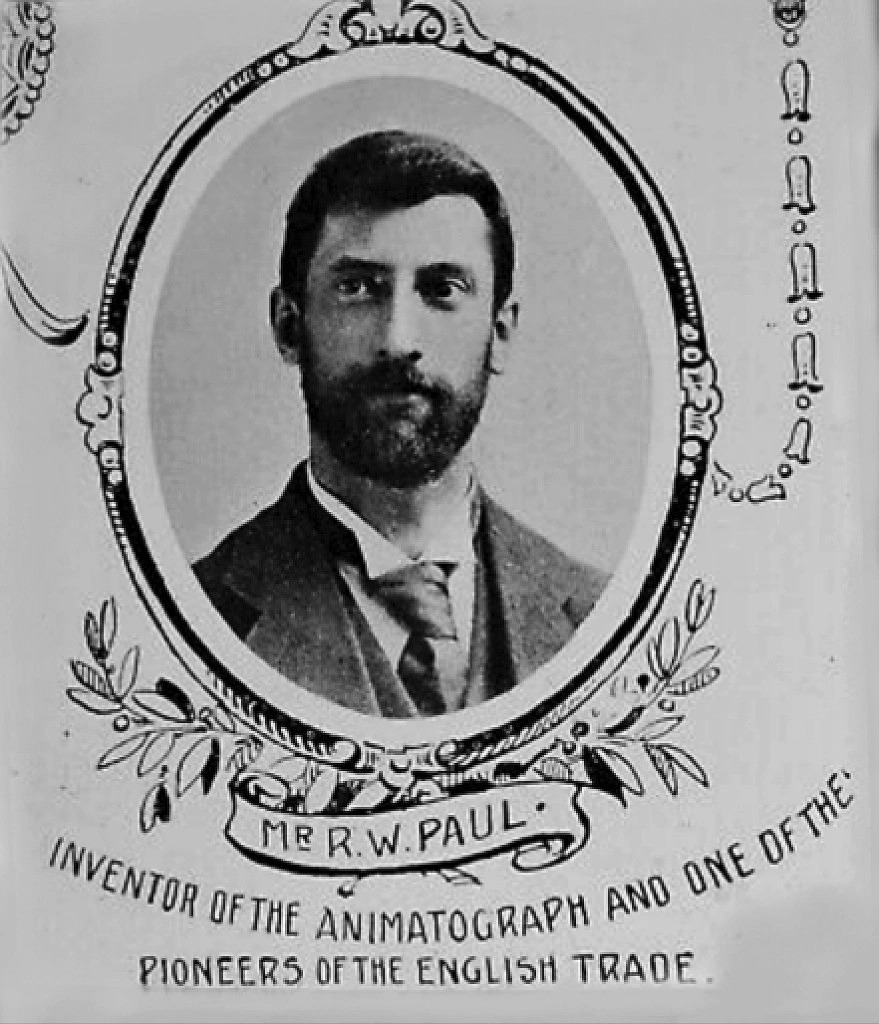
Scientific instrument maker and not-to-be-forgotten film-maker
Without Robert Paul there would be no Tudor’s Circus website! A chance encounter with an advertisement for a screening at Tudor’s New Circus, Auckland Road in October 1896 inspired the research behind the story of the circus. Paul’s season of films at the Alhambra in London during the summer of 1896 had been a great success and that autumn he sent his projectors and films out to the provinces, delegating the task to a number of managers. In Cambridge this was Mr P Shrapnel and we believe he presented the first moving pictures shown in this town.
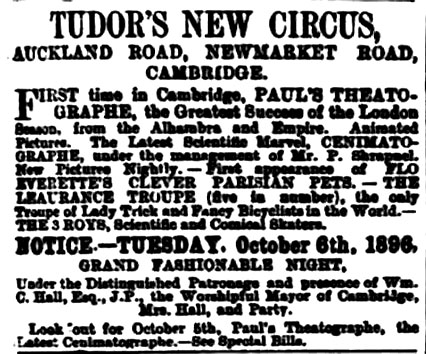
Cambridge Chronicle, 2 October 1896, p 5
For the Cambridge Festival in April 2022 the Cambridge Museum of Technology presented Discovering Robert Paul: Cinema Pioneer and Inventor when Professor Ian Christie, Professor of Film and Media History at Birkbeck College, London, and Dr Joshua Nall, now Director and Curator, Whipple Museum of the History of Science, brought together the two sides of Paul’s career in a presentation for an enthusiastic audience. Archivist and photographer Beth Darbyshire wrote this summary of Robert Paul’s career for the occasion and she has kindly allowed us to reproduce it here.
Discovering Robert Paul: Cinema Pioneer and Inventor
Robert Paul was an inventor of scientific instruments and a pioneer of early British cinema. Rising to prominence between 1896 and 1900, RW Paul became the most important figure in the newly emerging British film industry. He achieved many of cinema’s ‘firsts’, both solo and collaboratively (notably with Birt Acres and Walter Booth). At a time when there was worldwide fury to be at the forefront of cinema’s new technologies, Paul was the first to be an exhibitor, supplier and producer. He was the first to use a “two-shot” in his films, a shot that shows two subjects in the same frame, allowing for a visible emotional reaction between the two characters. He was the first to use intertitles and made the first presentation of a film with colour and created Britain’s first true fiction film.
Paul invented the Theatrograph, Britain’s first cinematic projector. The commercial success of this projector only added to his acclaim and allowed his early film contemporaries, like Georges Méliès, to further their film making ambitions when Lumière projectors became hard to acquire. After building Britain’s first film studio, Paul’s productions were at the cutting edge of early special effects.
To say Paul was prolific is an understatement. In his 14-year film career, Paul created 779 films. Then in 1910, as commercial enterprises for motion picture were saturating the world, he sold all his interests in the business.
Paul returned to the engineering profession and the Robert W. Paul Instrument Company which he had established in 1891. His scientific instruments were lauded, winning medals at the St. Louis Exposition in 1904 and the Brussels Exhibition in 1910. Paul’s most successful instrument, the Unipivot Galvanometer, remained in production for over 50 years. The device was used to detect and measure electrical current. Several examples can be found in the collections of Cambridge Museum of Technology and The Whipple Museum.
Paul’s firm joined with the Cambridge Scientific Instrument Company in 1919 to form the Cambridge and Paul Instrument Company. This became the Cambridge Instrument Company Ltd in 1924 and Paul remained a director until his death in 1943. The companies’ combined histories have had a pivotal role in the collections of Cambridge Museum of Technology and Cambridge’s rich industrial history.
Bibliography
British Film Institute (2006). RW Paul: The collected films 1895-1908. London, BFI DVD and Blu-ray.
Cattermole, MJG and Wolfe, AF (1987). Horace Darwin’s Shop: A History of The Cambridge Scientific Instrument Company 1878 to 1968. Bristol, Adam Hilger.
Christie, Ian (2019). Robert Paul and the Origins of British Cinema. Chicago, The University of Chicago Press.
Darbyshire, Beth (2022) Discovering Robert Paul: Cinema Pioneer and Inventor Cambridge, Cambridge Museum of Technology [Available at: https://www.museumoftechnology.com/news/2022/3/22/discovering-robert-paul-cinema-pioneer-and-inventor] Accessed 9 June 2024.
Sharp, R. (2004, September 23). Paul, Robert William (1869–1943), maker of scientific instruments and cinematographer. Oxford Dictionary of National Biography. Retrieved 9 Jun. 2024, from https://doi.org/10.1093/ref:odnb/50386

 William Tudor's Circus