Josephine Mathews (sometimes Matthews, occasionally Williams), known as Evetta the Lady Clown, born 1868, was often described as the first and only lady clown, and William Tudor brought her to Midsummer Common in August 1893. However, there was an earlier female clown, Amelia Butler, in America, in 1858 (Adams and Keene, 2012, p 184). MacMahan and Senelick (2023) refer to ‘Mary Ann Maskell’ or ‘Ida Isaacs’, 1843-1913, an early female clown in the United Kingdom, first noted in 1867.
In an 1895 interview (below), Josephine tells us that she entered the ring at the age of six. The first reference to her that we have found is on page 22 of The Stage, 30 December 1887, when she appeared in the harlequinade in Robinson Crusoe, alongside three of her sisters. In February 1889 she was on the bill as ‘the Refined and Funny Lady Clown’ at the New Theatre Royal, Bolton, taking part in ‘the Greatest Novelty on the Stage, an Entire Lady Harlequinade.’ Her seven acrobat sisters were there, too (The Era, 16 February 1889 p 24).
By April 1892 she was with Newsome in Bootle:
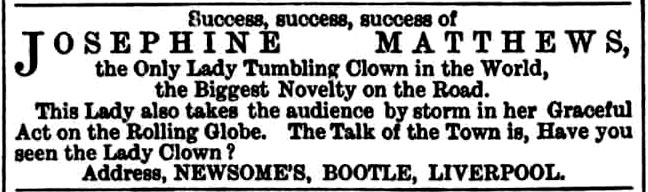
The Era, 30 April 1892, p 26
In March 1893 she appeared in Birmingham at Day’s Crystal Palace of Varieties, as half of ‘Miss Josephine Mathews and Miss Adella in their New, Novel and Marvellous Performance’ (Birmingham Suburban Times, 25 March 1893, p 1). It was to be her performances at Barnum and Bailey’s Circus in the USA in 1895 and 1896 that caused the most excitement.
Barnum and Bailey were expert promoters and in 1895 pieces appeared in provincial papers all over the UK, mostly with identical wording, enthusing the novelty of this female clown, now called Evetta.
The Dublin Evening Telegraph in 1895 referred to an interview with Josephine in the New York Sun:
My first engagement was with Newsome’s Circus, which was showing in the provinces of England, and you may be sure that I didn’t let the management know that the business was new to me.
The first night I went into the ring I had no idea what I was going to say, but I made a big hit. It wasn’t so much what I said, but the way I said it, that caught the crowd. A woman clown was a novelty. It was not my cleverness, but my idea and the confidence I had that carried me through.
My father and mother were in the business all their lives and a few weeks after the twenty-one children were born it was wheeled across the tightrope in a wheelbarrow by my mother. That was our first appearance. Is it any wonder that we went into the circus or on the stage? When I was six years old I entered the ring and I haven’t been out of it for twenty years, except occasionally to go on the stage.
When I first went into the ring I showed in the provinces. I then went with Crouet’s [probably Croueste’s] Circus for a season and finally went to the Olympia, in Paris, where I acted the clown all last summer. I have travelled all over Europe, and when I was in Moscow at the coronation in 1883, I performed before the Csar, who gave me a silver medal and a silver goblet. I was delighted to sign with Barnum and Bailey because I was so anxious to come to America.
(Dublin Evening Telegraph, 20 April 1895, p 8)
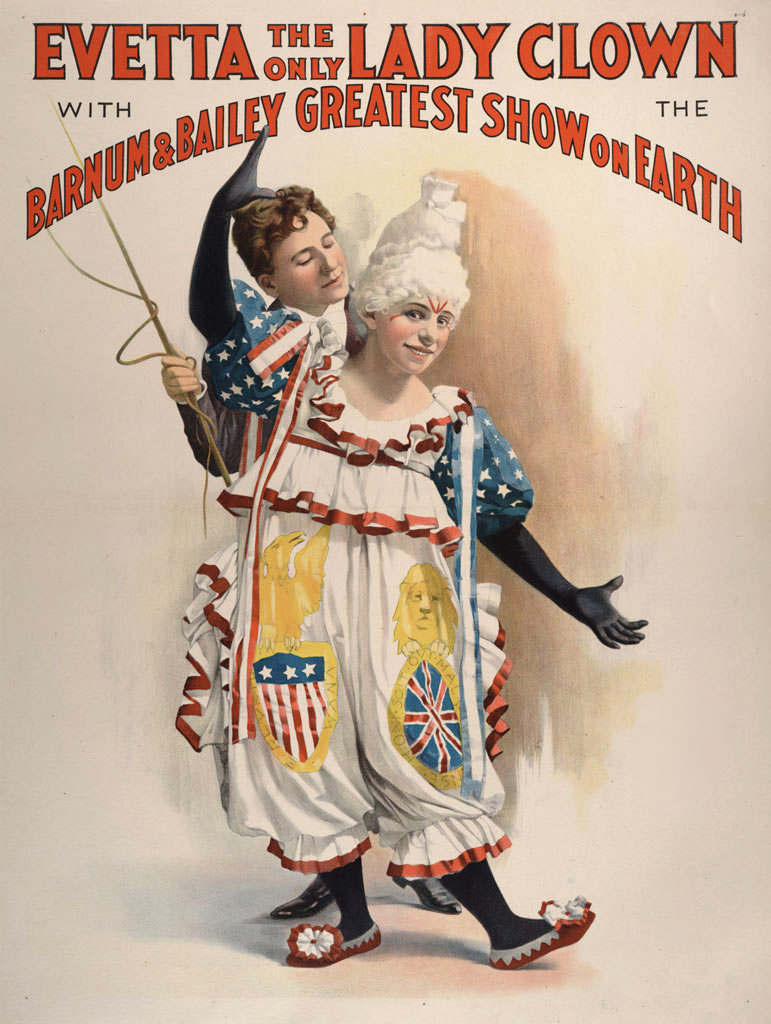
A Barnum & Bailey poster of 1895 (Collection of the John and Mable Ringling Museum of Art Tibbals Collection, Florida, USA)
The New York Times of March 1895, declared that the clowns of the Barnum and Bailey Circus this year were up to date. ‘A woman has invaded this branch of the profession. Miss Mathews, who is announced on the programme as “the only lady clown on earth,” entered into active competition with all the old-time tumblers, and fairly earned the generous share of applause that she received’ (NYT, 29 March 1895, p 3).
Two days later the paper published an interview with Evetta headed Why Miss Williams [sic] is a clown.
‘My reason for becoming a clown’ said Miss Williams, the only lady clown on earth, according to the circus bills, ‘was to make money. My father was a clown for forty years. He was with the Barnum & Bailey show in this country for twenty years. He had twenty-one children and all of them were in this business in some capacity or other, generally as acrobats and tumblers. My three brothers were clowns, and they used to come to me for ideas. I was not suited for an acrobat. It is too hard work. I thought that I would become a clown myself and make use of the suggestions I used to furnish them. There are twelve of our family now in the circus business. Father has retired. He keeps a little public house near London. In the Winter I go there and help him. This is my first voyage to America.
‘I believe that a woman can do anything for a living that a man can do, and do it just as well as a man. All my people laughed at me when I told them I was going to enter the ring as a clown. But now they do not laugh now, when they see that I can keep in an engagement all the time and earn as much or more money than they can in other branches of the business. I am paid for my ideas. Every day I try to think out something new, and the management usually gives me pretty wide latitude.
‘My first engagement was with an English circus in the provinces. I made a hit and managed to get into the Hippodrome in Paris. I was there two years. Then I went back to London and did pantomime work. But I like circus work the best. The chief difficulty is making myself heard. But, then, nobody ever listens to what a clown says. Everything depends on the antics. I am a fair tumbler and manage to get along all right. I shall probably stop in this business until I get married. Of course I hope to get married some day. Every woman does. But I do not believe in women sticking to the business after they get married, though the rule in a circus seems to be just about the reverse. These bareback riders and trapeze artists all have husbands or brothers about the building somewhere. That is why the standard of morality in the circus is far better than it is in the theatre. That is a fact.’
(NYT, 31 March 1895, p 27)
The writer of the article then goes on to describe Evetta as
a rather undersized woman, about twenty-five years old, with an abundance of health and energy. She rides a bicycle, swings Indian clubs, and does everything else that a man does to keep herself in proper trim. One of her favorite tricks as a clown is to put on a bonnet and a long cloak and sit by an innocent young man in the audience. In nine cases out of ten he is very much preoccupied in the performance, and does not pay any attention to her. Suddenly she astonishes him by shouting to the ringmaster for a job. He takes the cue and begins to dicker with her.
‘How much will you give me?’
‘Ten dollars a performance.’
‘Oh, no! This young man here that I am engaged to will give me more than that to stop here with him.’ (Great confusion of the young man referred to if he does not grasp the situation.)
Finally the cloak and bonnet are tossed aside and the lady clown leaps into the ring. This trick worked very successfully the other night. The men in the clown business rather enjoy Miss William’s antics, but they do not regard her as a serious competitor or believe that any other women are likely to follow her example.
(NYT, 31 March 1895, p 27)
In May 1895 she is in Wheeling, West Virginia (Wheeling Daily Intelligencer, 15 May 1895, p 3), and in September in Rock Island, Illinois (Rock Island Argus, 14 September 1895, p 7).
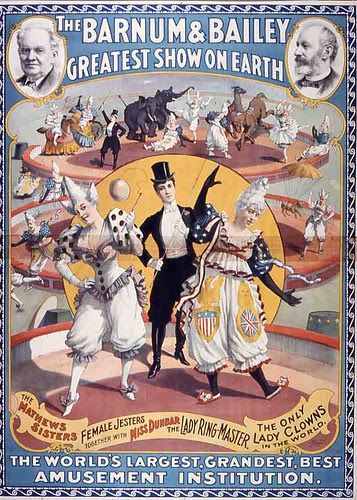
Back in Britain, almost identical articles about this novel lady clown appeared in numerous provincial papers. In Sunderland a piece headed A Woman Clown, reported
America can boast the cleverest lady clown in world —Josephine Evetta Matthews. She is short and plump, and remarkably strong, and one of her feats is to carry her six sisters on her shoulders. She says the first night she appeared she had no idea what she was going to say, but nevertheless managed to make a big hit. It was not so much what she said, but the way she said it, that caught the crowd. It was not her cleverness, but her idea and confidence that carried her through. She is one of a family of 21 children, 13 of whom were boys, and eight girls, and all are on the circus or stage. Miss Matthews’s reason for wanting to be married is that unless she does she will have to mend all the old bachelor’s clothes in the next world. Her mother trained each of her girls to do some domestic work. Miss Matthews is a first-class cook. One of her sisters had all the sewing, another the marketing, another wrote all the business letters; all had some special duties besides their professional work.
(Sunderland Daily Echo and Shipping Gazette, 29 May 1895, p 3).
And almost identical articles appeared in May and June in the Mid-Lothian Journal, the Ulster Echo, the Yorkshire Evening Post, the Daily Gazette for Middlesbrough, the Northern Weekly Gazette, the Hampshire Telegraph and the Luton Times and Advertiser.
At this point an advertisement appeared in The Era, the journal of the British circus trade, indicating that Evetta would be back from America, and looking for work in the circus. This was presumably rather than helping her father in the pub over this year’s winter (The Era, 22 June 1895, p 27).
In September 1895 her fame has reached South Wales as she appears in both the South Wales Echo and the South Wales Daily News with a short piece. ‘The New Woman has turned circus clown. The first of the gentle sex to don the motley is an Englishwoman, one Miss Evetta Matthews, and she is at present one of the attractions of Barnum’ (South Wales Echo, 19 September 1895, p 2). And a little later the Empire News & The Umpire comments ironically:
Evetta Matthews is actually one of the attractions of Barnum and Bailey’s colossal show. Miss Matthews is described as being an expert gymnast and acrobat, and her tumbling in the ring is stated to afford a spectacle well worth seeing. Her work is radically different from that performed by male artistes, and she is never vulgar. Even her jokes are new. This is the saddest blow of all. With the circus clown up-to-date, and discarding the time-honoured chestnuts which have done such yeoman service since the day of Noah, clearly the millennium must be near at hand
(Empire News & The Umpire, 22 September 1895, p 1).
In the photographer’s studio
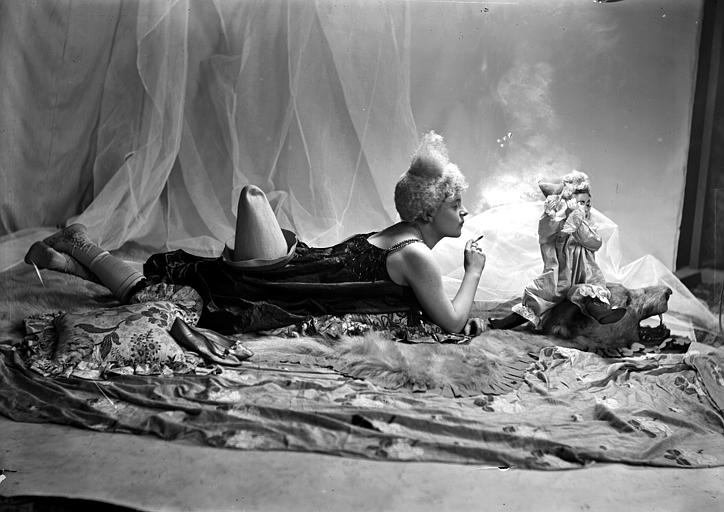
In Paris the artistic photographer Émile Joachim Constant Puyo (1857–1933) took a series of photographs of Josephine, possibly in 1895. She is featured in a studio in comparatively scanty clothing – voluminous pantaloons with a vest-style top. Her pointed clown’s hat features. She interacts with a doll/puppet figure, dressed in a clown costume, sometimes in circus poses, sometimes in domestic ones. In the section on contemporary research below, Russell comments on these images.
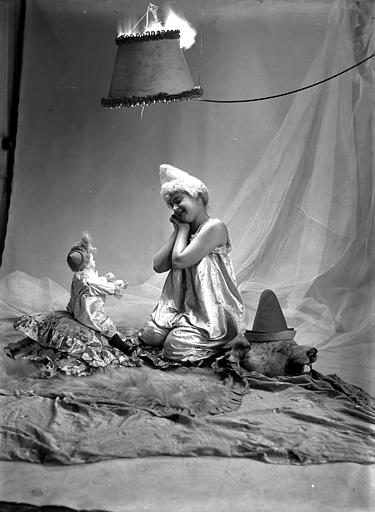
There are also two photographs where she is naked, or semi-naked, the circus references are absent and the doll that appears in one is not in clown’s pantaloons but appears to be a Japanese child and held to her breast. Whether Josephine modelled for these photographs in support of Puyo’s claims for photography as a high art, or whether she was in need of money we do not know. The photographs may be found here.
Back in the USA
By April 1896 Josephine had returned across the Atlantic, sailing from Bremerhaven on the steamship Aller, and was back with Barnum & Bailey. The New York Times took a peep behind the scenes at the circus to where the artistes congregated before interviewing the lady ringmaster Miss Newsome and equestrienne Miss Reid. Evetta gets a passing mention: ‘Any one would know the woman clown was a woman if she didn’t look it, for it takes her nearly five minutes by the clock to find the pockets into which she puts her hands for her grand entrée, although they are in the most convenient places, one on either side, and big enough for three or four hands the size of hers’ (NYT, 22 April 1896, p 10).
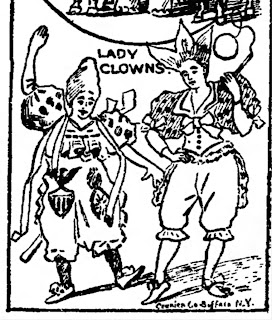
From a Barnum & Bailey 1896 Newspaper Advertisement – the online source is here
By June she is appearing in New Haven where the local paper is intrigued by the fact that the New Woman has invaded the circus as Barnum and Bailey’s latest novelty is a woman clown.
The newest woman with the circus is the female clown, Evetta on the bills, Miss Matthews in private life, a plump young English woman whom Mr Bailey’s agent found in London and persuaded to come to America. Miss Mathews is an acrobat and she indulges in odd antics and burlesque feats of skill, as well as in the pantomime and knockabout tricks of circus clowns. She has proved a great favourite with audiences in New York City.
Performing with her was a female ringmaster Pauline Newsome who cracks her whip ‘just like a man,’ and the equestrienne Jessie Ashton (New Haven Morning Journal and Courier, 5 June 1896 p 3.) Barnum and Bailey were making the most of the oddity of these female performers by promoting the unusual quality of their sex as a draw.
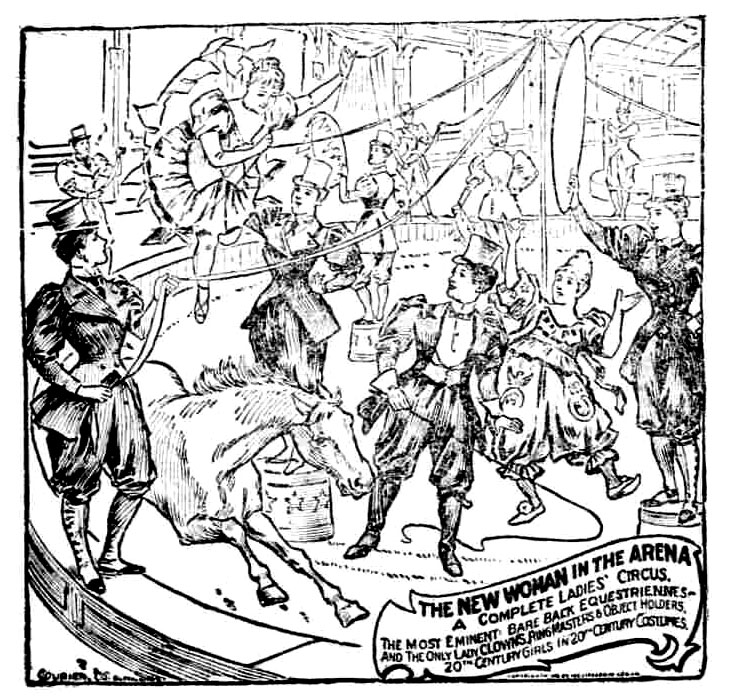
Back in Britain, Barnum & Bailey’s Greatest Show on Earth was on Midsummer Common for one day, 8 September 1898. There is Evetta, in the Show’s advertisement on page 4 of the Cambridge Independent Press six days before but unnamed either in the advertisement or in the Cambridge Chronicle’s review (9 September 1898, p 8).
Finally, in 1899 she is appearing as Josephine Mathews once more at the Marina Theatre of Varieties, Ramsgate (The Era, 2 September 1899, p 23) – but that seems to be that, as we have found no further mention of her online.
Family background
Josephine had certainly come from a theatrical family. Turner lists her mother, Mrs Lauretta Matthews, a tight rope walker and dancer and equestrian actress. Born Caroline Lauretta Tanner in 1834, she worked for her father who was a portable-theatre proprietor, and crossed Clifton Gorge on a tightrope, and was the first woman to play the lead role in the hippodrama Mazeppa. She married Billy Matthews in 1851 (Turner, 1995, p 89).
William Frederick Matthews, described by Turner as ‘clown, gymnast and leaper, later ringmaster,’ performed in many circuses, including Sanger’s. He joined Barnum & Bailey’s in the USA in 1871–2 and later toured world-wide, before returning to British circuses and theatres, and dying in Essex in 1915 (Turner, 1995, p 89).
Although Turner has no entry for Evetta, her eldest sibling, Laurina, has an entry in volume two, as an equestrienne and gymnast, subsequently becoming a member of the Matthews Troupe, described in New York in 1873 as England’s most famous gymnasts (Turner, 2000, p 75).
Josephine appears in the 1881 census aged 13 years. The family are at 4 Blenheim Terrace, in Brighton. As well as mother and father there are nine siblings listed, and a niece. Josephine is listed as being born in Scotland and, like her brothers and sisters, is an ‘acrobat’.
Modern research
Recent growth in feminist and women’s studies has thrown more light and interpretations on Evetta when it comes to women in the circus.
Adams and Keane, in chapter 12 of Women of the American circus, saw Evetta’s ‘choice of clowning as tied to women’s emancipation’ and ‘brand new’ when she first appeared at Barnum & Bailey’s in 1895. ‘As a feminist clown in 1895, Mathews appeared as part of the New Woman circus constructed by Barnum as a special ring and attraction.’ The newspapers see her as ‘a satirist of traditional mores, but the one and only, an anomaly, not a participant in any sort of trend.’ Her act presents her as a ‘surprisingly aggressive New Woman.’ The authors also note the restrictions that Bailey placed on her performances. Evetta describes how she is not allowed to tumble and somersault like the male clowns, actions of which Bailey disapproved (Adams and Keane, 2012, p 185–186).
Jacqueline Russell, in her 2020 MA thesis Feminist clowning, has a section devoted to Evetta (pages 26-31). ‘Despite the growing number of female circus clowns and the widespread effects of the New Woman Movement, Mathews’ contributions to this popular phenomenon were often dismissed.’ She comments on the restrictions imposed by circus owners: ‘Mathews was an accomplished acrobat and contortionist, but James Bailey would not allow her to do either in the ring.’
Russell reproduces two of the photographs of French photographer Emil Constant Puyo, taken around 1895. ‘Given the artistic focus of Puyo, it can be inferred that these images are not circus publicity photos but rather an exploration of Mathews’ clown in a form where “[w]omen were posed with flowers or in idyllic landscapes . . . whose images often sought to create a feminised ideal”’.
Russell sees the doll-like figure in the photos as ‘conjuring iconic scenes of domesticity and motherhood. Against a canvas backdrop that evokes the backstage of a circus tent, Mathews appears in a stripped-down version of her clown costume with no discernible face makeup. In a juxtaposition of the feminine ideal found in most of the photos, one photo shows Mathews lying on her stomach on a bearskin rug, gleefully blowing cigarette smoke into the face of the doll-child.’ This is interpreted as both ‘embracing and rejecting cultural norms of femininity’ (Russell, 2020, p 26-31).
In Send in the clowness, MacMahan and Senelick see Evetta’s costume as derived from the Columbine costume that she would have seen when performing in Paris. ‘Judging from posters and photographs one finds that Evetta Mathews, who had spent two years at the Paris Hippodrome, adopted that as her clown costume with a minimum of makeup and with baggy pantaloons in lieu of tutu.’
With regard to Evetta’s act of disguising herself in the audience before revealing her clown identity, they describe her as
provoking embarrassment in the male spectator by pretending to be his sweetheart, she is loud, intrusive, outspoken, and forward in her pretentions. In the act the clown does not hide her gender but behaves as the traditional unruly woman to create mayhem by pressuring her two male targets: the ringmaster (who is in on the bit) and her beau in the audience (who is not).
(MacMahan and Senelick, 2023, p 33-34)
Bibliography
Adams, Katherine H., Keane Michael L. Women of the American circus. McFarland, 2012.
MacMahan, Matthew and Senelick, Laurence. Send in the clowness: the problematic origins of female circus clowns. Theatre Survey, 2023. 64. 24-48.
Puyo, Emile-Constant. The photographs of Evetta may be found here (Accessed 7 May 2024).
Russell, Jacqueline. Feminist clowning: serious pleasures and strategic possibilities. University of Calgary, Alberta, Canada. MA Thesis, July 2020.
 William Tudor's Circus