GONE, BUT NOT FOREVER.
The departure of Mr. Tudor and his company of artistes from Blyth on Sunday last drew together a very large number of spectators at the Railway Station, including most of those who had almost become personal friends of either the clowns or the riders, not forgetting Mr. Tudor and his manager, Mr. Pearce Butler. The most interesting item in the departure was to witness the putting of the horses into the travelling padded railway boxes, which are specially fit up for the conveyance of horses of more than ordinary value.
The antics of the wise animals were quite enjoyable, and one or two had to be escorted into the travelling stable blind-folded. The special train of nine carriages left in the morning about 10, and after the shaking of hands the train steamed out of the station, and the circus passengers were soon lost to view, as were their gaily bordered handkerchiefs that were being wafted from the windows.
They arrived at Cambridge the same evening about seven, and on the Monday opened to a crowded house of the fashionable elite of the students’ knowledge ground. On Saturday evening at Blyth the circus was crowded, it being the last night, and at the close of the performance the manager, Mr. Butler, appeared on behalf of Mr. Tudor, and expressed his thanks for the generous patronage of the Blyth people during a season that had been most tempting for everything outdoor instead of indoor.
Mr. Tudor will return to Blyth about the latter part of July, 1894, during which the Blyth circus will be closed and not be run as an opposition ‘show’ to the Blyth theatre. This is generous.
Morpeth Herald, 8 July 1893, page 3.
There cannot have been many direct trains from Blyth to Cambridge over the years, let alone one with a complement of horses and clowns. Sadly, the Cambridge press do not appear to have emulated the Morpeth Herald and gone out on a Sunday evening to provide us with an account of the arrival.
William Tudor’s return to Butt Green
Two years earlier, in February 1891, William made an unsuccessful application to rent a spot for a wooden circus on Butt Green during July, August, and September. An application from his old colleague and partner Charlie Keith, despite the latter’s combative relationship with the Cambridge authorities, was accepted instead (Cambridge Independent Press, 21 February 1891, p 5).
We do not know if Tudor tried again in 1892 but if he did, Keith prevailed once more. However, early in 1893 Cambridge Borough Council reported receiving an application
from a Mr. W. Tudor, of the New Circus, South Shields, for the hire of a portion of Midsummer Common for the purpose of erecting a circus thereon, and beg to recommend that a portion of such common be let to Mr. Tudor from 19th of June to the 30th of September (both inclusive), at a rent of £10 per week, payable in advance; that no other circus be permitted to occupy any portion of the Common for a longer period than two days previous to the 19th of June next; and, further that, a deposit of £20 be paid by him on the acceptance of the above terms.
(CCJ, 3 February 1893, p 7)
The memorandum of agreement (Cambridgeshire Archives CB/2/CL/17/14/Page 117) between Tudor and the Borough required him to make good any damage to the common at the end of the tenancy. The Borough would own any manure or dung left behind.
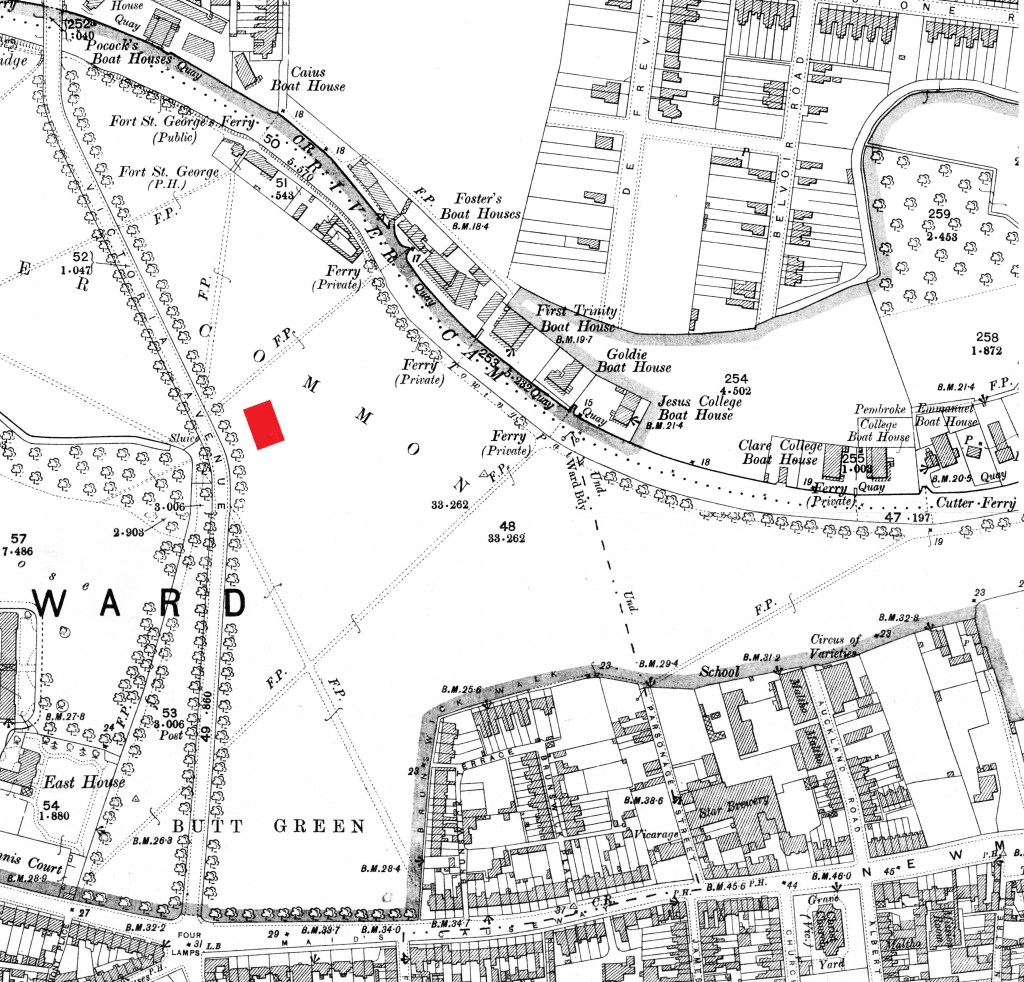
Butt Green and Midsummer Common, surveyed in 1901, with Charlie Keith’s temporary 1892 building shown in red next to the bend in Victoria Avenue. Tudor’s 1893 building was ‘near the corner of Jesus Grove,’ which we take to refer to the same position and we assume the same location in 1895. There is evidence that the buildings of 1888 (Keith & Tudor), 1890 and 1891 (Keith), were much further south and possibly west of the line of Victoria Avenue, which opened in 1890. Tudor’s permanent building of 1896, here in its second guise as the Circus of Varieties, is shown next to the common at the north end of Auckland Road.
Four months later William Tudor advertised in the Cambridge Daily News, asking for tenders for ‘the supplying and creation of all gas fittings, paper hanging, painting &c for Tudor’s New Circus’ (CDN, 14 June 1893, p 2). Despite still being at his circus in Blyth, Northumberland, William must have been confident that the building would be completed promptly, as advertisements appeared in the Cambridge press just two weeks later for the Grand Opening Night on July 3rd 1893, with his motto being ‘Novelties, Variety and Refinement’ (CDN, 28 June 1893, p 2).
July 1893: a Grand Opening featuring Onzalo, Demon of the Air, and other turns and novelties
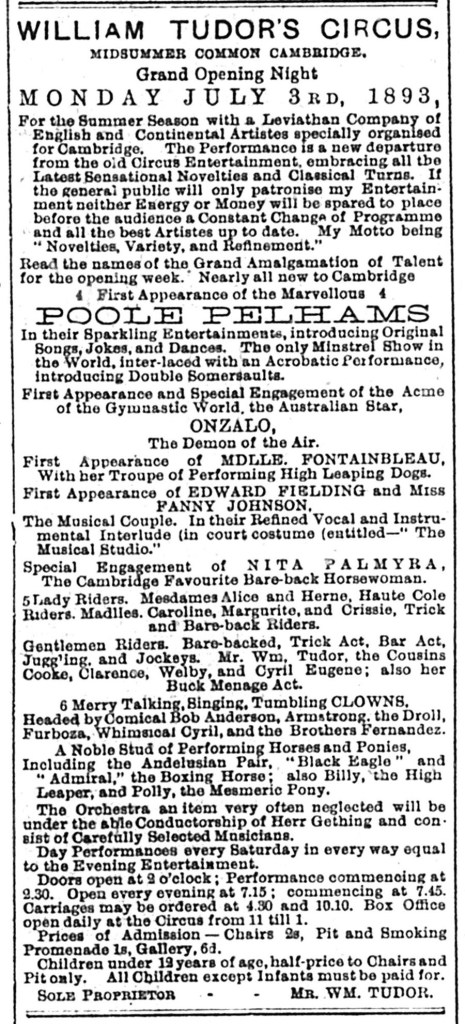
The Cambridge Independent Press approved the fact that ‘Mr Tudor has recently been at Blyth, and other Northern towns, and has had a very successful time’ (CIP, 30 June 1893, p 8).
The audience came, the first reviews were enthusiastic, describing the wooden building as ‘commodious and comfortable’, the circus well managed, and reporting that ‘all went merrily from first to last’ (CDN, 4 July 1893, p 2), with dancers, vocalists, acrobats, performing dogs and horizontal bar performers all praised. There were three separate equestrian acts – Mdlle Caroline, Mdlle Fontainbleau and Mdlle Nita Palmyra – as well as Mr Tudor’s two performing horses, Admiral the boxing horse and Black Eagle. For the Cambridge Express, Mr Tudor was ‘an old friend of the Cambridge public’ and had ‘brought with him enough of old favourites of the ring, and a sufficient number of new ones, to make the success of his performances pretty well assured’ (CE, 8 July 1893, p 8).
The Cambridge Chronicle also approved: ‘The building, which is situated near the corner of Jesus Grove, is well built of wood and has a comfortable appearance inside.’ The importance of the musical accompaniment was not forgotten as ‘the small string band, which executes selections of music in a fine style, under the direction of Herr Gething’ was also complimented (CCJ, 7 July 1893, p 4).
The Cambridge Independent Press reviewer was particularly taken with Mademoiselle Alice Fontainbleau’s ‘very clever manège [dressage] with her horse Mornington’, but it was her marvellously trained, four canine wonders that really caught the attention:
Two of them first dance round and round upon their hind legs, and then the terrier jumps over two hurdles, nearly a foot high, all the while remaining on two legs only. A French poodle stands on a cylinder, which the terrier pushes with its front leg; but it has to do the return journey pushing the cylinder with its hind legs. Finally three of the dogs have to jump over a couple of hurdles, and then over a gate from about eight feet to ten feet high
CIP, 7 July 1893, p 5
Alice Fontainbleau was a slack-wire balancer, juggler, and performing dog trainer. She toured widely in the 1880s and 1890s, appearing for the Cooke family and for other circus proprietors, including Boswell, Croueste, Ginnett, and our old friend Charlie Keith. On page 21 of the Era, 23 December 1882, she announced that she ‘would purchase [a] good Rolling Globe’, on which she soon became highly proficient. In the 1890s she further expanded her repertoire to include dressage.
Two years after appearing for Tudor she was seen at Ginnett’s Circus in Ambleside by Beatrix Potter, who wrote in her Journal on 24 August 1895:
The scornful Madame Ansonia was arrayed in blue and silver, and, alighting from her piebald, put on galoshes publicly in the ring. The fair-haired enchantress did not appear [again?] unless indeed she had shrivelled into Madame Fontainebleau, who displayed her remarkable dogs in an anxious cockney accent, and twinkled about in high-heeled French boots and chilly apparel. Tights do not shock me in a tent associated with damp grass, they suggest nothing less prosaic than rheumatics and a painfully drudging life.
(Linder, 1989, p 397)
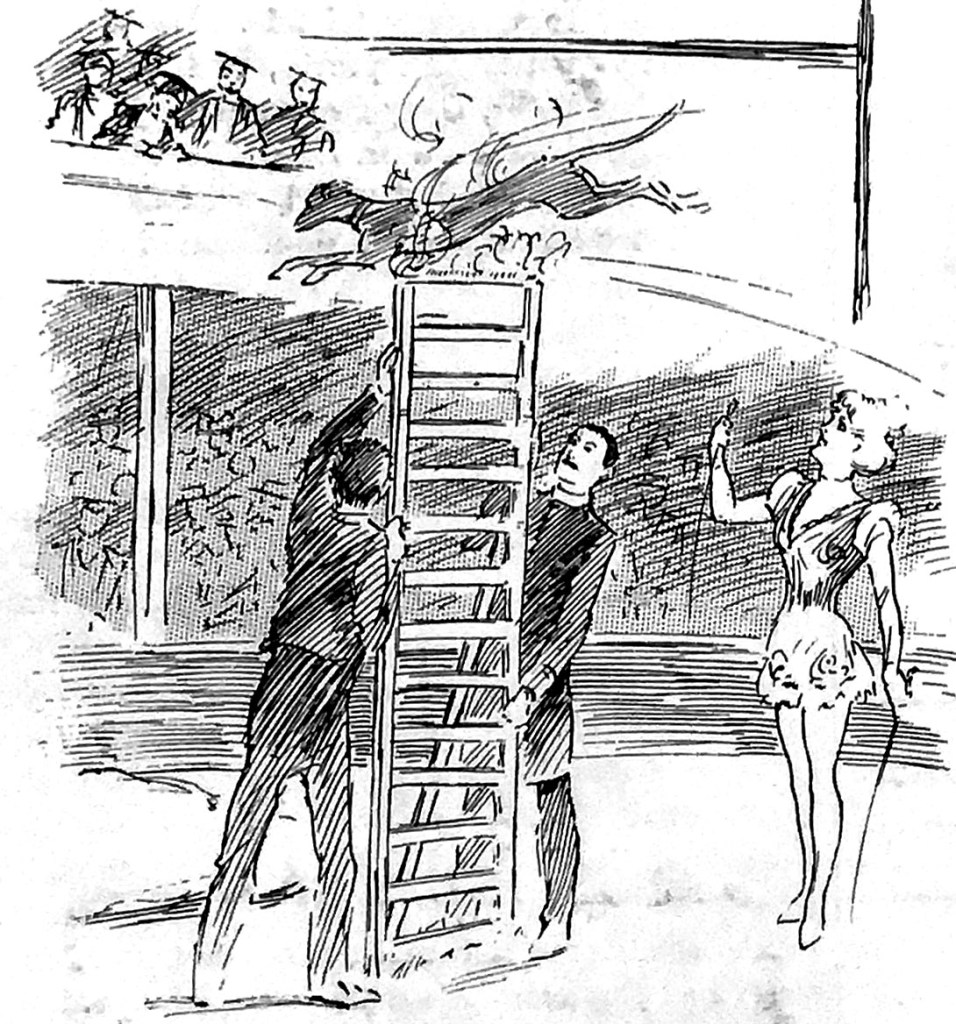
Madame Fontainbleau, whose performing dogs were a feature of the opening programme in 1893, drawn when she returned to Auckland Road in 1900. (Talbot W Ellison, Cambridge Graphic, 9 June 1900, p 14)
The acrobat Onzalo, The Demon of the Air, whose real name was the more prosaic William Biddle, also impressed, flying through the air in a clever, daring and sensational manner. The evening’s performance finished with the American Riding Machine in which circus riding skills are demonstrated with the aid of a harness and rope which can (safely) suspend the rider in the air above the moving horse. Two local boys were selected from the audience, and their attempts to stay on horseback caused great amusement.
By 15 July William Tudor could claim his circus was the talk of the town (CE, 15 July 1893, p 2). There had been some poor houses but by the end of the week there was a large, enthusiastic audience. Performances began at 8 pm to make the most of the long evenings.
Nita Palmyra, an old Cambridge favourite, was a brilliant and daring equestrienne who specialised in trotting and hurdle acts on a bareback horse. She had performed with Hengler’s Circus in Liverpool, Whitmee’s Circus in Oxford, at Charlie Keith’s circus in Cambridge in 1890 and in 1891, when her husband was ringmaster (Turner, 2000) and co-proprietor, so she was no stranger to Midsummer Common. For the reviewers she was ‘Far and away the most clever and accomplished equestrienne that has ever received the plaudits of the Cambridge audience’ (CDN, 11 July 1893, p 2), as she performed her ‘daring leaping act over hurdles and gates with a barebacked horse about the speed of which there can be no mistake’ (CE, 15 July, 1893, p 8).
Acts were often retained for two weeks, though each new week would see a change in the programme. But there was always a stock company, particularly the equestrians and clowns, who remained throughout the season and helped out in many roles. Circus performers would be called on to assist with tasks in the performances and needed a variety of skills. On the indisposition of rolling globe performer Mademoiselle Alice, William Tudor himself donned a dress and successfully deputized for her, as ‘he walked, ran, balanced and juggled as though to the manner born, and was received with great applause’ (CE, 15 July 1893, p 8).
But Alice soon recovered enough to perform ‘splendid manoeuvres on the rolling globe’ (CDN, 18 July 1893, p 2). A week later she was leading ‘a splendid troupe of leaping and performing dogs’ (CE, 25 July 1893, p 3). By 21 July the CIP could state that the circus was well established, and singles out Alice in particular: ‘While on the top of a large globe, she rolls it over various obstacles of considerable height without dismounting, then goes up and down and balances a high seesaw’ (CIP, 28 July 1893, p 8).
As one would expect, the staple circus acts of acrobats, jugglers and trapeze or wire artists were always on the programme. An expensive engagement, according to the Circus advertisements, was of the sensational acrobats, La Troupe Fretelli, direct from Paris, who turned double and single somersaults from head to head. On the same bill was Wallacini, or Ben Hadsi, who appeared twice nightly, once as Wallacini, leaping backwards from a pyramid of tables, and then as the Arab Whirlwind somersaulting backwards around the ring four times with amazing rapidity (CDN, 11 July 1893, p 2). The audience must have left with their heads whirling after all the tumbling, somersaulting and reverse flips.
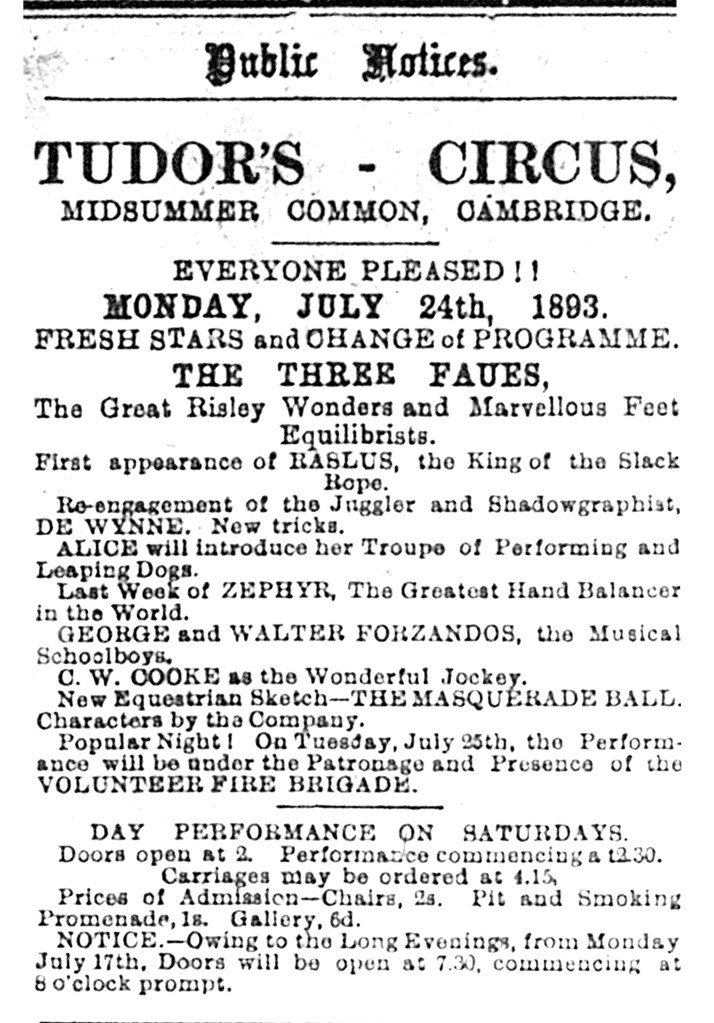
On July 17th the marvellous male and female trapeze artists, the Flying Stellios, were announced who, despite their exotic name, were all from the Holloway family and had previously appeared in Cambridge for Charlie Keith. Their acrobatic feats received a deserved ovation as they walked upside down and backwards from nine suspended rings, holding on only by their feet. Two performers who often appeared together on the same bill, Zephyr the hand balancer and Professor De Wynne, a previous performer with Charlie Keith in Bedford in 1892, who juggled and also did shadowgraphic manipulations with his hands, were much appreciated. In late July and early August the appearance of the Three Faues, ‘The Great Risley Wonders and Marvellous Feet Equilibrists’ was announced (CDN, 24 July 1893, p 2).
Into August: a lady clown, a man fish, and a Cambridge heatwave
In the Risley balancing act of the Faues one acrobat lies on their back and juggles, spins and tosses objects, or people, in the air with their feet.
The eldest of the three lies in a reaching position and throws the other two about with his feet in the most alarming and grotesque manner, some of the most unimaginable positions being maintained. Finishing up with some remarkable double somersaults from the feet of the eldest, they were so enthusiastically applauded that they were obliged to re-appear.
(CDN, 25 July 1893, p 3)
These well-known acrobats were to return in 1897 and again in 1898.
The CDN reviewer on 8 August, was much taken by the flying trapeze exhibition of the Flying Fitzroys, returning to Cambridge from the previous year, ‘two pretty young ladies of wonderful agility and intrepidity, and their performance is extremely graceful and sensational. Their thrilling flights through the air are executed with such precision and beauty of action that the audience watched the two in bewilderment’ (CDN 08 August 1893, p 2). Adeline Martha Munday and Lily Munday were sisters who performed together on the rope and the flying trapeze. After Adeline‘s marriage Lily continued to perform with her brother Fred (who was to marry Charlie Keith’s daughter) and then solo, and she was still performing in 1937.
Women had appeared as performers in fairs from medieval times. Unusually, William Tudor advertised Josephine, a ‘lady clown and wire walker’ (CE, 12 August 1893, p 1). This rare act caused much interest as ‘Mr Tudor has provided a novelty in the shape of a lady clown, who does some very good business’ (CDN, 15th August 1893, p 3). The Cambridge Express reviewer was even more enthused as he said ‘Josephine, the female clown, greatly pleased with her tumbling and lively sallies’ (CE 19 August 1893, p 8).
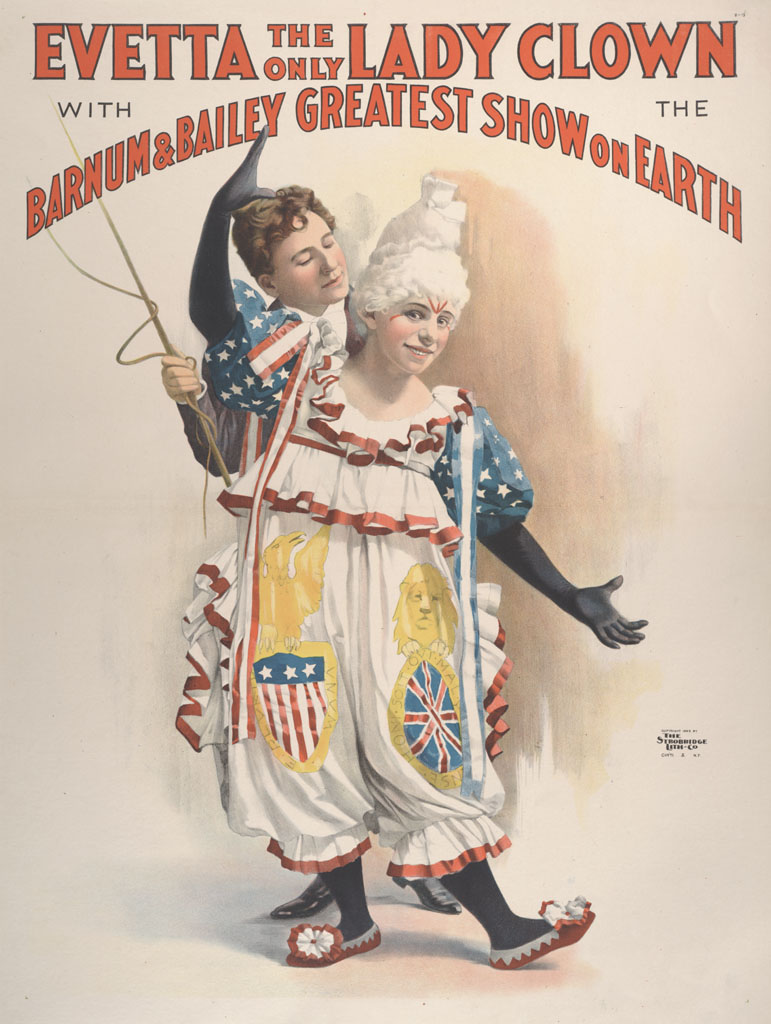
‘I believe that a woman can do anything in life that a man can do, and do it as well as a man.’
She was Josephine Mathews, or Josephine Williams, known as Evetta, the Lady Clown, who went on to be quite a sensation in the USA with Barnum and Bailey. On the same bill in Cambridge were ‘the two Sisters MATHEWS, Comical Knock-about Song and Dance Artistes’ (CDN, 14 August 1893, p 2), who were almost certainly Josephine’s sisters, or possibly Josephine and one sister, as she came from a prodigious circus family. Our CDN reviewer thought that these ‘knockabout song and dance artistes, created a good impression by their singing and dancing, the latter being particularly good’ (CDN, 15 August 1893, p 3). A week later Josephine had become ‘quite a favourite’ with the Cambridge crowd as she gave ‘a very pleasing performance on the telegraph wire, but eclipsed herself in her next entrée by a cleverly-executed serpentine dance’ which ‘fairly brought down the house’ so much so that she ‘had to bow her acknowledgments several times’ (CDN 22 August 1893, p 2). For more information on this unique young woman see Evetta the Lady Clown.
As summer progressed, Cambridge people and groups flocked to the circus on the Common and certain performances would be billed under the patronage of local bodies. On Thursday 20th July Volunteer Night was under the patronage of Lieut-Col. Fawcett and officers of the 3rd Cambridgeshire Volunteer Battalion, of the Suffolk Regiment. On August 2nd there was a Grand Cycle night under the patronage and presence of the Cambridge Bicycle Clubs. Wednesday 16th August was announced as the Grand Cricket Night, under the patronage of the Cambridge and Oxford County Eleven and local cricket clubs.
By 14 August Tudor could claim his circus was ‘in the full flood of success’ (CDN, 14 August 1893, p 3). Despite an evening performance each day and a matinee on Saturday afternoon, its popularity meant that ‘on Monday a very large number of people were unable to obtain admission, and as some who were present could not get a view of the performances owing to the crowded state of the building, Mr Tudor very liberally gave them passes for another evening’ (CE, 12 August 1893, p 8). Well could he claim it to be the ‘Successful Home of Harmless Amusement.’
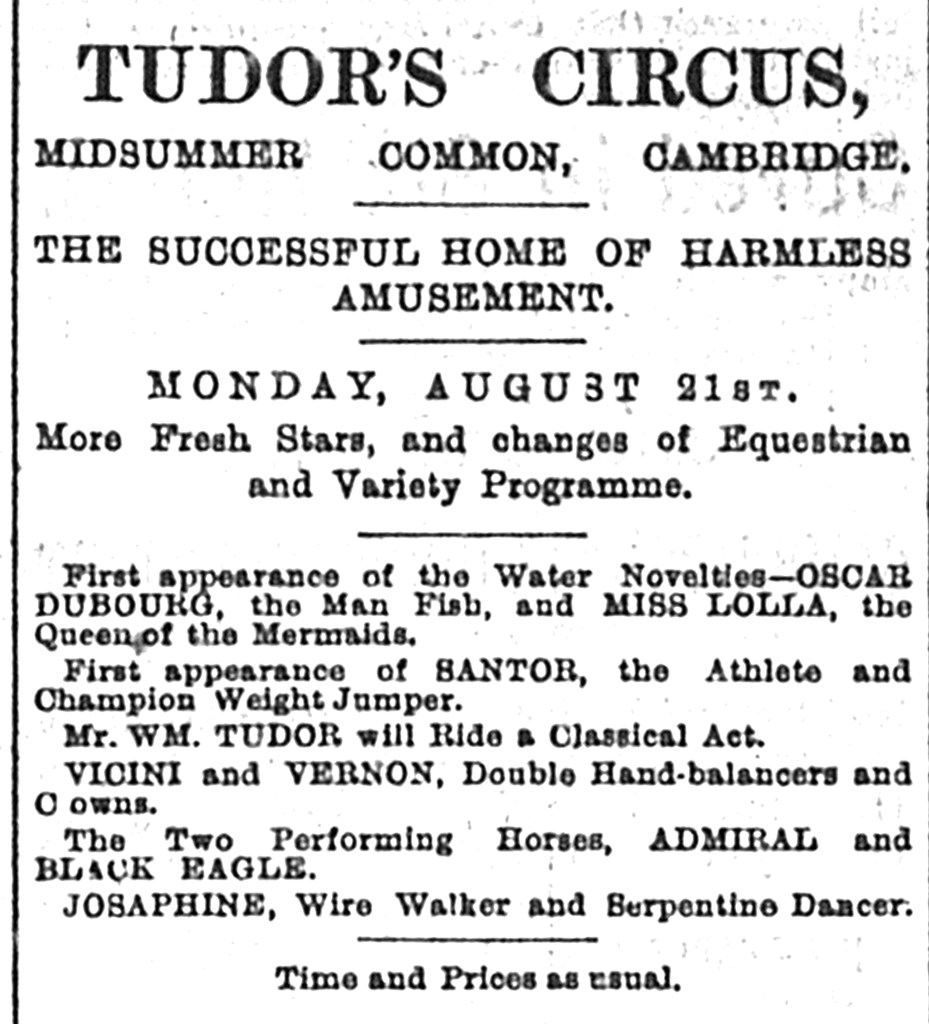
Mid-August was remarkable for a stretch of intensely hot weather in Cambridgeshire, with athletics and cricket matches affected, one cricket player suffering heatstroke. Advice on light clothing (drill and holland cloth) and advertisements for cooling drinks appeared in the local press. The week of 18 August was fearfully hot, with the temperature at 88 degrees (31 centigrade) in the shade. There were reports of plagues of wasps and even extra deaths. However, the corn harvest, swimming matches at the Bathing Sheds at Sheep’s Green and Tudor’s Circus seemed to do well in the tropical heat. Despite the parching weather the CDN reported that ‘The circus is so well ventilated that the intense heat is no drawback to the enjoyment’ (CDN, 15 August 1893, p 3).
The Thriblis (athletic staircase experts), Josephine the lady clown, The Flying Fitzroys and Kingsley, the royal handbell soloist, must have been a big draw. The Cambridge Express reviewer applauded William Kingsley’s ‘artistic and expert solo performances on a complete set of handbells’ (CE, 12 August 1893, p 8). He was to return to Cambridge in 1897 and was still performing in the UK in 1913. Professor Quickman’s clever whistling imitations of birds proved very popular, but all the reviewers’ greatest praise was for Monsieur de Saurin, the strong man with an iron jaw. He received a liberal recognition from the audience for the prodigious feats of ‘drawing a long nail with his teeth from a 2-inch plank through which it has been driven, lifting a barrel containing 36 gallons of water’ [according to the announcement] ‘from the floor of the ring to a table, lifting the barrel, with two men upon it, clear of the table, in each case with his teeth, and twisting a horseshoe in two’ (CE, 12 August 1893, p 8).
However, the major stars of Tudor’s circus were the horses. On 18 August William Tudor appeared with another of his horses, Polly the mesmeric Pony, who could do everything but speak. A few days later he was in a daring double act on horseback with Miss Chrissie, and he then demonstrated the skills of his Andalusian horses Admiral and Black Eagle. Further equine skills were shown by the riders Cyril E Cooke and Clarence Welby Cooke with their horses leaping the double hurdle and gate, and Clarence leaping over four horses at once.
Clarence Welby Cooke, who had been one of the stock company all season as both equestrian and clown, was part of the large and extended Cooke circus family, sometimes appearing in a double act on horseback with his sister Alice. Their father, Harry Welby Cooke, had run the Cooke Brothers’ Circus in Scotland and the north of England, with his cousin Alfred Eugene Godolphin Cooke, who was Cyril Cooke’s father. Much earlier in his career, William Tudor had toured on the Continent with Clarence Welby Cooke and performed together in the UK (Morpeth Herald & Reporter, 4 June 1892, p 3).
Not just a horse-rider, on 18 August C W Cooke delighted the Chronicle reviewer with his comic turn as Little Tommy in the humorous sketch Mr and Mrs Brown in their Visit to the Circus. He ‘is apparelled in a clean pinafore for the occasion and whose enormous sugar-stick acts as a balm for all ills, is, together with Armstrong, the clown, irresistibly laughable, and the sketch is one of the chief attractions of the evening’ (CCJ, 18 August 1893, p 4).
Mademoiselle Caroline continued to entertain with her ‘flights of fancy’ on horseback (CDN, 22 August 1893, p 2). Then a grand equestrian piece, Steeplechase and Harvest Home, was advertised, and the audience were invited to a ‘TROTTING MATCH ROUND THE RING for Local Horses, Cobs and Ponies’ on 1 September (CE, 26 August 1893, p 1). The winner of the timed trot ten times around the ring would win a handsome electro-silver cup. The Harvest Home was a rural scene complete with a maypole and was followed by a steeplechase around the ring, finishing up with a water jump, ‘made very laughable by the flounderings in the water of a policeman and a thief, whom he was trying to arrest’ (CIP, 1 September 1893, p 8).
But before then the audience was treated to the appearance of Oscar Dubourg the Man Fish and Lolla the Mermaid on 21 August.
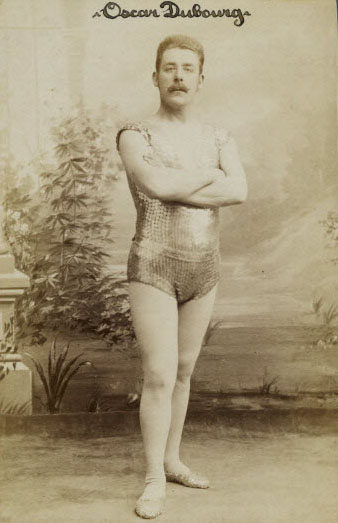
Oscar Dubourg the Man Fish ((C) RMN-Grand Palais (MuCEM) / Franck Raux
Museum of European and Mediterranean Civilisations http://www.mucem.org)
This novel aquatic entertainment took place in a glass tank full of water. ‘Dubourg justifies his name, “Man Fish”, by the swiftness of his movements, and the alacrity with which he glides between the supports of a chair. In addition to this he eats, drinks and even smokes while under water, while Lolla picks up over 100 coins from the bottom of the tank’ (CE, 26 August 1893, p 8). The CDN is even more enthusiastic, praising Lolla, also known as the Water Queen, for ‘picking up eggs, and 115 coins, from the bottom of a tank, while peeling an apple, and staying under water for considerably over two minutes’, and Dubourg and Lolla for playing cards together, all while submerged (CDN 22 August 1893, p 2).
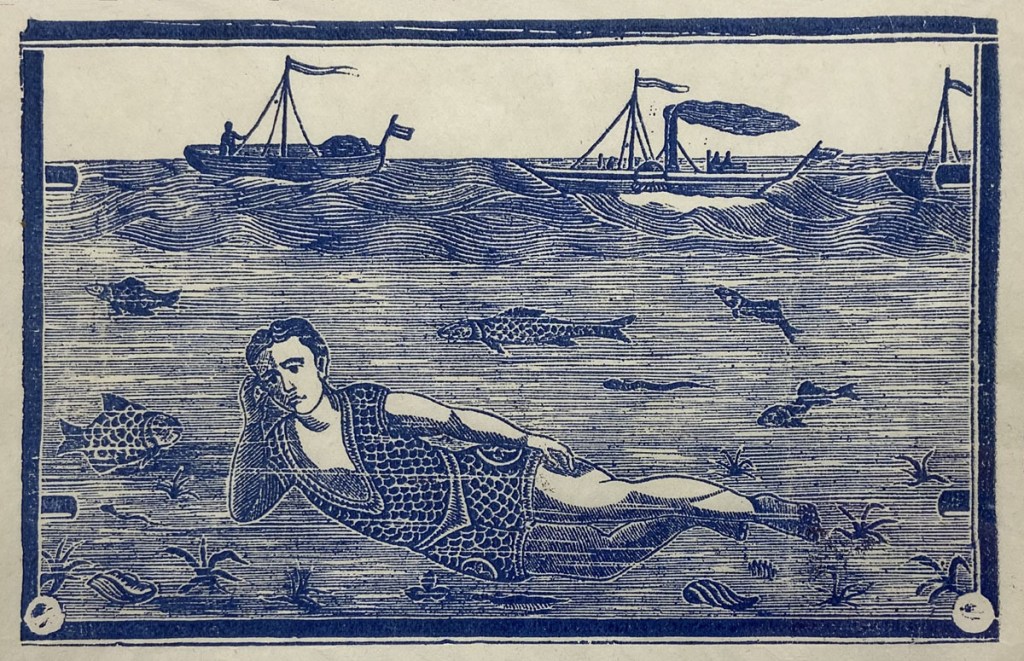
This fanciful illustration is from a poster for the Prince of Wales Theatre, Birkenhead, week-beginning 28 December 1885, when Oscar Dubourg and Little Jim the Boy Frog were at the top of the bill (Courtesy of the University of Sheffield Library, National Fairground & Circus Archive)
Dubourg is recorded in provincial newspapers performing in a number of music halls and theatres from 1872, sometimes solo but frequently with Lolla or with Little Jim the Boy Frog. In January 1887 he wrote to the entertainers’ trade newspaper The Era to deny that he had been in any danger when ‘rescued’ from his tank on 30 December 1886 by a concerned audience member at the Gaiety Music Hall in Sheffield. That incident had been reported widely in the press.
September: season’s end, Dick Turpin’s Ride to York, and farewell to Tudor
The programme change for early September introduced the pantomime roller-skaters Hess and Lisbon, Little Merry Frisco, the singing clown, who continued to perform in circuses as late as 1919, and Master Charles, the ‘Midget Paganini’ who ‘caused some amusement by his ungovernable temper, which culminated in his breaking a violin and playing a solo on a broom-stick’ (CCJ, 08 August 1893, p 8). But the biggest draw was the performance of the hippodrama Dick Turpin, which was billed to start performances on 4 September and played nightly to tremendous applause, particularly for the well-trained horse.
This kind of ‘curious dramatic hybrid, the hippodrama’ (Speaight, 1980. p 38) was a popular entertainment staple for circuses in the 19th century. Horses not only featured but were considered important actors in the narrative. For more on this strange and wildly popular drama and the crowd-drawing Dick Turpin click here.
William Tudor was foremost an equestrian and hippodramas could display the skills of his horses and performers while providing exciting and/or amusing entertainment. On 11 July Miss Nita Palmyra was advertised as appearing as Joan of Arc in ‘a historical descriptive scena on horseback in which the lady is seen to great advantage’ (CDN, 11 July 1893, p 3). The hippodramas continued when the entire company took part in a ‘splendid finale’ entitled The Riggs of Mr Biggs as a conclusion to the next week’s performance. The CDN reviewer called it ‘a capital equestrian piece, (taken from sketches in Punch, by the late Thomas Leach)’ (CDN, 18 July 1893, p 2).
At the end of July there was another new equestrian sketch, The Masquerade Ball (CDN, 14 July 1893, p 2), not mentioned by the reviewers. And during the Bank Holiday week there was a ‘Sensational and Comic Equestrian Piece Fra Diavolo, or The Englishman’s Adventures among the Brigands’ (CDN, 7 August 1893, p 2). The Cambridge Chronicle reported on ‘a very sensational and comic equestrian piece ‘in which almost the whole of the company take part, not excepting Mr Pearce Butler, the popular ringmaster, who in his part of the English gentleman, excites much enthusiasm and applause. Mr Tudor, as the chief of the Brigands, is also warmly received’ (CCJ, 11 August 1893, p 4).
Early September saw Dick Turpin’s Ride to York enacted and this became a staple end-of-season entertainment. Written by Henry M. Milner, the plot followed Turpin’s escape with his horse Black Bess jumping the Hornsey Toll Gate, then galloping to York, where the steed begins to slow and stumble, and finally ‘Black Bess, dies beneath him at a crossroads’ (Barnes, 2015, p 55). She remains lying still until, in some versions the horse is carried out on a board on the shoulders of the cast or audience members.
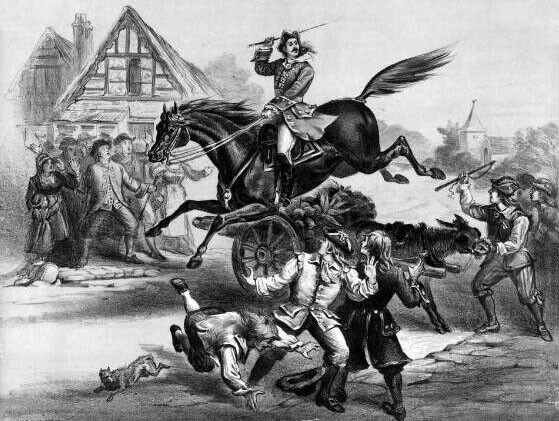
Turpin’s Ride to York (Victoria & Albert Museum)
The CDN reviewer describes this ‘great feature’ in detail.
To witness this ever popular display there was a bumping house. Mr Tudor’s Dick Turpin is well acted, and better still is the wonderful docility and intelligence of ‘Black Bess’. Mr J. Pearce Butler is a dashing, devil-may-care Tom King. Mr Bucknall, as the ‘first beadle’, is an ideal representative of Bumbledom, whilst ‘Sammy, his son’, in the person of Bob Anderson, is indescribably funny. The other characters are well sustained. The best scene is the death of ‘Black Bess’, which should be witnessed by all who wish to see the perfection of horse training.
(CDN, 5 September 1893, p 3)
The CE reviewer writes that ‘The piece has been performed nightly, and has been received with tremendous applause. The fine horse which Mr Tudor introduced in the sketch is a masterpiece in training’ (CE, 9 September 1893, p 8).
Similar equine scenes earlier in 1893 had seen Madamemoiselle Caroline and Mr Cyril Cooke in The Swiss Lovers on Horseback, and then the comic entertainment of The Steeplechase and Harvest Home, all on the programme of the last week of August. A ‘grand equestrian’ and ‘fairy pantomime’ of Cinderella, was to follow from mid-September 1893, using 100 singing and dancing local children, continuing the use of drama and spectacle. The CIP thought Cinderella a great success, with the local children well-trained and taking a keen delight in the pantomime. But for Cinderella the cast of characters is surprisingly wide. ‘The part of Cinderella is capitally played by Miss Herne, and Miss Crissie played the Prince well. Minnie Whitehead looks well as Britannia. Little Napoleon (Thomas Newman) is a great success, and is the centre of great interest in his impersonation of the famous emperor-general. Albert Evans as John Bull is very good, and Kate Rice as Mrs Bull makes a nice little partner. Maud Burton makes a pretty little Mary Queen of Scots, and James Yerrill plays the part of the Emperor of China very well’ (CIP, 15 September 1893, p 7).
As the season drew to a close even more varied acts appeared with W Salmon, the world’s demon trick and musical bicyclist, who ‘astonished the audience with his tricks on a bicycle’ (CCJ, 8 September 1893, p 8).
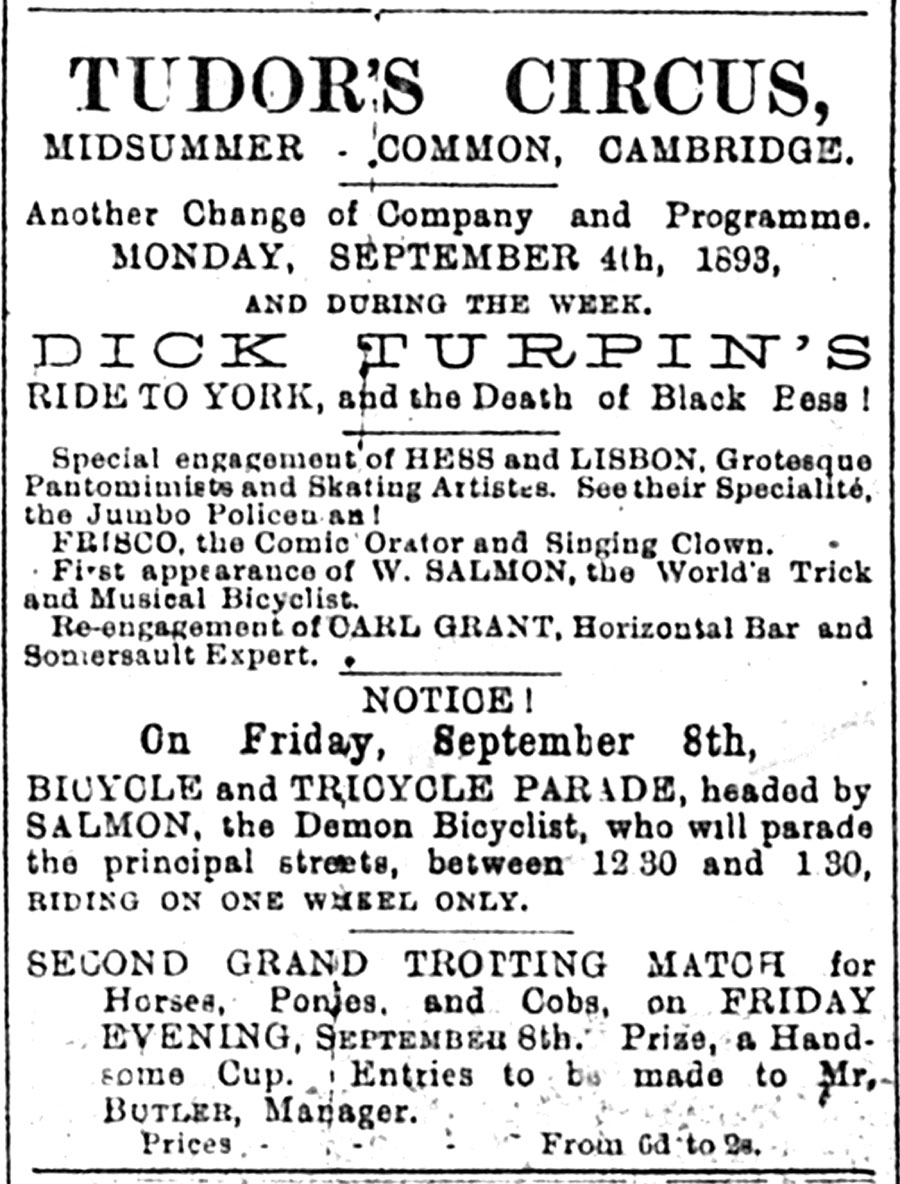
There was a shooting entertainment by Cowboy Carl and Little Red Feather (CCJ, 12 September 1893, p 3) and roller skating by Hess and Lisbon. Miss Patta Bella did impersonations of music hall artistes and J W Cardownie performed his national dances from other countries. Further cycling skills followed with the Royal Silvani Troupe of Lady and Gentlemen Bicyclists. The ‘marvellous dexterity’ of the seven bicyclists (CDN 19 September 1893, p 2), may have been the inspiration for a cycling contest on 21 September for locals, again ten times round the ring for a cup. The Silvanis, originally from Birmingham, were still performing in the 1890s but by then there were only four lady cyclists in the troupe.
On 20 September the doors opened early for a carnival night which opened with the ascent of two balloons, eighteen feet in diameter, that rose above the circus building. The performers included the return of the Three Faues, champion big boot dancers, singers, acrobats, clog dancers, a football dribbling competition (three times round the ring), a missing word competition and a guess the number in the audience competition (1,400 won by Mr F Catchpole of 59 Sidney Street). On 22 September Tudor began advertising the final two weeks of the season.
In September the CIP noted the kindness of Mr Tudor who had invited the children of the Chesterton Workhouse to the circus ‘and had distributed buns and apples to the little ones’ (CIP, 8 September 1893, p 8). The Board of Guardians of the Workhouse reported that ‘Mr Tudor invited the children, and some of the women to the circus, and treated them to apples and buns. It was decided to write and thank him for his kindness’ (CIP, 8 September 1893, p 6). The invitation was repeated when the Chesterton Guardians reported that ‘Mr Tudor has again invited the children and aged inmates to his circus on Saturday next’ (CCJ, 22 September 1893, p 7).
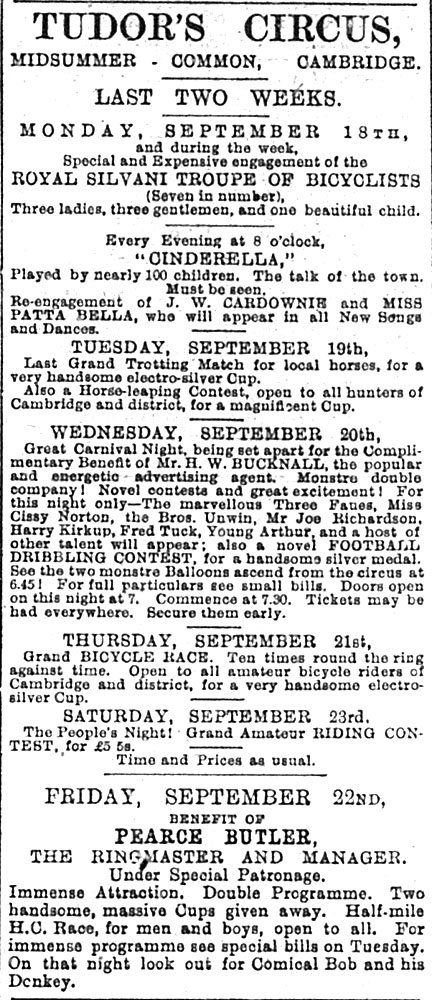
Benefit shows were put on wherein some proceeds would be allocated to a particular performer. There was a benefit for the advertising agent, Mr Bucknall on the 20th September and one for Pearce Butler, the Ringmaster and Manager on the 22nd. Mr Butler presented Bob Armstrong, the regular clown with a Malacca cane, mounted in silver and inscribed as a memento from The Judge and Jury Club, Cambridge. Bob Armstrong made a speech of thanks: ‘he had only been in Cambridge about three months but he could assure them he had never mixed in better society’ (CDN, 23 September 1893, p 3). He also presented Mr Butler, on behalf of the Judge and Jury Club, with a handsome cigar case. Mr Butler reminded the audience that were would be a benefit for Mr Tudor on the night of Friday 29 September when he hoped the audience would be as generous as they had been towards him.
Throughout the season the stock company of clowns performed daily, and the Cambridge Chronicle acknowledges these stalwarts, whether performing in their own skits or entertaining the audience while the next act is prepared. ‘A capital programme is provided this week at this popular place of entertainment, in which Comical Bob again takes the leading part. Armstrong, the clown, gives a very humorous entrée, and together with Whimsical Cyril and Bob Anderson, keeps the house in continual laughter’ (CCJ, 25 August 1893, p 4). As well as the humour of slapstick, the clowns included equestrian tricks, mock-boxing, played musical instruments, acted in the hippodramas, assisted some of the other acts, and generally kept the audience entertained while sets were changed.
As early as 21 July Armstrong had been noted for his ‘grand entrée’, having been transformed ‘from the Fool to the Droll’ (CIP, 21 July 1893, p 5). In September ‘Bob Anderson is to the front again, this time with a novelty, this time in the shape of a performing horse, bearing the name of “Wicker Ribs”’ (CDN, 26 September 1893, p 2). ‘Comical Bob Anderson’ had appeared in Cambridge in 1888 with Keith and Tudor, again in 1891 and worked much of the 1893 season. For the Cambridge Express reviewer ‘ever comic Bob Anderson creates loud applause on the introduction of his pugilistic ball, and his running banter and comicalities are as enjoyable as ever’ (CE, 28 August 1893, p 2). Bob Anderson, sometimes with his brother Sam, had performed with numerous circuses around England from the 1870s. The last appearance recorded by Turner is at the Great Yarmouth Hippodrome in 1904 (Turner, 1995, 2000).
On Friday 22 and Saturday 23 September, hundreds of caravans, horses and cheap-jacks had made their way to Stourbridge Common to provide a few hours entertainment for the residents of Cambridge on the Monday at Stourbridge Fair and to allow them to spend their money on cheap and nasty things, as the Cambridge Chronicle grumbled. The horse fair was not such a success as in previous years, hops were sold and there was a display from local iron founders Headly and Edwards, but the Fair was not what it had been, and was little competition for Mr Tudor. Despite the counter-attractions the circus had very good audiences of up to 1,400.
As the circus entered upon its last fortnight in Cambridge the Cambridge Chronicle felt that ‘Mr Tudor is making an effort to leave a remembrance behind which shall be treasured up, and make his return to the town something to be looked forward to’ (CCJ, 22 September 1893, p 8).
As a finale to the season there would be two illuminated day performances on Thursday 28 and Friday 29 September (CDN, 25 September 1893, p 1). The CDN review reported: ‘We are glad to learn that Mr Tudor has had a good season, and we can only express the hope that he is as satisfied with his visit as the public have been with the fulfilment of his promises’ (CDN, 26 September 1893, p 2). Amongst the last acts were The Brothers Olmar, acrobats on the triple horizontal bar, and the Olmar Troupe of lightning acrobats, all formed by Olmar, the late James Chadwick, who had performed previously in Keith’s circuses. Also performing were a Miss Violet and Miss Kitty on the slack wire, Miss Chrissie, who was still performing on horseback but also ‘executes a very meritorious skipping-rope dance’ (CDN, 26 September 1893, p 2), Mr Charles, singer and harp-player, and the Silvanis again.
Ludwig Linus, a contortionist whom Cambridge audiences had seen the previous year, appeared as the Boneless Wonder, ‘with a body as sinuous as a serpent, and his contortions are as graceful as they are grotesque’ (CDN, 26 September 1893, p 2). The CIP reviewer felt that ‘The contortions of his body are extraordinary though not always pleasing’ (CIP, 29 September 1893, p 8).
On 30 September an advertisement in the CDN proclaimed ‘Don’t forget to-night is positively the last performances of the best circus programme ever seen in Cambridge’ (CDN, 30 September 1893, p 1). In the middle of the packed programme before an enthusiastic crowd, Mr Albert S Scales (a local brewer) stepped from the Dress Circle and presented Mr Tudor with a beautifully illuminated address and a gold ‘Albert’ watch chain from his many Cambridge admirers.
A similar address presented to Tudor in 1894 by the citizens of Blyth in Northumberland, where William and his third wife settled much later, gives an idea of what the Cambridge one may have looked like. You will find it in our next section.
In his speech Mr Scales recalled William Tudor’s previous circus project with Charlie Keith:
Five years ago two gentlemen came to Cambridge and built a circus, and one of them was present that evening. During that period the gentleman he had referred to had established a reputation which many of his profession would be proud to acknowledge. Needless to say, that gentleman was William Tudor – (cheers) – and he thought they all agreed with him when he said that he had upheld that reputation during his recent stay in Cambridge. (Loud applause). On the last occasion Mr Tudor shone more particularly in his brilliant act of riding, but this season he had delighted them with fine exhibitions with what could be done by kindness and attention in training horses to perform in the ring – applause – but whether in or out of the ring; whether riding or training horses; whether in public or private capacities, he was always the same ‘Good Old Tudor’ (Cheers).
(CDN, 30 September 1893, p 3)
Scales then presented Tudor with the watch chain and a silver-mounted Malacca cane with an ivory handle. William gave a speech of thanks to the smiling faces and many friends in the crowd and hoped to be able to continue next season. Auld Lang Syne was sung and, with no pause for the circus, the final note stated that ‘Mr Tudor and his company travel by special train to Durham on Monday, where they open on Saturday October 7th’ (CDN, 30 September 1893, p 3).
Tudor’s first circus season in Cambridge as sole proprietor was over. The building would be taken down and all evidence of his circus would disappear from the Common for another two years. William would not return to Butt Green until 1895.
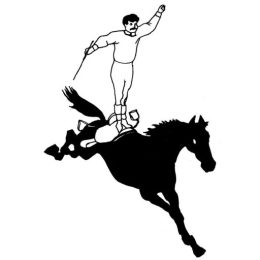
 William Tudor's Circus