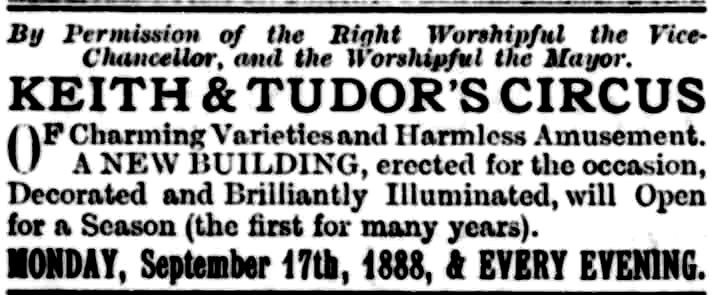
By 1888, Charlie Keith (‘the Roving English Clown’), born 1836, was a well-established circus manager, clown, and designer of temporary circuses. William Tudor, 17 years his junior, had about 20 years of performing behind him, as well as some management experience. The two men had worked together in 1882 when Tudor toured with Charlie Keith’s portable circus. On 8 September 1888 this advertisement appeared in the Cambridge Daily News.
Charles Keith had agreed to pay the Borough of Cambridge £6 per week to hire a portion of Butt Green, Midsummer Common, measuring 92 feet by 54 feet ‘for the purpose of erecting a wooden building to be used as a circus thereon’. The hiring was to the end of the month but there was a provision to extend into October (Cambridgeshire Archives CB/2/CL/17/13/Page 330).
On 21 September the Cambridge Chronicle (page 8) declared that:
Popular as circuses usually are in Cambridge, there seems to be every probability that that of Messrs. Keith and Tudor, which now finds a locale on Midsummer Common, will surpass its predecessors in general esteem, and that this will be the case there can be little doubt, if throughout the season . . . such excellent programmes are arranged as the one which has this week been presented to the public.
The Chronicle goes on to tell us that there was a mix of horsemanship, juggling, gymnastics, tight-rope dancing and clowning. Attractions during this first week included Signor Peyrani and his greyhounds, and Madame Peyrani’s horseback hunting act ‘in the course of which she introduced a troupe of highly trained pigeons’. Tudor himself juggled knives, plates and balls while galloping around the ring and he later accompanied Charlie Keith in a clown double-act. Lizzie Keith had ‘few equals as a performer on the tight rope and her evolutions on the rope have been greatly admired . . .’
Advertising what they now called their New Grand Circus in the Chronicle, also on 21 September, Keith and Tudor were moved to proclaim:
SUCCESS. A GRAND AND GLORIOUS SUCCESS. Without any puff or boasting this Superior Company has won the admiration of all Cambridge. Everybody delighted, amused, and perfectly satisfied with the splendid new building. ELEGANCE, NOVELTY AND REFINEMENT. Best Company yet seen. Visitors will find every Comfort. The talk of all Cambridge is the Talent of Madame PEYRANI, leaping with a Horse over a Supper Table. TUDOR, the Champion Jockey Rider. The Trained Horses and the Mirth of the Clowns.
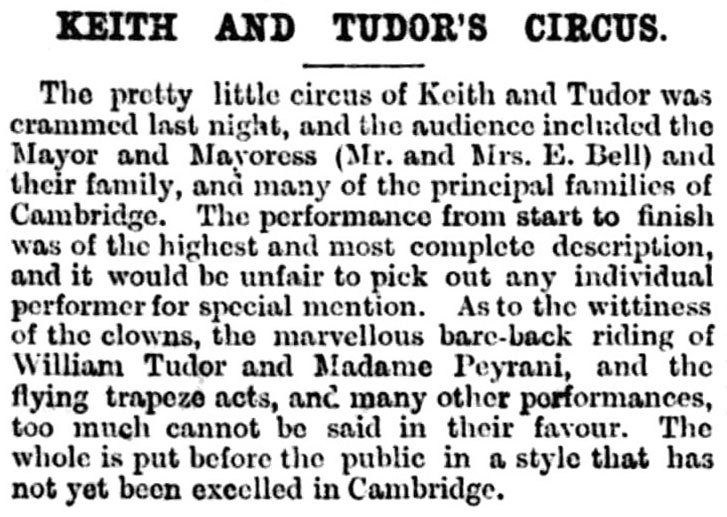
That sounds very much like ‘puff or boasting’, but on 28 September the Cambridge Daily News seemed to agree:
A couple of weeks later we have this handbill, a rare find in Cambridge University Library.
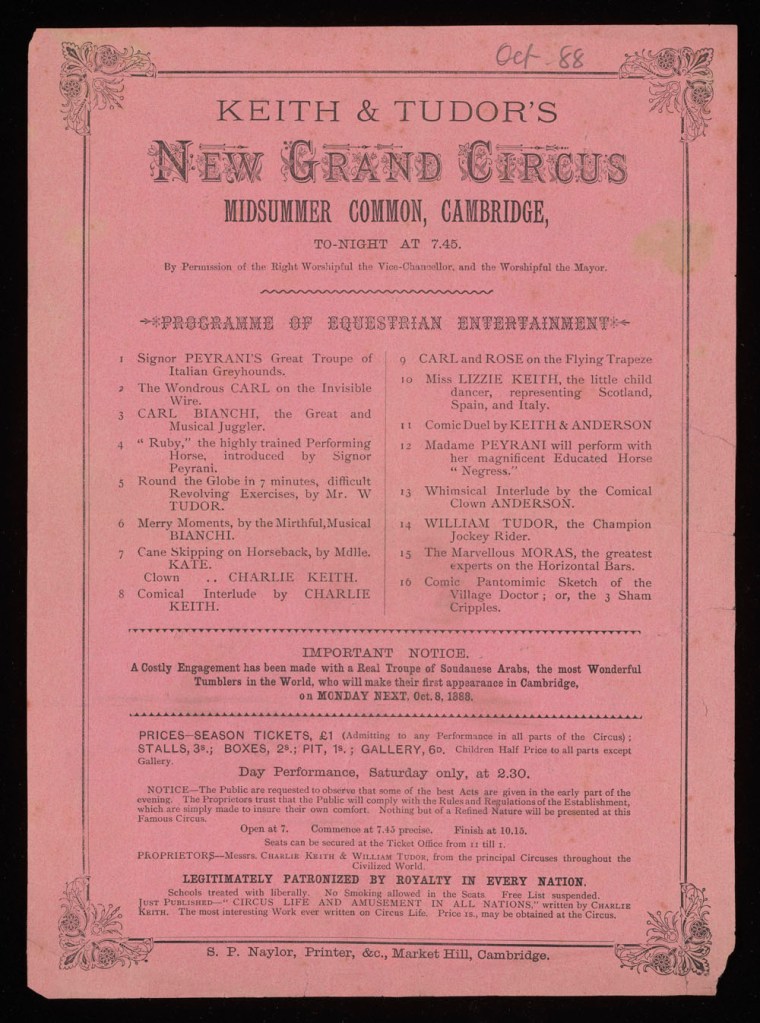
A Keith & Tudor handbill from October 1888 (Reproduced by kind permission of the Syndics of Cambridge University Library: Cam Papers City Boxes 38)
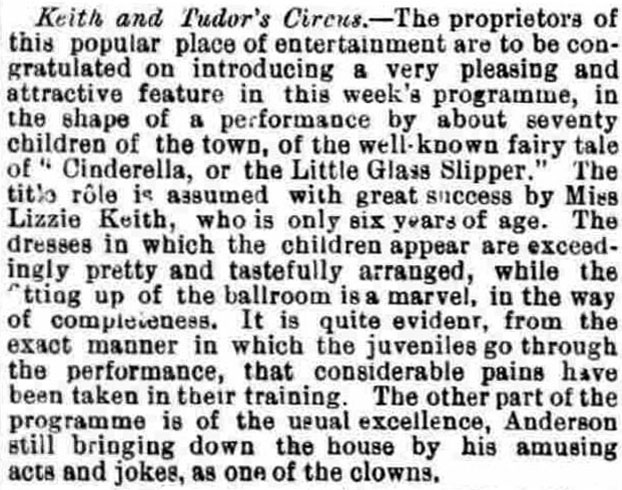
More praise came in the Cambridge Independent Press on 26 October:
However, the Circus was not universally welcomed, as this letter of support (CDN, 22 October) in the face of criticism tells us:
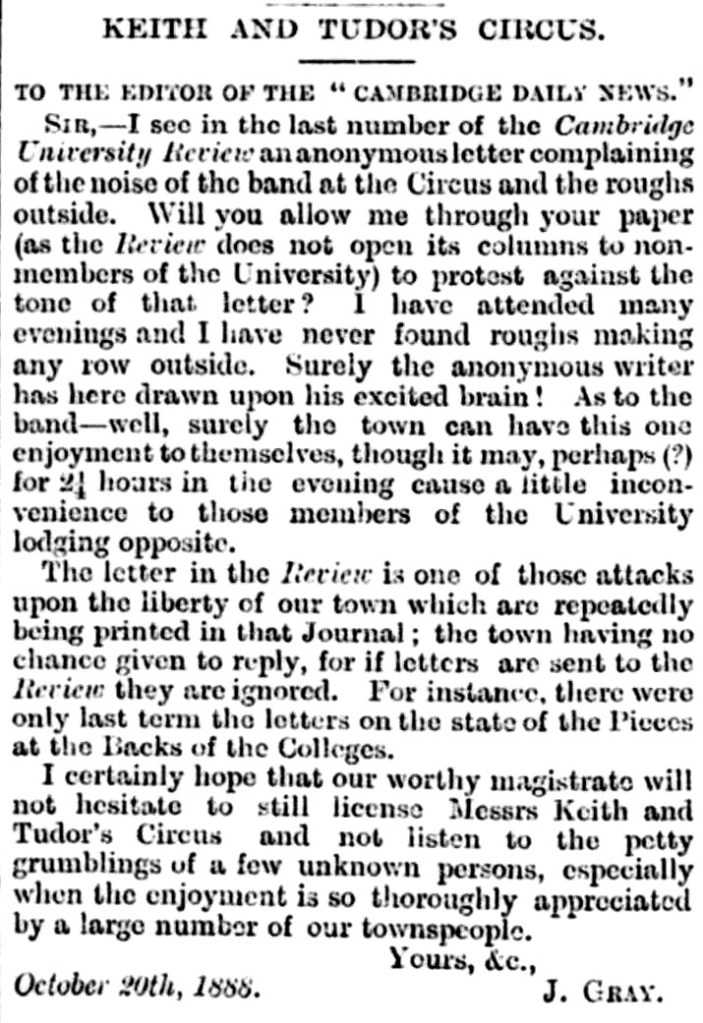
The original correspondence is to be found in the Cambridge Review in the University Library: a complaint from a resident of Jesus Lane about the circus music and rowdy people hanging around outside drew a withering response from Charlie Keith. (Keith was a master of the withering response, as will be seen in 1890 and 1891.) Then a third letter supported the original complaint. We have transcribed the correspondence here.
But Keith and Tudor just got on with the business of entertaining Cambridge, advertising in the same edition of the CDN:
TO-NIGHT and Every Evening at 7.45. A Big Programme. First time of TULSA, the Great Gymnastic Wonder. MIVCO, the Mexican Marvel. HOLMES, the Man of Mystery. SAM ANDERSON, Somersault Rider, and the Great Arab Troupe.
And then, on Monday 29 October, the same paper published a letter above the pen-name ‘Keep Faith with the Child’, who seems to have been a critical friend of the circus. On the Saturday the writer had encountered some children on the common, in tears at being unable to get into the afternoon show with their special-rate tickets because of the crush of ‘grown-up people’. This appears to have been written in good faith, as he claimed to be ‘favourable to Messrs Keith and Tudor’s performances’.
Charlie Keith’s reply was published on 30 October:
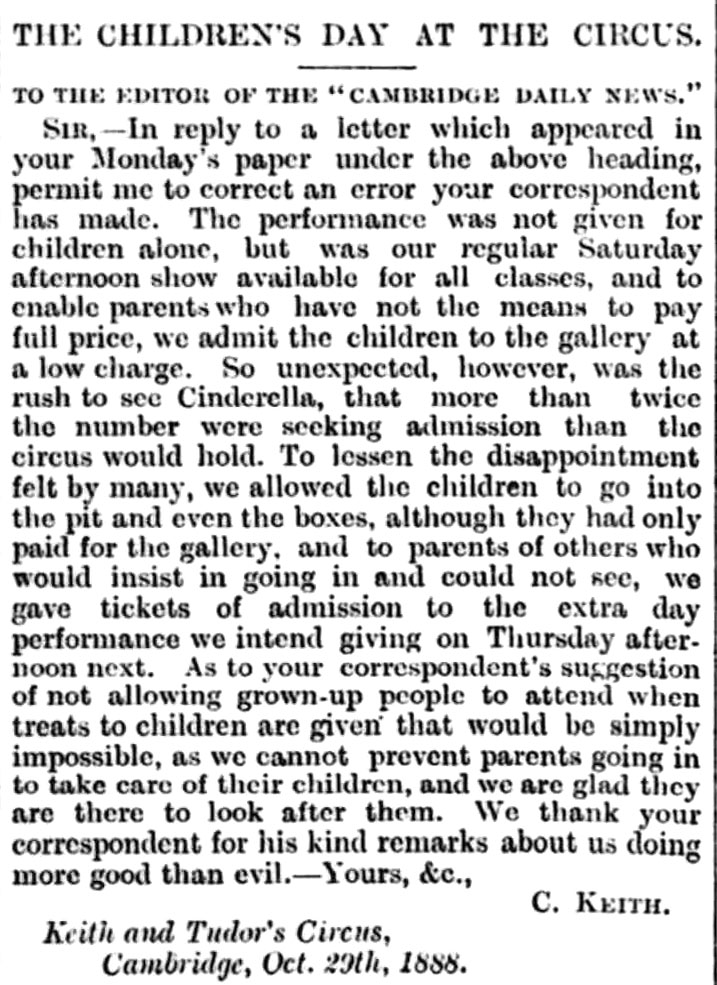
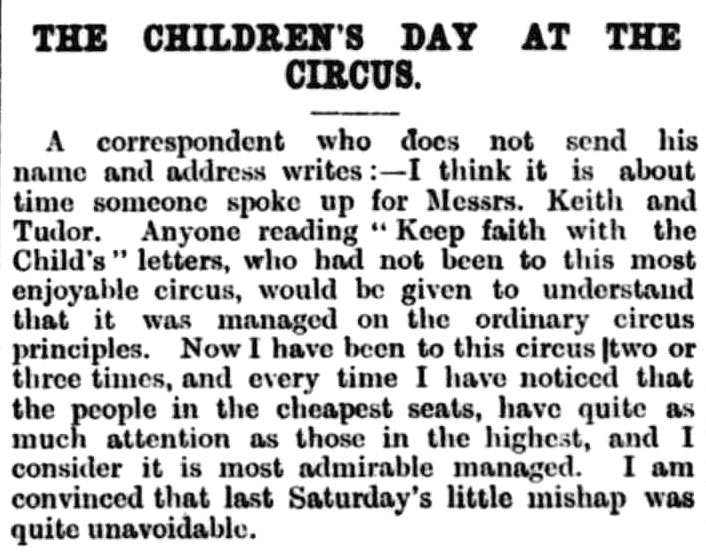
But ‘Keep faith with the Child’, still friendly but not fully satisfied, wrote again on 31 October that he thought Keith and Tudor should manage things better if they ‘desire to make the performances at their circus as popular as they deserve to be’. On 1 November, there was unequivocal support for Keith and Tudor:
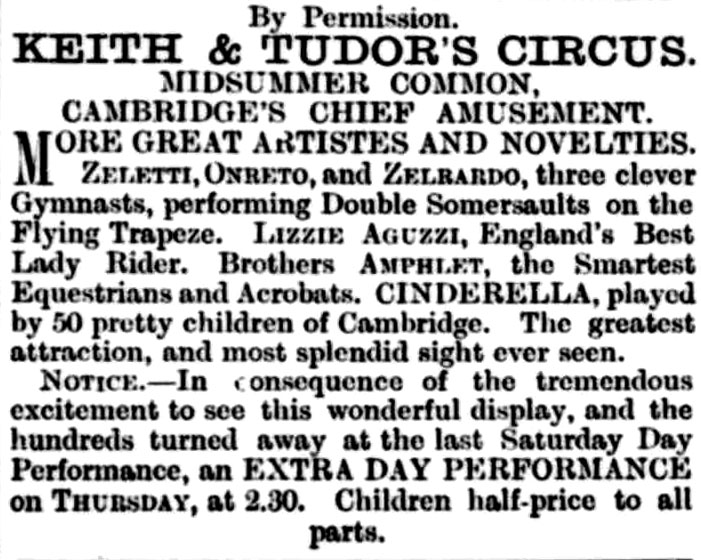
Perhaps conscious of the need for good public relations, also on 1 November Keith and Tudor advertised cheap tickets for children to attend ‘Cambridge’s Chief Amusement, More Great Artistes and Novelties’ on the following Thursday:
However, Mr J Gray is once again published in the Cambridge Daily News on 3 November, defending the circus from complaints in the Cambridge Review. It seems to be a classic town-and-gown culture clash, as these excerpts show:
Can anyone explain why a few members of the University are so opposed to this circus? I should like to know from what this opposition springs. What difference is there between this place and the theatre? – perhaps the circus attracts more of the poorer class . . . why should the University be so opposed to that which is not meant for them . . . ?
‘What difference is there between this place and the theatre?’ Although, as enthusiasts for popular culture, we might cheer on Mr Gray, historical accuracy compels us to note that on 2 November, Keith and Tudor advertised Cinderella and acrobats Zelleto, Onreto and Zelvardo. On the same page of the Cambridge Daily News the Theatre Royal in St Andrew’s Street announced Hamlet and A Midsummer Night’s Dream.
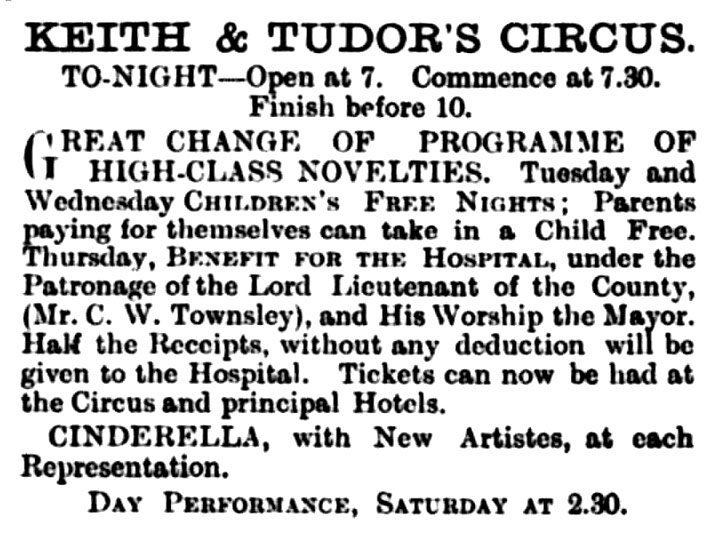
Keith and Tudor must have taken corporate responsibility seriously because on 7 November they advertised free nights for children and a ‘benefit for the hospital’ (we presume that must mean Addenbrooke’s) in the presence of some local worthies – the town’s leading citizens clearly happy to be associated with the circus.
On 10 November the Cambridge Daily News reported some audience participation:
. . . last night the principal attraction at this popular place of amusement was an amateur riding contest. Our readers will be aware that Messrs. Keith and Tudor offered the sum of £5 to any amateur in Cambridge who could stand on the back of a horse whilst the animal went six times round the ring and five shillings to the person that made the best attempt . . . It is needless to say that no sooner had the young men got on their legs on the horse than they fell off it. One of them, indeed, did manage to stand for a few moments, and to him was awarded the prize of 5s.
The season was extended until 21 November, but not before Keith had been summoned to the Cambridge Borough Police Court for putting on a performance on 20 November without the written permission of the Borough Commons Committee. The account of the hearing in the Cambridge Independent Press on 23 November seems to reveal a tale of misunderstanding rather than bad faith on the part of Keith and Tudor. Mr J Ellison, defending, claimed that ‘there was never a performance in Cambridge that was better conducted than that of Messrs. Keith and Tudor (applause in court). It was of a respectable character, and every person who had witnessed it was perfectly satisfied with it.’ But Keith was fined £10, plus costs.
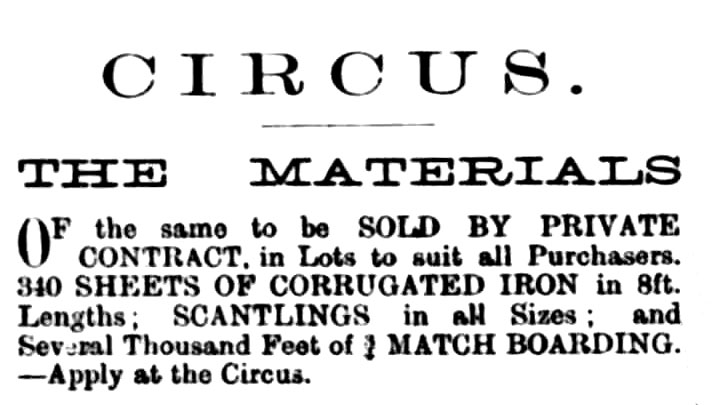
An advertisement in the Cambridge Daily News on 22 November tells us something about how the temporary building was constructed. Keith and Tudor needed to make sure they could fulfill their obligation promptly to clear the site and make good any damage to the ground, so they put the roofing, battens and tongue-and-groove boards from the building up for sale:
Yorkshire, Norfolk, Suffolk, and tour’s end in Wales
Then, according to Fitzroy (1998, p 152), Keith and Tudor opened another new building in Halifax on 3 December where they performed until April 1889. Immediately they moved on to King’s Lynn, and yet another building. Here they were admonished for taking children out of school to perform in Cinderella, before moving into Suffolk to the Theatre Royal, Lowestoft in June, advertising to let their ‘Pretty Wood Building with Iron Roof’ in King’s Lynn as they left. And then it was back up the coast to another new building in Great Yarmouth in August, until December. Then they advertised in The Era for acts to perform in Newport, South Wales, where they commissioned another new building which they opened two days before Christmas, 1889.
The last performance in Newport, featuring ‘various contests and a duck hunt’ was on 12 April 1890 and that was the end of the partnership ‘after a period of eighteen months and visits to six towns’ (Fitzroy, 1998, p 159). Keith went off to Weymouth but was back on Midsummer Common on 4 August, this time in partnership with Mr Palmyra. Perhaps we can conclude that William Tudor had learned a lot about building temporary wooden circuses from his older, vastly experienced colleague.
William Tudor went to Folkestone, hired to perform by Weston Gibbs (Folkestone Express, 29 March 1890, page 5) saying in 1892: ‘I enjoyed this engagement though at times the salary was nil’ (interview in the Morpeth Herald, 4 June 1892, p 3). June found him at Boswell’s Circus in Maidstone (Kent County Standard, 20 June 1890, page 1) and then off he went to Llandudno with Professor Dainez and his goats.
 William Tudor's Circus