Cambridge Circuses and Fairs before 1888
Circuses had been visiting Cambridge for years and itinerant performers would have been seen since medieval times, particularly at Stourbridge Fair, which was chartered in 1211, and also at Midsummer Fair on Midsummer Common. Honor Ridout, in Cambridge and Stourbridge Fair (2011), relates the history of that great annual September event, which took place one and a half miles from the town on Stourbridge Common, between Newmarket Road and the river Cam.
Trade in such commodities as horses, cheese, linen, cloth, wool, coal, hops, ironmongery, kitchenware and furniture was the main function of the fair, but Honor Ridout makes it clear that it also provided forms of entertainment that were to become the staple of circuses in the 19th Century. In the language of the Fair’s heyday, she lists 18th-Century ‘dwarfs’, ‘giants’, and ‘freaks’, as well as clockwork models and menageries. A tiger, ostrich, rhinoceros and more than one elephant were to be seen on Stourbridge Common between the 1720s and the 1790s. There were even learned pigs (one could do arithmetic!) and learned dogs and horses that could answer questions.
At Midsummer Fair in 1714, Richard Baxter (2021) tells us, attractions included ‘Punch, a giant, a dwarf, wild beasts, dancing dogs, three-legged cats and a female rope dancer’.
For a number of years entertainment came to Stourbridge Fair from Sadler’s Wells in London. In 1768 this included ‘stiff rope dancing’, ‘several curious equilibres on the slack wire’, ‘ground and lofty tumbling’ and a pantomime, Harlequin Restored. In the 1790s, Honor Ridout tells us, the famous circus pioneer and horse trainer Philip Astley performed at the Fair.
Victorian diarist Josiah Chater was 16 in November 1844 when he recorded that ‘Van Ambury [actually Van Amburgh] is building a large brick place on Midsummer Common for the keeping of his wild beasts and to show off his horsemanship’. A year later, ‘Wombwell’s wild beasts are on the Common’, and in 1847 Josiah was unimpressed by Cooke’s Riding Circus: ‘I could see how it was done and there was much imperfection in it’ (Enid Porter (ed.) 1975, Victorian Cambridge, Josiah Chater’s Diaries, 1844–1884.)
There is a long list of other circuses that came to Midsummer Common across the middle of the 19th century:
- Anthony, Powell & Clarke
- Barnum & Bailey
- Batty’s Great London Circus
- Edmond
- Fossett
- Ginnett
- Hengler
- Holbrook
- Hutchinson & Tayleure
- Manders
- Myers
- Newsome
- Pinder
- Powell, Foottit & Clarke
- The Sanger brothers
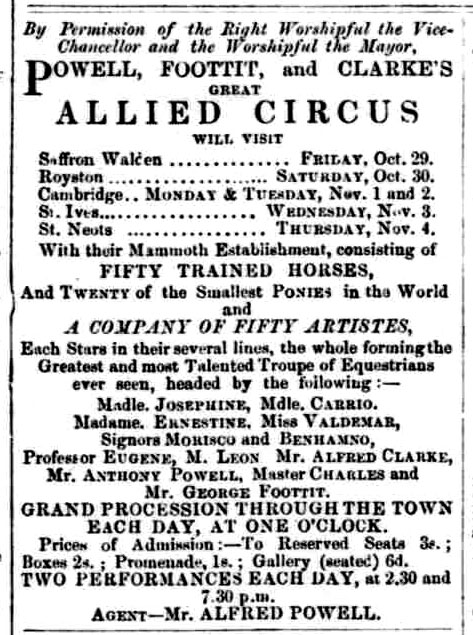
Cambridge Independent Press, 30 October 1869, page 1.
It is possible that 16-year-old William Tudor performed in Cambridge in 1869 with Powell, Foottit, and Clarke. We know from an 1892 interview (Morpeth Herald and Reporter, 4 June 1892, page 3) that his uncle George Foottit (probably George Tudor Hall) had started training him a couple of years before. However, the first visit we can be sure about was in 1888, when he came with Charlie Keith.
Go to next section: Charlie Keith and William Tudor, 1888–1890
 William Tudor's Circus