Tudor on the move: from Llandudno to Ipswich via Rotherham
We don’t know much about Tudor and Dainez’s season in Llandudno. The Era (16 August 1890) tells us that ‘Messrs Tudor and Dainez have established a circus in Lloyd-street, and have been well patronized. Principal features in the programme is the performance of Smiler, an educated donkey, and the troupe of goats trained by M. Dainez.’ The season cannot have been more than a couple of months, because in October Tudor was advertising himself (from a Rotherham address) as ‘now Performing without success at Stacey’s Circus. At liberty to accept Engagement December 8th for Jockey, Juggling Act, Bar Act, and Turpin, with own Mare. Three Ring Horses’ (The Era, 18 October).
Stacey’s Circus was in Tudor Street, Sheffield. Tudor himself tells us that: ‘. . . the circus of wood was adjoining a paraffin oil shop, and as Mrs Tudor was afraid of fire, and that the stock of horses would be lost, we cleared out’ (interview in the Morpeth Herald, 4 June 1892, p 3). Ellen Tudor was quite right to worry as Stacey’s Circus burned down in 1893. In the same interview Tudor said: ‘I next went to Bradford where I had good luck.’ That last engagement was with Croueste’s Circus (Bradford Daily Telegraph 3 December 1890, p 3).
We can see from this that while William was developing his career as a circus proprietor, it is clear that he was frequently ‘at liberty’ to hire himself out to other managers. He did so in 1896 even while preparing for the first season in the new building in Cambridge. This is likely to have been a financial necessity: the pages of advertisements in The Era, in which artistes advertised their availability and proprietors invited applications, show that the circus world was founded on what we would call the gig economy.
Ipswich, December 1890 to April 1891
But he was soon to be back in charge again, this time without a named partner, although we can confidently infer that Ellen was a crucial colleague. We learn from The Era on 22 November that the Tudors went to Suffolk:
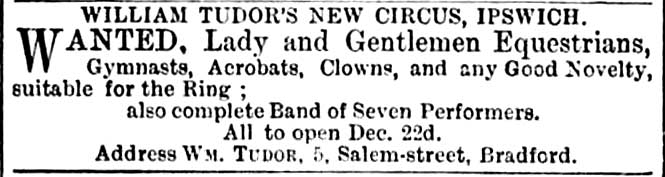
This seems to have been the first of his many ‘new’ circuses. ‘I next went to Ipswich again, and put up a round circus’, William told his interviewer in 1892. The circus was next to the Mulberry Tree public house at the town end of Woodbridge Road.
We know that Tudor would have gone back to Cambridge in the summer of 1891, had the borough awarded him a contract, which went to Charlie Keith. Instead, our William spent nine months of the year busy in the north-east.
From Ipswich to Stockton-on-Tees
The Ipswich circus ran until mid-April 1891 – possibly until Saturday 18 April as the last advertisement we have found is in the East Anglian Daily Times of 15 April. But then we find he had pulled off the trick of being in two places at once as he had opened in Stockton-on-Tees on Easter Monday, 30 March:
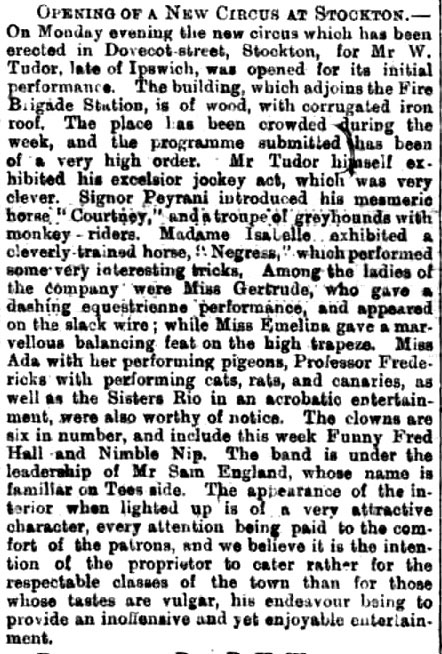
William’s brother, clown Funny Fred Hall, was with him at the new circus in Stockton, as were Professor (sometimes plain Mr) Fredericks and his cats, rats and canaries (Stockton Herald, 4 April 1891 p 8).
A bit of researcher’s luck means that we know how he did it. Census night 1891 was 5 April: Ellen Tudor was in charge in Ipswich, and that’s where she is recorded. William is in the census in Stockton, having left managing in Ipswich to Ellen. This seems to have been the period when William’s relationship with north-east England began, or at least was consolidated. It culminated in a long association with and residence in Blyth, where he died in 1940.
The 33-week season in Stockton is notable for having staged some wet and novel attractions. While our research focuses on Cambridge, the story of this season is worth telling by means of cuttings from the local press and, first, this poster for Fredericks and his furry and feathered friends. Fredericks was married to James Newsome’s daughter Emma.
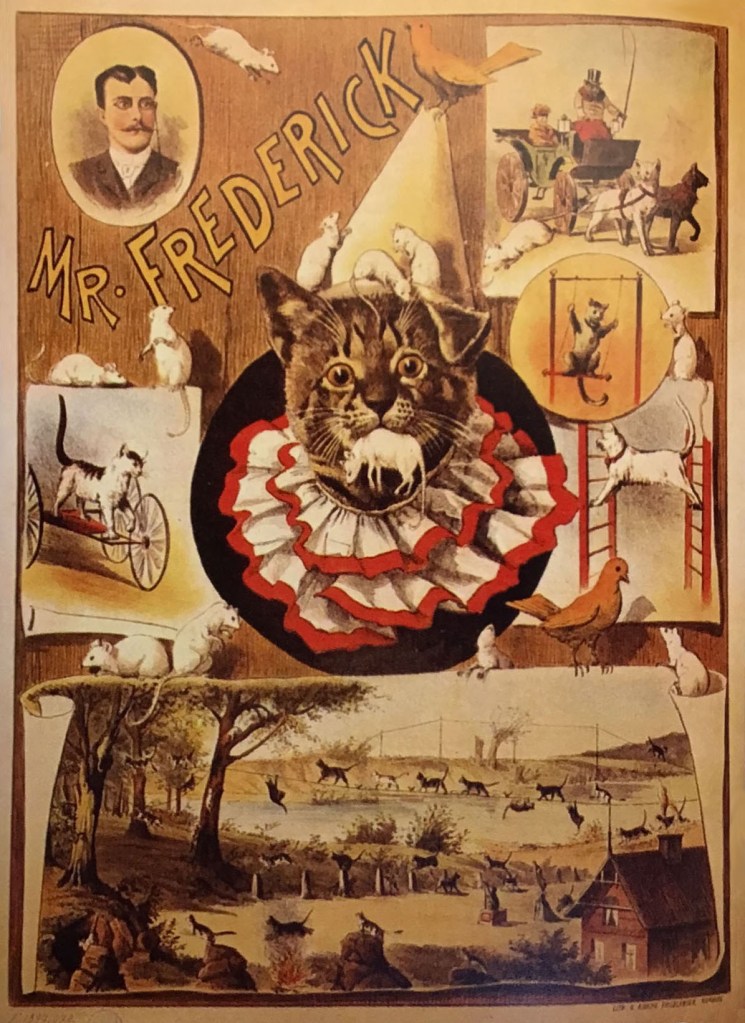
(McMillan, 2022)
This new circus at Stockton is fully justifying the complimentary things said about it when opened last week, and is proving highly popular with all classes of people. A fresh programme was presented at the beginning of this week in the smart and thoroughly well appointed building in Dovecot-street, and for two hours and a half the audiences have witnessed a series of varied, clever, and enjoyable exhibitions . . . The entertainment continues to be of a refined character, and Mr Tudor evidently intends to spare no pains to introduce novelty . . .
(Stockton Herald, 11 April 1891
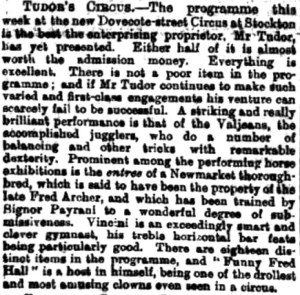
(Stockton Herald, 25 April 1891, p 8)
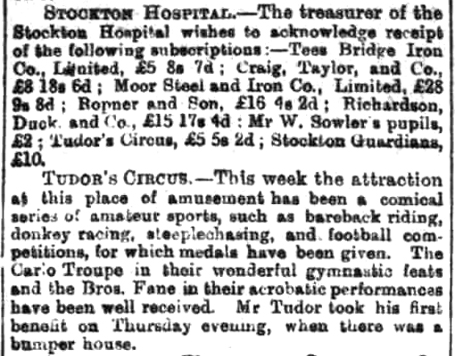
(Stockton Herald, 16 May 1891, p 8)
During July, Permane’s Siberian bears (about whom see more here) were a major attraction (Stockton Herald, 11 July 1891, p 5) . Then, on July 16, the circus company again helped raise funds for Stockton Hospital at a comical but rain-ruined cricket match (though we must report once again that the bears were present):
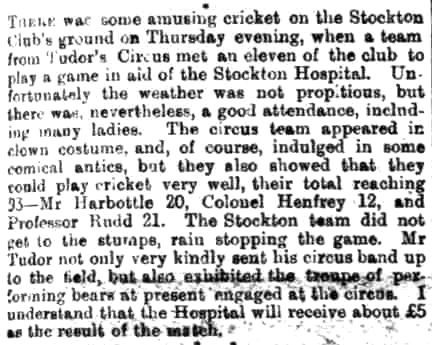
(Stockton Herald, 18 July 1891, p 5)
Then, on 12 September, the Stockton Herald (page 8) reported something truly wonderful – a masterpiece of farcical-aquatical stage-management:
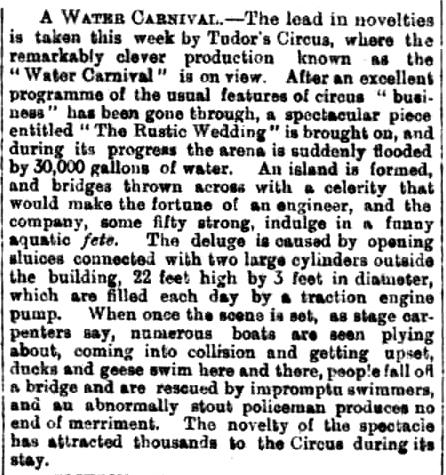
Only the circuses at Blackpool and Great Yarmouth are capable of staging such watery delights now. This aquatic extravaganza may first have been floated by Albert Hengler (The Era, 6 December 1890, p16), who called his Village Wedding a ‘water pantomime’. Tudor called his carnival The Rustic Wedding but it’s obvious from the following illustration that story, characters, and staging were the same as Hengler’s.
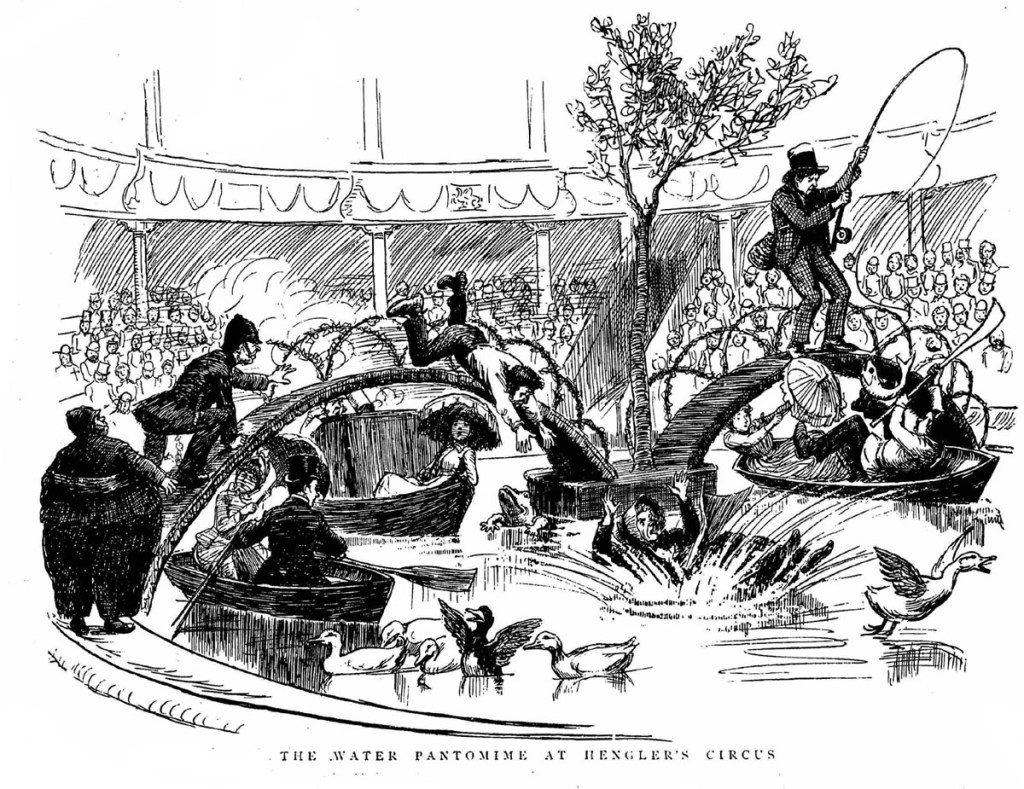
Hengler’s Village Wedding, The Graphic, January 10 1891, page 6.
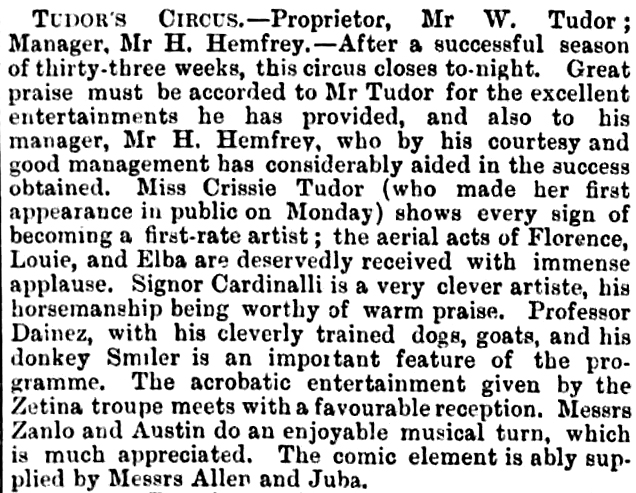
Finally, The Era (31 October 1891, p 18) reported the end of a successful season – but who was Miss Crissie Tudor? We do not know! But Professor Dainez was back in the Tudor court:
Durham: 3 August to 14 November, 1891
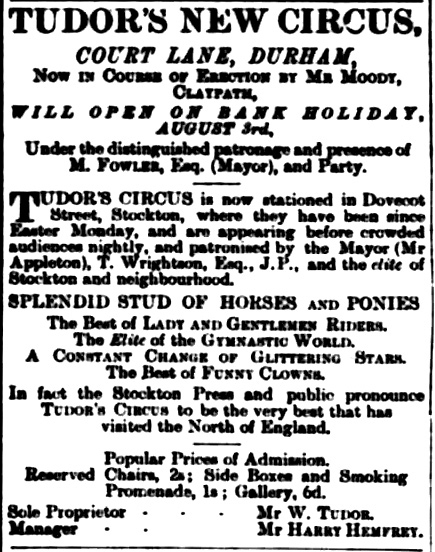
Once again, for three months, Tudor was running two simultaneous circuses, this time only 20 miles apart in Stockton and Durham. Manager Harry Hemfrey was involved at both venues.
(Durham County Advertiser, 24 July 1891, p4)
The Durham season seems to have been a great success and Tudor staged the Grand Water Carnival there from 5 October, claiming on page 5 of the Advertiser on 25 September that it was ‘The same that has been witnessed by over 25,000 persons at Tudor’s Circus in Dovecot Street, Stockton during the past three weeks.’ A week later, on page 8, the same journal opined:
The management are to be congratulated on having again this week succeeded in drawing large numbers to the new circus, the promised success of the opening week having been more than maintained. Each evening during the present week the performance has been witnessed by large and enthusiastic bodies of spectators, who have frequently testified their high appreciation of the efforts of the performers.
The success of the season and the evident good humour with which it was conducted must have been marred, however, by the death of circus groom Frederick Sievers on Sunday 4 October. He was with three other men in an overloaded and unbalanced rowing boat which capsized on the river Wear. His companions were all saved or managed to swim to safety: Sievers, a former sailor, unable to swim, was lost, as was his dog. At the inquest the following day the jury returned a verdict of accidental drowning (Durham County Advertiser, 9 October 1891, p 8). As far as we know, the Grand Water Carnival went ahead as planned that evening.
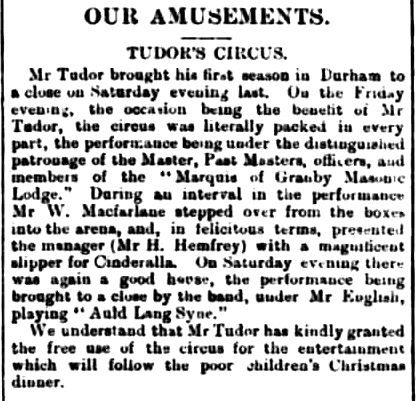
The circus ran for another six weeks and closed on Saturday 14 November.
(Durham County Advertiser 20 November 1891 p 8)
On to Middlesborough
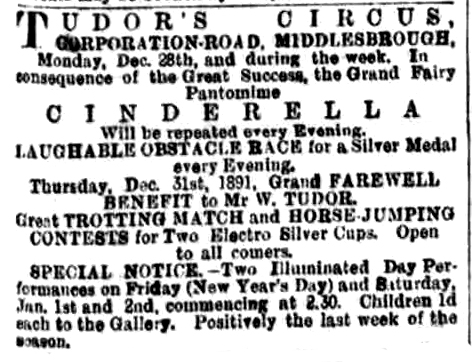
Monday 16 November 1891 saw the opening of yet another venue, in Corporation Street, Middlesborough (North-Eastern Daily Gazette, 14 November 1891, p 4). On 17 December (page 3) The Gazette reported that ‘Tudor’s Circus . . . is being well patronised, the football contest attracting a good deal of attention . . . “Dick Turpin’s Ride to York” is well acted . . .’ And then the six-week season finished on 2 January 1892.
(Northern Echo 29 December 1891)
Back to Durham and on to Blyth
Three months after leaving Durham, Tudor and his company were back there on 15 February (The Era, 6 February 1892, p 21). That eight-week season, during which the Durham County Advertiser several times noted less-than-capacity audiences despite the quality of the entertainment, finished on 9 April. Tudor himself tells us the reason for the poor houses:
. . . I reopened the circus at Durham, but unfortunately the week following commenced the strike agitation, the result was that the people were too much occupied with the strike that they had neither money nor inclination for circus attractions, and business was bad.
(Morpeth Herald, 4 June 1892, p 3)
Half-way through the run, on 5 March, our Mr Tudor was advertising in the Blyth News (page 4): ‘WANTED, TENDERS for the Erection of Wooden Circus Building on Mr. Stanley’s Ground.’ That building, in Croft Road in Blyth, was to be the subject of a controversy that meant that the long and happy relationship between William Tudor and the citizens of that town nearly fell at the first hurdle.
Tudor advertised some familiar names in the Morpeth Herald on 9 April 1892:
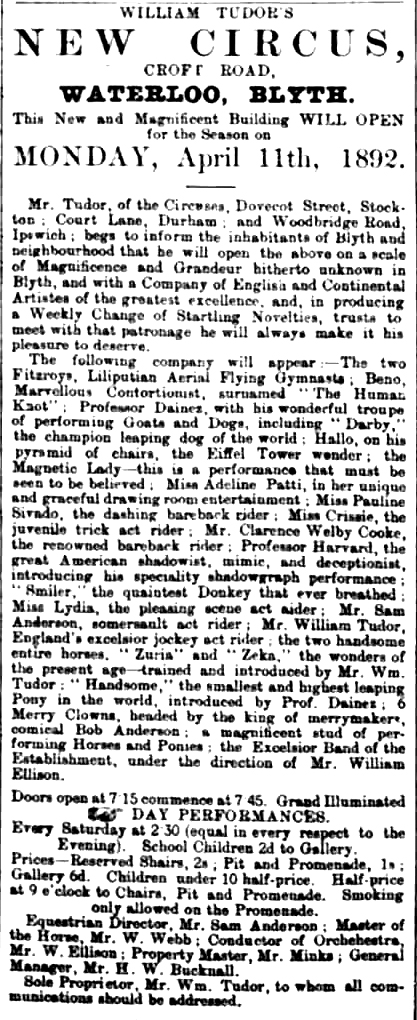
Morpeth Herald and Reporter, 9 April 1892, p 4
At the end of the month (Blyth Weekly News, 30 April 1892, p 4) that old favourite, Dick Turpin’s Ride to York was announced for the following week. In the same advertisement Tudor announced ‘Friday, May 6th, is set apart for the BENEFIT OF THE DURHAM MINERS Who are now on Strike, when a clear half of the takings will be handed over by Mr Tudor to the Secretary of The Durham Miners’ Federation Society’.
Not long after that, the whole season was thrown into doubt – but a dispute about the safety of the building that threatened to close it down was resolved, in part because of Tudor’s popularity:
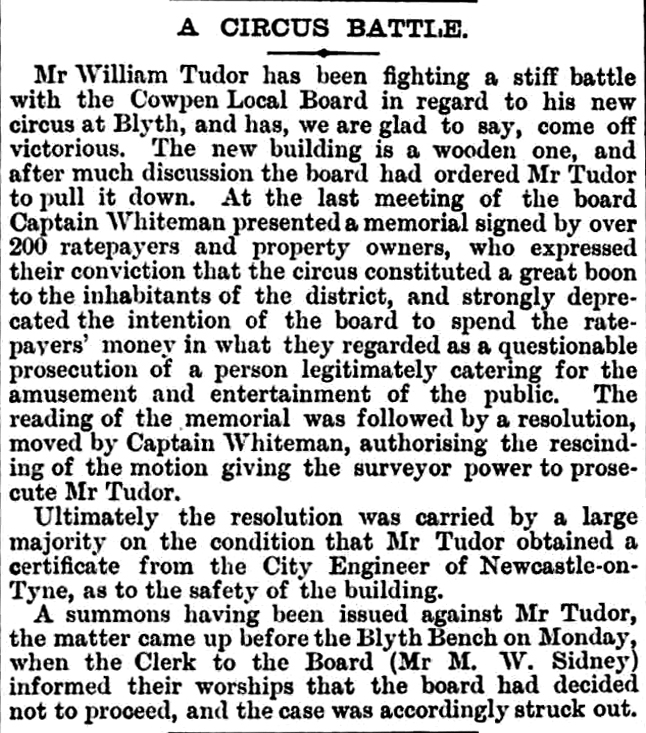
(The Era, 17 May 1892, p 17)
Tudor discussed that contretemps with good humour in his interview with Mr Fraser of the Morpeth Herald (4 June 1892, p 3). The interview tells us much about his early life and career and you can download it here.
This first season in Blyth then turned out to be a success and the friendship between the citizens of the town and Willliam Tudor was now well established:
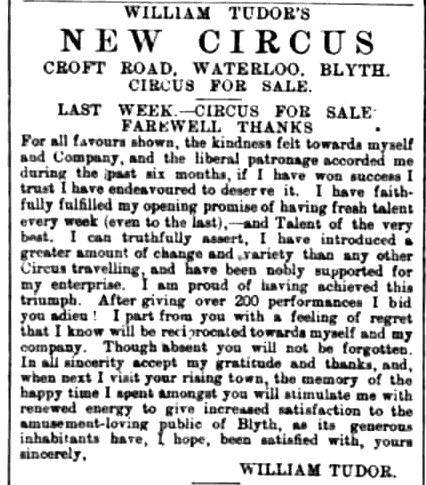
Morpeth Herald, 24 September 1892, p 4
From Blyth to South Shields and Sunderland – and back to Blyth
Tudor’s next port of call, South Shields, is only ten miles down the coast from Blyth where he’d been planning his move for some weeks. On 5 September he advertised in the South Shields Gazette (p 1), ‘To plumbers, gasfitters and paperhangers Tenders wanted for the erection of Gasfitting and Paperhanging at Tudor’s New Circus, John Clay Street . . . South Shields’. On 16 September, in the same paper (p 1), he was looking for furnished apartments.
And then the circus opened on Monday 3 October:
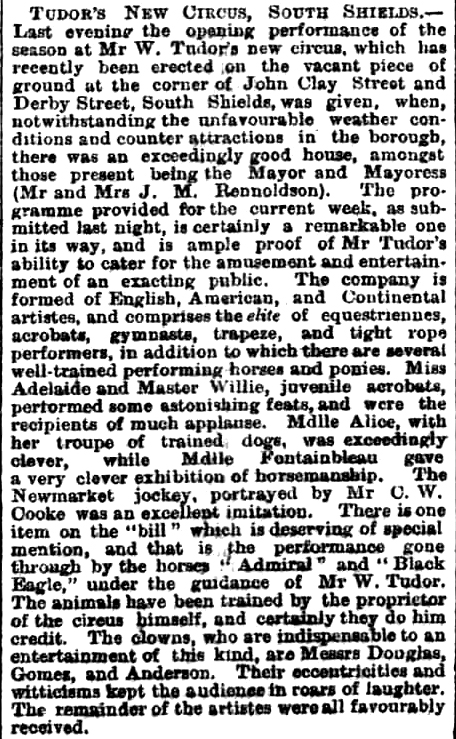
Shields Daily Gazette, 4 October 1892, p 3
Throughout our research there has been little to suggest that William Tudor was anything other than a genial and humorous man. Amos Dowell probably didn’t agree:
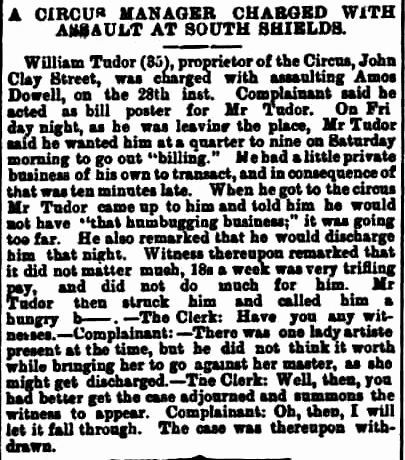
Shields Daily News, 2 November 1892, p 4: Tudor was actually 39.
Despite that incident the season seems to have been a success and there was a special attraction in December for the season of goodwill. On 29 December 1892 (page 1) Tudor claimed, with hyperbole worthy of his old colleague Charlie Keith:
TUDOR’S NEW CIRCUS . . . Legitimate Gigantic Success of the Fairy CHRISTMAS PANTOMIME ‘CINDERELLA’ Played by 100 Shields Children, The Pantomime of the Town . . . Nothing ever seen like it before. News must out that 5,831 PERSONS PAID FOR ADMISSION ON MONDAY and TUESDAY . . . This is not idle boast but real facts. Ask them what it is like . . .
The 22-week season finished on 4 March 1893: but what roads led to Cambridge? The first went south to Sunderland, only 8 miles away, with an immediate opening at a venue called Arcadia on 6 March. This two-week season featured the ‘Water Carnival Ally Sloper’s Half-Holiday, which creates roars of laughter’ (The Era, 11 March 1893, p 18).
Blyth Revisited
Then, it was 20 miles north back to Blyth, whence he had departed with ‘feelings of regret’ only five months earlier, to open a three-month season on 27 March, in the same building he had advertised for sale, but presumably had not sold, the previous September.
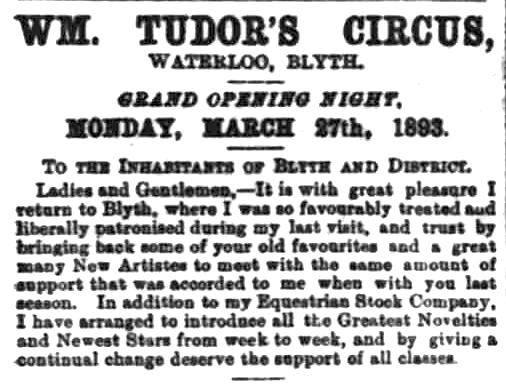
Blyth News, 18 March 1893, p 4.
Once again, the people of Blyth gave him a warm welcome when the circus opened with the usual range of artistes, familiar and otherwise. As so often, the old-favourite hippodrama, Dick Turpin’s Ride to York or, the Death of Bonny Black Bess featured during May. Unusually in our research, Tudor advertised ‘WANTED. 20 MEN to assist in carrying the mare. – Apply at the Circus immediately’ on page 5 of the Blyth News, 20 May 1893. At the end of June, William was getting ready to head south for the summer and the last night was 1 July:
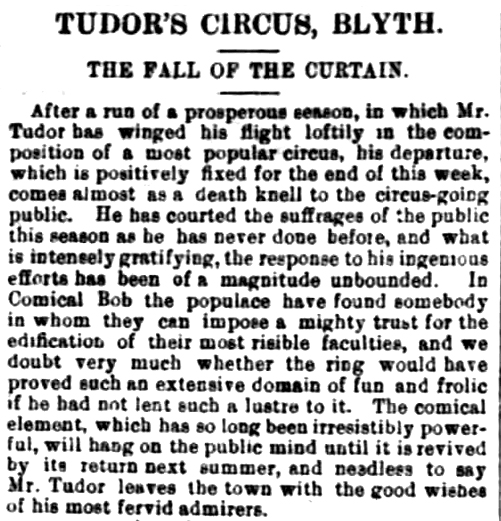
Blyth News, 1 July 1893
But that was not the end of the press coverage. Our last cutting from Blyth is worth transcribing for clarity and at full length as it tells us how a small circus travelled substantial distances when it needed to, and it opens our story of the Cambridge season.
 William Tudor's Circus