The ‘curious dramatic hybrid, the hippodrama’ (Speaight, 1980, p 38), was a popular entertainment staple in 19th century England and France. The Elizabethan theatre buildings and the later riding master schools, particularly that of Philip Astley, were precursors of the permanent circus buildings, with their circular arena and their emphasis on equestrian tricks and displays. In 1768 Astley had included a comic act combining horse-riding with the story of a tailor attempting to ride to vote for John Wilkes at Brentford. ‘The tailor first cannot mount his horse; when he eventually succeeds it won’t move; then it gallops so fast that he is thrown off; and finally it chases him round the ring’ (Speaight, 1980, p 24). This popular act would be performed for years and in many venues, and other historical events and pantomimes would be enacted. The composer and playwright Charles Dibdin and Charles Hughes, equestrian, attempted to combine drama with horsemanship at the Royal Circus in the late 18th century, but it was at Astley’s in the early 19th century that the hippodrama began to flourish. Speaight lists The Brave Cossack, Dick Turpin, The Battle of Waterloo and Byron’s poem Mazeppa, as stories in which horses could figure prominently. Mayer and Mayer state: ‘By 1860 there were more than thirty-five licensed hippodromes in British cities for displays of horsemanship and dramas that featured horses and other quadrupeds’ (Mayer, C and Mayer, D, 2012, p 83).
Horses were regarded both as integral parts of the mise en scène and as actors in their own right. It was for them that practicable settings of mountain heights and pathways, bridges, cataracts and triumphal arches were constructed; for them, too, that plays were specially commissioned to display their ‘sagacity’ and intrepid feats of daring (Saxon, 1968, p 54).
Saxon (p 45) also tells us that ‘out of pantomime . . . hippodrama slowly evolved.’ In 1877 we find William Tudor and his brother Funny Fred Hall performing in Northampton. Fred (Poteen, the Evil Spirit of Ireland, and Clown) and William (Blousabella Busker, and Pantaloon) played in ‘an entirely new Equestrian Christmas Pantomime: O’DONOGHUE and WHITE HORSE of KILLARNEY: or WHISKEY versus WATER’ (Northampton Mercury, 22 December 1877, p 1).
The popularity of horses in drama even caused the actor John Kemble to reluctantly feature horses at Covent Garden, a great success despite an outcry from critics. By the mid-nineteenth century you could see horse-dominated Shakespeare with William Cooke producing equine versions of Richard III, Macbeth and Henry IV Part 1, and even Edmund Kean revising his Richard III with horses. Saxon describes the bizarre image of Lady Macbeth sleepwalking on a Shetland pony (Saxon, 1968, p 158).
William Tudor was foremost an equestrian, and hippodramas could display the skills of his horses and performers while providing exciting and/or amusing entertainment. The 1893 Cambridge season featured Joan of Arc, The Riggs of Mr Biggs, The Masquerade Ball, Fra Diavolo, or The Englishman’s Adventures among the Brigand, The Swiss Lovers on Horseback, The Steeplechase and Harvest Home, and Cinderella.
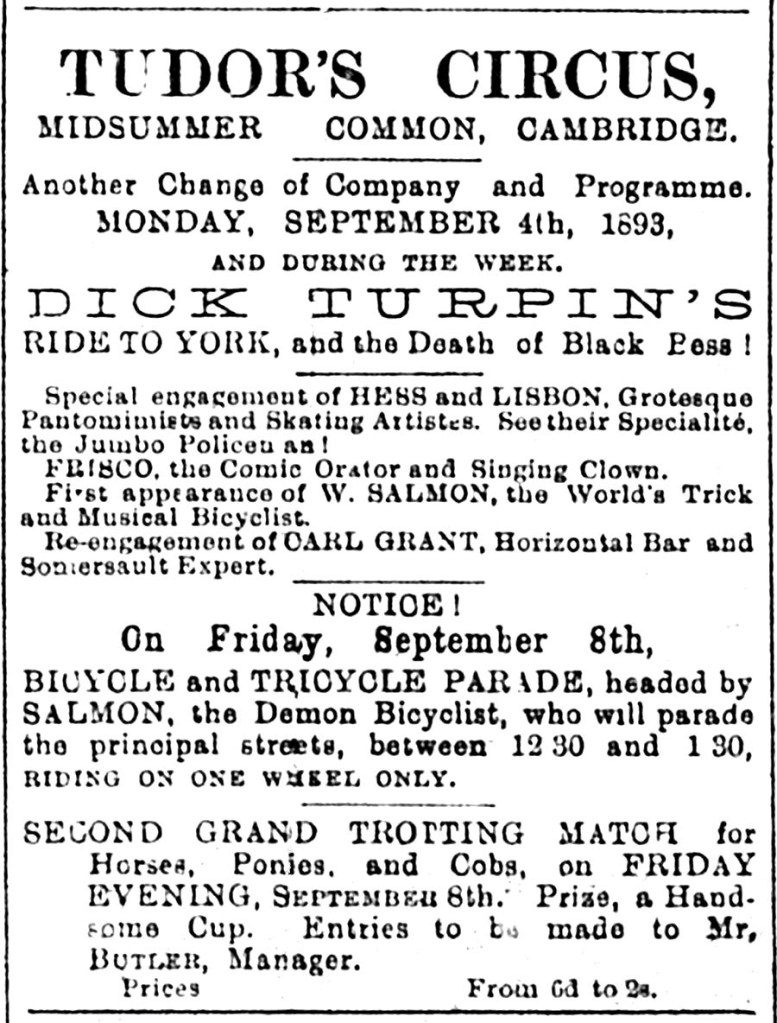
(CDN, 7 September 1893, p 1)
Early September saw Dick Turpin’s Ride to York enacted and this became a staple end-of-season entertainment for Tudor. Written by Henry M. Milner, after the novel by Harrison Ainsworth, the plot followed Turpin’s escape with his horse Black Bess jumping the Hornsey Toll Gate, then galloping to York, where the steed begins to slow and stumble, and finally Black Bess ‘dies beneath him at a crossroads’ (Barnes, 2015, p 55). She remains lying still until, in some versions the horse is carried out on a board on the shoulders of the cast or audience members. This remarkable example of horse-training is described in Thomas Hardy’s Far From the Madding Crowd and in Dickens’s journal All The Year Round (Mayer, C and Mayer, D, 2012, p 89).
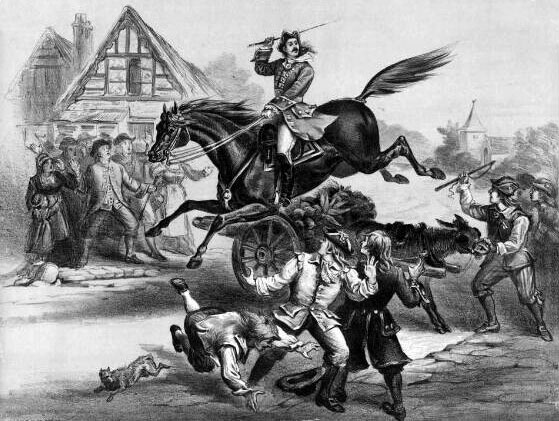
(Victoria & Albert Museum)
Historical spectacles such as The Battle of Waterloo and The Fall of Khartoum, melodramas such as Mazeppa and pantomimes and Harlequinades, and even Shakespeare, were all used for hippodramatic purposes, but it was ’the gallant robber, horse-stealer, and murderer Dick Turpin, whose history, repeated at Astley’s and elsewhere for a period of well over a hundred years, was still being performed in tenting circuses long after Mazeppa and the other great hippodramas of the nineteenth century had been forgotten’ (Saxon, 1968, p 67).
After Astley’s closed in 1893 the great circus proprietor George Sanger turned to touring England with travelling circuses often featuring ‘the most popular spectacle of all’ the old favourite Turpin’s Ride to York. Saxon describes a performance that gives some idea of a production:
The façade of an inn was placed across one of the entrances to the ring in Sanger’s tent. After accidentally shooting his accomplice Tom King, Turpin fled on Black Bess through the opposite entrance, then rode around behind the tent to return at the other entrance, where the Doncaster tollgate had meanwhile been set up to bar his way. Bess made her celebrated leap over the gate, and in the following scene carried her master to the robbery of the York mail coach . . . The concluding scene, heralded by a carpet spread over the sawdust, depicted the poignant death of Bess, who staggered in, fell down, and raised her head for one last kiss from her prostrate weeping master. Eight grooms and tent-men dressed as yokels entered with a huge shutter, and the horse, with Hamlet-like ceremony, was carried out shoulder-high. (Saxon, 1968, p 222)
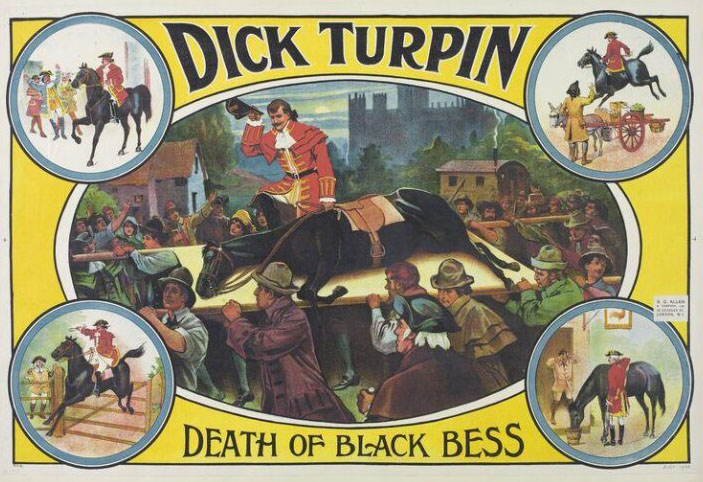
(Victoria & Albert Museum)
Did Tudor’s circus match up to this spectacle? William had played Turpin at his own circus in Blyth in May 1892 (Blyth News, 7 May 1892 p 7) and had plenty of hippodrama experience to draw on as he had been performing in Dick Turpin for many years. During his tour with Stoodley & Harmston in the late 1870s he played Ralph the stable-lad in Dick Turpin’s Ride to York alongside his brother Funny Fred Hall as Sammy, the Beadle’s son (Northampton Mercury, 15 December 1877, p1; Lincolnshire Chronicle, 10 May 1878, p 4).
In 1893 the CDN reviewer describes this ‘great feature’ in detail:
To witness this ever popular display there was a bumping house. Mr Tudor’s Dick Turpin is well acted, and better still is the wonderful docility and intelligence of ‘Black Bess’. Mr J. Pearce Butler is a dashing, devil-may-care Tom King. Mr Bucknall, as the ‘first beadle’, is an ideal representative of Bumbledom, whilst ‘Sammy, his son’, in the person of Bob Anderson, is indescribably funny. The other characters are well sustained. The best scene is the death of ‘Black Bess’, which should be witnessed by all who wish to see the perfection of horse training (CDN, 5 September 1893, p 3).
while the Cambridge Express reviewer wrote that
The piece has been performed nightly, and has been received with tremendous applause. The fine horse which Mr Tudor introduced in the sketch is a masterpiece in training’ (CE, 9 September 1893, p 8).
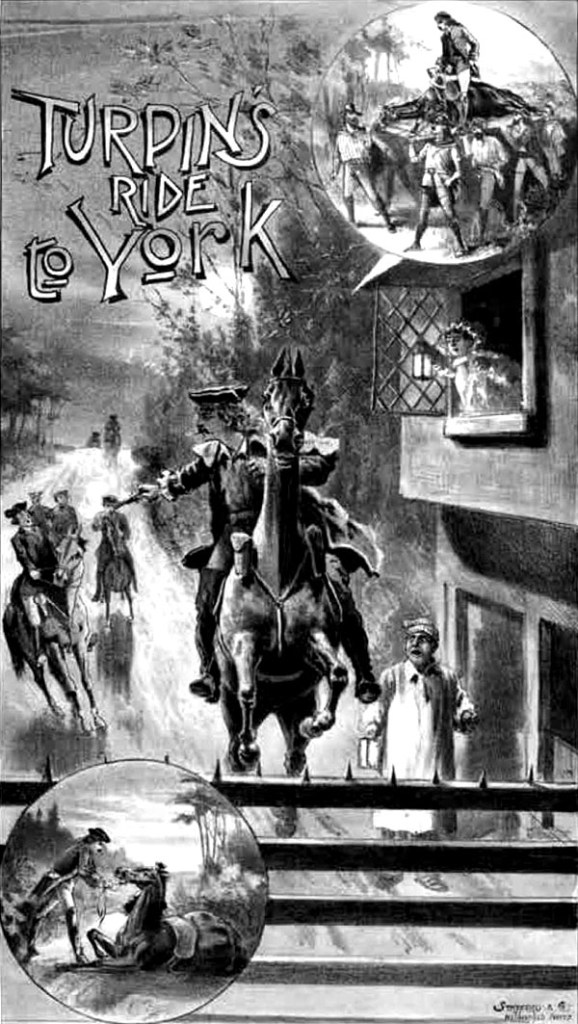
From Mayer, C and Mayer D, Exit with Dead Horse. Plate 33: Turpin’s Ride to York, stock poster printed by Stafford & Co., n.d., © Michael and Bell Diamond Collection
Two years later in 1895 the Cambridge Daily News gave an even more detailed review. ‘The grand equestrian Spectacle’ is repeated and ‘much appreciated by the Cambridge public, and the circus was filled in every part.’
Everyone is familiar with the story of the notorious highwayman Dick Turpin, of the death of Tom King and the famous ride to York, where Black Bess’s strength is exhausted, and where she dies. On its first production at the circus this season, every incident was followed with great attentiveness, and Mr Tudor and his Black Bess were frequently applauded. Mr Tudor gave a capital impersonation of Dick Turpin, his lines being delivered in a natural and feeling manner, especially when a mile from York his mare goes lame and begins to stagger, and then, exhausted, finally fell, and there were many moist eyes amongst the audience. Hearty applause greeted the artistes at the conclusion. Mr Albino as Tom King, gave a fine representation of Dick’s daring friend, who was killed by the latter’s hand. Mr J. Fernandez was the ideal of a pompous old beadle, whilst his son, Sammy (Nimble Nip), as he always does, kept the audience in one continual state of laughter (CDN, 23 September, 1895, p 3).
Dick Turpin’s Ride to York would continue to delight the Auckland Road audiences in 1896, 1897 and 1898.
George Sanger continued to feature Dick Turpin in his touring circuses in the 1890s but the days of the hippodramas were effectively over.
Bibliography
Barnes, L. (2015). A Crowded Stage: The Legitimate Borrowings of Henry Milner’s Mazeppa. Nineteenth Century Theatre and Film, 42(1), 50-65. https://doi.org/10.1177/1748372715616795 (Accessed 3 May 2024).
Mayer, C. & Mayer, D. (2012). Exit with Dead Horse. Nineteenth Century Theatre and Film, 39 (1), 78-92. https://doi.org/10.7227/NCTF.39.1.7 (Accessed 3 May 2024).
Mayer, D. (2011) Riding for a Fall: a Saddle for Mazeppa’s Fiery Steed, in Stephen Johnson (ed.) A Tyranny of Documents: The Performing Arts Historian as Film Noir Detective, New York, Theatre Library Association, Performing Arts Resources. Vol. 28. 2011. P.143-150. 2011, pp. 143-150. Available at: https://www.stagestories.org/wp-content/uploads/2019/03/PAR28-Colleary.pdf (Accessed 3 May 2024).
Saxon, A H (1968). Enter foot and horse: a history of hippodrama in England and France. New Haven and London, Yale University Press.
Speaight, G. (1980). A History of the Circus, London, Tantivy Press.
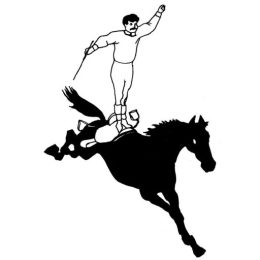
 William Tudor's Circus