The historical background
Performing animals and circuses have gone together since antiquity and from medieval times exotic and performing animals were seen in Britain on village greens and at fairs. Shakespeare refers to a dancing horse in Love’s Labour’s Lost, Act 1, Scene 2, line 58, and on 1 September 1668 the diarist Samuel Pepys went to St Bartholomew’s Fair and saw ‘several sights’, including a mare that ‘tells money’. Another description of the fair has ‘scores of booths which showed everything from dancing dogs and monkeys to puppet shows, clowns, jugglers, tightrope walkers, giant hogs and plays’ (Fountain, 2011, p 3). Exotic animals came to Stourbridge Fair, as we showed in our first section.
The Tower of London housed a menagerie of wild animals from the 13th century, with lions, bears and an elephant. Speaight describes animals being toured for exhibition in the 16th century, including lions, elephants and apes, and traces how the circular cockpits, bear gardens and bull-baiting rings of the Elizabethan period developed into theatres. Finally, the circular hippodromes of Philip Astley, Charles Hughes and others led directly to the circus arenas with their diameters of 40 to 47 feet, the best dimension for a circling horse and performer (Speaight, 1980, pp 14-15, 24).
Wild animals in Cambridge
American showman Isaac Van Amburgh toured Britain and the Continent with performing lions between 1838 and 1845, and was very popular, being seen by Queen Victoria and Prince Albert.
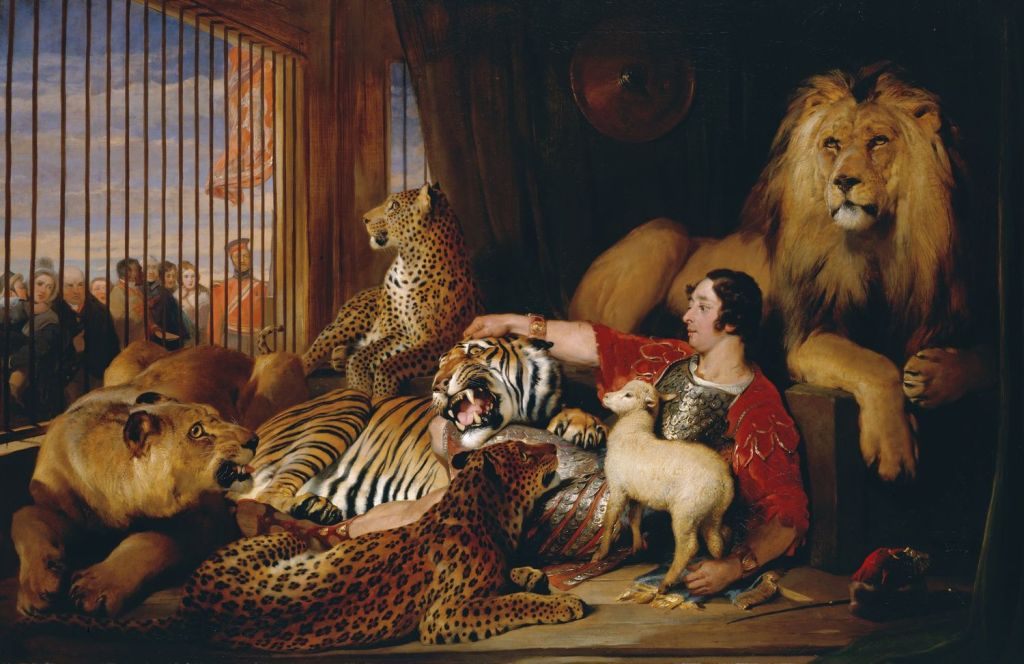
Queen Victoria saw van Amburgh’s show seven times in 1839 and commissioned this painting from Edwin Landseer (Royal Collection Trust)
He kept his training methods secret but there was much controversy at the time over the cruelty, and it was thought he used beating, baiting and starvation. As Josiah Chater tells us, Van Amburgh visited Cambridge for three nights from Tuesday 16 November 1841 and on 11 November 1844 advertised a ‘Roman Amphitheatre’ circus on Midsummer Common for 12 nights.
The people of Cambridge would also have been used to seeing wild animals in some of the larger travelling circuses and menageries, particularly the American ones, that visited the town later in the 19th century. Wombwell’s, Sanger’s and Ginnett’s circuses all had wild animals and Mander’s Royal Menagerie was a regular visitor.
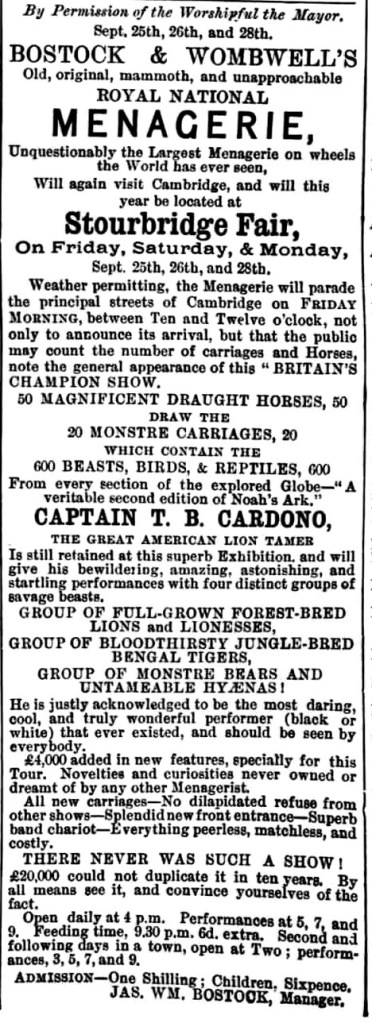
Cambridge Independent Press, 19 September 1885, page 8
Sanger’s circus and menagerie visited every two years or so, including Tudor’s off-year of 1894. In 1890 Sanger advertised over 100 horses, a horse and a bear that walked a tightrope, and a riding lion, in addition to the menagerie (CDN, 30 October 1890, p 2). ‘The performances were preceded, as usual, by a procession through the town, the very tame “wild animals” exciting a great deal of curiosity’ (CCJ, 7 November 1890, p 4).
Trade in wild animals
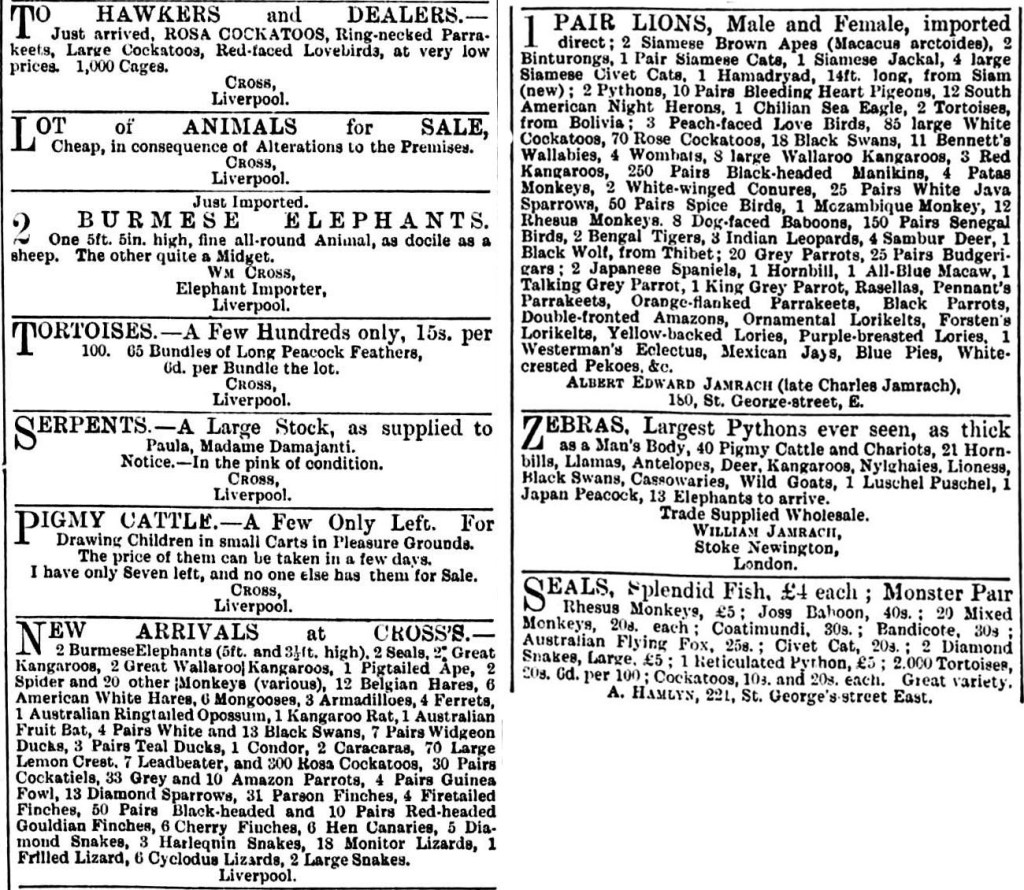
Where did the show people obtain their exotic animals? These advertisements from The Era (2 May 1896, page 25) provide an answer and indicate the extent of the trade. Cross, the Jamrach family, and Hamlyn were all well-known suppliers to circuses, zoos, menageries and collectors, located within easy reach of the docks where the animals arrived. Here we find where Nala Damajanti bought the snakes she brought to Auckland Road a few months later, and learn that Albert Jamrach had a pair of lions, three Bengal tigers, a black wolf from Tibet and three Indian leopards available in a startlingly diverse list. Hamlyn and Cross sold tortoises by the hundred.
Animal welfare and cruelty
But more people were expressing concern about the welfare of animals that were moved regularly from town to town in confined spaces and trained, perhaps cruelly, to perform. William Tudor (never, as far as we know, accused of cruelty) was praised for the care of his horses: ‘The dumb animals under his command are his constant study and care, and the perfection at which they have arrived are the most convincing testimony to his love and care for their material welfare’ (Morpeth Herald and Reporter, 4 June 1892, p 3). Tudor’s old friend James Newsome received good coverage in Cambridge, too.
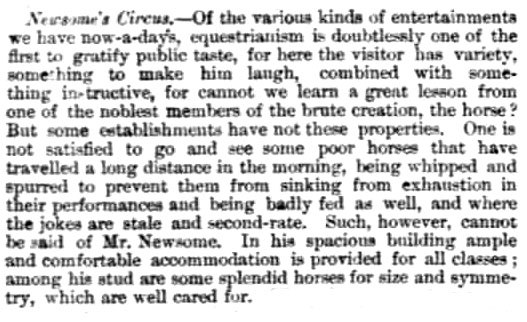
CCJ, 28 June 1862, p 5.
Wild animals seldom featured in Tudor’s circuses at Cambridge, but we have noted four acts: Clemolo’s monkeys in 1895; Nala’s snakes in 1896; Permane’s bears in 1898; and Lockhart’s three elephants in 1899. There were, however, plenty of domestic animals and pets such as performing horses, donkeys, dogs, cats, pigeons, chickens, and the occasional goat. There were ducks and geese in the water carnival in Tudor’s northern circuses.
Circus owners and animal trainers would be quick to deny that welfare suffered or that cruel training techniques were used. The year after his bears made their brief appearance in Cambridge, William Vincenti Permane brought a libel case against at the Blackpool Gazette for printing the complaints of a Mr J Simpson, the consulting engineer of the Blackpool Empire Theatre. Simpson had witnessed Permane’s extreme cruelty to his bears backstage at the theatre. Simpson had written that:
Several times the bear fell and as a result was thrashed unmercifully with a heavy whip over the head, kicked, and afterwards treated in Mr Permane’s eminently fervid manner.
[The treatment continued as Permane dragged the bear by its chain, beat its nose till it groaned, kicked its lower parts . . .]
and generally gave such an exhibition of brutality as I, personally, have never seen the equal. If only people of this country knew the horrible tortures that performing animals suffered in their training they would hiss the show off the stage.
(Lancashire Daily Post, November 29, 1899, p 3)
Witnesses backed up Permane’s denial of cruelty, he won his libel case, and was awarded £75 damages (Bradford Daily Telegraph, 30 November 1899, p 6). He continued to appear with animals, finally with a performing monkey in 1938 (Turner, 1995).
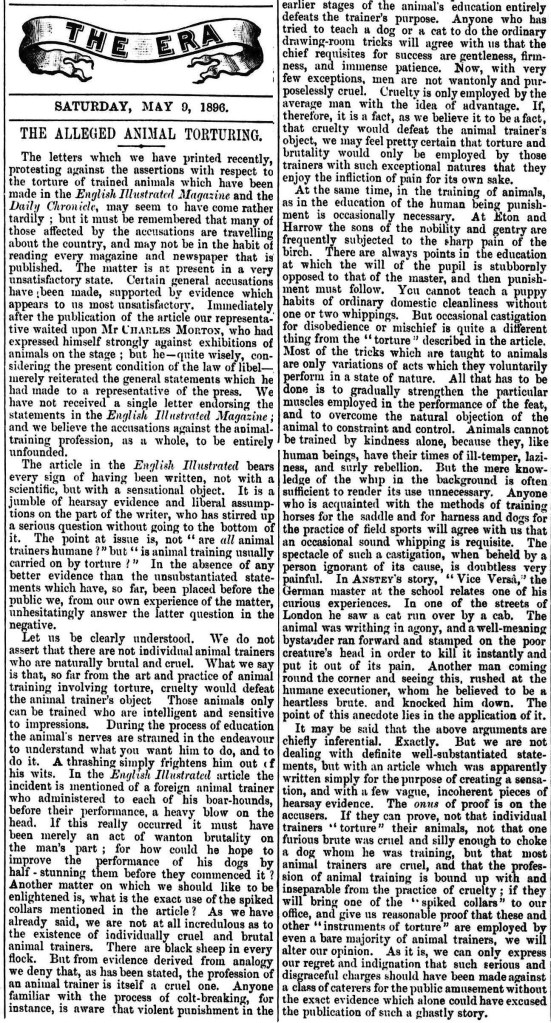
Page 17 of The Era, 9 May 1896 carried an editorial piece in response to matters raised in the Daily Chronicle and the English Illustrated Magazine:
The Era itself had already published correspondence on 2 May, but here is a letter from Louis Duprez on the ninth. This was a year before he performed at Tudor’s circus. It shows the anxiety about performing animals and the concern of some owners for their creatures’ welfare. Other supportive letters were printed that day too:
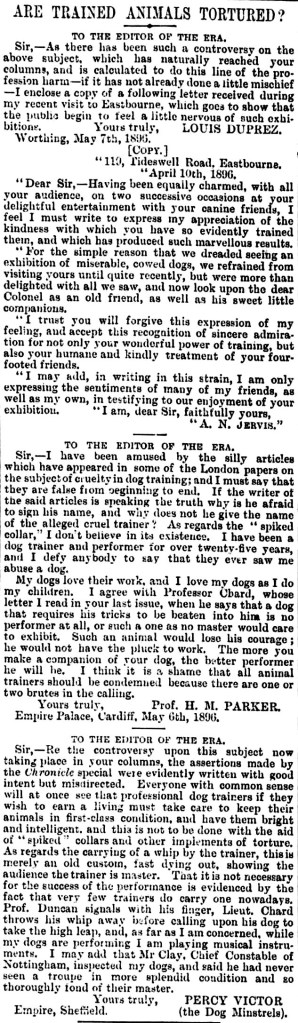
The Era, 9 May 1896, p 19
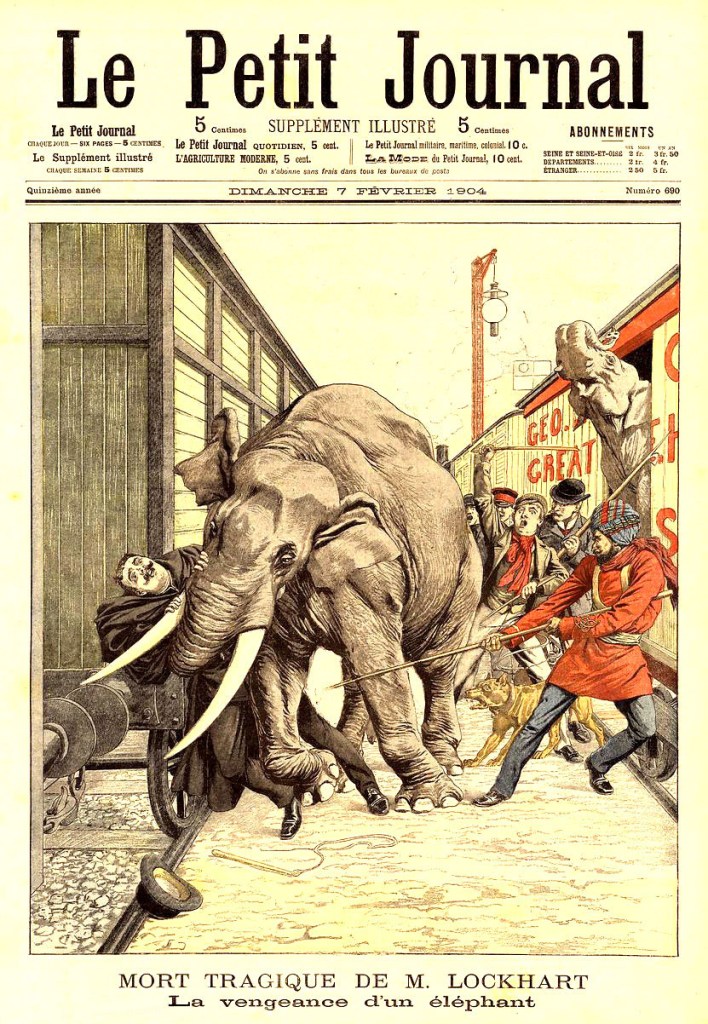
The elephant on the train: George Lockhart’s untimely death , reported in Le Petit Journal, 7 February 1904.
In 1899 George Lockhart’s elephants appeared at Tudor’s Circus for one week. Lockhart was an elephant trainer who toured Britain and Europe with his three elephants, Boney (a Borneo pygmy elephant), Molly and Waddy. Boney did most of the performing, playing a hand organ and cymbals, and riding a tricycle. Lockhart was praised for his meticulous training and the act remained very popular for years. In 1902 he purchased four female Indian elephants – Salt, Sauce, Mustard and Pepper, collectively known as Cruet. In 1904 he was crushed to death by one of his troupe when they were being unloaded from a train at Walthamstow station. Several books have been written about him, including Grey Titan, The Book of Elephants by his son George Lockhart Jnr and W. G. Bosworth, 1938.
And so the spectacle of performing animals and menageries continued, particularly with the American touring circuses such as Barnum and Bailey’s Greatest Show on Earth, described in our section on 1898.
The modern era
The menageries and touring circuses with wild animals continued to visit Midsummer Common into living memory, and photographs and reminiscences can be seen in the local press of circus elephant processions through the streets of Cambridge up to the 1970s.
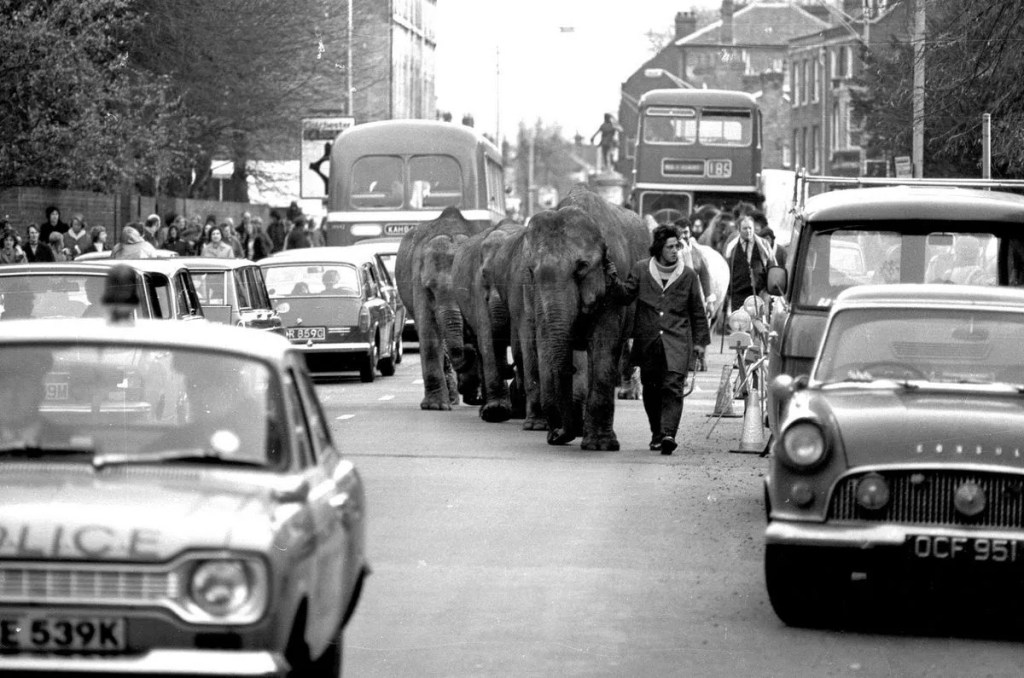
The Robert Brothers’ Circus parade from Cambridge station to Midsummer Common on 10 November 1974 was reported the following day on page 4 of the Cambridge Evening News. This photograph from the parade was published on the CambridgeshireLive website, 30 March 2022.
But as people in the 19th and 20th century became increasingly concerned about this use of animals in circuses and in zoos, organisations were founded such as the RSPCA (1824), part of a movement against cruelty to animals, both wild and domestic, which led eventually to the Wild Animals in Captivity Protection Act in 1900. In 1914 the Performing Animals Defence League was formed, PETA in 1980, and several other national and local campaigning organisations followed. Subsequent legislation included the Performing Animals (Regulation) Act 1925 and the Dangerous Wild Animals Act in 1976 which required a licence for a wild ‘pet’ but did not apply to circuses.
An opinion piece by Jean Gumbrell in the Cambridge Evening News (2 October 1979, page 6) sums up what many local people were feeling:
Do zoos and circuses give as much pleasure as we are led to believe? What sort of thrill do we get from elephants balancing on small wooden stools, and lions roaring to the command of the lion-tamer’s whip? Whether there is actual cruelty involved in the training of these animals, I am not equipped to say, but certainly I feel that in teaching animals to perform in a way that must surely be unnatural to them, we are suffering them to an indignity that debases us, the spectators. And one wonders what sorts of lives these animals live outside the circus ring, cooped up for endless hours in trucks that travel from one town to another.
In 1981 City Councillor Liz Gard called for a ban on circus animals on municipally-owned land in Cambridge, while Councillor Peter Howell thought that performances by wild animals should be banned in circuses but domestic animals allowed to perform (Cambridge Evening News, 12 September 1981, p 6).
A group of circus proprietors yesterday condemned Cambridge City Council’s decision to ban all circuses with wild animals from using council–owned land . . . At last week’s council meeting members also outlawed circuses with domestic animals not inspected regularly by a vet.
(Cambridge Evening News, 15 October 1981, p 12)
In 1985 the Austen Brothers Circus tested the ban by bringing elephants to Cambridge, a City Council officer having erroneously allowed them to do so (Cambridge Evening News, 11 September 1985, page 3). There was more controversy in 1996 when the Council decided that it needed to check whether it actually had the power to forbid circuses from using wild animals (CEN, 29 January 1996, p 7).
A few years later, national legislation clarified matters with the 2006 Animal Welfare Act, the Welfare of Animals (Transport) Orders in 2006 and 2007, Animal Welfare (Licensing of Activities Involving Animals) (England) Regulations 2018, and the Wild Animals in Circuses Act in 2019. This has banned wild animals in circuses since 2020. This does not apply outside circuses, so zoos and private individuals may own wild animals but they must be licensed. The RSPCA and the government have published guidance and information on keeping wild animals.
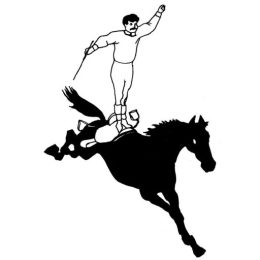
 William Tudor's Circus