(CCJ, 22 February 1895, p 7)
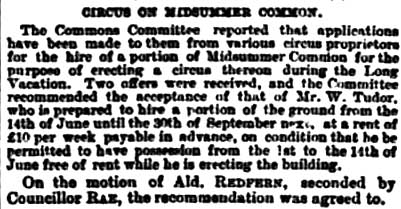
After a gap of almost two years because of the 1894 Royal Show, Tudor’s Circus was back on Midsummer Common in another temporary wooden building. As we see above, Tudor was not the only applicant but his offer succeeded and he paid a deposit of £20. As in previous years, his agreement with Cambridge Borough (Cambridgeshire Archives CB/2/CL/17/14/Page 349) required him to repair any damage to the common at the end of the tenancy. The usual dung clause applied, too.*
Tudor was advertising for acts in The Era (p 23) as late as 15 June:
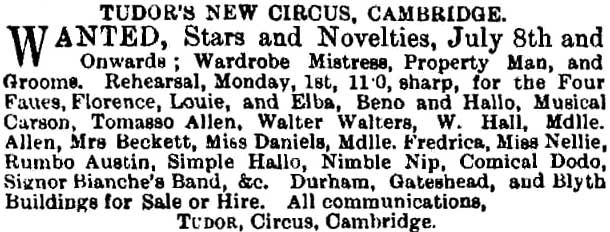
A week later the Cambridge Express was pleased that ‘a large building has been erected on Midsummer Common, in which the comfort of the audience has been well consulted’ and that it was ‘an entirely new and commodious building’ (CE, 22 June 1895, p 8). The Cambridge Daily News reported on a ‘specially erected building on Midsummer Common’ which was ‘of a substantial character, commodious and exceedingly comfortable’ (CDN, 18 June 1895, p 2), while the Cambridge Independent Press was grateful that the monotonous long vacation would be relieved by the return of Tudor’s Circus.
In the meantime, William maintained his usual hectic pace. The Era (8 June 1895, p 20) tells us that he was in Blyth ‘paying a flying visit to the scenes of former triumphs’ with his performing pony Billy and in ‘a capital double act on two horses’ with Rebecca Daniels. Brother Fred is described as lessee of the circus and, as we would expect, performed as Funny Fred Hall.
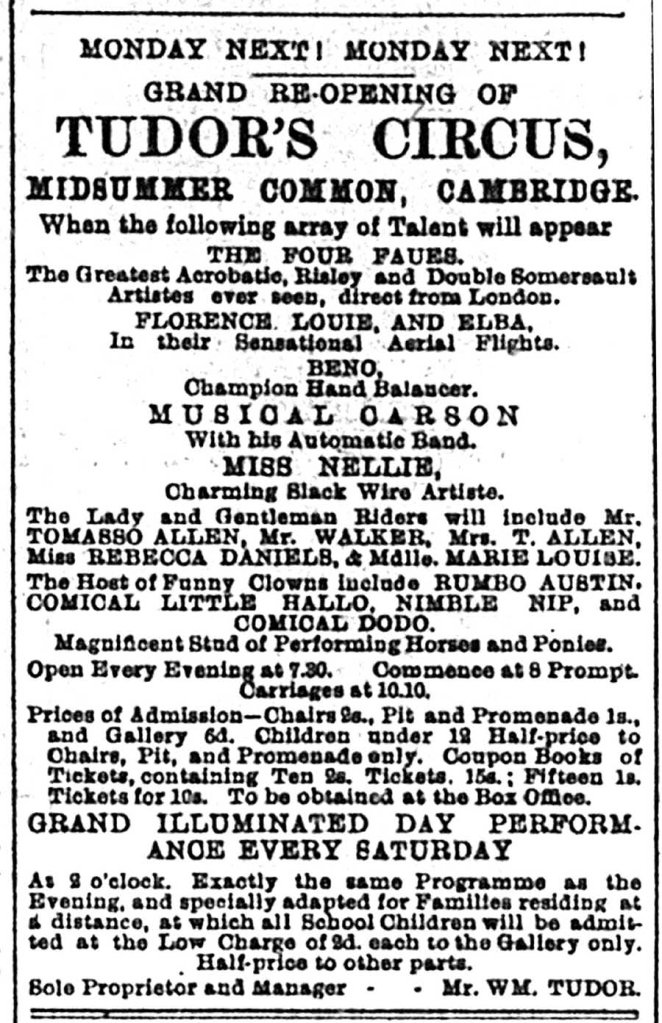
The grand re-opening on Monday 17 June was announced. Mr William Tudor trusted ‘that his efforts to cater for all classes may be appreciated in the same magnificent manner as on the same ground two years ago.’ As usual Tudor was concerned that the circus would be high class and respectable, so that it ‘will not offend the eye, and will be entirely devoid of vulgarity.’ Under his personal management Tudor promised male and female ‘Equestrians, Athletes, Gymnasts, Acrobats, Musical and Vocal Comedians, the latest London and Continental specialities, and six Merry, Droll and Whimsical Clowns. A First-class Stud of Performing Horses and Ponies. An efficient Band and a qualified Manager of each Department’ (CDN, 8 June 1895, p 1).
A week later the opening cast was announced. The acrobatic Four Faues were back, as well as trapeze artists, hand balancers, and slack-wire artists.
(CDN, 13 June 1895, p 1)
The enthusiastic CDN reviewer reported on the first programme of the season. Apart from the indifferent performance of the band the evening made ‘a very auspicious commencement.’ Mr Tudor’s educated pony Billy showed ‘cleverness and intelligence seldom seen in the ring.’ Mr Tomasso Allen, as ‘the Newmarket Jockey’ sustained a nasty fall but pluckily continued his dashing performance. A daring rider, he had performed with Ginnett’s, Croueste’s and Keith’s circuses in the past and was married to Jenny Ducrow (Madame Frederica), another Tudor regular. Sadly he was to die of consumption in November 1898 aged only 37 years.
The best act were the sensational Four Faues, and Nimble Nip the clown had a special mention for his ‘very clever and novel skipping rope performance.’ There would be a ‘grand fashionable night every Friday, and an illuminated mid-day performance every Saturday’ (CDN, 18 June 1895, p 2). Musical Carson, with his patent Automatic Band, managed to play concertina, fairy bells, drums, triangle and cymbals, all at the same time, and was cheered for his impersonation of a Salvation Army band. The CIP reporter, however, thought the latter disrespectful (21 June, p 8).
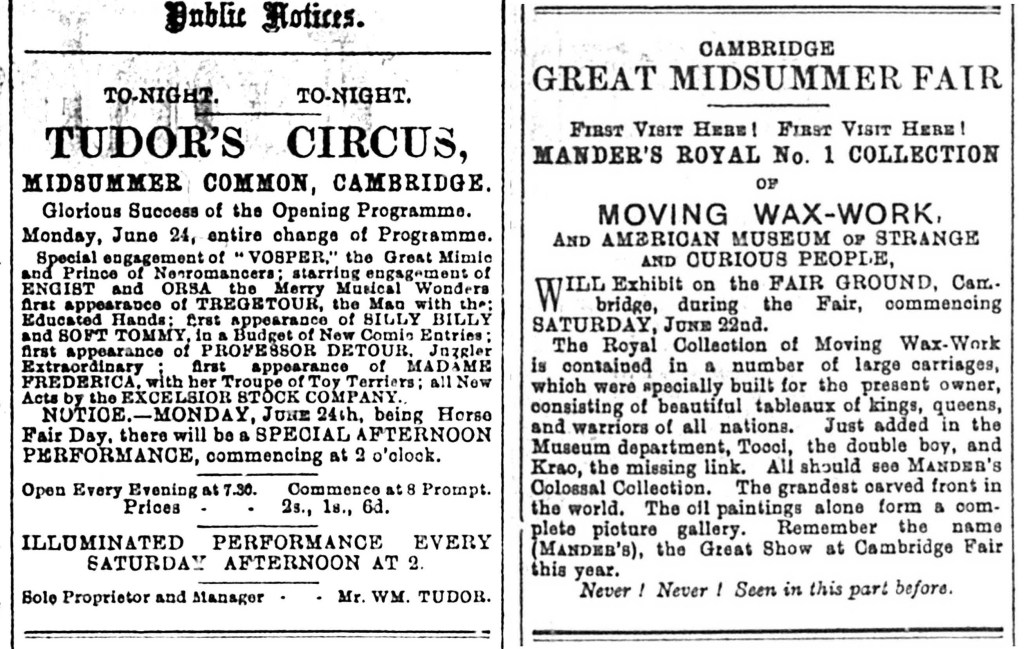
Nearby on the Common, Midsummer Fair on June 22 advertised a special attraction – Manders’ Waxworks ‘An American Museum of Strange and Curious People.’
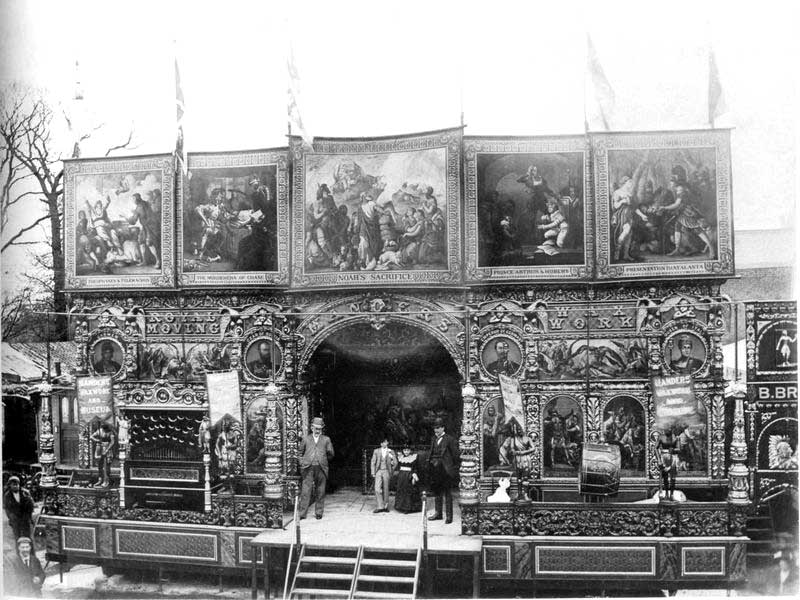
Manders’ Waxworks in the 1890s – the source of this picture is here
Undaunted, Tudor placed his advertisement directly above on the front page of the Cambridge Daily News on 21 June and it seemed to do the trick.
And then we learn that the Fair was both vulgar and dangerous!
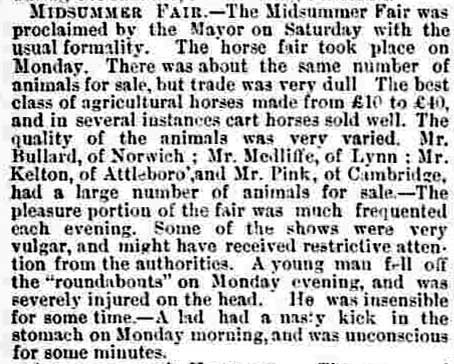
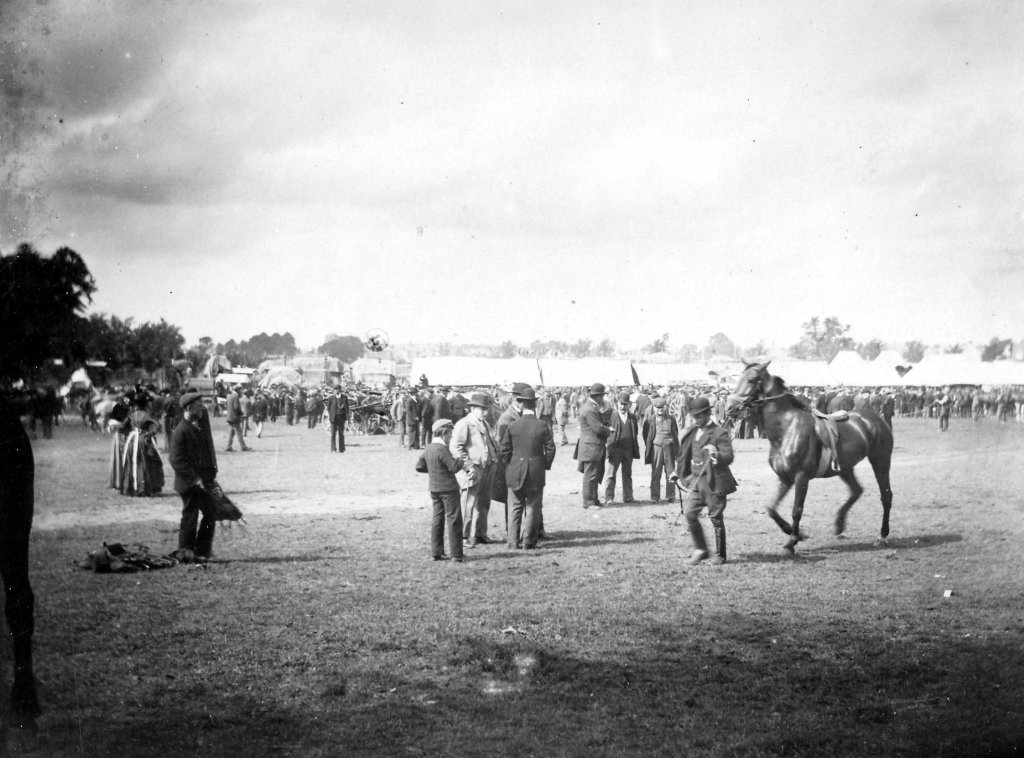
Midsummer Common Horse Fair in 1898. Three years earlier, ‘trade was very dull.’ Milton Road windmill can be seen on the skyline above the roof-tops, left of centre.
Back at the circus, which of course was never vulgar, the band had strikingly improved by the second week and the reviewer was particularly impressed by Mademoiselle Frederica’s nine terriers who ‘skip and walk on their hind legs, jump hurdles in the same position, and turn complete somersaults backwards, as neatly and as quickly as any human acrobat.’ Mr Tregetour with the help of a screen and lanterns, by manipulating his hands and fingers cast shadows of various animals, birds, men and women. The highest billing Vosper, fresh from having entertained London society, did the same for Cambridge, turning water into wine and back again, and giving impersonations of Burns and Shakespeare, the actors Ellen Terry and Henry Irving, and various politicians. The audience, as cosmopolitan as their London counterparts, gave hearty applause. One of the pair of musical clowns who appeared as Engist and Orsa, was David John Gillings, or George Mozart, who went on to become a well-known music hall act, appeared in many films, and was a co-founder of Hammer Film productions. He had already appeared at Tudor’s circus in August 1893 as one of the amusing and musical Two Mozarts. Finally, the reviewer could not resist pointing out that despite the large number of clowns ‘several fresh jokes were cracked’ (CDN, 25 June 1895, p 2).
July gets off to a flying start
The next programme took off with the The Flying Zedoras, with Alar the Human Arrow, and Salmon the Demon Bicyclist. The Zedoras were a startling and sensational trapeze act.
One little slip or a fraction of a second late in the flying acts and they are precipitated into the net below. This happened twice last night, but only in attempting one of the most difficult feats that has been witnessed in Cambridge, viz, flying from one end of the building past the centre, turning a double somersault and catching hold of a bar, upon which is a lady swinging to the other end of the building, and back again in time to fly onto his own bar (CDN, 2 July 1895, p 2).
One of the male Zedoras performed blindfolded and with a sack over his head but it was the young girl, Alar, who really impressed.
Click here for more information about this remarkable woman.
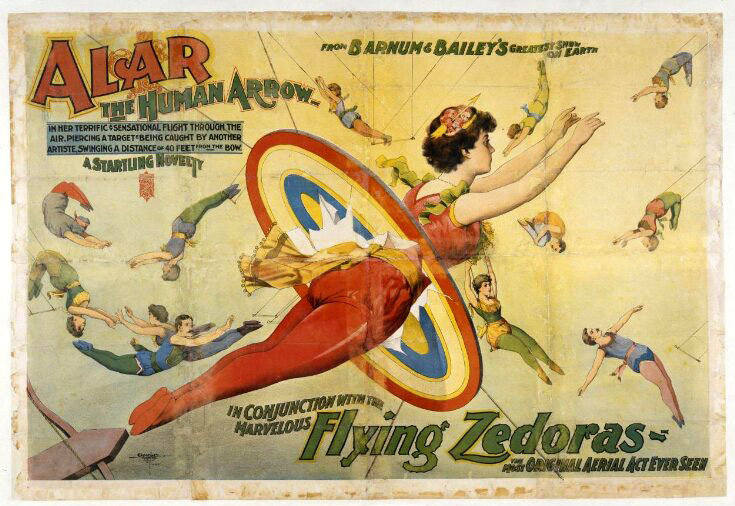
Alar the Human Arrow and the Flying Zedoras were hired for Barnum & Bailey’s Greatest Show on Earth (Victoria & Albert Museum)
Salmon, the Demon Bicyclist, was so skilful that it was said Cambridge’s local cyclists could learn a lot from him. Having removed the handlebar and bar, he rode on the front wheel, and the back, and then on stilts, and then played a violin, and all on the bicycle.
The next week saw a complete change when Leopold Leglère’s five acrobats presented living pyramids and backwards somersaults. They were to appear again in Cambridge in 1897 and 1898.
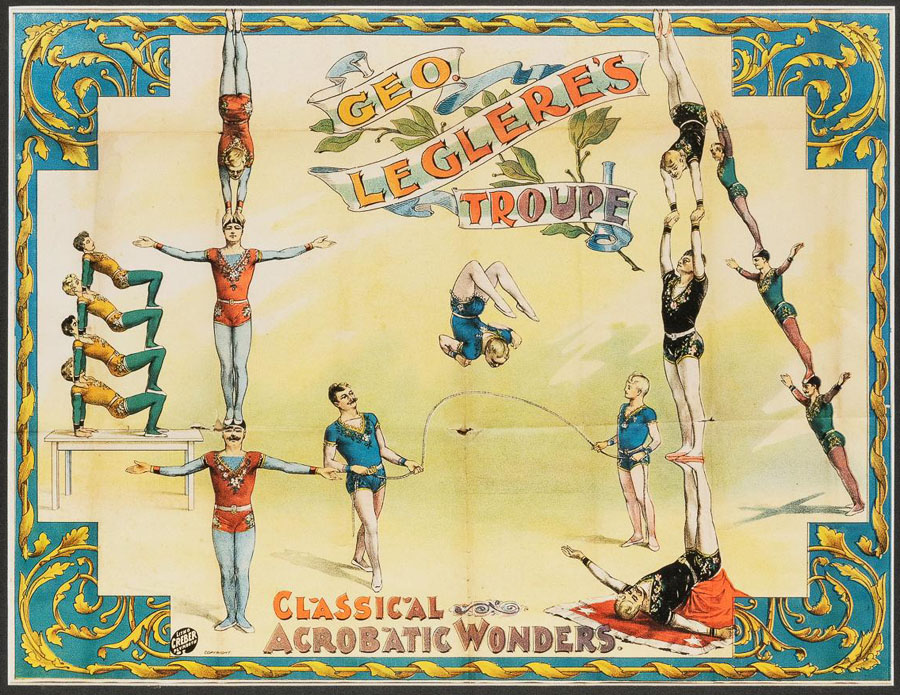
This poster for George Leglère’s Troupe gives a good idea of how Leopold Leglère’s acrobats would have appeared in Cambridge
Were the audience confused by Pongo the agile Man Monkey and Clemolo with his troupe of performing, real monkeys on the same bill? More animal jinks came with the reappearance after an absence of seven years of Frank Anderson, or Handy-Andy, with his comical and intelligent donkey Patsy. Her finale was to ‘bite a significant piece out of Anderson’s nether garments, which, of course, again, convulsed the audience’ (CDN, 10 July 1895, p 2). Not distracted by the various political meetings in town for the forthcoming General Election, the Cambridge townsfolk enjoyed the comic turns and clowns and monkeys with hearty and frequent applause.
The painful death of Henry Bucknall
Tudor suffered a major blow on 11 July when his business manager and advertising agent Henry Bucknall died in his lodgings at 23 New Square ‘after a short and painful illness, aged thirty-three. Deeply regretted’ (The Era 13 July 1895, p 10). ‘Short and painful’ would appear to be an understatement as the death certificate reads ‘Ulceration of bowels, 21 days; Haemorrhage, 21 days; Exhaustion’. Dr David Davies tells us that this means ‘Acute stomach ulcer with bleeding complicated by perforation . . . a slow and painful death’.
Bucknall is buried in the St Andrew-the-Less section of Mill Road cemetery. He had received appreciative coverage in the press during Tudor’s 1891-1893 north-eastern peregrination, being the object of a benefit night in Blyth and the recipient of ‘a handsome gold watch . . . subscribed for by friends who hold him in high esteem’ (The Era, 17 June 1893, p 10). We also encounter him in Cambridge during that same summer, when he received another benefit and played the First Beadle in Dick Turpin. Bucknall married Louie Guildford while managing Tudor’s circus in Durham in September 1894 (The Era, 8 September 1894, p 12) and was clearly a popular man of many parts. Tudor’s regret – we think it likely it was he that posted the notice in The Era – must have been sincere.
Clemolo, Little Jo, Clown Clemolo or Professor Clemolo had performed for many years as a trapeze artist with his brother, and also with an eccentric troupe of intelligent, performing dogs and monkeys. Tudor must have known the Clemolo brothers for a long time as he was on the same bill as them at Stoodley and Harmston’s Circus in Leicester in March 1876 (Leicester Chronicle, 11 March 1876, p 10). In December 1883 at Tayleure’s Circus, Clemolo, on going to feed his three dogs, found that they were dead. We do not know what happened, but he was able to recruit more, and dogs and monkeys were soon back in action in January 1884. His most famous monkey, Alley Slinker, the most marvellous monkey on earth, was a great favourite throughout the 1880s and 1890s. He could walk a tightrope and turn a double somersault on a rolling globe, a feat which was apparently the talk of London. The poster below appears to be Clemolo with a monkey called Boz, who is doing the same tricks, and since Slinker was performing in March 1895, it was likely to be him in Cambridge: ‘Clemolo’s champion performing monkeys are the most attractive and interesting feature and cause any amount of laughter’ (CIP, 12 July 1895, p 8).
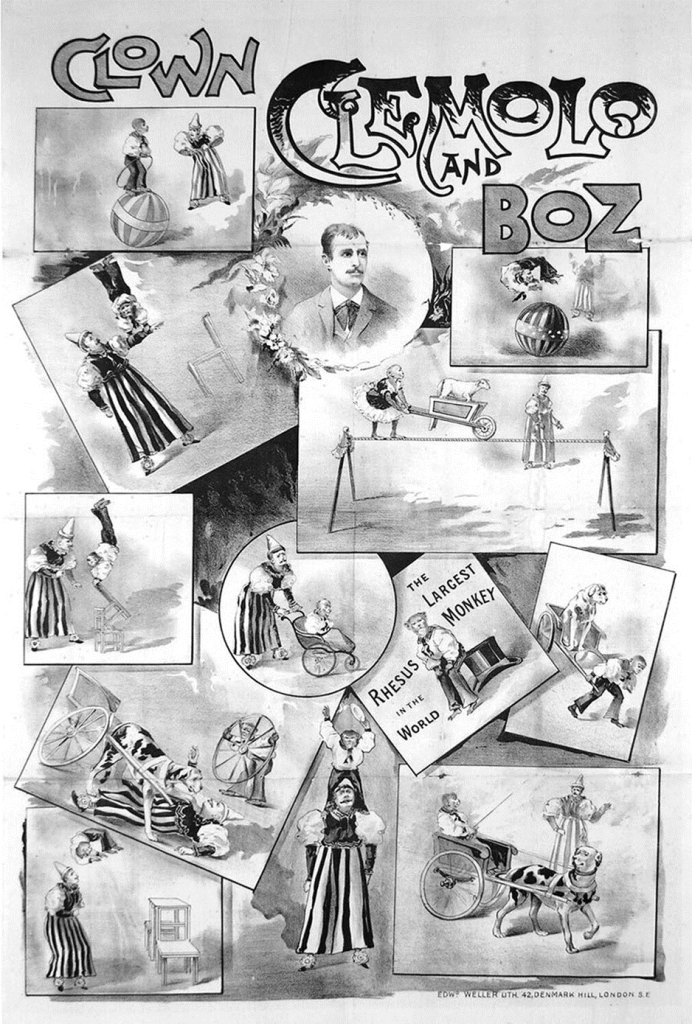
Mademoiselle Frederica demonstrated the versatility of circus performers by next appearing with her handsome horse Monte Carlo, and then alternating her dogs with her horses. She also demonstrates the often-close connections between circus families. She was born Jenny Ducrow, from the Ducrow circus family, married Thomas (Tomasso) Allen and, following his early death at 37, married George Batty, grandnephew of William Batty of Astley’s Circus. She became famous for her troupe of performing terriers and appeared at Tudor’s Circus from June to August in 1895. But this lengthy engagement began to pall. A week later the dogs are causing roars of laughter with some new tricks. On 23 July she performs with her horse Ishmael. Then the wonderful terriers were back. The Cambridge Express seemed slightly disheartened by the fact that ‘Mddle Frederica’s troupe of performing dogs are with us yet’ (CE, 3 August 1895, p 8). The following week they found her the perfect horsewoman on her beautiful horse, Ishmael. On August 13 the terriers are ‘as fascinating as ever.’ But by 20 August the audience were getting a little tired of some of the stock company and appreciated a complete change of programme.
We do not wish to be understood to mean that their performances were not very clever. On the contrary, the dogs were some of the best trained we have seen, but there is such a thing as having too much of a good thing (CDN, 20 August 1895, p 2).
Mdlle Frederica was not to appear again until she returned for two weeks in the summer of 1898. Handy Andy and Patsy the donkey stayed for a second week along with new acts of mimics, acrobats and ladder artists and the whole company performed a comic ballet called Love in All Corners.
In mid-July there was much excitement in the town over the General Election, with many public addresses from the candidates. On 16 July the counter-attraction of the declaration of the poll meant a smaller audience than usual. Conservative Robert Uniacke Penrose Fitzgerald won with 3574 votes (55 per cent). But the lively and loquacious puppets of the ventriloquist Mr Hutchinson gave almost as much verbal entertainment, as they chattered and sang with different voices and accents, sometimes at the same time.
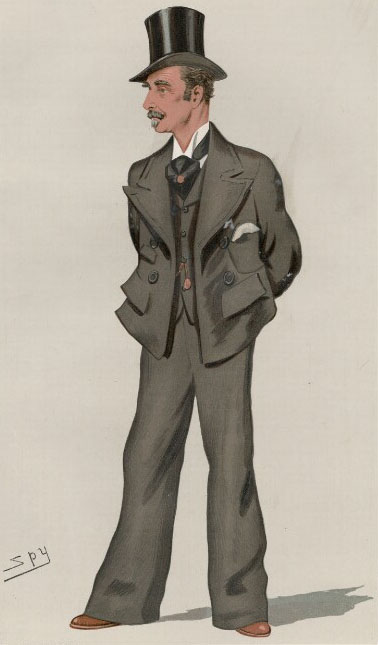
Robert Uniacke Penrose Fitzgerald, who was MP for Cambridge from 1885 to 1906 (Vanity Fair, 28 February 1895)
The circus advertisement on 17 July asked for 70 pretty local children for a grand military spectacle. In the ring some novelty acts kept everyone entertained. Mr Gus Gauntlet appeared dressed as a Hussar and gave demonstrations of the military lance and sword, then of wooden Indian clubs, and finally reappeared doing top boot and skate dances.
The Four Valladolis, who were dressed in white, and gave a somewhat weird appearance as the gas had been lowered, then gave their ‘statue’ acrobatic entertainment, in which they assume some novel and attractive poses, for each of which they were cheered, in one of which the senior of the troop bears the other three on his shoulders and outstretched arms, and indeed in almost every conceivable posture. (CDN 23 July 1895, p 2)
On 27 July the request for the children is explained as they appeared in a pleasing spectacle, a military review called Queen and Country.
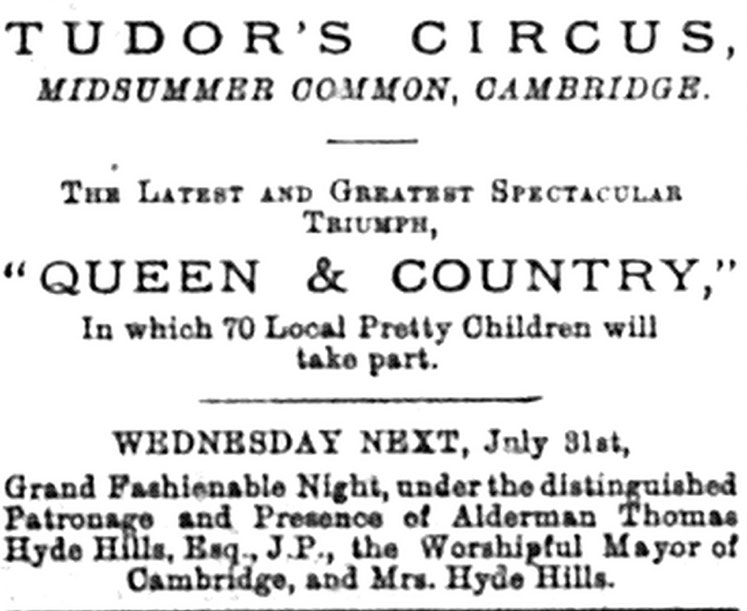
(CE, 27 July 1895, p 2)
Mr Tudor had trained the children perfectly and, dressed in naval and military uniforms they paraded and drilled, sang and danced before those dressed as Queen Victoria, Brittania and the Prince and Princess of Wales.
A number of military movements ensue, and they are watched with much interest, great attention, and considerable amusement. The formation of a square and bayonet exercises evoke great applause. During brief intervals, patriotic and other songs and tries are sung, and in the choruses of even the most rollicking of them, the ‘throned monarch’ and the Prince and Princess forgot, for the nonce, their dignity, and join in the singing as heartily as the rest
(CEX, 3 August 1895, p 8).
To celebrate the results of the General Election, the Conservative and Liberal Unionists held a grand demonstration on Monday 29th, with a procession through the town, headed by a band, a mass meeting on Parker’s Piece and a fireworks display. Despite this great attraction, the performance of Queen and Country drew a good audience and continued through the Bank Holiday.
A hot and stormy August
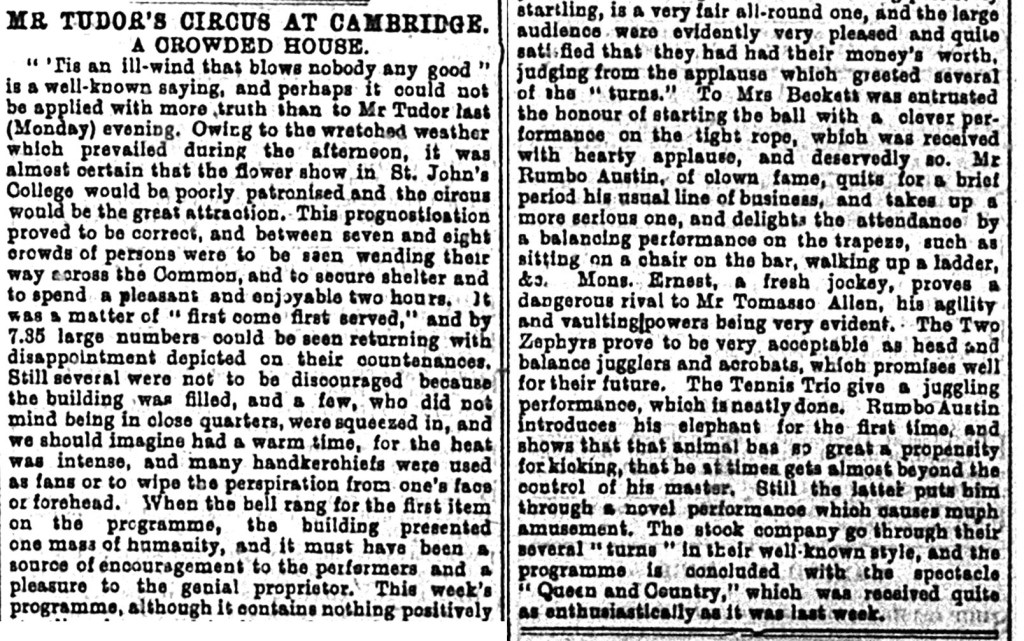
Hot and stormy weather was to dog August. The Working Men’s Cottage Garden Society’s annual flower show at St John’s College on Bank Holiday Monday, August 5th was rained out throughout the afternoon. But it did not detract from the circus. In fact the building was packed and 300 people were turned away. The review on August 6th described a warm and steaming ‘mass of humanity,’ showing their appreciation of the jugglers and tight-rope walkers and the 70 children. The clown and trapeze artist Rumbo Austin, (Thomas William Austin from the Austin circus family), introduced his elephant whose kicking got the better of him to the audience’s delight. Was this a real elephant? We do not know. The Tennis Trio gave a novel juggling act and the ringmaster that night was Mr William Albino, equestrian, who was to be Tudor’s acting manager and ringmaster from 1896 to 1899.
(CDN, 6 August 1895, p 3)
A new act was Mr Frank Whiteley, a self-described negro comedian, musician and dancer, who ‘brought the house down at once by his comic song, proved himself as no mean banjoist’ and was ‘loudly recalled’ (CDN, 13 August 1895, p 2). The CCJ called him an excellent turn who ‘plays a banjo with great skill’ (CCJ, 16 August 1895, p 8). As usual, he performed on the same bill as the vivacious singer Alice Oakley.
Our CDN reviewer was less impressed by Joe Darby, champion jumper, than by Mr Twestello, ‘the boneless wonder’ a contortionist who performed extraordinary feats, so extraordinary he found them impossible to describe (CDN, 13 August 1895, p 2).
The hot weather continued and increased but the circus was well filled to see the Three Dagmars, a trio of feet-balancers, gymnasts, horizontal bar and ladder performers. The Dagmars – Victoria, Francois and Ricardos – had been performing in circuses throughout the 1890s and Victoria, the first woman to perform a double somersault on the horizontal bar, was still appearing in 1914.
Also on the bill were Harland and Rollinson, marvellous musical grotesques, who gave ‘merry mirthful and musical melanges’ and the Flying Pheros, acrobats and tumblers, who, perched dizzyingly high on their trapeze, flew about with marvellous skill, despite having no net (CDN, 20 August 1895, p 2).
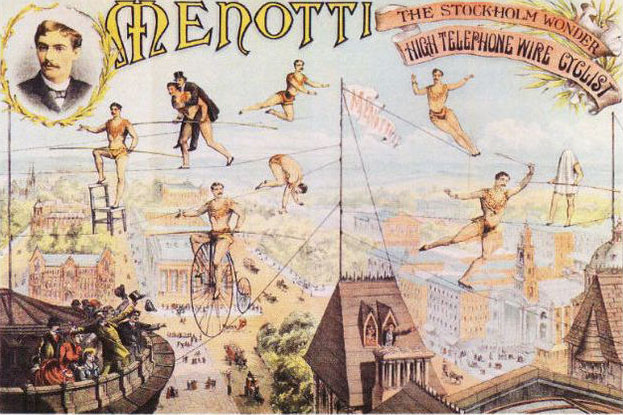
The programme on 23 August advertised ‘Mr W. Kingsley, the only Royal handbell soloist who had performed by special command before Her Majesty the Queen at Osborne House,’ but in the event he was unable to appear. One hopes that the daring tumbling of Jackley and Fratelli and the high-wire cyclist from Stockholm, Menotti, made up for the loss. Menotti succeeded. No-one from the audience volunteered to be carried across the highwire so Nimble Nip the clown was substituted. Menotti concluded by riding a bicycle backwards and forwards on the wire to deafening applause. The CDN wondered if Cambridge had ever seen his equal (27 August 1895, p 2).
The heat continued and Tudor applied to extend his lease upon the Common for another month until 12 October. Alderman Redfern of the Commons Committee agreed that the General Election and the fine weather had affected the circus.
Mr Tudor had conducted the place in an admirable manner and had afforded a great deal of amusement, especially amongst the poor folks. (Hear hear.)
Councillor Nichols went further and suggested no charge at all:
Mr Tudor conducted his business in a very creditable way and he gave a high class entertainment to the people of the Town and of the County. From what he heard it had been a losing game for Tudor. He thought they might extend their liberality by letting Mr Tudor have the ground for a month free of expense (CCJ, 23 August 1895, p 7).
But these amendments were not carried and Cambridge Town Council payments record a receipt from Mr Tudor for £50.
The heat was now causing severe thunderstorms. The organisers of the concerts at the bandstand on Midsummer Common asked for it to be moved to Christ’s Pieces as the ground on the Common was so soggy (CIP, 23 August 1895, p 6). There had been a violent thunderstorm on Saturday 11th, when two chimney pots on a house in Romsey Town were demolished leaving a hole in the roof. There was more lightning on the Monday and another downpour on the Tuesday.
On Thursday 22nd, during a severe thunderstorm in Cambridge, an inch of rain fell between 4 and 5 am and there was a half-hour electric storm which terribly frightened many people. Several buildings were struck by lightning, a postman, a porter at the Lion Hotel and a policeman, PC Joseph Pammenter, who was patrolling Grange Road at 4 am, were all injured by lightning strikes. PC Pammenter was struck unconscious and the newspaper feared the consequences might be very serious (CIP, 23 August 1895, p 8). We were pleased to discover that PC Pammenter survived and a later census shows him living in Stapleford aged 49 as a police pensioner and jobbing gardener. By the end of the month the harvest was interrupted and the potato and barley crops were badly affected, but the circus played on.
William Tudor had further troubles of his own when he was taken to court by a circus groom, William Webb, of 74 King Street, whom he had sacked for not looking after his horses properly and giving Tomasso Allen’s horses better treatment and straw. Webb had worked for Tudor for five years and had twice before been given notice. Tudor claimed he was impudent, late and had disobeyed orders over the hay so the row over the horses’ bedding was the last straw.
Wm. Tudor, residing at Causeway House, Cambridge, said on Monday, the 15th, he was a little short of straw, the plaintiff having forgotten to tell him before he went to the Market. Witness gave him instructions to use some old hay. The plaintiff gave Allen’s two horses more that day that [sic] the other eight put together. Witness noticed this on the Tuesday, Wednesday and the Thursday. He called Webb’s attention to it, and Webb said he was blind and called him a liar (CIP, 30 August 1895, p 7).
Despite various witnesses supporting Tudor, the magistrates considered he had failed to prove serious misconduct, wilful disobedience or habitual neglect by Webb, and judged in Webb’s favour. Tudor had to pay him a week’s wages of 23 shillings plus £1 costs.
September: Turpin’s Ride and a tumble on horseback
September brought a new clutch of performers, among them Mdlle Winona, aerial rifle shot, and Miss Lily Howen, Zulu Queen. Winona was not just an excellent shot but fired her rifle while hanging upside down on a trapeze and played a tune by firing shots at a harp. Lily’s bizarre turn consisted of a ‘dandy’ song, a top boot dance and a very popular song and dance in the character of a Zulu Queen. The regular equestrians, Monsieur Ernest, Miss Daniels and Mr Walker continued to please, as did Mr Tudor with his trick pony Billy ‘an animal which shows not only training but intelligence’ (CDN, 3 September 1895, p 3).
As in 1893 Tudor remembered the inmates of the Chesterton Workhouse. The Board thanked him for his generosity in inviting inmates, both adults and children, to the circus, each being given a present (CCJ, 6 September 1895, p 7).
The Zedoras were back and Alar, the Human Arrow, was shot from her bow once more, but one lady performer was ill so some of their other spectacular acts were curtailed. There was a foot equilibrist, a ventriloquist and Funny Little Teddy Saul, a clown replacement for Rumbo Austin, who performed a dance on a spade. The most fun came from A Jolly Day at Newmarket when the circus ring was changed in a few seconds into a steeplechase course, complete with fences, brick walls, a real water jump, jockeys and racehorses, race-goers, a policeman, maypole dancing, wrestling, two yokels on a day out, and two stereotypical Irishmen spoiling for a fight A grand steeplechase followed and various incidents with the company, some of whom inevitably ended in the water jump (CDN, 10 September 1895, p 2).
The audience was pleased that The Zedoras were kept on for another week, in full force this time, and gave them ‘deafening applause’ particularly for a daring double somersault from the trapeze, while Mr John Frederick Clarke performed phenomenal somersaults on horseback. Rather more sedately Mademoiselle Rubina on the ‘telephone wire’ was ‘pleasing’ and the four lady acrobats, the Lizzettes, ‘aquitted themselves to the satisfaction of the audience’ (CEX, 21 September 1895, p 8). Those daring Zedoras were a hard act to follow.
(CDN, 20 September 1895, p 1)
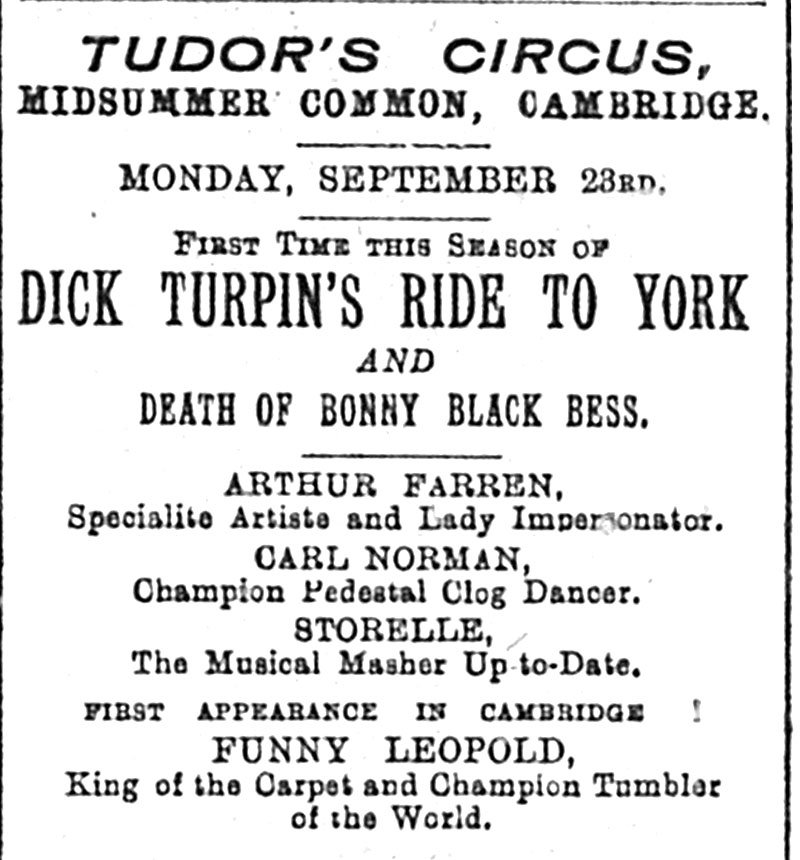
There were large audiences at the circus as the ever-popular hippodrama Dick Turpin was back again. ‘The grand equestrian Spectacle’ is repeated and is ‘much appreciated by the Cambridge public, and the circus was filled in every part.’
Everyone is familiar with the story of the notorious highwayman Dick Turpin, of the death of Tom King and the famous ride to York, where Black Bess’ strength is exhausted, and where she dies. On its first production at the circus this season, every incident was followed with great attentiveness, and Mr Tudor and his Black Bess were frequently applauded. Mr Tudor gave a capital impersonation of Dick Turpin, his lines being delivered in a natural and feeling manner, especially when a mile from York his mare goes lame and begins to stagger, and then, exhausted, finally fell, and there were many moist eyes amongst the audience. Hearty applause greeted the artistes at the conclusion. Mr Albino as Tom King, gave a fine representation of Dick’s daring friend, who was killed by the latter’s hand. Mr J. Fernandez was the ideal of a pompous old beadle, whilst his son, Sammy (Nimble Nip), as he always does, kept the audience in one continual state of laughter (CDN, 23 September 1895, p 5).
On the same bill, Little Leopold, or Funny Leopold, was probably one of the Leopold Brothers, a family of Irish acrobats and tumblers, most of whom were acrobat clowns, not to be confused with the more famous Leopold Leglere acrobats seen in July.
Two more unusual acts were Mr Arthur Farren, female impersonator, mimic and a regular as a pantomime dame, whose make-up ‘defied detection,’ and Mr Carl Norman, pedestal clog dancer whose neat, quick steps made him a great favourite. The two advertised together, Norman being called Farren’s pupil, and frequently appeared on the same bill. Farren was a regular with Tudor, appearing at Tudor’s Circus in Durham in 1894 and 1895 and in Gateshead in March. Their last collaboration was at Tudor’s Circus in Darlington in 1900, this time with Ferran’s later protégé, Young James Mackenzie, the Boy Dancer. The Stage reported the whimsically Dickensian Farren still hoping to revive his later career with his own touring company in the late 1920s before his death in 1933. Even Stourbridge Fair this week did not reduce the audiences (CDN, 23 September 1895, p 3).
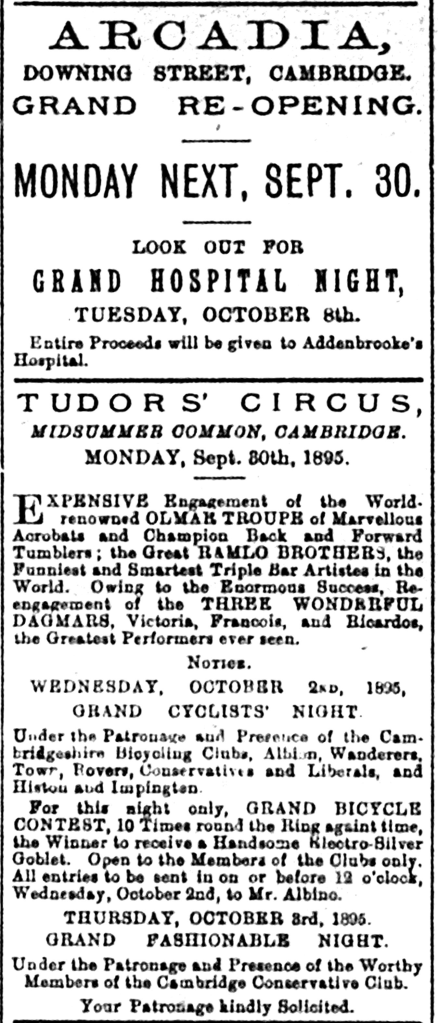
An advertisement for the Circus for 30 September onwards announced the return of the Dagmars and a Grand Cyclists’ Night. But above it was an advertisement for the reopening of the Arcadia Music Hall in Downing Street which, up to now, had not coincided with Tudor’s Circus. The Arcadia was in the old Corn Exchange, St Andrew’s Hill, on the corner of Corn Exchange Street. The building had been a shopping arcade and was later a garage and cycle depot.
(CEX, 28 September 1895, p 8)
As we have seen, Tudor had managed to extend the circus season beyond the end of the month and on 1 October the CDN was reporting on a variety of acrobatic acts including the Paulos on their colossal ladder. The Grand Cyclists’ Night was eagerly anticipated on the Wednesday with a race ten times round the ring between the various Cambridge Cycle Clubs. The following week there was to be a Buffalo night under the auspices of the Cambridge Royal Antediluvian Order of Buffaloes. The CDN was now reviewing Arcadia as well as the circus so even more entertainment for the reporter! The CEX reported that ‘Notwithstanding that the Arcadia has been open during the week the circus has received a good share of patronage’ (CEX, 5 October 1895, p 8).
The Olmars returned having performed in 1893, and the Dagmars were still performing. If the band is good it is seldom noted so it must have been encouraging when the indefatigable circus band, conducted by J R Tidewell, RAM, was specially mentioned and the pieces played were General Webb’s March, Guards and Breped’s Zarer (CEX, 5 October 1895, p 8).
The riders, Mr Walter and Mademoiselle Marie-Louise, were still cantering round the ring but one rider had an accident.
Mr J. F. Clarke, the favourite rider during the last few weeks, met with an accident on Monday night; as he was attempting to leap on the horse’s back, he fell against the woodwork round the ring and hurt his foot. Mr Clarke on attempting to ride again, was greeted with hearty applause. He, however, failed and was cheered out of the ring (CEX, 5 October, 1895 p 8).
Clarke had been performing since a child as a tumbling and somersaulting bareback rider. Turner describes him as ‘one of the best and most celebrated riders of his time. A fair man of slender height who frequently worked in gold-spangled green tights . . . he made his work look so easy that the public failed to recognise the difficulty and cleverness of the feats he performed’ (Turner, 1995, p 28). Despite a lifetime of dangerous riding Clarke died in 1954 at the age of eighty-five.
As the season drew to a close the audiences still came and all the papers gave long reviews of the last week’s acts. The French Troupe, a group of four trick cyclists, impressed and perhaps gave Cambridge cyclists some ideas as their finale consisted of the four riders on one bicycle:
. . . climbing each other’s backs, and somersaulting backwards and forwards over the handle bar, and one by one climb the back of the senior of the troupe until they form a monster pyramid, the males upon each other’s shoulders, and the lady riding on the step. (CDN, 8 October 1895, p 3)
(Cambridge Daily News, 8 October 1895, p 2)
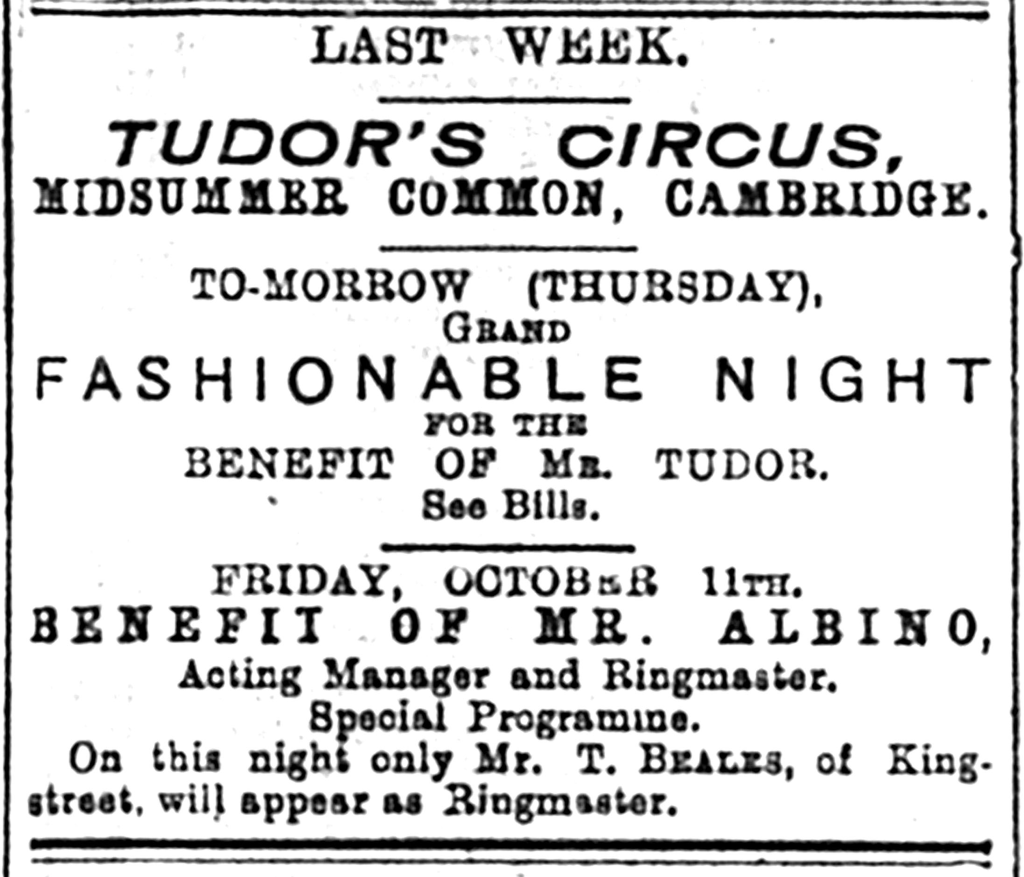
There were benefit nights and competitions with the proceeds on Tuesday 15 October donated to Addenbrooke’s Hospital, and benefits for the popular clown Nimble Nip on 7 October, for Mr Tudor at A Grand Fashionable Night with horse races in the ring on 10 October, and on the next night for Mr Albino, while Mr T. Beales of King Street acted as ringmaster. The faithful CDN reviewer reported the winners of the various races, horse racing, a trotting race, a running race, a duck hunt, musical chairs, a guess-the-money-in-the-bottle competition and a conundrum competition: ‘Why is Nimble Nip the clown like glass? Because he is a tumbler’ (CDN,12 October 1895, p 3).
And so ended the 1895 season and the temporary wooden building was taken down. The Cambridge Express noted that ‘We understand that Mr Tudor has purchased a piece of ground at the end of Auckland-Road, where he intends opening a circus about July next’ (CEX, 12 October 1895, p 8). For the first time a permanent circus building was planned for Cambridge, but would it materialise? The Guildhall and Planning Committee turned down his application on 18 October as it was not in accordance with Bye-law 11 (CIP, 18 October 1895, p 6).
As we know, William was not a man to let the grass grow under his horses’ hooves, so Turpin-like he dashed north to Yorkshire and opened a season in the Grand Circus Hall in Doncaster on 21 October, running until 16 January 1896. Overlapping with that was a six-month season in a new building in Macclesfield, 25 November until 23 May 1896. Tudor and his Macclesfield circus had been so popular that a special concert was arranged at which he was awarded an illuminated and framed address, while Mr Albino was presented with a gold watch.
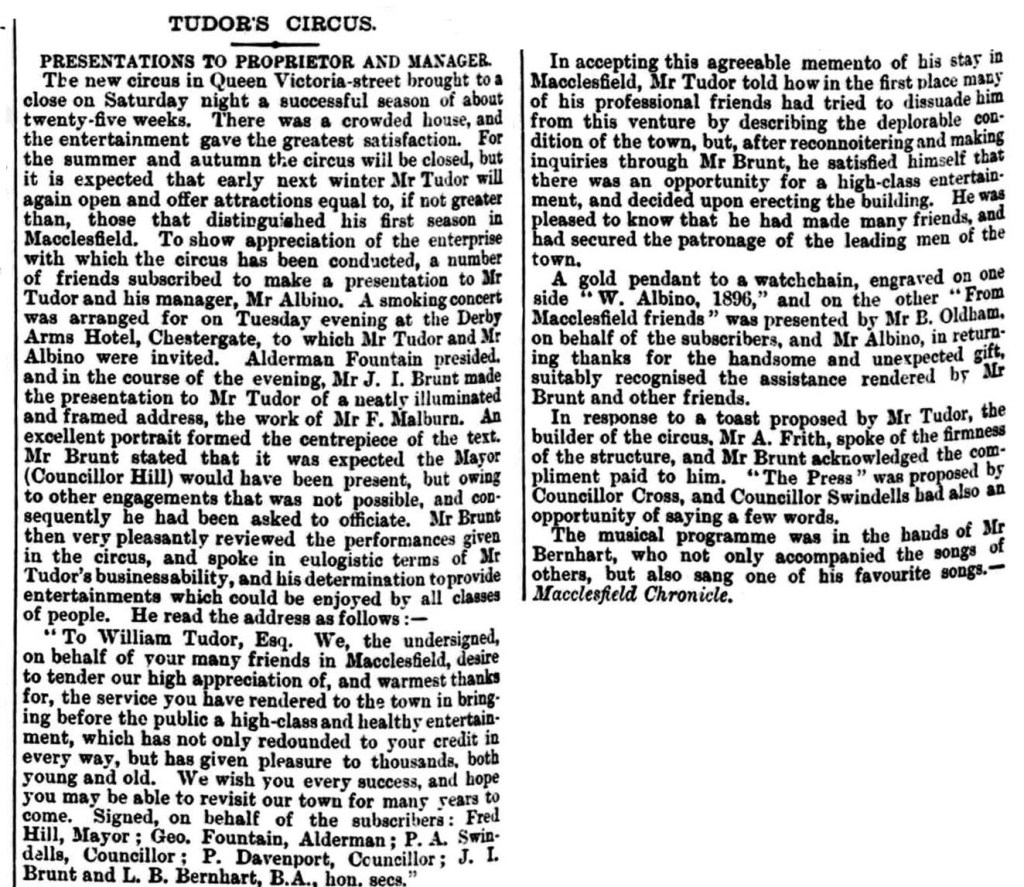
This account from the Macclesfield Chronicle of the tribute concert was reprinted in The Era, 30 May 1896, p 16
After that, Cambridge beckoned again, but not before visits to Durham and Scarborough in early summer 1896. In the meantime, a new planning application for Auckland Road succeeded in April – read here about the new building and here about the 1896 season.
Go to next section: 1896: Tudor’s New Circus in Auckland Road
 William Tudor's Circus