The Flying Zedoras were a popular group of between three and six aerial acrobats and trapeze artists who became famous for the performance of one of their team, Alar the Human Arrow. Alar’s ‘marvellous performance’ consisted of her being shot 40 feet through the air from a giant crossbow, through a paper target, and across the building to where she was caught in the air by a female catcher who was hanging from a trapeze. During the 1890s the Zedoras toured Britain, Europe and the USA, appearing for four seasons with Barnum & Bailey, as this poster shows:

The Flying Zedoras performed during several seasons at Barnum and Bailey’s Greatest Show on Earth (Victoria and Albert Museum)
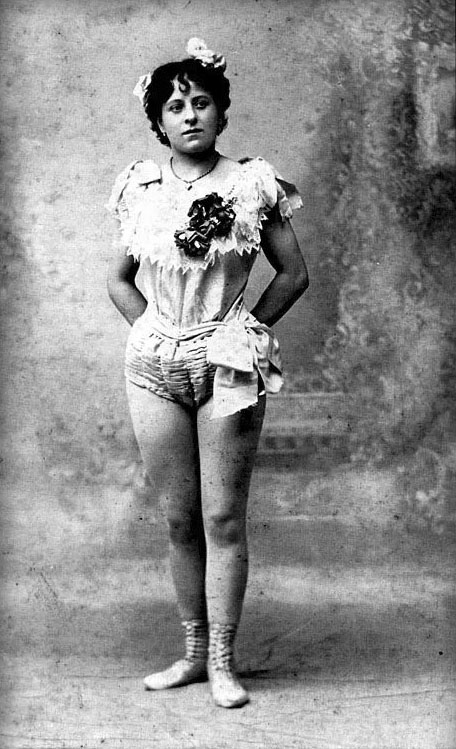
Alar was Pansy Murphy, seen here probably in 1897
Although the members of the Zedoras varied, Tony Zedora, Adele (Adelaide Murphy) and her younger sister Pansy (Frances Murphy), known as Alar, were the members when they performed in Tudor’s Circus on Midsummer Common in Cambridge in 1895 and then in his Auckland Road building in 1899. Born in Liverpool, Adele ran away to join the circus and when their parents died, her younger sister joined her. The Human Arrow trick which Pansy performed was dramatic, dangerous and, as the Zedoras claimed, unique.
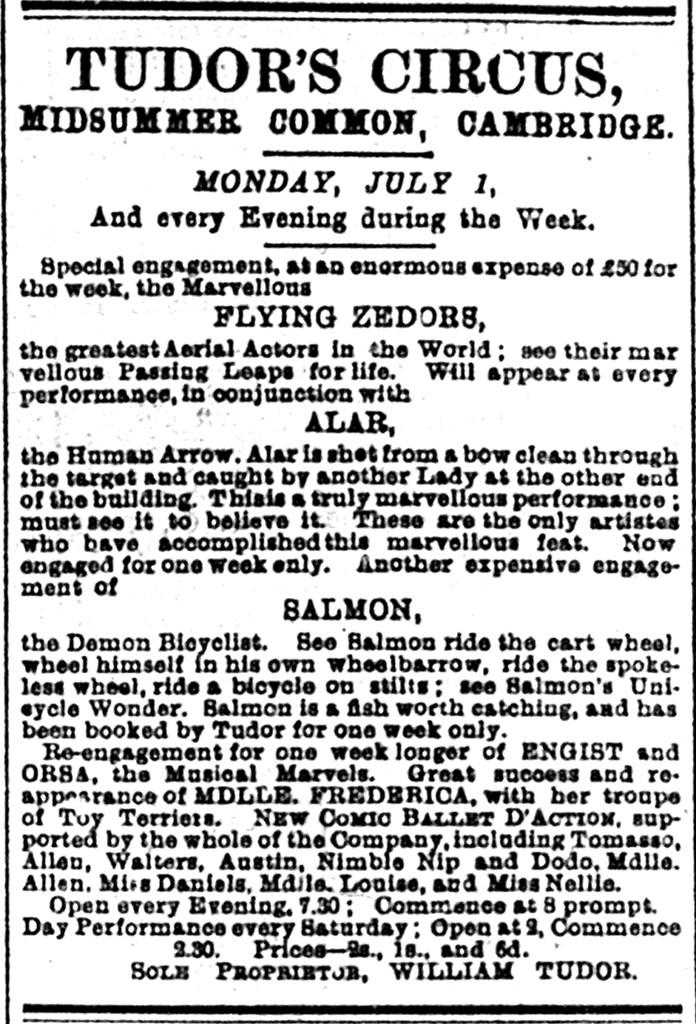
CDN, 28 June 1895, p 2
They go through their daring performances in a manner which speaks well for their nerve power. One little slip or a fraction of a second late in the flying acts and they are precipitated into the net below. This happened twice last night, but only in attempting one of the most difficult feats that has been witnessed in Cambridge, viz, flying from one end of the building past the centre, turning a double somersault and catching hold of a bar, upon which is a lady swinging to the other end of the building, and back again in time to fly onto his own bar. It was a splendid and plucky act, and though he failed at his first two attempts, he succeeded the third time, and was loudly applauded.
Besides this act, Zedora flies, with a pocket handkerchief over his eyes and a sack over his head, from his bar, and is caught by one of his female confreres. A great act was expected from Alar, and the audience was not disappointed, their excitement, when the word was given to go, apparently being at its zenith. A bow is fixed over the gallery, Alar is the arrow and is shot through the target and caught by a young lady the other side. This fresh and unparalleled feat was greeted with a regular roof raiser.
CDN, 2 July 1895, p 2
We think there has not been any artistes of the same character at Cambridge to excel the Zedoras. The male artist goes through his performance in an excellent manner. He acts blindfolded and with a sack over his head and body. Alar, ‘the human arrow,’ who is in conjunction with the last-named performers, is quite a sensation. This young person lies on a board, and by means of a bow is shot through a target into the air some feet, where she is caught by one of the previous performers. This artiste has received on all occasions the hearty applause of the audience.
CE, 6 July 1895, p 8
A few months after their Cambridge appearance, the Zedoras’ performance at the Royal Aquarium, Westminster was reported in the Cardiff Evening Express:
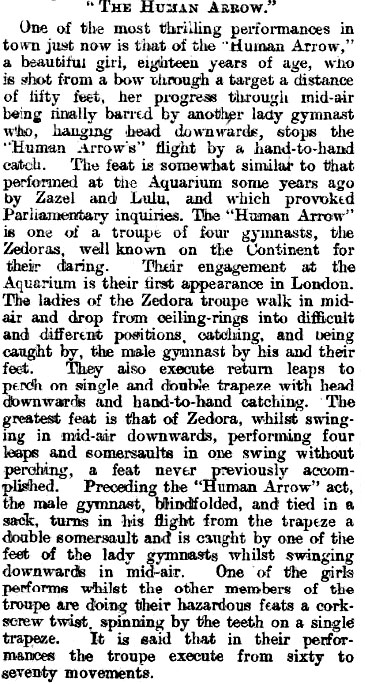
Cardiff Evening Express, 25 November 1895, p 4.
The following year, Framley Steelcroft described the act in the Strand Magazine, (volume XI, January to June 1896, pages 466–475):
This is the Human Arrow, ‘a thing the imagination boggles at,’ as Browning’s incomparable parodist once remarked. And yet the lady is actually shot from a monstrous cross-bow, and traverses some 30ft. of hot, vitiated atmosphere before striking the target . . . The distance is short, a regulation net is used, and the target, on being touched, retires as gently and gracefully as the ‘Arrow’ herself does shortly afterwards
. . . I must confess that powerful springs have more to do with this aerial flight than the string of the bow.
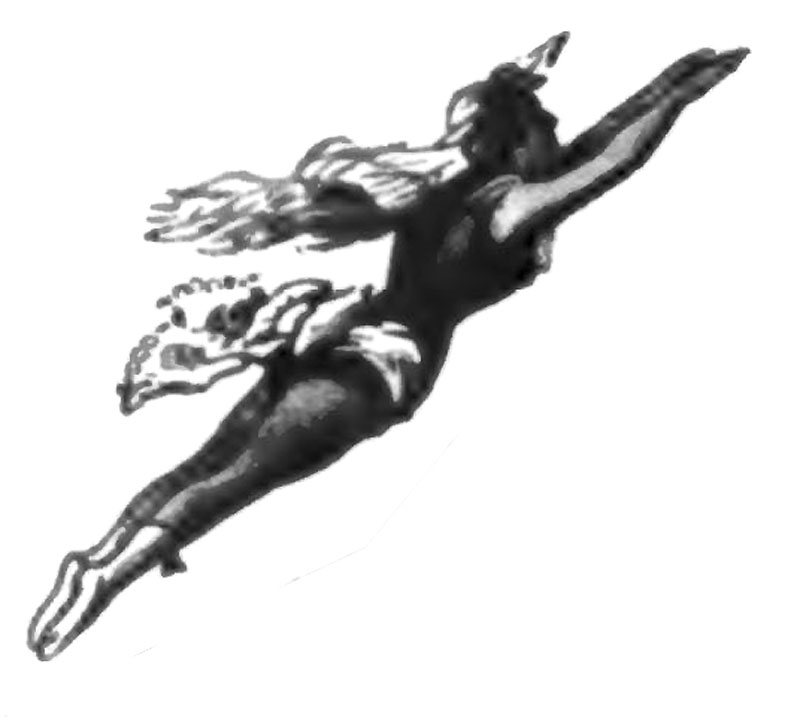
You’ll believe a woman can fly – Alar aims high in this illustration from the Strand Magazine article.
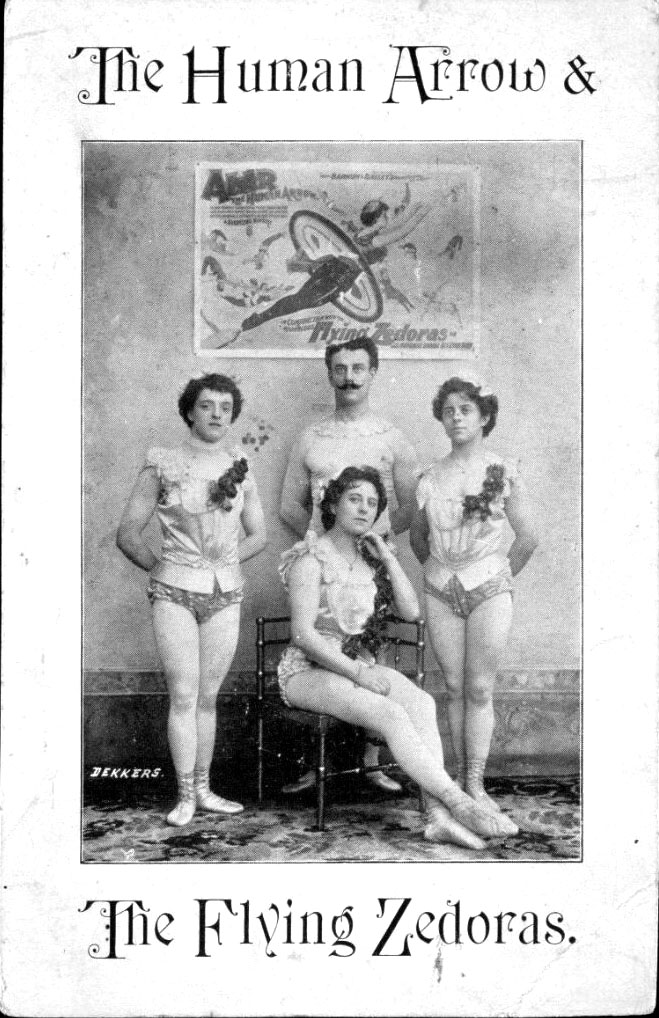
An 1897 postcard (Victoria & Albert Museum)
When the Zedoras appeared at The Colston Hall, Bristol, in 1901, an interview with (we assume) Tony Zedora appeared in the the Bristol Magpie:
A chat with Mr Zedora
Messrs. Poole could hardly have inaugurated the twentieth century better than by bringing to Bristol so novel and powerful an attraction as is supplied by the world-renowned Flying Zedoras and thinking that a special interest must attach to the production of so thrilling and graceful an act, we conceived the idea of a chat with the gentleman whose fertile brain evolved so daring a stroke of originality . . .
‘Is the Human Arrow your own invention?’
‘Yes, and much time and money were needed to bring it to perfection.’
‘Your performance is quite novel in other respects.’
‘I hope so. We may certainly claim to have introduced our style of diving, the passing leaps side by side, the Human Arrow and the general mounting of an aerial act.’
‘You have the “arrow” trick patented and legally protected?’
‘Yes, in England, on the continent, and in America.’
Bristol Magpie, 24 January 1901, p 16.
Alar herself does not seem to have merited a mention.
When the Zedoras returned to Cambridge in April 1899 they were as much of a hit as they had been four years earlier:
The Marvellous Zedoras Troupe of three ladies and one gentleman, drew forth laud applause, with a sensational turn. Their forte is an aerial gymnastic performance, in which Alar, the human arrow, is introduced, that personage altogether startling the audience with some daring feats.
CIP, 14 April 1899, p 5
However, Alar suffered at least one accident, at Madison Square Garden in New York, shown in this newspaper report in New York, source unknown:
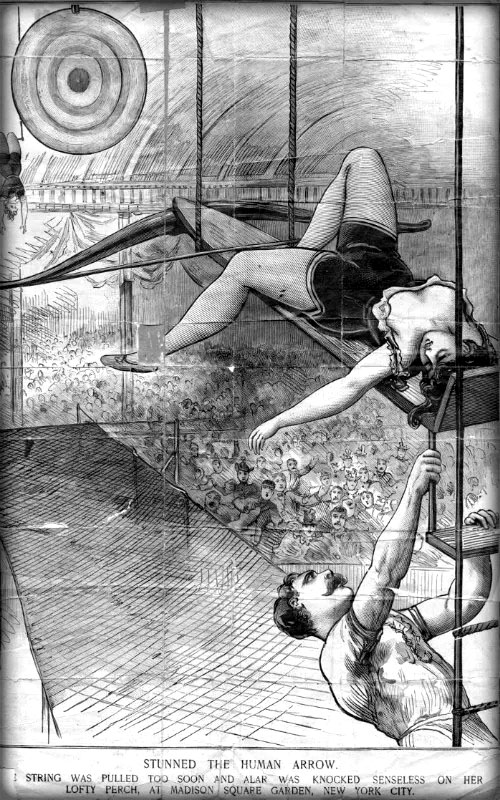
But, despite the accident, she continued to perform as the Human Arrow until a personal tragedy occurred, when her sister Adele died in 1902, aged only 32.
Patsy, later Patsy Chinery, continued to perform on the variety stage, touring mostly in England with troupes called The Mars Trio, Leighton & Lindford, and Ritz and Ritz, specialising in comic acrobatic and gymnastic acts, but seems never to have flown as the Human Arrow again. One of her specialities was a so-called ‘teeth-spinning’ number in which she revolved from a hook . . .
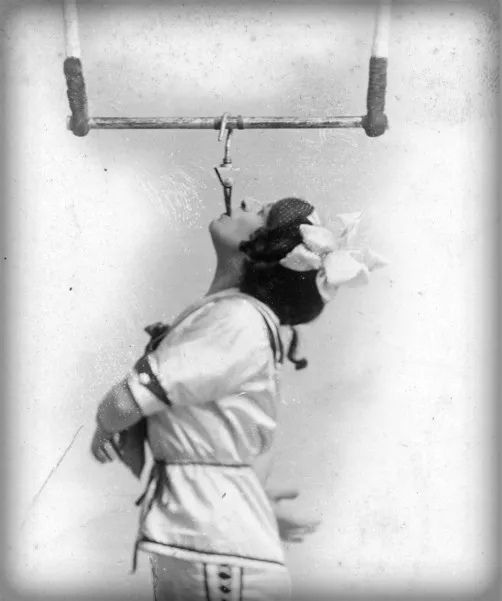
Patsy Chinery’s ‘iron jaw’ act (Victoria & Albert Museum)
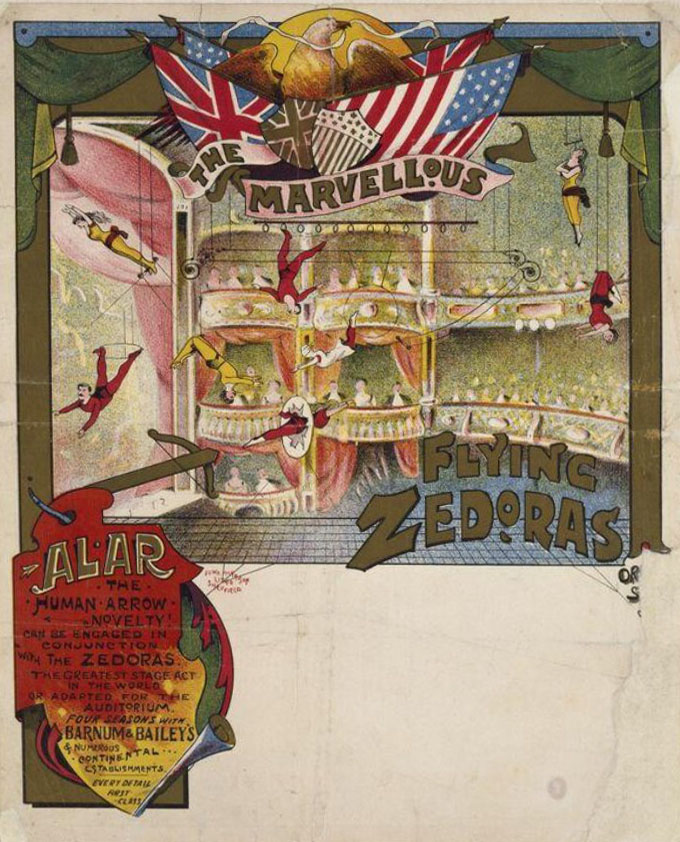
The Zedoras’ letterhead, with Alar bursting through her paper target (Victoria and Albert Museum)
Bibliography
Jones, John Peter, The Flying Zedoras, Southchurch, Essex, Arcady Press, 2010.
Tait, Peta, ‘Viewing deadly targets for feminine identity: Alar the Human Arrow’, in Toulmin, Vanessa and Popple, Simon (ed.), Visual delights – Two: exhibition and reception (Eastleigh, John Libbey Publishing, 2005), 123-134.
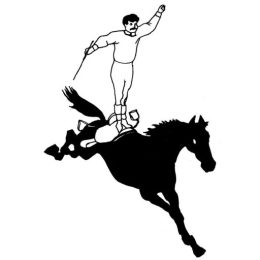
 William Tudor's Circus