The Empire Circus of Varieties – a New-Year re-opening
The ‘greatly improved’ circus reopened on 28 January 1901 with Captain G H Fowler, the self-styled champion rifle shot of America, top of the bill. Touring since the 1880s when he would shoot an apple from the head of his intrepid wife and fellow shot Nellie Frazell, or a lighted cigar from her mouth, Fowler was now solo which may have led to a slightly lukewarm review. ‘Captain Fowler gives a remarkable display of shooting, his best feats, perhaps, being those performed with pistols’ (CDN, 29 January 1901, p 2).
The circus was leased to the management of Messrs A Turle and Harrison, with a grand but short-lived new name, The Empire Circus of Varieties, though this was to change to The Grand Circus and Novelty Hippodrome, The New Grand Circus and The Circus of Varieties during the year, as though the building could not decide on its identity. To many local people it was just The Circus. Although Turle had advertised in The Era on 19 January for variety artistes from 28 January onwards, the new incarnation only lasted into early February.
There were three singers, a comedian, and the dancer, singer and comedienne Alice Chasemore, a music hall and pantomime regular returning to Cambridge. There was a comic sketch from the Gilchrist Trio and a ‘dance illuminare’ from Miss Murray, which was ‘a dance of the serpentine order, with flowers, photos, &c., thrown on her flowing robes by means of limelight’ to a ‘very pleasing effect’ (CDN, 29 January 1901, p 2). Campkin the Tramp Cyclist telegrammed from Nantwich at the last minute to say that he was ill and forced to scratch, but the CDN reviewer was positive and anticipated a very successful season.
The New Grand Circus – the return of George S King
Queen Victoria died on 22 January 1901 and her funeral took place on Saturday 2 February. Pubs and shops closed, memorial services were held in churches and chapels, and there was no matinee at the circus. Thomas Askham placed an advertisement in The Era that day for the circus ‘to let, Fitted with Good Stage, rent Low’ (The Era, 2 February 1901, p 25). Then we hear no more until April when the New Grand Circus, having lost its empire, reopened under Mr George S King, whom we encountered in Auckland Road in August 1900.
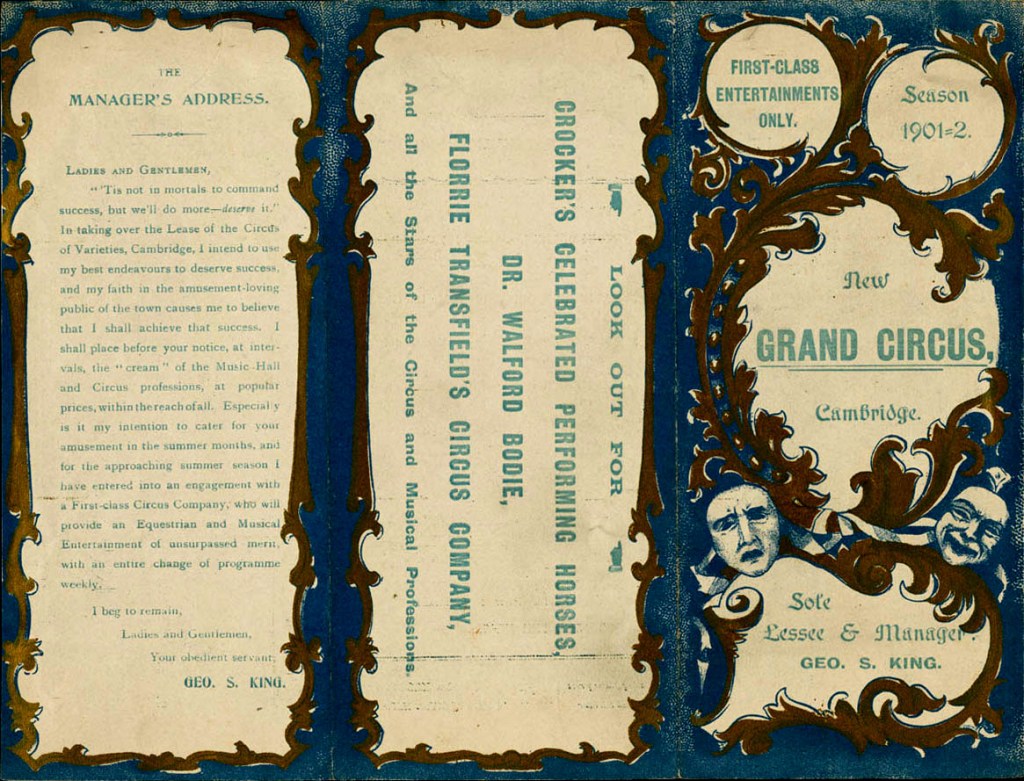
On 7 February he had advertised from the Theatre Royal, Batley, Yorkshire, for a ‘First-class Variety Combination’ commencing Easter week with dates up to late November (The Stage, 7 February 1901, p 19). Our circus was ready for action and opened on 8 April with a particularly impressive list of performers, many of them circus rather than music hall artistes. King addressed his potential audience in a handbill that was discovered in Cambridge University Library:
MANAGER’S ADDRESS.
LADIES AND GENTLEMEN,
‘’Tis not in mortals to command success, but we’ll do more—deserve it.’ In taking over the Lease of the Circus of Varieties, Cambridge, I intend to use my best endeavours to deserve success, and my faith in the amusement-loving public of the town causes me to believe that I shall achieve that success. I shall place before your notice, at intervals, the ‘cream’ of the Music Hall and Circus professions, at popular prices, within the reach of all. Especially is it my intention to cater for your amusement in the summer months, and for the approaching summer season I have entered into an engagement with a First-class Circus Company, who will provide an Equestrian and Musical Entertainment of unsurpassed merit, with an entire change of programme weekly.
I beg to remain,
Ladies and Gentlemen,
Your obedient servant,
GEO. S. KING.

There was Marie Clifford, performing without her Spanish Choir and Ladies’ Orchestra, who impressed with her ‘beautifully toned musical glasses’, Professor Carson, a ventriloquist ‘of some ability’, comic singer Flo Merry with her patriotic khaki coster (cockney) song Not in a thousand years, the acrobatic Farnham brothers, a cinematographe, a boxing kangaroo – all supplied by Dr Seaton’s Combination Company – and Dr Seaton himself (CDN, 9 April 1901, p 3).
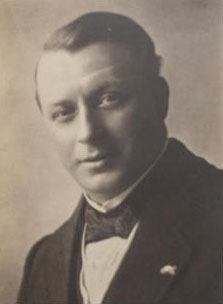
There was also George Formby, father of the more famous ukelele-playing filmstar comic. George Formby senior, 1875-1921, with his eccentric comic songs and comic Lancashire characters, had come from extreme poverty to be one of the great music hall stars of his time. More information is available online and in the biography It’s turned out nice again by Sue Smart and Richard Bothway Howard.
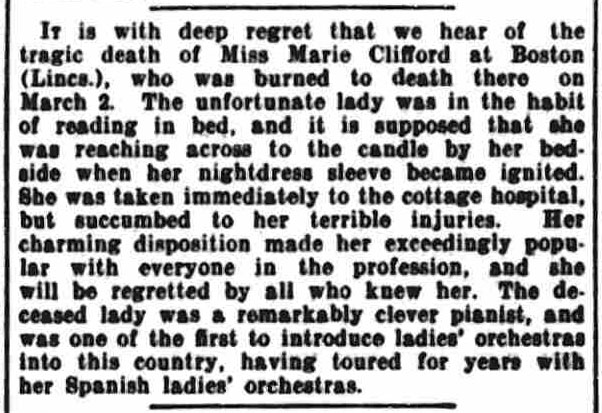
Dr Seaton and his wife Marie Clifford had toured together since the 1880s, she with her orchestra and he as hypnotist, illusionist, Premier Prestidigitator (he was a great self-promoter), thought-reader, plate balancer and spinner, and company manager. The cinematographe with 50 animated pictures of Our Army and Navy in the Boer War and patriotic recordings played on an Edison phonograph, enabled him to produce a variety of turns on the same bill and raise funds for the war effort.
Dr Seaton is not new to Cambridge audiences. Six years ago he created quite a furore with his man in a trance. He had a fine reception on Monday, and proved himself worthy of it. His best act, perhaps, was his manipulation of plates, dishes and pans. In this branch of his profession Dr Seaton is certainly without a rival.
CDN, 9 April 1901, p 3.
But two other animal acts on the opening programme of 8 April 1901 really impressed the audience – Leoni Clarke’s performing cats and the ‘distinctly novel’ boxing kangaroo:
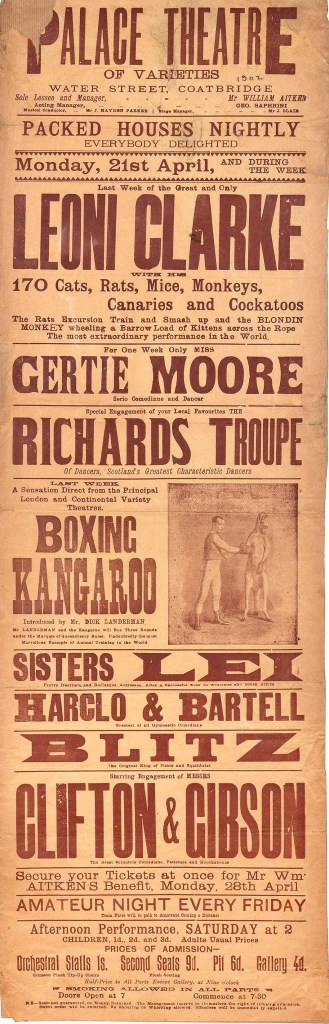
‘The boxing kangaroo first had two rounds with a man boxer, and displayed much intuition. The wrestling bout followed, and the animal succeeded in throwing the man twice’ (CDN, 9 April 1901, p 3).
Clarke’s extraordinary performing cats and mice act had amazed audiences everywhere. Cambridge was no exception:

Of course Leoni Clarke’s cats, &c., are the prime attraction, and were the source of much wonderment on Monday. Cats of all sizes and colour go through a performance the like of which has never previously been seen in Cambridge. Rope and wire-walking and balancing are done with consummate ease by the cats, and a fine specimen of the feline tribe descends from the top of the building by means of a parachute. Rats and mice figure largely in Mr Clarke’s performance, and the trapeze work of a splendid cockatoo adds further testimony, if any were needed, of the remarkable training of the animals and birds. In fact the animals do everything but talk, and their performances must really be seen to be believed.
CDN, 9 April 1901, p 3.
Read more about Clarke and his performing animals here and find out what happened finally to the boxing kangaroo.

On 13 April Dr Seaton’s company was augmented by the comic Irish singer J C Heffron, the singing and dancing of the very young Babies Humphreys, the juggler Rosa, and Mdlle Rouletta. No reviews appeared in the local press until May but The Era gives an idea of ‘charming young’ Mademoiselle Rouletta
who gives an exhibition of transformation dancing, winding up with the serpentine. After some graceful movements on the boards, a large ball is rolled out from the wings, and on this precarious foothold the fair danseuse continues her evolutions to an accompaniment of enthusiastic applause.
The Era, 21 September 1895, p 16.
The cinematographe showed scenes of a Spanish bull fight, a football match at Crystal Palace and the University Boat Race, the slowest since 1877, won by Oxford.
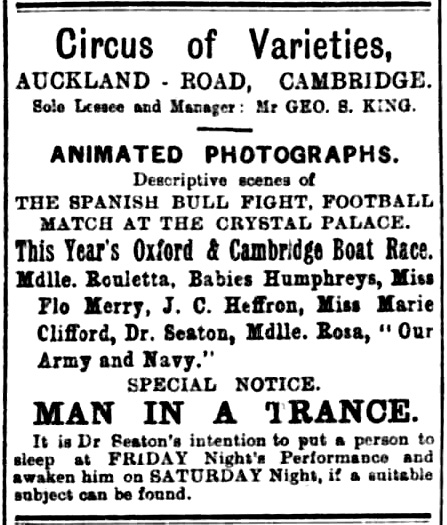
Sadly we have no idea whether a man was put into a trance for 24 hours. Perhaps no-one wanted to be left unconscious at the circus for that long!
No mention is made in the press of the circus until early June but in the meantime George King hired the Corn Exchange for a week’s equine extravaganza with Professor E K Crocker’s ‘thirty Educated Horses, Ponies, Donkeys and Mules’ (CIP, 10 May 1901, p 5).
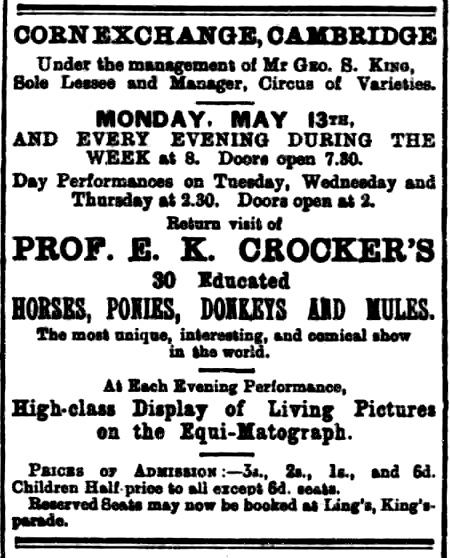
The Professor, born in Michigan, USA in 1859, had been touring Britain every year since 1888, and this was a return visit to Cambridge.


For more on this performer, trainer, published author and inventor (he had two patents for riding bits) see the Central Michigan University Library, where his collection is held. His home-town local history society has written him up here.
As June opened, so did the circus with a company called The Merry Mascots, under the management of Eric Levaine. There was much singing and dancing. Marie Harding sang two comic songs, the Sisters Horsley warbled and danced, the Two Roses ‘did all that was required of them’, the Three Sisters Godfrey did acrobatic and statue dancing, and Mdlle Vora ‘gave a very effective serpentine picture dance’ (CDN, 4 June 1901, p 2). Allegro and Adagio were clever musical clowns as was the ‘loose-legged funniosity’ Will Saunders. There was fancy trick roller-skating from the Hungarian E H Tasker but the stars of the evening were the Australian trick cyclists led by Archie Daunton-Shaw. He had emigrated from the UK but returned with his troupe in 1898 and continued to tour successfully in the UK, Europe, and the USA, eventually retiring to Essex.
The best and most popular turn of the evening, however, was provided by the Daunton-Shaw troupe of trick cyclists. There are four riders – two of either sex – and the way they manipulated their cycles was a revelation. We have had trick cyclists in plenty, but it is doubtful if smarter or more graceful riding has been seen on the boards in Cambridge than that by the Daunton Shaw quartette. They met with a great ovation, and, after replying to an encore, had to bow their acknowledgements on three occasions.
CDN, 4 June 1901, p 2.
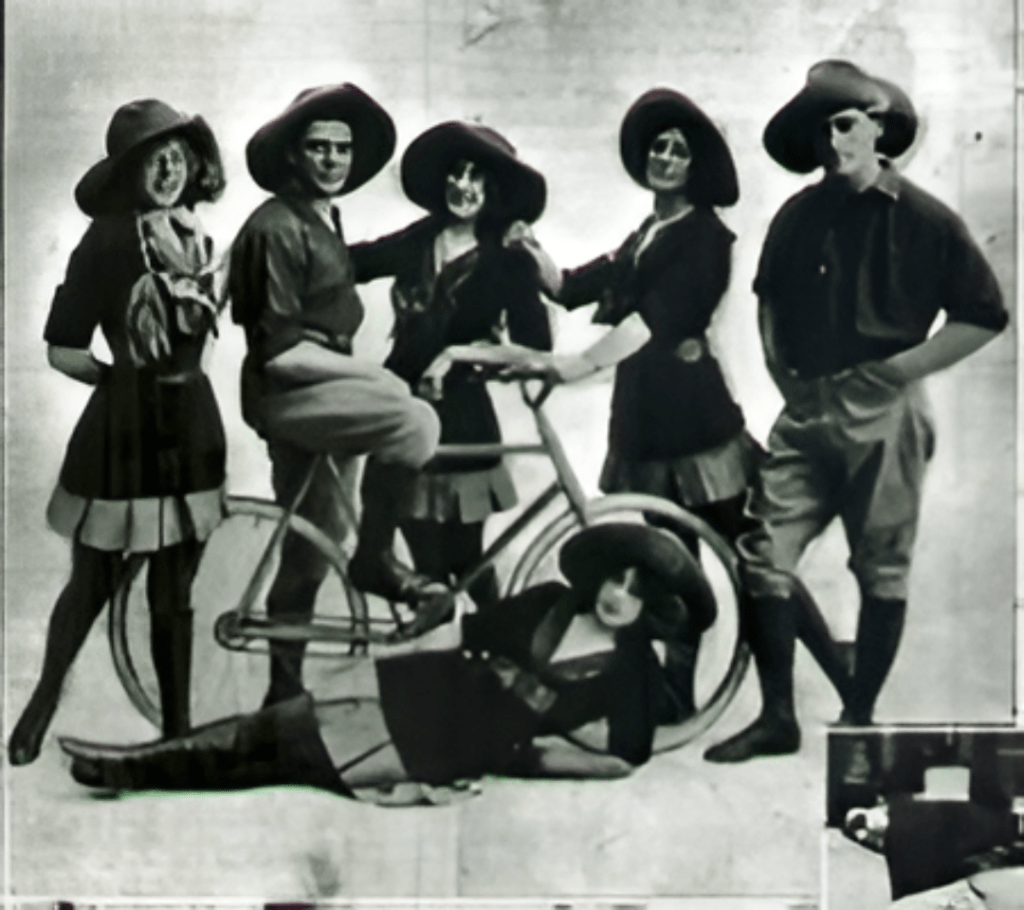
This picture of the Daunton-Shaw Troupe was found here. For further reading, see Plummer, 2005.
We find no press mention of the circus until late June. Midsummer Fair – ‘the usual flash of tinsel, glare of lights and blare of instruments of torture’ (CIP, 28 June 1901, p 5), began on June 24 and there must have been competition from the Biddalls’ Colossal Combination of Menagerie, Museum, Theatre of Varieties and Circus (CIP, 21 June 1901, p 5). Their gruesome and sensationalist advertising perhaps appealed to the ‘thousands nightly [who] have convinced themselves that they enjoyed these flashy sights and nerve-shocking sounds’ (CIP, 28 June 1901, p 5). Taylor’s Cinematograph was also at the Fair.
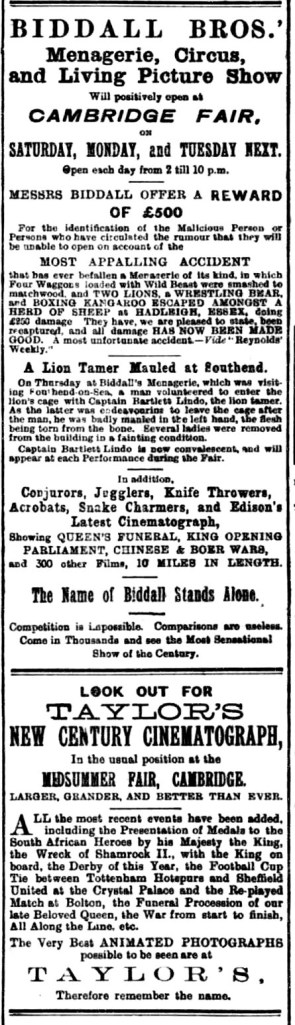
The CDN reporter (25 June 1901, p 3) bemoaned the fact that the ‘excellent turns’ of the ‘exceptionally good’ programme at the circus coincided with Fair week. There was limelight and statuary – that is, the presentation of living tableaux – by Les Trois Olvenes, who depicted St George and the Dragon, a skating act (the Rozalas), Flora Platt with her illustrated songs, comedians Read & Lerne and, for singing and dancing, The Sisters Norbury and Blanche Blanchard. On the trapeze was graceful and daring Senorita Eloina, who performed with leading acts The Elliots and The Savonas, from 1898 to 1913.
These very popular acts had appeared in Tudor’s circus in 1897. The Elliott Troupe of six trick cyclists, also performed as the Savonas, seven musical clowns. Founded by cyclist J B Elliot in the 1870s, the troupes consisted of various members of his family and performed to great acclaim until the 1930s. For their story, particularly of when they toured in the USA with Barnum and Bailey, and were nearly prosecuted for child cruelty in New York in 1893, see Mike Brubaker’s At Bicycles and Saxophones, The Elliott-Savonas Troupe (2022). You will find it here.
A description of their two acts a year earlier at the Star Palace of Varieties in Barrow-in-Furness gives a vivid impression of the performances, the Era (6 October 1900, page 18) quoting from the Herald of that town:
This week the place of honour at the Star is held by the Seven Savonas, musical celebrities. One of the finest stage effects possible is the Savonas’ staging of their musical instruments. It is described as as ‘a perfect Paradise of splendour and bewilderment,’ and with its 1,000 electric lights it certainly does not belie the description . . . The Elliotts appeared again as the world-famous trick cyclists, when the audience cheered and cheered again these wonderful performers.
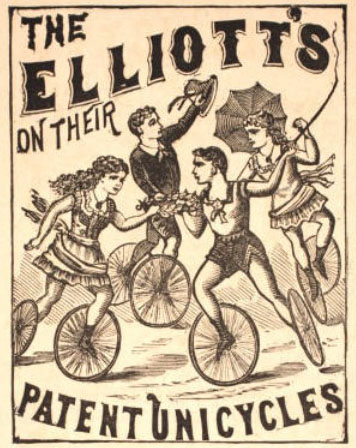
In Cambridge The Savonas showed ‘extraordinary talent. They extract music from all sorts of queer instruments and in all positions. When the Savonas have been heard one can easily understand their world-wide reputation’. And as the Elliotts they
perform almost incredible feats. It is only when the Elliotts are performing that one begins to realise what the capabilities of the bicycle are. The balancing acts of the performers, their evolutions and daring tricks, would seem to be almost impossible.
CDN, 25 June 1901, p 3
And attempts at similar tricks can be seen by young boys on Cambridge’s streets to this day.
July: mostly musical, but Cambridge is shocked – shocked – to find that gambling is going on here . . .
July opened with an entirely different form of programme, consisting mainly of musical turns and a music hall sketch. The review was lukewarm, acts were ‘pleasant’, ‘acceptable’, and ‘well-contrived’ was the highest praise except for the Whimsical Warners, combining comedy and music, who were ‘excellent’ on the banjo, mandolin and bells (CDN, 2 July 1901, p 2).
There was greater drama outside the circus when, on 23 June, three young lads had been apprehended by Detective Marsh when gambling on the Common at the end of Auckland Road. They appeared before the beaks on 2 July.
Detective Marsh stated that on the day in question, a Sunday, he was on the Common. It was about a quarter to nine p.m. He was going towards Auckland road at the end of which he saw a number of lads, including the defendants, throwing up coins. Witness got within 80 yards when one of the lads shouted ‘Look up, here’s Marsh coming.’ There was a scramble for the money and most of the lads ran up Auckland road. Shaw, Young and Fabon, however, lay down on the ground. When witness spoke to the defendants they stated they had been playing with marbles.
CDN, 2 July 1901, p 3.
This did not wash with the magistrates: Fabon was fined and 18-year-old Shaw, of 16 Albert Street, ended up in chokey for 14 days.
A British School, (free and non-denominational), had been built that year in Auckland Road opposite the circus. A tragic event nearly happened when a pupil, Arthur Coulson, aged only 3½, was playing on the Common with friends and fell into the river while trying to rescue his hat, but luckily was rescued by a young man passing by.
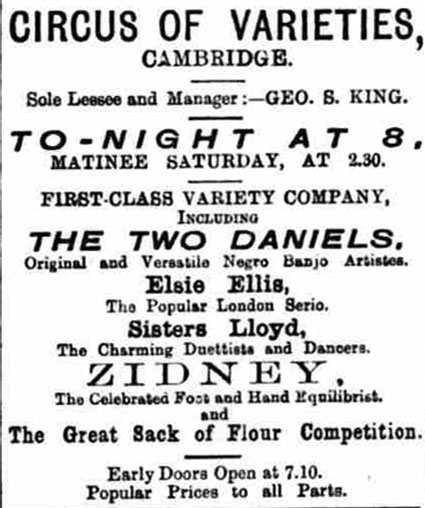
Top of the bill on 9 July were the Two Daniels, who had performed at Tudor’s circus in September 1897. Harry and Sonny Daniels, highly entertaining black comedians, musicians and dancers (stilt, clog, big boot, pedestal and spade dancing), performed regularly from 1882 to 1924 and were always popular. They were supported by the singing of Elsie Ellis and of the Sisters Lloyd, returning from October the previous year. Zidney, the foot and hand equilibrist returned from October 1896. Sadly we do not know what The Great Sack of Flour Competition involved. The ‘steadily increasing popularity of the circus under Mr King’s management’ was noted in the press (CDN, 8 July 1901, p 2).
Mid-July saw the return of a favourite from 1898, the highly talented singer Cassie Walmer, ‘The Black Princess’. For more information about her see August 1898. The ‘Powerful Company of Star Artistes was all singing, dancing and comedians and well worth the visit’ (CDN, 15 July 1901, p 1).
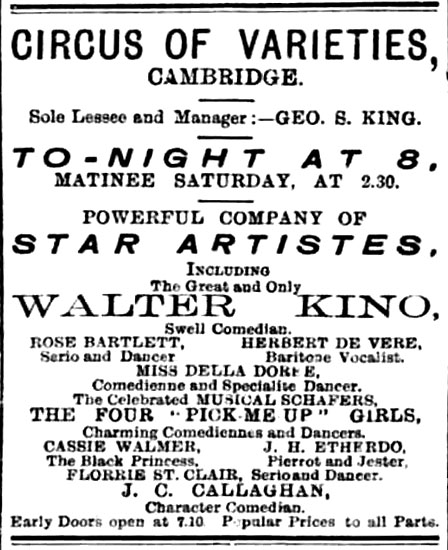
Top of the bill was comedian Walter Kino (Walter Davis) who had been heading variety programmes from the 1890s and was a great favourite with Cambridge audiences who found his ‘manner of singing a humorous song is refined and quite irresistible’ (CDN, 16 July 1901, p 2). Four months later this sad notice appeared in The Era (7 December 1901, page 20):
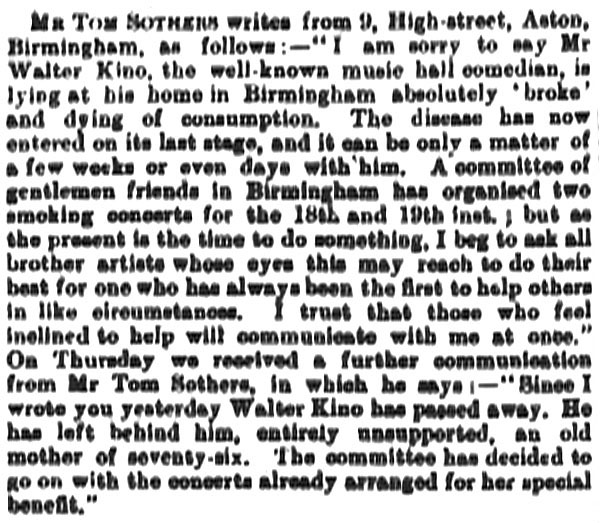
He was only thirty-four, phthisis being a great killer of younger people during our period. But he’s not forgotten, as one of the songs he wrote, ‘The fellow who played the trombone,’ is still performed now.
The serios and dancers were all complimented, petite Rose Bartlett, Miss Della Doree, Florrie St Clair and baritone Herbert De Vere among them. Comedy came from the Musical Shafers, J. C. Callaghan and J. H. Etherdo, pierrot and juggling jester – probably one of the large family of performing Etherdos. He impressed the audience by ‘balancing a pyramid of glasses and small lighted lamps upon his head, lowering himself to the stage, and, in a lying position, passing himself through a remarkably small loop’ (CDN, 16 July 1901, p 2). The circus was ‘the only place of amusement available in Cambridge just now’ and only four days later the Saturday show would be the final performance of the Summer Variety Season. ‘The building will then close for re-decoration and cleaning, re-opening on August Bank Holiday with a first class equestrian company’ (CDN, 20 July 1901, p 2).
August: ‘Auckland Road is again a circus’
On Monday 5 August The Grand Circus and Novelty Hippodrome opened:
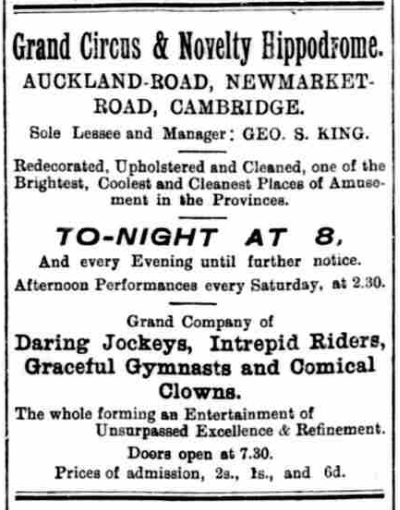
To the delight of the Cambridge Daily News the circus was back in town.
THE CIRCUS. — Tonight (Bank Holiday) Mr King will inaugurate a circus season at this place of amusement. The entertainment will be purely equestrian; there will be no music hall element in it whatsoever. As three or four years have passed since we had a regular circus in the town, there should be large houses. During the short recess, Mr King has had the whole of the buidling re-decorated, and the interior now presents a most attractive and cosy appearance.
CDN, 5 August 1901, p 2
And it was now under joint direction with Mr Val Simpson, of 8 City Road, who had run circuses previously in Hull. On 22 June he had advertised in The Era for ‘Sisters with single turns, a ventriloquist with a conjuring act and a good comedian for the Circus in Cambridge’ (The Era, 22 June 1901, p 27).
Despite the counter-attractions of the Working Men’s Annual Show and Fête in the Fellows’ Garden at King’s College, the circus was crowded on Bank Holiday Monday and the audience received the varied artists with enthusiasm.
Auckland Road is again a circus. The music-hall element has given way to the equestrian. Once again merry clowns crack merry jokes; once again there is graceful and daring horsemanship. The management announced a grand entertainment for Monday night, and their popular place of amusement was crowded. It reminded one of some old days.
CDN, 6 August 1901, p 3
Even The Era commented that ‘The management here has done wisely in reverting to the old order of things. On Monday a good house welcomed the various turns’ (10 August 1901, p 21).
The hand-balancer and acrobat Flemini performed wonderful achievements despite having only one leg, and his agility astonished the audience, and Sam Anderson the excellent comic somersault rider returned to Cambridge – he had performed for Keith and Tudor in October 1888. Miss Greenway rode with skill and grace but the greater rider was John H Swallow, whose father, the equestrian John Swallow, ran his own circus from 1841 to 1883. After his father’s death, the younger Swallow (who was also Sam Anderson’s brother-in-law), carried on with his own circus, later joining Barnum & Bailey in the USA where he drove the Deadwood Coach in the grand finale. Then he reinvented himself in Britain as Broncho Bill with his Great Wild West Exhibition, which drew crowds for years, and finally toured with his two elephants, Salt and Sauce. For more about Swallows senior and junior go here.
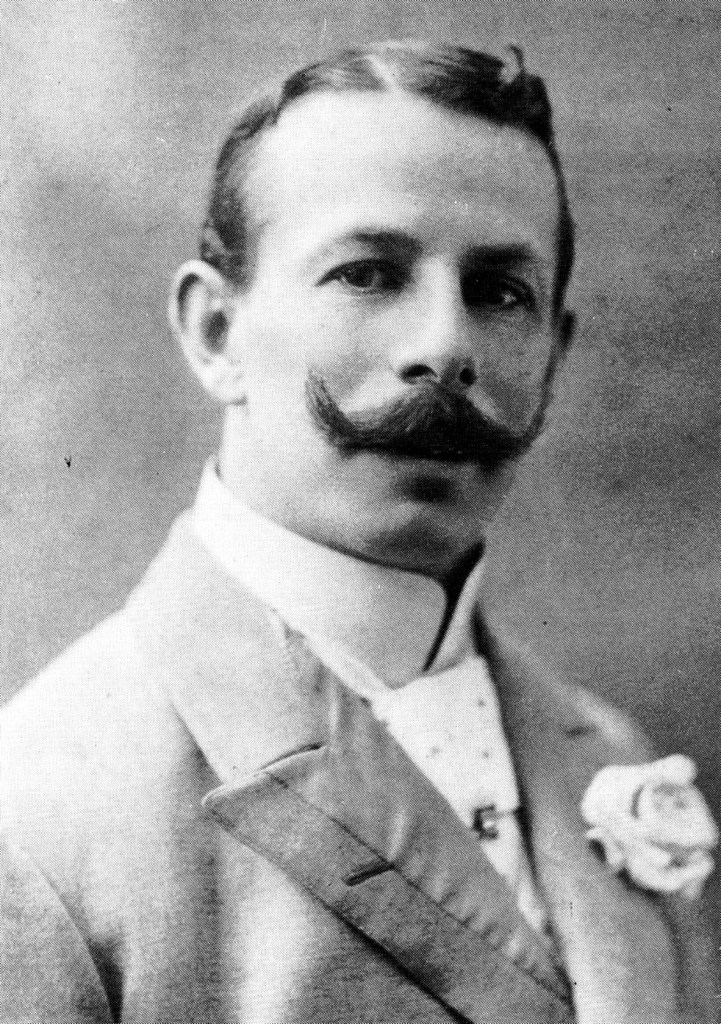
For Cambridge ‘the greatest jockey act rider in the world, was as clever as when we last saw him. His bareback feats mark him as the finest horseman who has appeared in the circus ring for many years’ (CDN, 6 August 1901, p 3).
And there were circus clowns, Comic Bimbo (Thomas Drake) a tumbling and knockabout clown, sadly without his famous educated pig or his famous very high stilts, and Yorick & Yorick, one of whom must have been Tom Yorick, another famous clown. They were ‘immensely popular’ in Cambridge, particularly ‘with the juvenile portion of the audience. And they were not only funny: they had some original jokes to tell’ (CDN, 6 August 1901, p 3), or what the Cambridge Graphic called ‘a good many old wheezes’ (10 August 1901, p 10).
Both the local press reviewers and the Cambridge audience appreciated the change in character back to the ‘variety and genuine fun’ of the traditional circus and there were bumper houses for the second week. There were trapeze artists (Two Harveys), sprightly female acrobats (the Parkers), and Alfrano on the flying rings. `The place has been fresh decorated and looked quite dainty in its new dress,’ said the Cambridge Graphic on 10 August 1901, p 10.
No circus would be complete without trained horses and riders and Cambridge was able to admire the bareback riding skills of two famous Swallows, Amelia and her brother John H Swallow. Amelia (married to Cambridge regular Sam Anderson the clown) had a distinguished solo equestrian career but had started performing with her brother and husband. Her turn portraying the three nationalities of England, Ireland and Scotland was found ‘particularly attractive . . . While on horseback, Miss Amelia changes costumes characteristic of the three nations, and while the horse is careering round the ring performs the three national dances.’ Her brother John Swallow ‘performs a number of feats, and finishes with jumping upon a horse blindfold, with a sack over his head’ (CDN, 13 August 1901, p 2).
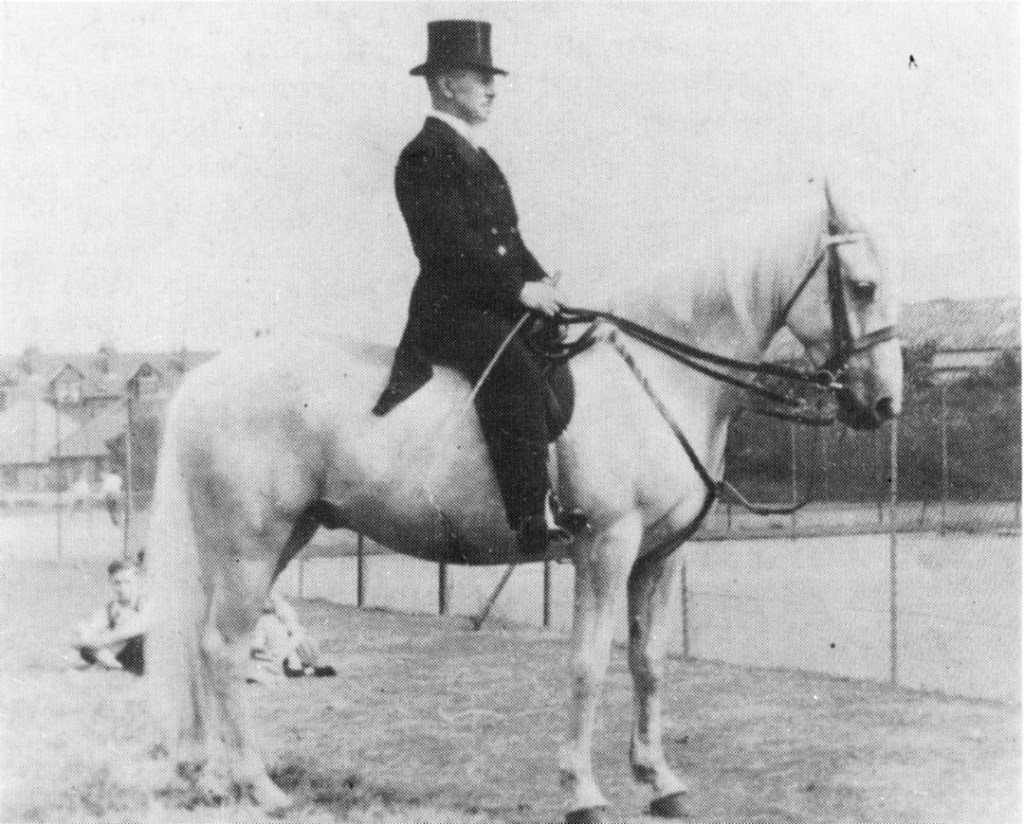
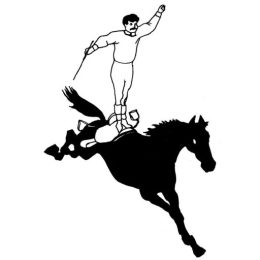
Not to be outdone, Sam Anderson acted out on horseback Shaw the Life Guardsman, the story of the heroic Corporal of Horse who died at the Battle of Waterloo and became a popular hero. His act was described as dramatic and realistic, though perhaps not quite as dramatic as Millais’s painting:

On a jollier note the Two Yoricks performed two comic sketches, one called The Ghost of Newmarket Road. Whether this is the waddling, penguin-like ghost of a Plague doctor of contemporary legend, we do not know. And the circus was really back as that old favourite, audience participation, was revived: a bicycle race was advertised for Friday evening, the prize a silver cup, and a pig hunt followed on the Saturday.
The next week’s new programme was full of activity. Full houses watched as in the ring a young Miss Marguerite rolled on her globe, The Rozzells swung on the horizontal bar, the acrobatic Four Grovinis tumbled, and Miss Pauline Sivado gave a graceful and pleasing bareback ride. In the air were Harry and Minnie on the flying rings and Alf Levarni, skilful on the high wire. But the act that made the biggest impact was Cassello the Human Gasometer. Cassello promoted himself as ‘The most Novel and Sensational Fire Act before the British Public. Thoroughly refined, and Guaranteed Safe’ (The Era, 29 December 1900, p 2), which was just as well if you read the CDN review (20 August 1901, page 2):
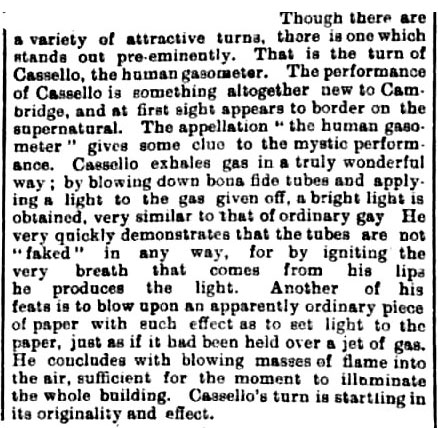
We are not told the results of the pig hunt but it must have been a success as a duck hunt was promised on Friday, as well as a ladies’ beauty show (prize a silver watch), and a bicycle race on Saturday night (prize a silver cup).
‘The old days of the circus are once again revived, for well-filled houses nightly assemble to welcome the excellent entertainment provided’ wrote the CDN the following Monday, in anticipation of ‘an almost entirely new company’ (26 August 1901, p 2). On that very same, and very wet, Monday night the new programme attracted a full house to the once-again renamed Cambridge Circus and Novelty Hippodrome. There was wire-walking by The Sisters Lemire but our reviewer was most taken by Ida Evilo, a graceful young lady of a most prepossessing appearance, balanced on a ladder, on top of the high trapeze. She balanced on a chair with only two of its legs on the trapeze, to rapturous applause (CDN, 27 August 1901, p 2).
On the same evening, horses were back in force again with a return visit from William Tudor’s old friend, the ‘exceedingly popular’ James Newsome, last in Auckland Road in 1896. He brought his wonderful trained horse Miss Mornington and his unrideable mule, a challenge for the more foolhardy members of the audience. Pauline Sivado rode again and Mons. Wilson Rogers displayed his performing pony, Monarch.
The promise of the weird Human Bat who would make sensational flying leaps from floor to roof of the circus did not seem to live up to expectations as although he ‘possesses in a remarkable degree the truly bat-like propensity of hanging head downwards’ the only other comment being ‘some of his evolutions are very sensational’ (CDN, 27 August 1901, p 2). At the end of the month, George King was advertising for more ‘Sensational Novelties and Acts of all Descriptions’ for 9 September and beyond (The Era 31 August 1901, p 28).
In the meantime, Pongo the Man Monkey, last seen in Auckland Road in 1897, was an astonishingly life-like monkey ‘not only clever but daring to a degree’ (CDN, 3 September 1901, p 3), and ‘original as well as daring’ (CG, 17 September 1901, p 7).
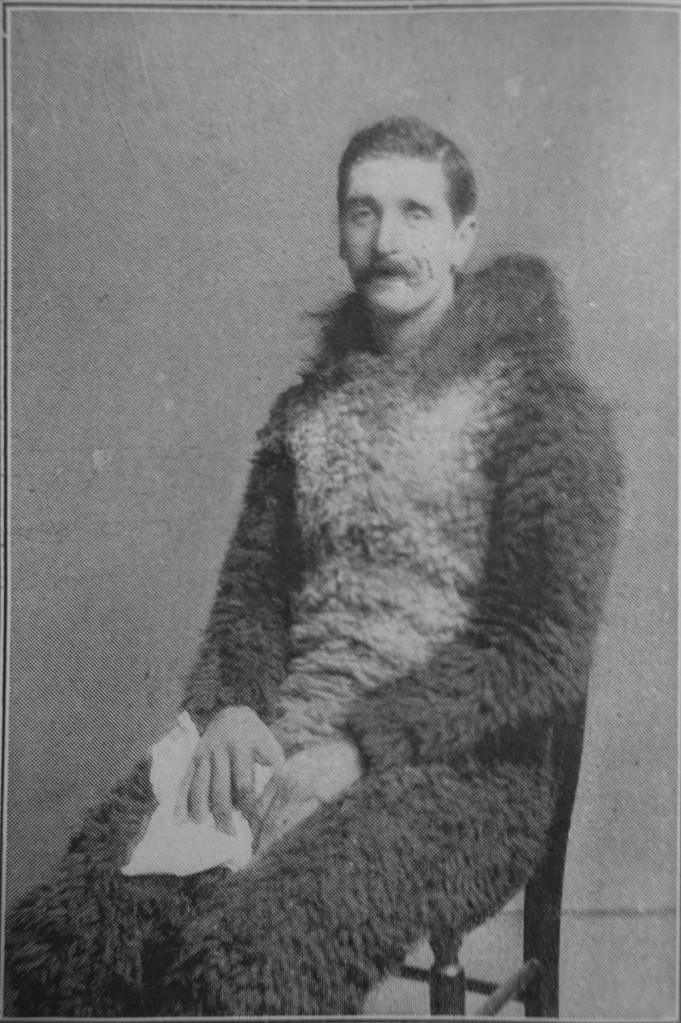
No hirsute gorilla, Pongo was played by human James Dubois, though his real name was Alfonse Mallaird. Pongo quoted an early review from the Oldham Chronicle when he advertised himself in The Era, 19 January 1889, p 24. We learn that ‘the marvellous skill of Mr James Dubois, as the original Pongo, creates great interest and admiration, and the agility with which he skips up a rope to the top of the building, by the aid of his hands and toes, and his astonishing feats on the rope and on a loose pole dangling from the ceiling, evoke the utmost enthusiasm at each performance.’
And in another self-advertisement Dubois quotes the Brighton Examiner of 5 November 1889:
‘This clever artiste is attired in a hairy covering which gives him the natural appearance of the animal he represents, and is first introduced to the audience in a cage, which he presently breaks down, and, leaping out, climbs up a rope which he ascends with marvellous rapidity nearly to the roof of the hall; he then swings himself on to the perch suspended from the ceiling in a perpendicular position, and there amuses his audience with several extraordinary feats of gymnastic display that prove as popular as they are daring (The Era, 9 November 1889).
For more on Pongo, and the controversy over the three competing Pongos read here.
Mdlle Alice, lady contortionist, ‘put her body and limbs into positions that would seem impossible’ and had a hearty reception. Another entertaining turn was Gilberts’ trained (and real) dogs and cats. Robert Gilberts had only to look at his pets to make them jump backwards, turn somersaults, and perform other interesting feats. The animals seemed to enjoy it too; especially a beautifully coated collie’ (CDN, 3 September 1901, p 3). The Zento Troupe of six cyclists had the heartiest applause.
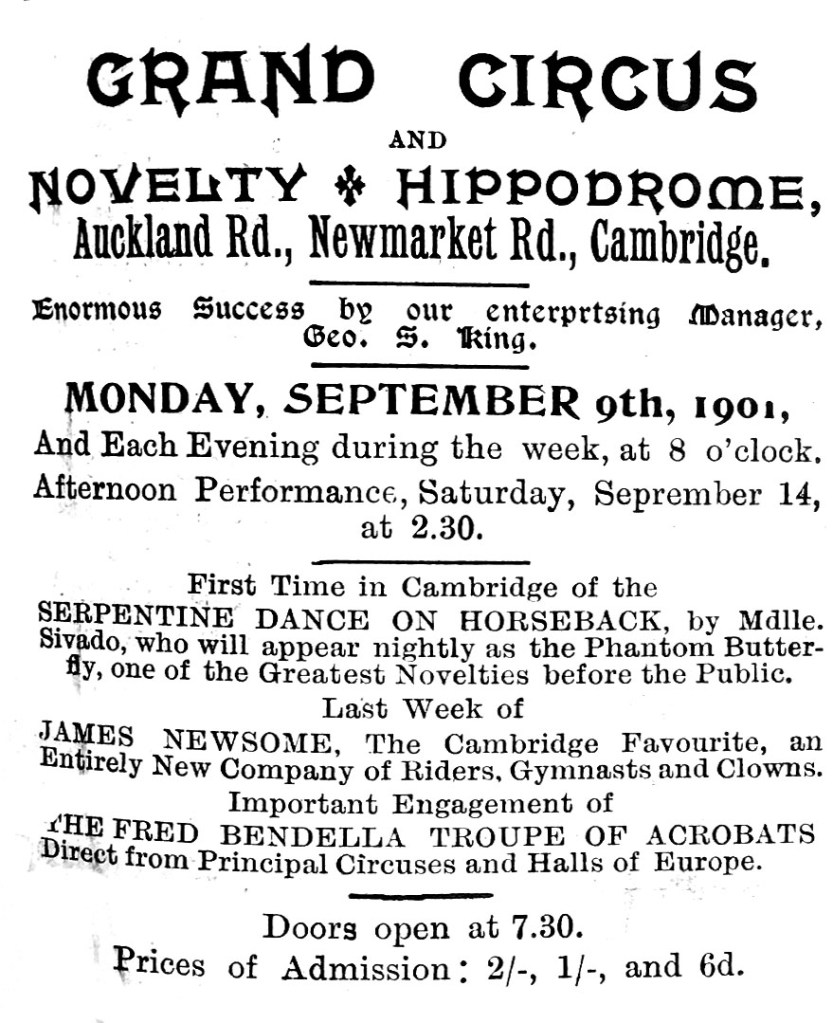
The next week horses were to the fore as Mr Newsome’s beautiful mare Miss Mornington received quite an ovation, while the unrideable mule failed to unseat its volunteer rider this time round, to the great amusement of the audience.
Miss Pauline Sivado (her stage name a reversal of her father’s name O’Davis) spruced up her riding act with a serpentine dance on the bare back of her beautiful white horse. She had been with both Tudor’s and Keith’s circuses elsewhere, as well as Transfield’s and Cooke’s, throughout the 1890s. She often appeared on the same circus bill as other Sivados, but she disappears from the circus press after 1905.
In 1892 she had successfully sued a circus owner Edward Wulff for non-payment of her salary, despite his claim that her mare was ‘a done-up old crock’. She was awarded £90. 0s and 6d, perhaps despite the evidence:
The plaintiff admitted that her bay mare, on which she did the trick act, was a little thick in the wind, and was a kind of ‘roarer.’ — Questioned as to the age of the mare, she said the learned counsel had better look at her teeth. She had used the horse since in her performances, and had never had any complaint about her.
The Era, 1 July 1893, p 16
Tambo the ‘marvellous tambourine manipulator’ had been at the circus before, in 1899. ‘His dexterity in keeping in motion a large number of these instruments (at one time no fewer than 17) is little short of genius’ (CDN, 10 September 1901, p 3). The Fred Bendella troupe of four acrobats and contortionists, male and female, gave a bewilderingly clever performance but the act that impressed most was Zanetto and Lorene, the Human Cranes (strength rather than aerobatics.)
They are described as ‘lion-jawed athletic human cranes,’ and their turn is a revelation of tremendous muscular development. Zanetto begins by suspending a 50lb weight upon a board held in his mouth. He proceeds to lift the lady performer, Lorene, amd swing her round rapidly while she is suspended from his teeth. Lorene lifts heavy weights, one 112lb, by means of her hair. An ordinary upright cottage piano, hired from a local firm, requires four men to lift it into the ring – Zanetto, standing upon a high erection, removes the instrument several times from the floor while gripping the rope with his teeth.
CDN, 10 September 1901, p 3
No wonder that the large audience on the Monday gave unstinted applause and several encores.
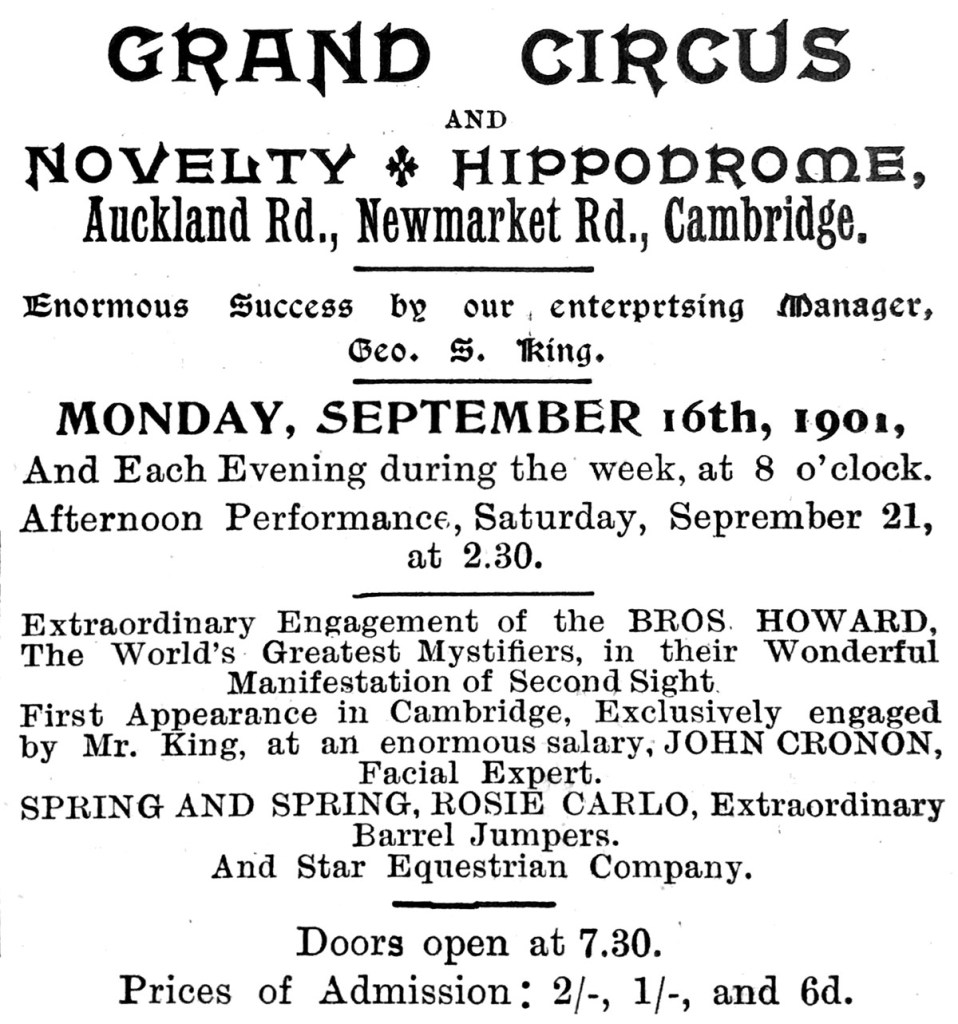
Top of the bill the following week were the remarkable Brothers Howard, a mind-reading duo, with a ‘remarkable turn’ who left the audience wondering over their apparently inexplicable feats.
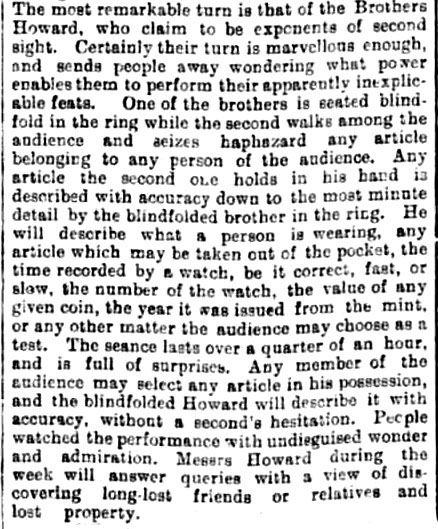
They were brothers to The Marvellous Howards, (Thomas and Louie, later Lilian) also mind-readers, and performed from the 1880s through to 1907. Sadly, we do not know if they really were clairvoyants or mind-readers!
Herr John Cronow, the Imperial Facialist, was a quick-change artist and impersonator who for many years represented the celebrities of the day – Bismark, Disraeli, Napoleon, Nelson and others, including ‘daring innovation ! — Her Majesty’ Queen Victoria (The Era, 4 August 1894, p 14). Our Cambridge reviewer thought him an expert of no inconsiderable ability with his faithful representations.
Action was provided by the regular equestrians James Newsome and Wilson Rogers, introducing the horse Monarch, and the clowns Bimbo and West and the barrel jumpers Spring and Spring with Rosie Carlo who performed extraordinary feats’ and were recalled time after time by the enthusiastic audience (CDN, 17 September 1901, p 3).
Two days later there was an ambiguous comment in the local press (Cambridge Daily News, 18 September 1901, p 2) over some posters that George King had been distributing around the city., on the same page that the New Theatre announced its re-opening for the winter season, directly above the circus advertisement. The circus and the theatre generally did not coincide, the circus taking the late spring summer season when there was less entertainment in town.
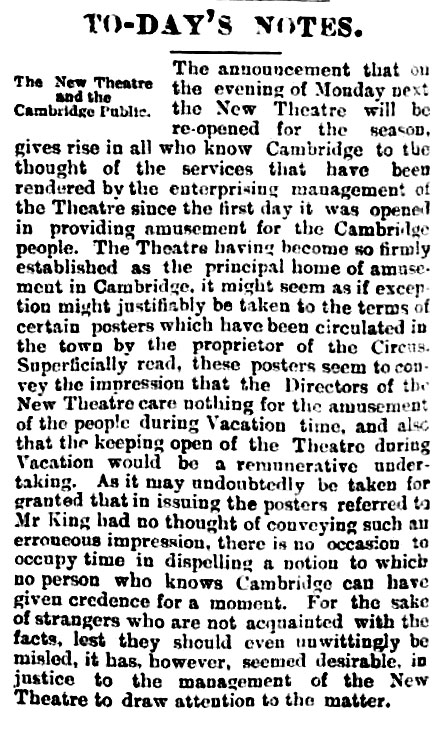
This is clearly written with some degree of irony but we still don’t know what it really means.
There is no further mention of the circus in the local press so we assume it closed on Saturday 21 September. A week later George King placed the following in The Era but it does not appear to re-open that year.
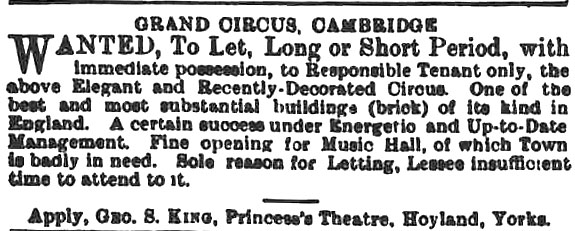
A hint of the closure came in a failed case brought by a basket maker (CDN, 3 October 1901, p 3). Wilson Rogers from the circus was called as a witness. He had ordered two basket masks (used for horses) on 20 September and paid three shillings, not to the basket maker but to one of his irregular workers, on or after September 30. The workman said that he thought the circus people had gone away. So had the workman and the three shillings.
If Cambridge people wanted to see the thrills of a circus they would have to travel to Saffron Walden when one of the elephants from the visiting Sanger’s Circus caused some chaos in November:
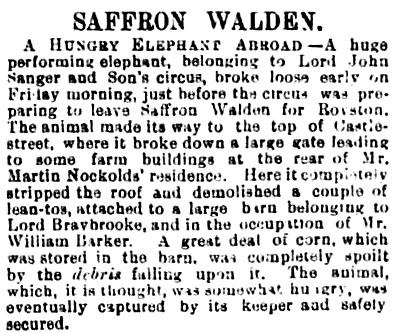
The story of Albert and the fence-posts
We have related elsewhere how the circus’s owner, Thomas Askham, sometimes sailed close to the legal wind. At the end of September 1901, soon after the circus closed, it was his son Albert who was prosecuted, but we cannot help thinking that it was his father’s determined presence behind yet another falling out with the powers of the town.
On 27 September a case opened in the Borough Police Court, summoning Albert Askham ‘for wilfully damaging certain Corporation property, to wit, the soil on Midsummer Common, on September 5th’ (CDN, 27 September 1901, p 3). He was alleged to have erected a fence that encroached upon the common land. A bye-law stated that anyone who removed, injured or defaced the turf of the Common was liable to a 40 shillings fine.
Acting for Albert, Mr O Papworth objected as his client had a ‘bona fide belief that the property in question did not belong to the Corporation,’ had been in their possession for twenty years, the fence in question had been there thirty years and that the case should be held in the Civil Court as some on the bench were members of the Corporation. The case was adjourned for a week, and the Court sat again on 4 October to discuss the matter of the 14 fence posts.
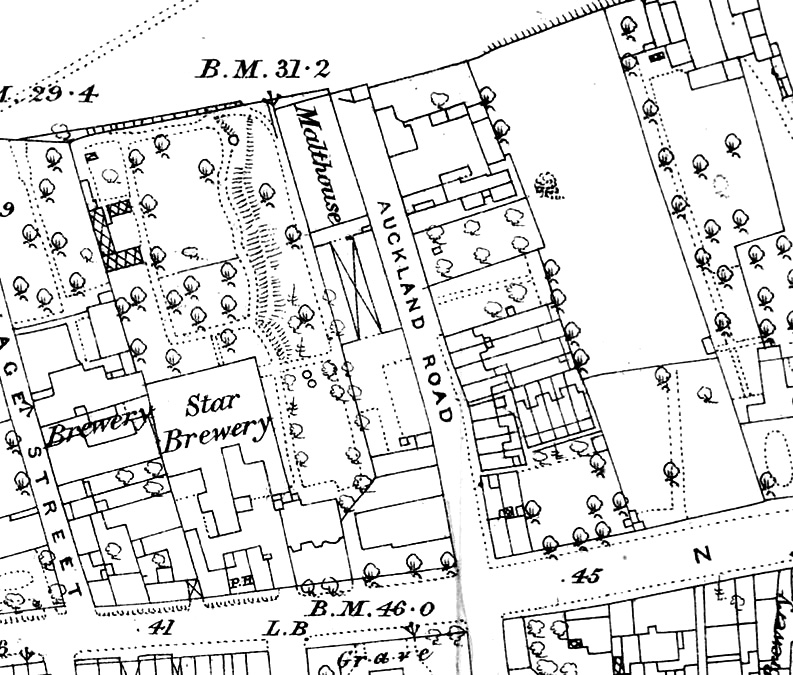
The Borough Surveyor came with the 1886 Ordnance Survey map and there was discussion of posts – broken, non-existent, wooden and iron – next to the circus and either bordering or encroaching on the Common. Mr Papworth did his best to cast confusion over the matter. Then there was the matter of damage to the Common which Papworth also vigorously contested.
The pindar who inspected the Commons was also called and though he confirmed the new fence was not in the same position as the old, broken-down fence, the chairman stated that the question was whether the fence was, in fact, on the defendant’s property or not. The magistrates retired to discuss the knotty problem and their verdict was that since they were not empowered to decide the matter it should be dismissed, but not before a lengthy hearing, about which you can read here (CDN, 4 October 1901, p 3).
Were the posts removed? Did the new fence remain? Does this mean Auckland Court, built on the circus site in 1993, encroaches on the Common? We do not know. But here’s a 1980s picture showing the fence by the Common. The circus closed for the winter and the soil settled until the new season opened in May 1902. Surely it was Thomas Askham who was behind the boundary dispute and Albert his proxy – but Thomas’s fight with the great and the good of Cambridge was only just beginning.
Coming next to Auckland Road Circus – the great theatrical licence show! Featuring, on one side, Dr Walker (Senior University Proctor), W K Vawser (Barnwell Mission), Rev. T K Allen (St Andrew the Less), Rev. J Jull (Eden Baptist Chapel) and other local guardians of working-class morality . . . and, on the other side, Thomas Askham and the ordinary folk of Barnwell.
 William Tudor's Circus