William Tudor leaves Cambridge
Why did William Tudor shake the dust of Cambridge from his shoes after a very short 1899 season? He had a number of other circuses under his management in the north-east, and in Ipswich. Was he making more money from these circuses? Was it just too much work and did he need to retrench? Or could he have felt that the town that had seen the deaths of his brother Funny Fred and his long-term agent, manager and friend Henry Bucknall, had too many bad memories?
Twice during 1899 Tudor had advertised the Auckland Road circus for sale or lease:

On 23 August he had his music and dancing licence for Auckland Road renewed at the annual Licensing Sessions (CIP, 25 August 1899, p 6). Perhaps this made the building more attractive when he advertised it again a few days later when he was working in Cleethorpes:

‘Licensed for Music Hall Business’ – a sign of things to come.
Whatever the reasons for William Tudor’s departure, he must have come to an arrangement with Thomas Askham, the Cambridge businessman who owned the land in Auckland Road.
Thomas Askham takes over – but when is a circus not a circus?
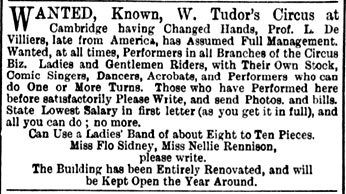
The Auckland Road building re-opened in May 1900, Askham immediately devolving management to Professor L de Villiers (a man whose academic status, like those of other circus professors, might not stand close scrutiny). This was the start of a series of new incarnations under different names – The Circus of Varieties, The Empire Circus, The Empire Music Hall, The Hippodrome, The Gaiety Theatre – although Tudor’s name was retained for the first two weeks. Tudor’s Circus was never to return, although William and third wife Edith brought their ponies in 1913 when the circus had become the Gaiety Theatre.
The first mention we find of our circus in 1900 is in an advertisement when ‘Prof. L. de Villiers and Prof. H.R. Massey will give an exhibition of horse training and will tame and subdue any horse brought up so that it can be ridden and driven successfully’ (CDN, 22 May 1900, p 1). Three days later it was announced that Tudor’s Circus would reopen on 28 May under new management with ‘a most wonderful aggregation of Circus Talent’ (CDN, 25 May 1900, p 1).
The Era posted this (26 May 1900, page 25):
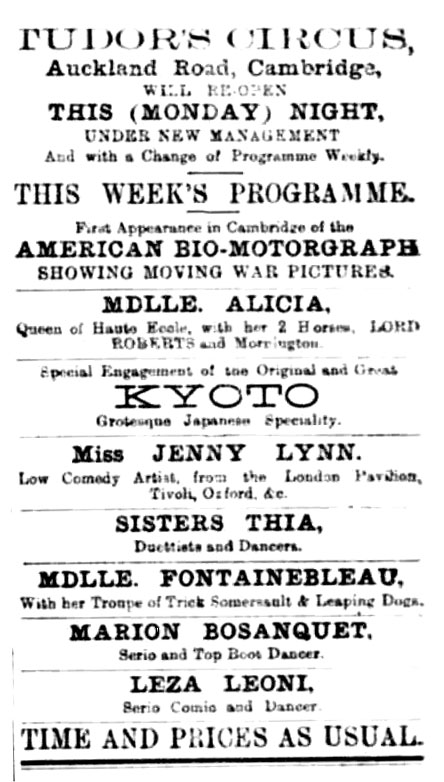
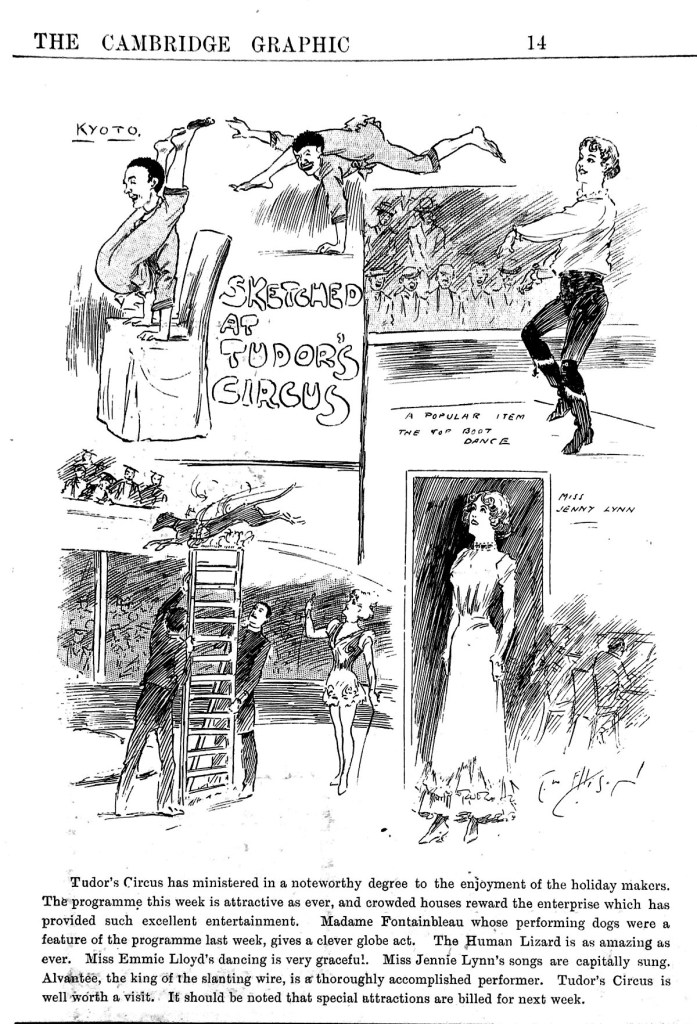
And the Cambridge Daily News (26 May 1900, page 2) announced: ‘a strong company of music hall and circus artistes have been engaged by Professor L. de Villiers to perform at Tudor’s Circus during the ensuing week’. So the horse-trainer from America was running the circus. There was a good audience on opening night, with many university members. Our old favourite Mdlle Alice Fontainebleau (see 1893 and 1898) entertained with her performing horses and her dogs. The illustration below is from the Cambridge Graphic, which ran from 1900-1901 and was the source of the drawings by Talbot Wilfrid Ellison, about whom you can read more here. The university students can be seen in the gallery in their gowns and square caps.
Alice Fontainebleau
In 1893 we heard Beatrix Potter’s warning of the painfully drudging life that would result from Alice’s chilly apparel in a damp tent. But Alice managed to avoid a drudging life by combining her dog troupe and her rolling globe skills with running the Marquis of Granby Hotel in Lincoln with husband George Spencer. He had been musical director and composer at many of Cooke’s circuses in the 1880s, and he and Alice definitely coincided at this time. The hotel targeted theatre, circus and music hall performers, George and Alice stating they would be glad to see their old friends. George died in 1906 but Alice carried on performing and managing – last noted in the press in1908.
She was always a highly competent and much applauded artiste, who promoted herself in The Era in a forthright, confident tone. She could give circus owners ‘three good numbers (Not Rubbish)’ of dogs, horse and globe, (28 September 1889, p 22) and urged them to ‘purk up’ and send her ‘their best offers’ (21 January 1899, p 28). If that left any doubt, she announced that she was ‘now appearing and knocking them at the Grand Circus, Birmingham’ (27 May 1899, p 26).
In Auckland Road the ladies were warbling. Miss Leza Leoni sang and danced on her own and as one of the Sisters Thia. Marion Bosanquet, another dancer and singer, frequently appeared on the same bill as Leza and the Thias, so it is possible she was the second Thia. Jenny Lynn also sang well despite having a cold, being pronounced ‘one of the best turns of the evening’ (CDN, 29 May 1900, p 3). The CDN reviewer commented that four out of nine acts were singers: ‘Apparently M. de Villiers will rely chiefly on music hall business to fill the house. A serio is not heard to best advantage in a circus ring, nor is skirt dancing enhanced by the absence of a proper stage, with limelight, but when artistes come and conquer these disadvantages it must be acknowledged that they are much above the ordinary’. A serio sang comic and serious songs.
The students were particularly taken with the contortions of Kyoto. ‘His performance was exceedingly popular with the more athletic of the undergraduates, who were not satisfied until he came and “mixed himself up again” as a well-known Blue remarked’ (CDN, 29 May 1900, p 3).
Kyoto was probably Naojiro Takeda, born in Kyoto, Japan, who performed in England from the 1890s onwards, both solo and with others, as a contortionist, equilibrist and juggler. He was often likened to a cat and was known to play the feline role in Dick Whittington (The Era, 21 January 1899, page 21). He married Rene du Rocher, a music hall artist in 1918, and they had two daughters. Sadly, he was convicted of the theft of £200 from a dancer, Dessie Desmond, in Glasgow in 1927 who reported:
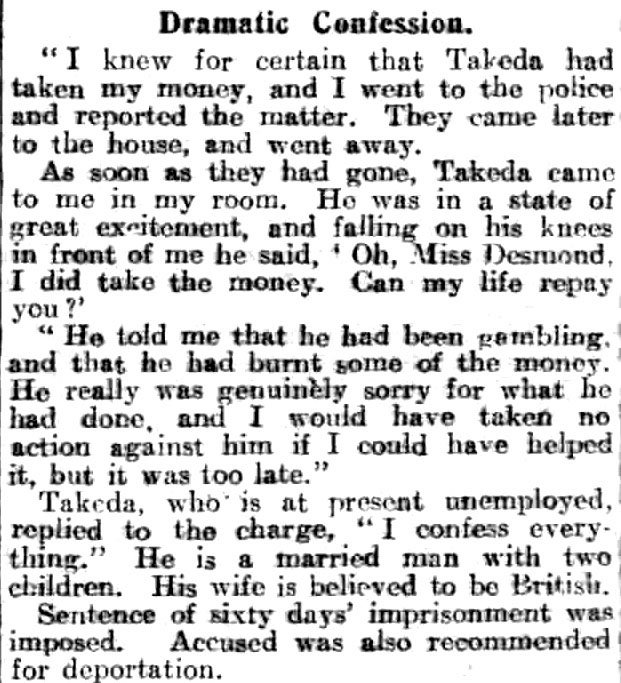
He was indeed deported two months later, leaving his family behind, and we hear no more of him.
The moving pictures displayed in the Cinematograph, mostly of the Boer War, were thought ‘exceedingly good’, but there was criticism of the band which was
scarcely so successful as could be wished; indeed there seemed to be much misunderstanding between the various instruments at times. The three gentlemen who accompanied the artists, however, at a moment’s notice acquitted themselves creditably. But a brass band, however good, is not a success in a music hall, and the management will be wise if they at once instal a string band of, say, some six performers. If that is done, and the excellency of this week’s programme maintained, there is no reason why M. de Villiers should not have a very successful season.
CDN, 29 May 1900, p 3.
A good circus/music hall orchestra is essential and a week later an advertisement appeared in the trade press stating ‘WANTED, Immediately, Musicians, to Complete Orchestra, Circus of Varieties, Cambridge, Rehearsal 1.0 p. m. Monday. Wire Terms, MUSICAL DIRECTOR. 80 St. George’s road, Forest-gate, E.’ (The Era, Saturday 9 June, 1900, p 21). Note the new name, Circus of Varieties; note, too, that Askham’s dismissal of the original band would land him in court in July – not that being sued ever seemed to bother him.
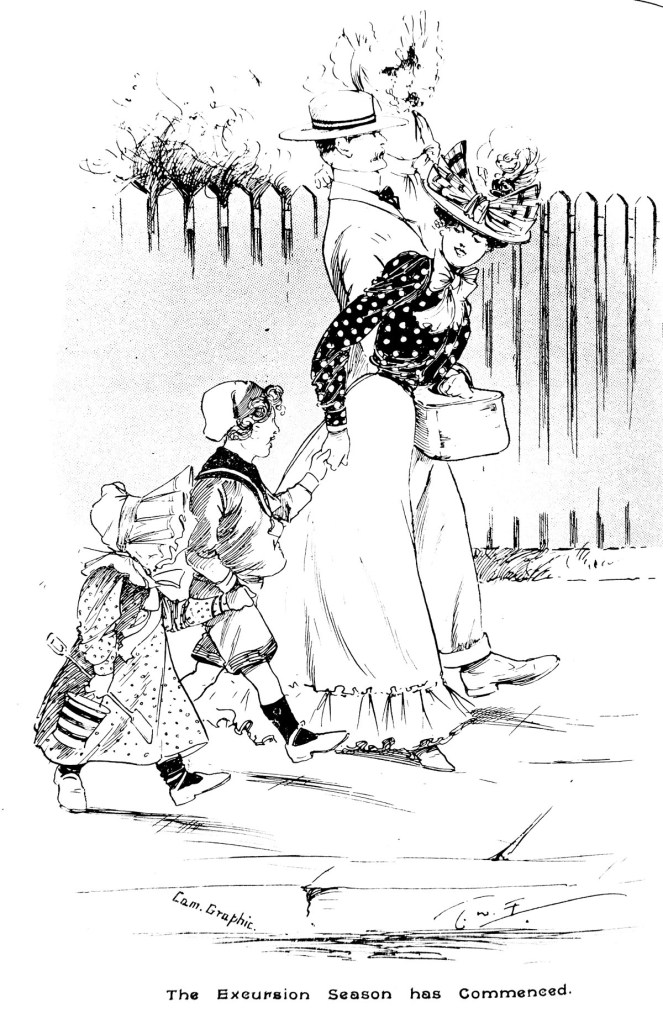
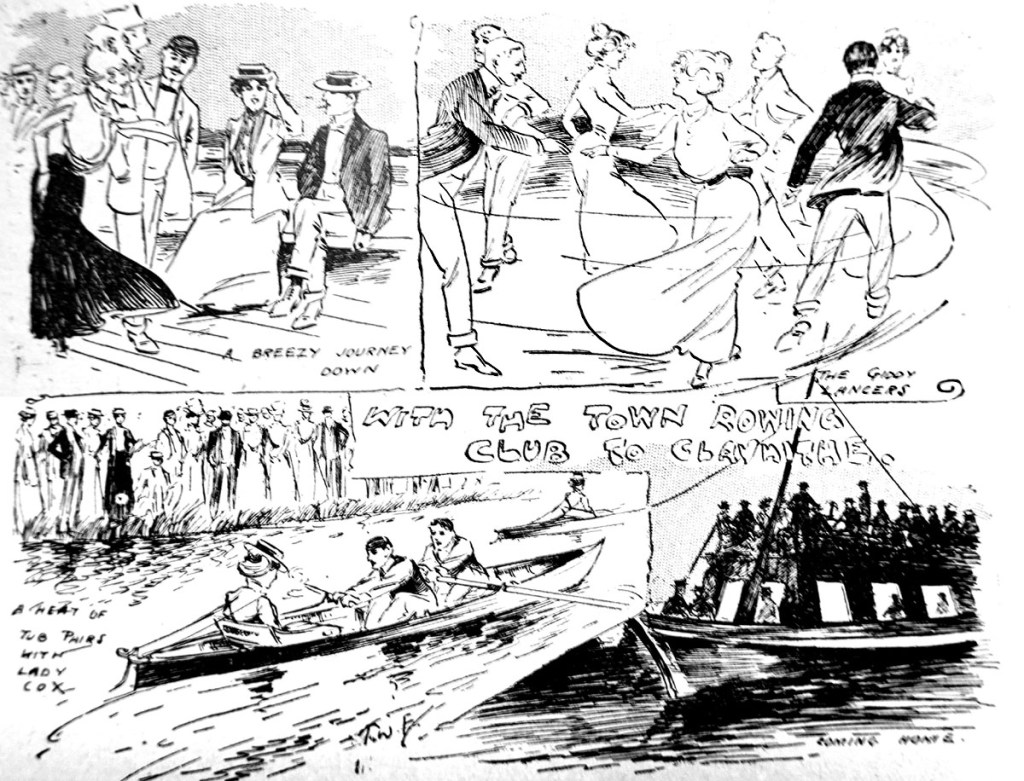
As the Whitsun holiday arrived, the weather improved and on Whit Weekend it was glorious, with cycling excursions, boating parties and picnics on Midsummer Common. Talbot Ellison provided lively pictures of Cambridge life for the Graphic.
Although Thurston’s fair was on the Common, our circus was packed, its programme augmented by Alvantee, King of the Slanting Wire, who had last performed in Tudor’s Circus in 1897. ‘His sensational slide down the wire from the top of the building was enthusiastically greeted’ (CIP, 8 June 1900, p 5).
Newcomers to the bill included Sam France, a popular tumbling clown who had been performing since the 1880s, and who was to take on the role of ringmaster, the Brothers Curry with a comic sketch and more tumbling, and Miss Emmie Lloyd, an excellent serio and skirt dancer. ‘That the variety entertainment now being provided for the Cambridge public by M. de Villiers at the building in Auckland-Road known as Tudor’s Circus is increasing in popularity is quite clear from the large audiences there during the present week. The building on Whit-Monday evening was crowded, and has been so nearly the whole week through’ (CIP, 8 June 1900, p 5).
Jenny Lynn must have recovered from her cold as she was highly complimented. She had ‘established herself a favourite, and was encored again and again for her new songs. Miss Lynn’s success is thoroughly well deserved, as she is a really good singer, with clear enunciation, and an entire absence of vulgarity’ (CDN, 5 June 1900, p 2). The CIP agreed that ‘The singing of Miss Jenny Lynn . . . was much admired’ (CIP, 1 June 1900, p 5). This was not to be the last we hear of her singing.
Jenny Lynn
Long-lived Jenny (1875-1973) had appeared with her father Harry Lynn, a favourite stage actor, as ‘the wonderful Child Actress’, from 1881 when she was only six. Harry declared she ‘scores one hundred laughs in twenty minutes’ (The Era, 6 October 1883, p 20). Her sisters Lotty and Emmy joined them, and Jenny continued as actress, comedienne, soubrette, male impersonator, serio-comic and singer, mainly on the stages of the London music halls and theatres. Her ‘low comedy’ was always praised, ‘low’ referring to the working-class comic characters, not the taste, as her songs and patter were always ‘without the slightest spice of vulgarity’ (The Era, 1 February 1896, p 31). The same paper (19 December 1896, p 18) offered even more praise: ‘What artiste, indeed, could give such point to the amusing interjaculations of a hard-working wife with a grumbling husband who earns but a “quid” a week. How the gallery and pit laugh at each recital of domestic differences.’ On 5 August 1899 The Era (page 18) proclaimed: ‘Her character sketches of the London woman of the lower and middle classes are always true to life . . .’
The Era reported her marriage to George Griffith in May 1897, and the birth of their five sons between 1897 and 1915 did not prevent her continuing her much-praised career with song and patter as well as comic drama, until the family emigrated to Australia in 1925. Jenny died in Adelaide in 1973, having had, unusually for our variety artists, a secure and successful life.
In the same week, Marion Bosanquet and Leza Leoni gave clever top boot dances, to be seen in Talbot Ellison’s illustration above.
We have read the praises heaped on Jenny Lynn and the complaints about the circus band. In July, Arthur Henry Foulger, publican of the Brewer’s Arms, Gwydir Street, sued Thomas Askham for £17 for the hire of a band of performers for three weeks. Foulger, himself a cornet player, claimed his band of five musicians were perfectly competent, as Askham himself had concurred at the end of the first week. On 10 June, Arthur Askham, Thomas’s son, had told Foulger the band was no longer required as they had engaged a band from London. They were therefore not paid for the three weeks. Foulger continued with complaints against Jenny Lynn, ‘an “inferior” lady artiste. She could not sing, and had no music which made it impossible for the band to accompany her’. A rather snide interjection from the judge and prosecutor followed: ‘She had no voice I suppose. (Laughter). – Witness : Quite true your Honor – Dr. Cooper : I suppose she was the “variety”’ (CIP, 20 July 1900, p 6).
Askham, however, denied there was a three-week agreement and defended Jenny’s singing, claiming:
Plaintiff [Foulger] had previously asked him to employ his band, and he communicated with him when he decided to open the building. It was settled that plaintiff’s band should come on Whit-Monday, but no definite engagement was made. He (defendant) was to pay £8 10s. for the week. There were a great many complaints about the band, and he frequently complained about it to plaintiff. When Jenny Lynn was singing the band was stopped and the lady’s sister accompanied her. He believed this occurred three nights. He paid Jenny Lynn £10 a week. The band was without a proper leader that week. When the band was paid on Saturday evening, he told plaintiff that there were so many complaints that the band would not be required any longer.
CIP, 20 July 1900, p 6
The Cambridge Chronicle and Journal pointed out that not all of the five named musicians actually performed on various nights and ‘at no performance was there a proper leader of the band’ (CCJ, 20 July 1900, p 3).
Despite testimony from his three witnesses, Askham lost the case. What it shows is that, despite delegating to De Villiers, Askham was very much the proprietor of the circus, and had taken on that role without the canny Tudor’s experience and expertise.
Whatever the merits, or otherwise, of Foulger’s band, the third week of the circus opened to good audiences, with much applause and many encores each night, the band (the replacements from London) showing ‘a marked improvement’. This was just as well, as singing and dancing that came from Rose Heath, Flora Lington (returning from 1898) who ‘warbles some good ballads’ (CDN, 12 June 1900, p 2), including a patriotic Made in England Not in Germany, and the returning Sisters Le Graham, formed a major part of the bill (CIP, 15 June 1900, p 7). The Cambridge Graphic (16 June 1900, page 7) also approved of the music: ‘The new London Bijou Band they have recently engaged is an effective little orchestra, suiting well the requirements of the performers.’
The Le Graham Sisters – Marie, Louie and Ada – ‘an excellent trio who afford much melody and mirth’ (The Stage, 3 January 1901, p 17), had been enjoyed by Cambridge in 1898, and remained ‘great favourites’ (CIP, 15 June 1900, p 7).
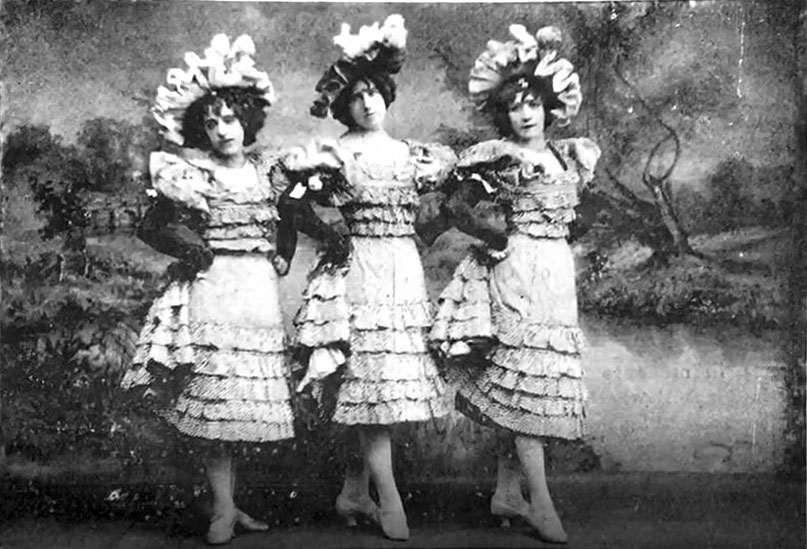
Jas Mackenzie, international dancer, returning from 1899, was ‘exceedingly clever’ and ‘loudly encored’, performing a Scots reel, a sailor’s hornpipe and an Irish jig exactly as he ‘gave before the Queen at Balmoral’ (CDN, 12 June 1900, p 2). Let us hope the Queen was not too alarmed by his fearsome shillelagh.
There were capital feats from the (male and female) Tarras Jugglers. ‘A risky performance – but well carried out – was the juggling with lighted torches, and with the ring in darkness, it was a weird scene’ (CIP, 15 June 1900, p 7).
Another circus act, Madame Dahlia, performed on the high trapeze, and on a bamboo perch suspended from the top of the building. Lord Tom Doddy and Gaiety Belle caused much amusement in their sketch Lackeys and Lovers, with high-class comic patter and the novelty of their respective heights (he 40 inches, she just under seven feet). As always this season, Talbot Ellison captured the action for the Cambridge Graphic:
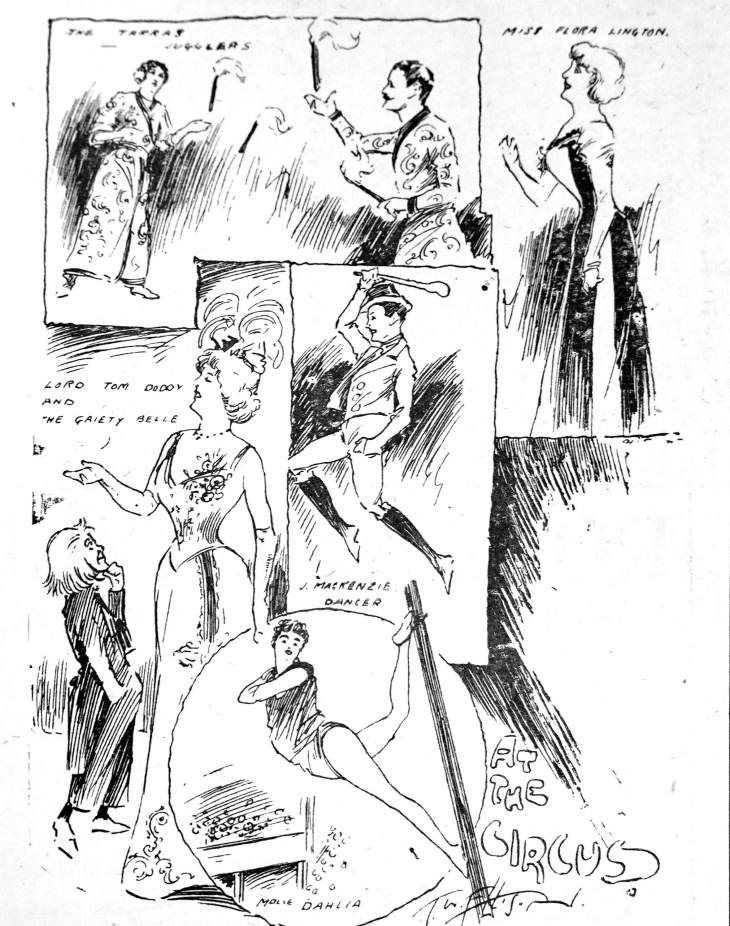
The Graphic’s reviewer felt that ‘the circus deserves well of its patrons, and were it situated closer to the centre of town its share of local patronage would undoubtedly be larger and more consistent’. They also commented that equestrian acts had given way to variety performances, posing the conundrum: ‘When is a circus not a circus? When it is an excellent variety show’ (CG, 16 June 1900, p 7).
The preponderance of variety singers continued in the next programme. The Le Graham sisters were retained for another week as Madame Lucretia was unable to come, but with lively, clever dancing and new and chic songs they were enthusiastically received. There was more singing from Emmy Dumouriez, the Sisters Spray, and from Saphrini and Montrose. The comedian JC Oliver, also sang. But the act that had everyone talking, including the reviewer from the Cambridge Daily News, was Senorita Eleonora, the daring Spanish high-trapeze artiste, on her third visit to Auckland Road, having performed in 1896 and 1898.
A more sensational trapeze performance than that given by Senorita Eleonora has not been seen in the circus. The perfect ease and grace with which she balances a chair on a swinging trapeze and then sits on it is well worth seeing. Her most startling act, however, is when she ascends almost to the roof, where is fixed another trapeze, and after making sure of her feet, she literally throws herself into space and continues revolving with great rapidity round the trapeze, supported only by her feet. It is needless to add that this brought down the house, and Miss Eleonora had to appear again and again and bow her acknowledgement.
CDN, 19 June 1900, p 3
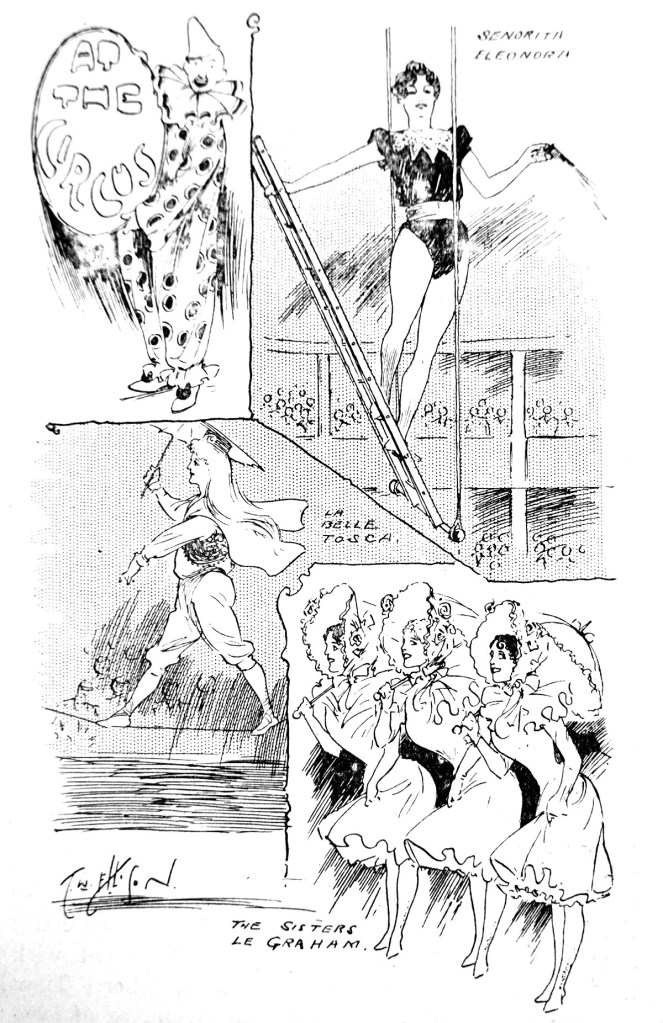
The Cambridge Independent Press (22 June 1900, page 8) was impressed by her ladder-and-pistol trick, seen in Talbot Ellison’s drawing above:

CIP, 22 June 1900, p 8
However, her daring display upset at least one anonymous audience member who wrote to the Cambridge Daily News and, while admiring Senorita Eleonora’s performance on the high trapeze, complained that ‘no net has been provided by the management (this was always done under like circumstances in Mr Tudor’s time). It would tend to the safety of the ‘artistes,’ and to the comfort of the public, at least of those possessed of a particle of HUMANITY’ (CDN, 20 June 1900, p 3). The very next day’s paper held the Senorita’s response:
Will you grant me space to reply to your correspondent of last evening on my performance on the trapeze without the use of a net? First let me thank ‘Humanity’ for the compliment his letter pays me. I have performed the act in question for the past eight years in England, and for the last seven I have not used a net, nor has one been insisted upon by the management of any hall where I have appeared, and I have performed in the best halls in London and the provinces. The feat, no doubt, is a daring one, but I have perfect self control, and there need not be the slightest fear.
Moreover, your correspondent might be interested to learn that I have performed this very act in the present building under the management of Mr Tudor, without a net. Very few aerial performers of any standing now use a net; and further, the management are entirely free from blame since it is not their duty to provide a net but the artist invariably carries one when such is used.–Yours, etc. ELEONORA
June 20th 1900, Newmarket Road.
CDN, 21 June 1900, p 2
The Senorita was able to stand up for herself, with or without her pistol!
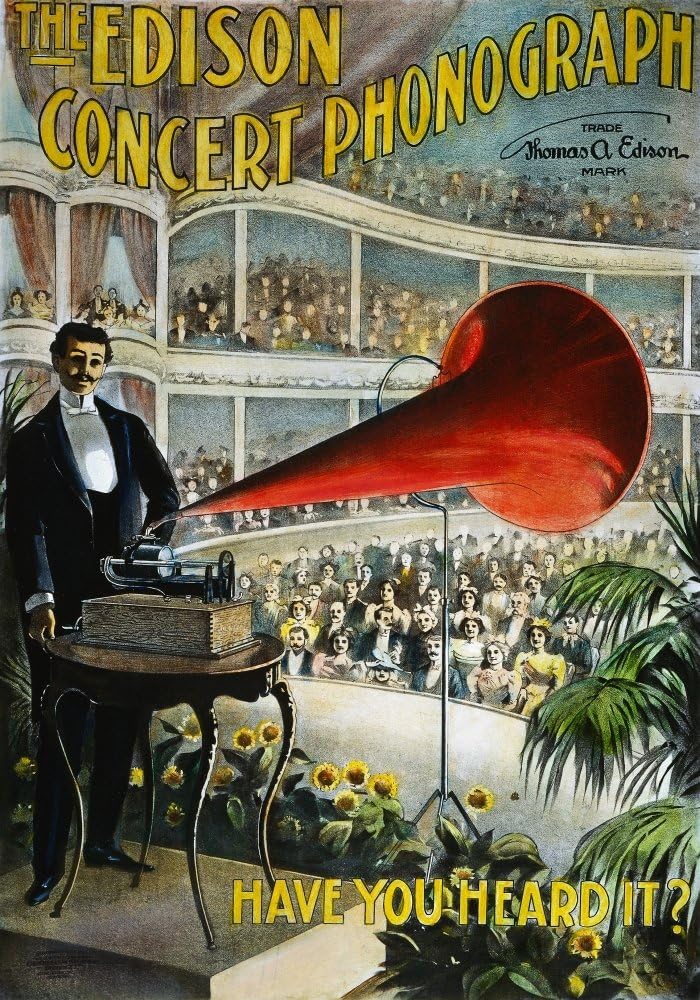
Another high-wire performer was the ‘exceedingly clever’ Belle Tosca. The CDN felt the best was kept to last with Edison’s Concertphone, which was thought vastly superior to the phonograph. The machine was manipulated by Mr Oliver, using his own recordings which were ‘well up to date–indeed, one of the best was that of Dan Leno singing “The waiter”, which was taken but six days ago. The records of the bands are very fine indeed, each instrument being very distinctly reproduced and heard in every part of the house’ (CDN, 19 June 1900, p 3). It is difficult to imagine how extraordinary this early example of the disc-jockey’s art must have sounded to the Cambridge audience, who would only have ever heard live music.
‘We are pleased to notice that the management have taken our advice, and a capable string band under the direction of M. A. Greco now accompanies the artists. The entertainment is well worth a visit’ wrote the Cambridge Daily News on 19 June 1900 (page 3). Judge Bagshawe, in the Foulger case a month later, presumably had not read this!
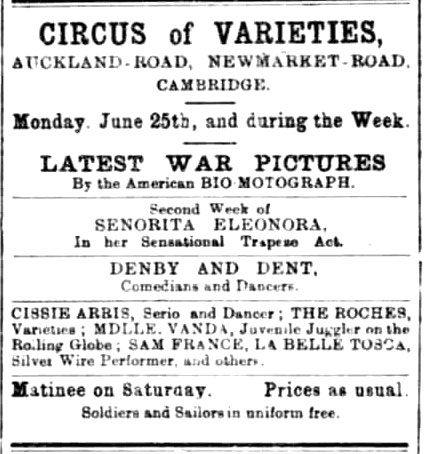
CDN, 29 June 1900, p1
The Le Graham girls nobly did a third week and Tosca was juggling on the rolling globe as well as on the high wire.
We do not know when de Villiers left but on 23 June Askham was announcing ‘Sole Proprietor and Manager, Thos. Askham’ (Era, 23 June 1900, p 24). In October Professor de Villiers was using The Era letterbox facility so presumably had no fixed address and we hear no more of him.
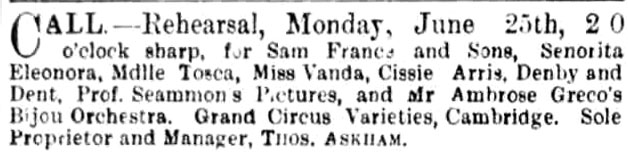
The Era, 23 June 1900, p 24
Some new performers at the end of June were the knockabout comedians Denby and Dent who sang some ‘rollicking songs’ (CG 30 June 1900, p 7).
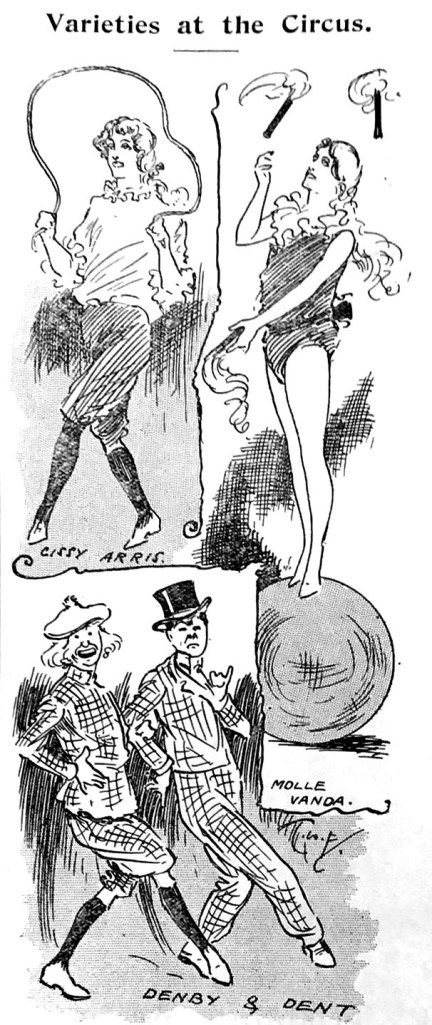
These two, previously The Doolans, combined witty patter, song and dance, and comic sketches such as The Singing Barber, that had the audiences in stitches, and were regulars at pantomimes. They continued well into the 1920s and were well known enough to appear on a cigarette card:
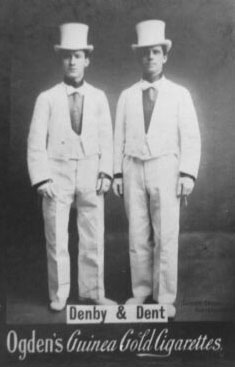
Another newcomer was Mdlle Vanda, ‘a clever little lady’ with ‘a very neat juggling act on the rolling globe, who must be congratulated on the coolness and dexterity with which she goes through her work’ (CG 30 June 1900, p 7). Serio-comic and top-boot dancer Cissy Arris also featured.
Otherwise the circus relied on its stock company and the previous week’s turns, including those hard-working ladies the Le Graham Sisters. Professor Seammon’s Bio-Motograph catered for the Cambridge people’s insatiable thirst for more pictures.
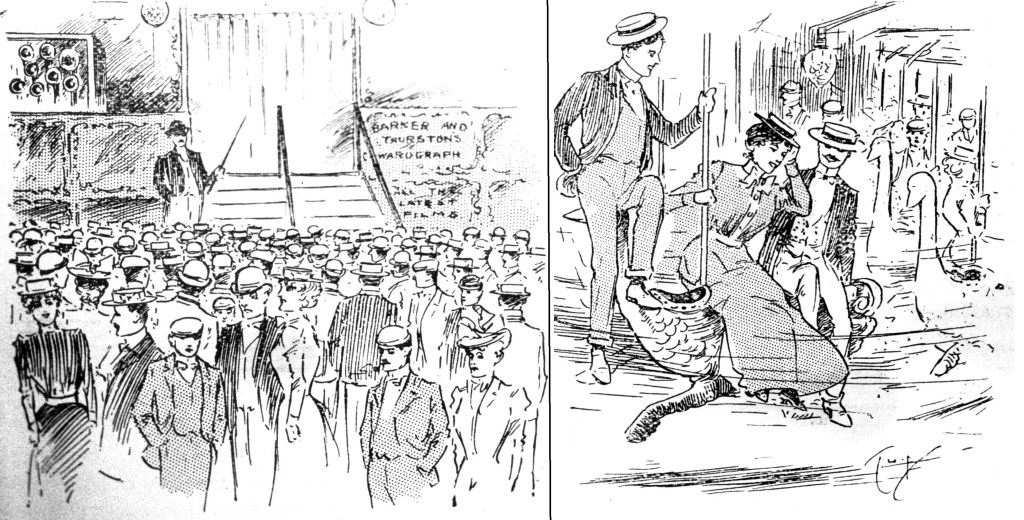
There must have been competition from the four-day Midsummer Fair, on the Common from Friday 22 June with its usual horse fair, stalls, roundabouts, switchbacks, Thurston’s Warograph, Jumping Giraffes, menagerie, shooting galleries, coconut shies, toy, sweet and fish stalls, meat stalls, whelk stalls, cheapjack wares, drinking booths, no less than fifteen refreshment stalls, and a cinematograph. Some of the entertainment booths were ‘of the questionable variety’ (CIP, 29 June 1900, p 8), and there were a few arrests, but most entertainment was harmless and gave ‘a brief respite from the daily round, the common task’ (CIP, 29 June 1900, p 5). Talbot Ellison was there with his sketch-book (above).
The few arrests give an interesting snapshot of the level of crime and policing at that time. A Bradford woman, staying at the Butcher’s Arms in Newmarket Road, was summoned for ‘exposing wounds and deformities for the purpose of obtaining alms, but was discharged on condition she left town’ (CCJ, 29 June 1900, p 6). A 16 year-old boy from Suffolk, working on a coconut stall, was arrested for being a deserter from the Royal Navy (CIP, 29 June 1900, p 8). And a travelling showman, posted at the entrance to William Taylor’s Naval and Military Exhibition, was charged with falsely wearing the uniform of the Argyle and Sutherland Highlanders. The proprietor paid his fine (CDN, 5 July 1900, p 2).
July 1900
July’s programme was entirely new, with Askham in sole charge, and the Cambridge Graphic continued its coverage, albeit with some reservations on the part of the reviewer. With its promotion as ‘An Exceptional Variety Show’ (CG, 7 July 1900, p 9) it seemed to be leaving its circus roots. The Second Boer War was on-going and there was huge patriotic support from the public as the British scored military successes. Any sailors and soldiers in uniform were allowed into the Circus of Varieties for free. And the programme included the ‘inevitable animated photographs. These latter include some excellent coloured pictures of our South African war heroes’ (CG, 7 July 1900, p 6).
Interesting and attractive is the new programme at the Circus. The London Bijou Orchestra, under the direction of Mr. Ambrose Greco and Sam France and Sons in the clown business appear to be fixtures, and, indeed, they are worthy of their permanent engagement. If I might venture a word in the conductor’s ear, however, it would be to the effect that he could, with advantage, drop the crescendo when accompanying the vocalists. He would then make it possible for us to hear the words, and we should be able to laugh at the right moment. The artistes are at a considerable disadvantage in having to sing in the ring, and Mr Greco, I am sure, desires to give them all the help he can – but it is possible to have too much of a good thing.
Cambridge Graphic, 7 July 1900, p 6.
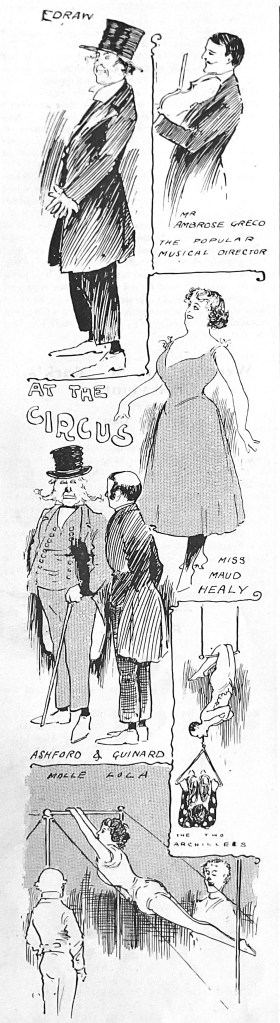
There were still some circus acts, including Mdlle Lo-la performing difficult feats on the horizontal bars with grace and skill, and the Two Archillees combining gymnastics on the rings while raising gales of laughter (CDN, 3 July 1900, p 2). ‘There is a good deal of talking, singing and dancing’ said the CDN reviewer with the droll songs of Edraw, serio-comic Maud Healy, and amusing Raymond Sinnott. ‘Ashford and Guinard, eccentric comedians, crack many jokes, deliver up much humorous patter, and finish up with a clever exhibition of step dancing.’ Finally, quaint Warde and petite Whylie had lively and original sallies. All in all, ‘the evening’s amusement is well worth the price of a seat’ was a satisfactory summary but it lacked the enthusiasm about the exciting thrills and spills of the circus days (CDN, 3 July 1900, p 2).
The next week Lo-la and the Archillees were retained and joined by Adolph Faue, probably of the Three (sometimes Four) Faues, on the highwire, who had held audiences spellbound in 1893 and 1897.
And there was Wiery Willie, a whimsical but dexterous equilibrist, and there were four lady artistes to ‘enliven the performance with musical items’ (CDN, 10 July 1900, p 2).
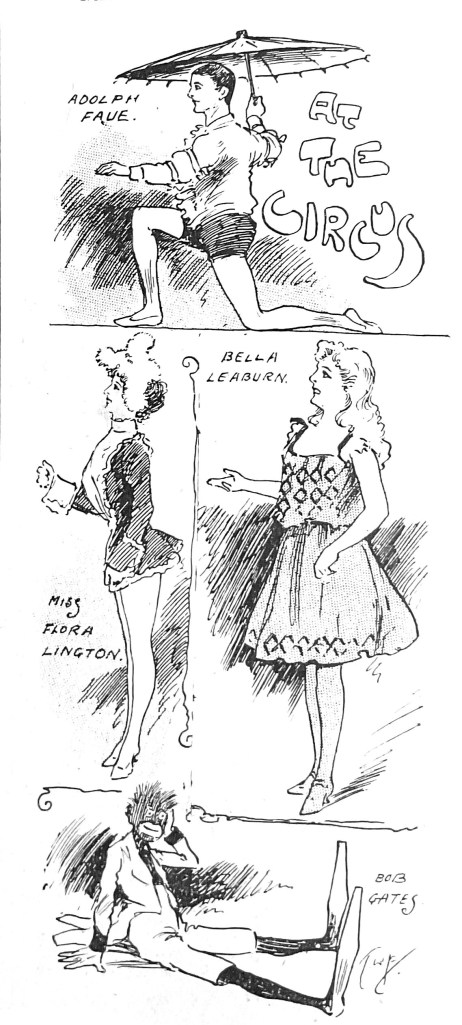
Flora Lington was back again, and she was followed by the powerful voice of Miss Bella Leaburn. There was pretty step dancing and singing from the Sisters Geraldine, and ‘orator’ Bob Gates made ‘quips and cracks, and besides furnishing some fun, does step and big boot dancing cleverly’ (CDN, 10 July 1900, p 2).
Bob Gates
Gates’s story is another reminder of the hard life lived by many of these travelling performers. Ellison’s illustration above is of a performer in blackface, but Bob was a black comedian and dancer who was extremely successful from the 1870s onwards. Despite losing all his costumes, music and funds in a fire at the Victoria Music Hall, Grimsby, in 1883, he continued performing a full schedule for many years, always popular for his comic patter and his dancing and loudly applauded whether in the circus ring or on the stage at music hall or pantomime. From 1903 his solo appearances reduced in number and he joined the Palladium Minstrels in 1913.
Bob Gates died in January 1914, aged 57, at the charitable Music Hall Institution in Upper Norwood. A fellow resident, who had known Gates professionally for thirty years, said he had complained of breathlessness the day before and The Era (14 January 1914, p 23) reports that ‘Thomas Sharpe, a music hall artiste residing at the Home, stated that on Friday last Gates appeared a little out of sorts, but he enjoyed his meals, and after dinner sang snatches of songs, much to the edification of the inmates. During Monday night his cough was very troublesome and at eight o’clock the following morning he was found dead in bed. The jury returned a verdict of death from natural causes, in accordance with the doctor’s testimony.’
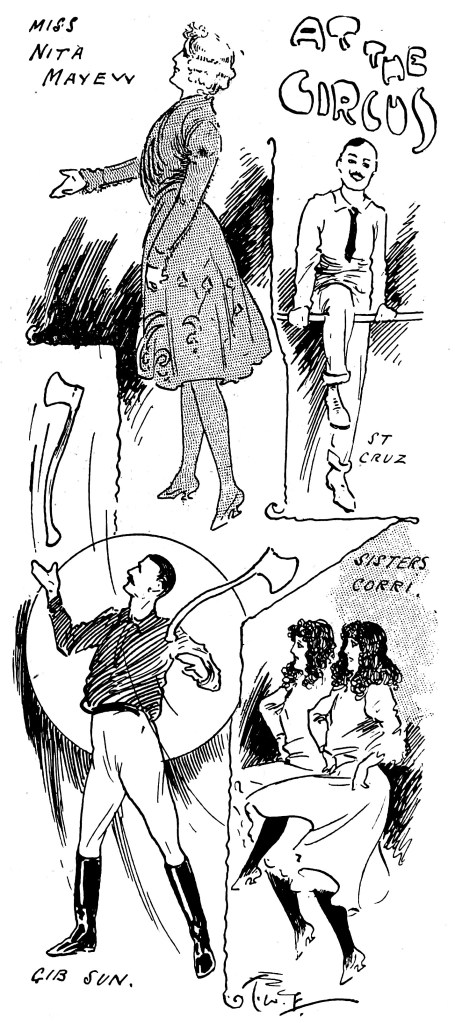
In Auckland Road, the circus took a turn for the better with an entire change of programme the following week, the majority being circus acts, and the large turnout greeted it with ‘hearty approbation’ (CDN, 17 July 1900, p 2). The weather was sultry, the streets of Cambridge broiling and dusty, but inside the circus it was appreciably cooler, and one reviewer declared it delightfully pleasant ‘with nothing to do but to sit and watch the entertainment one was able to forget the freaks of the thermometer’ (CG, 21 July 1900, p 6). Sam France was still clowning and had a most amusing conversation with his son from the altitude of stilts. Miss Leoville had a sure eye and foot on the high wire, St Cruz performed clever feats on the horizontal bars and Aeolia’s skill and daring on the trapeze had the audience closely fixed.
There was singing and character dancing from the Sisters Corri and from Nita Mayew [Mayeu] who was ‘possessed of a capital voice and her singing of several songs was marked by capital expression and genuine spirit’ (CG, 21 July 1900, p 6). As the Vocal Spark, she performed frequently with Horace Gibb, refined comedian and descriptive vocalist, sometimes in musical comedy and pantomime. This pair brought their photographs to promote themselves in the Cambridge press:
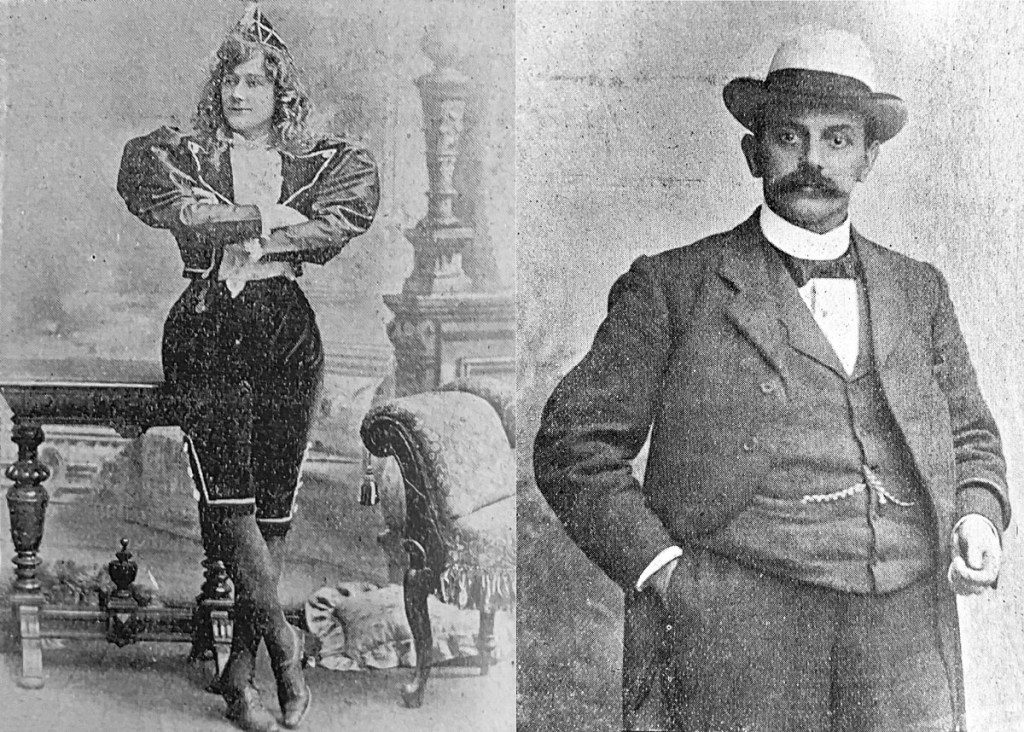
Nita Mayew and Horace Gibb, Cambridge Graphic, 21 July 1900, pages 6 and 12
But the sensation of the week was Gib Sun, the Australian Bushman: ‘the dexterity and precision with which he throws keen-edged hatchets about, handles firearms in his own particular way, and juggles with firebrands is worthy of a true Bushman’ (CDN, 17 July 1900 p 2). This Antipodean juggler of axes, rifles, knives, flaming torches and boomerangs was a popular act in Britain for a few years, appearing at Tudor’s circus in Blyth in 1903, then we hear no more of him. Presumably he returned to Australia, where axe-juggling may have been a useful example of bushcraft.
August 1900: George S King is Askham’s new manager and a damp bank holiday brings the crowds indoors
The Foulger band court case was now over, Thurston’s Fun fair was holding a Bank Holiday Gala on Midsummer Common, there were fetes, sports and flower shows in the villages, railway excursions to the seaside, the Working Men’s Cottage Garden Show at Trinity College and cricket matches on Parker’s Piece and at Fenner’s. On Bank Holiday Monday (6 August) the weather was gloomy and wet – ‘the rain it rained and the wind it blew, and the holiday was completely spoiled’ – but this may have been good news for our circus, now under entirely new management, with ‘every part of the building being packed’ (CDN, 7 August 1900, p 2).
A piece in the Cambridge Graphic by Audrie Lesden describes the city (still stinking, despite new sewers and pumping station) that week:
Bank Holiday was distinguished by terrible weather, and the open-air festivities suffered from the inclemency of the elements. I saw a pretty wedding set off from New Cherryhinton in the morning, the bridal party not in the least depressed by the wind and rain . . . Of dramatic entertainment there is none, excepting the Variety Show in Auckland-Road, which, I am told, is worth seeing. This merry and musical medley is, I hear, being run by a relative of a well-known Cambridge medical man.
Nearly everyone is away holiday-making, and I purpose paying a flying visit to the east Coast for a few days next week, for the aroma of Cambridge streets is getting a little too much for me. I fear we shall never make a popular holiday resort of Alma Mater until something is definitely done to suppress the nuisance, and that, methinks, will never be!
In the same edition, the Graphic also reported:
What the pleasure-seekers of Cambridge would have done without the Circus of Varieties on Bank Holiday it is not easy to conjecture. It was the only popular indoor entertainment available, and the building was not half large enough to contain the people that crowded round the doors. Those who were fortunate to pass the box office were well rewarded, for the programme was of a high order of merit.
Cambridge Graphic, 11 August 1900, p 5
The Cambridge medical man referred to is probably Dr Bushell Anningson, the Borough’s Medical Officer. It was from his address, a house called Walthamsal in Barton Road, that circus manager George S King advertised in the Era on 11 August. Although Mr King was in town, the Irish comedian Hugh Demspey both performed and filled the bill with his Variety Combination. ‘Combination’, in this context, meant a package of acts forming a complete show, a very different way of constructing a bill from that of William Tudor.
Dempsey, self-styled ‘Star from the Shamrock Shore’, had been entertaining British audiences with comic songs, top-boot and step dancing and amusing impersonations since the 1880s, as well as touring Australia, Africa and America. From 1897 he had toured his own companies, The Bright Lights Vaudeville Company, and now The Stars of the Night company of artists which filled an entire programme – ‘A Combination which embodies the very Pink and Perfection of Song, Dance, Histrionic, & Terpsichorean Art’ (CDN, 6 August 1900, p 2).
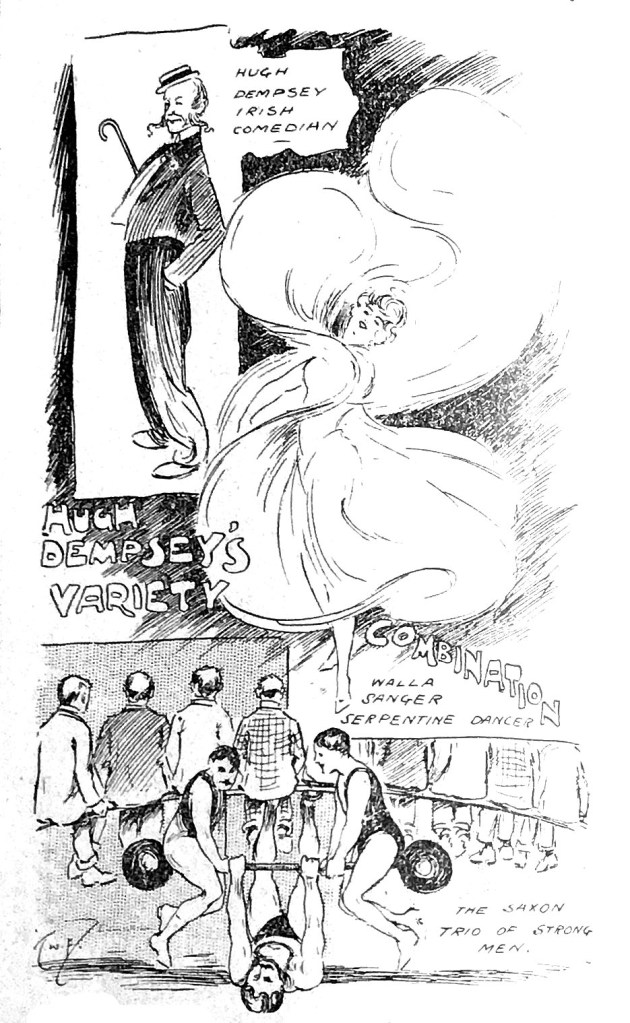
Jessie Reed and Annie Revande (serio and male impersonator) provided the musical entertainment, and the very pretty Miss Walla Sanger (Hugh Dempsey’s wife), performed her serpentine dance which was most fascinating and very popular with the audience. The audience seemed happy with the small but satisfactory band, directed by Mr Woodward Crouch.
Nellie Sunderland was an unusual act, being a woman conjuror and illusionist. There were the ever-popular images of the Boer War from Mons. Minelli’s Cinematograph, and Orio, (or was it Orlo, or was it Vesto, the papers differ) on the high trapeze. But the most popular act were The Saxon Trio of ‘truly marvellous’ strong men, Arthur, Kurt and Hermann Saxon. The Cambridge Graphic (11 August, p 5) claimed that their ‘toying with bar bells weighing 1,000 lbs is a sight that should not be missed’ and Talbot Ellison’s illustration confirms that this was no exaggeration. Arthur ‘supports nine men see-saw fashion with his legs while lifting three others seated on a bar-bell with his strong arms’ (CDN, 7 August 1900, p 2).
Arthur had defeated the world-famous German bodybuilder Eugen Sandow in 1898 in Sheffield (though Sandow was to take him to court over this), and the Trio took his name as his fame grew. Born Arthur Hennig in Germany in 1878, he achieved great success and published two books on weightlifting.
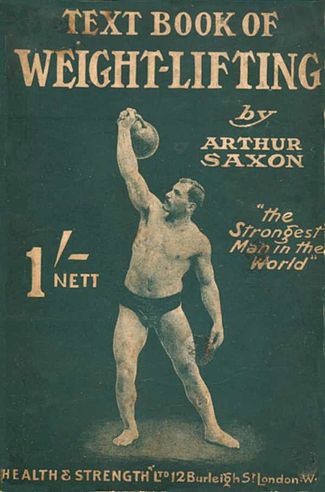
Sadly he suffered from poor health during the First World War and developed tuberculosis, dying in August 1921 aged 43.
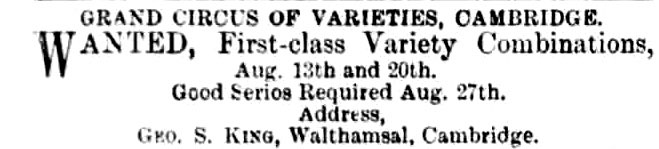
Although circus acts remained very popular, George King was advertising in the Era (11 August, p 27) for serios, or serio-comics, a term applied to female music hall performers who often combined both comedy and serious topics or pathos in characters and song:
In the meantime, Hugh Dempsey brought a cast of performers new to Cambridge, with the exception of Bob Gates from last month who was warmly welcomed, and the Leopold Leglere Troupe of five acrobats from 1897 and 1898, who were ‘as wonderful as ever. They are by far the smartest troupe ever seen in Cambridge, and their reputation is almost world-wide’ (CDN, 14 August 1900, p 2).
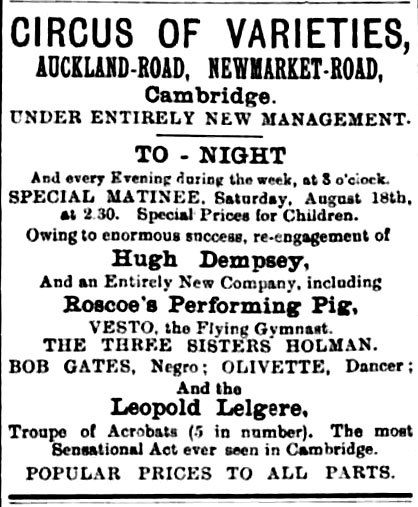
Foremost, perhaps, of the new comers is Rosco, with his performing pig, dog, and roosters. This act is absolutely unique, and must be seen to be believed, or even understood. The dog first performs, and, among other things, puts his own collar on, and takes it off immediately someone suggests, sotto voce, that it is of German manufacture. The roosters, too, cause genuine fun, but it is the pig that convulses the house. To hear it call ‘Mamma’ – but to tell more would not be fair, the animal must be seen.
Cambridge Daily News, 14 August 1900, p 2
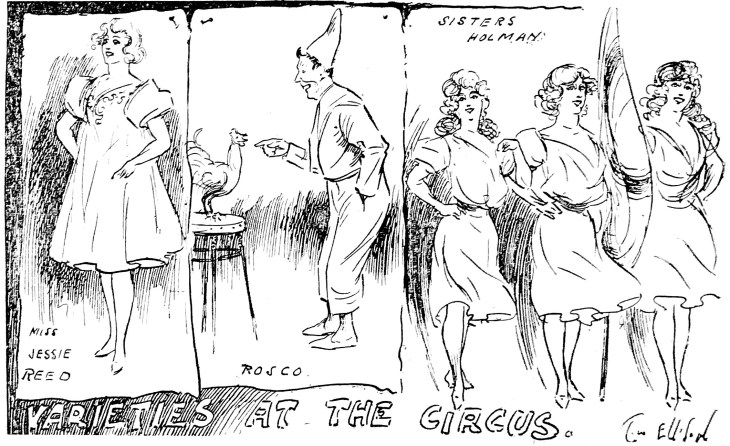
J. C. Rosco had started his career with the pigs, whose porcine pantomime had audiences highly amused. They had even made their debut in New York in 1899. The act developed with the pugilistic roosters and the dog but after 1906 we hear of them no more.
There was plenty of singing and dancing from Walla Sanger, Jessie Reed and Annie Revande (again), and Ada Vest and the Sisters Holman, three Tyrolean warblers and prancers.
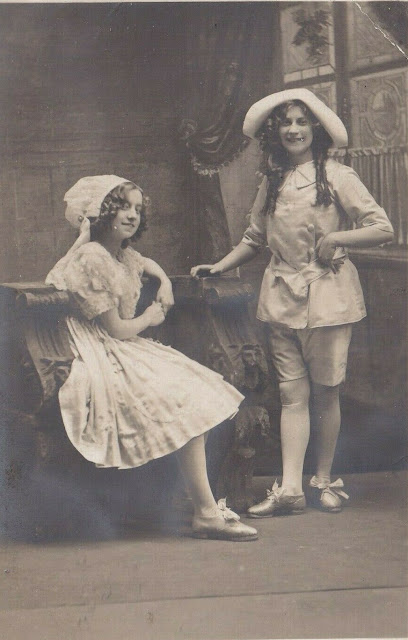
Blanche and Beatrice Holman toured with their sister Edith, who performed as Ada Vest. The picture comes from the blog of Kurt Gänzl, an authority on popular singers of this period, and he writes about the three Holmans here. He describes them as ‘one of the thousands of “acts” which provided popular entertainment to the music-halls of England in their declining days . . . ’
Hugh Dempsey continued as maestro for another week, but the programme, mostly dancers and comedians, was advertised at reduced prices, 4d for the Gallery, the Pit and Promenade 6d, and the stalls were 1 shilling and 6 pence. The house was full. The Leglere acrobats and Rosco with his two- and four-legged companions were the only circus acts, the ‘marvellous pig’ continuing ‘its astonishing feats’ (CG, 25 August 1900, p 5). Otherwise, there was singing, dancing and comic patter from Hugh Dempsey, Miss Ellis Ferndale, Frank Lawrence and the comedians Melnotte & Morgan.
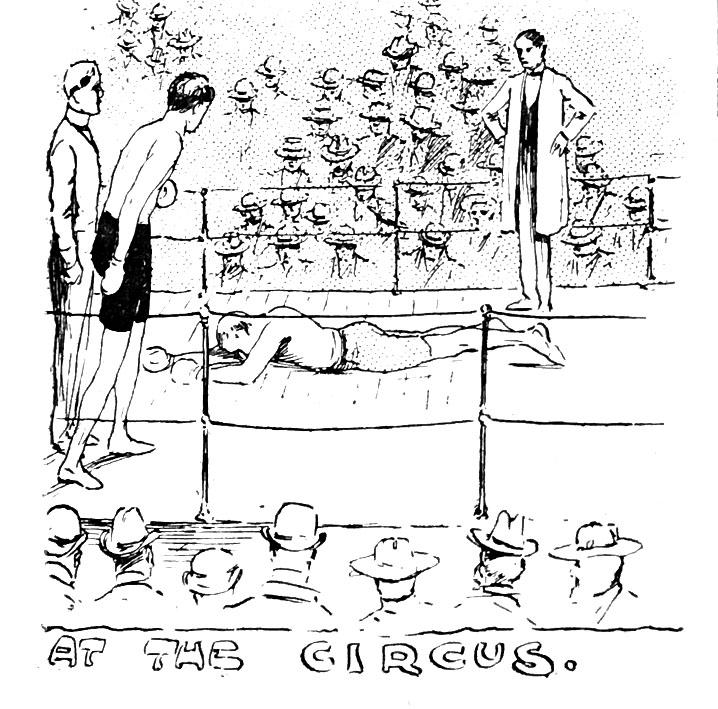
The great success of the evening was Monsieur Mellini’s Cinematographe, showing the January 1900 middleweight boxing match in New York between Irishman Peter Maher and American Charles ‘Kid’ McCoy. Maher, the Irish Giant, was knocked out in round five. McCoy’s extraordinary life and career is worth looking up as it included acting, films, ten marriages, and a manslaughter conviction.
Members of the Auckland Road audience were invited to have a go punching at Corbett’s Boxing Ball, the best performance winning a silver medal. This was so popular it was repeated the following week. Like Tudor, Dempsey knew that audience members can get the most fun out of their own performances.

Ashford and Gurnard, last seen in early July, came back with their knockabout comedy. There were amusing eccentric acrobats The Valenos, while Maria Bound, the Victoria Sisters and Grace Garcia provided music and dance.
On a more circus-like note, who could resist the promise of the ‘Special Engagement of FUNNY HILDA’s Troupe of Highly Educated Musical and Acrobatic Dogs and Monkey, introducing Serpentine Dance, Somersaults, Leaping, Balancing and Trapeze. The magnificent Leaping Hound, “Peter the Great,” who will clear 13 feet high and 20 feet long in one jump’ (CDN, 29 August 1900, p 2). The Graphic‘s reviewer (1 September 1900, p 7) thought Hilda provided ‘capital entertainment’ and that Horace and Alice De Roys, as Venus & Clown the ‘illusionists and wonder workers are as wonderful as ever’ while for the CDN (28 August, p 2) ‘Prince Rudolph in his lofty chair act deserved special mention.’
And with that, Hugh Dempsey left the scene.
September 1900: Askham at the helm again
In September the circus was back under Askham’s command – he was `Sole Proprietor and Manager’ (CDN, 1 September 1900, p 2), although it’s possible that George King was there too. Askham advertised in The Era for ‘Big Star Turns, Specialities, and Novelties; Good Vocalist, without Vulgarity. N.B.–No Fancy Prices’ (8 September, 1900, p 25). As befits a purveyor and hirer of bicycles he announced ‘Bicycles and Tricycles Stored free of Charge during Performances’ (CG, 8 September 1900, p 8). And with the change of Manager there was a complete change of programme:
Novelty succeeds novelty at the Cambridge Circus of Varieties. Week after week the programme contains new and attractive items, so that the regular patrons of the entertainment have no reason to complain of monotony. This week there is an entire change. The management retains singing and dancing as a conspicuous feature.
CDN, 4 September 1900, p 2
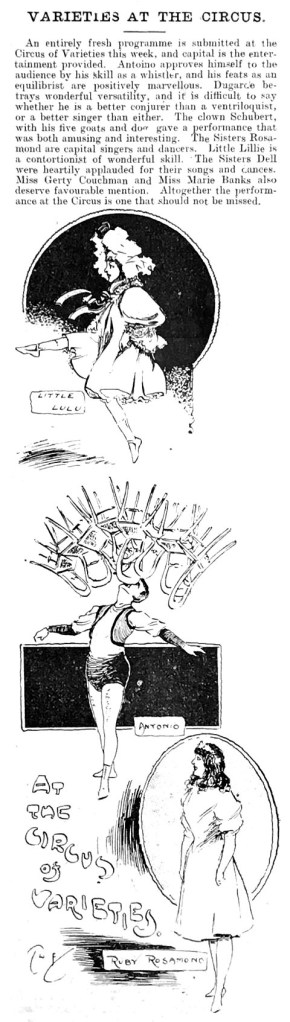
A bevy of attractive young women sang and danced their way around the circus arena – The Sisters Rosamond (Ruby and Lulu), The Sisters Dell, the humorous Miss Marie Banks and Miss Gerty Couchman.
Antonio Savaro held a wealth of accomplishments as Agouste clown, whistler/siffleur, tumbler and sword swallower, hand balancer, chair equilibrist, and bird and animal mimic – ‘The Poll Parrot a Speciality’, later adding electric light, watch, and bayonet swallowing to his repertoire. At Cambridge he restricted himself to mimicry, whistling and equilibrism, demonstrating ‘surprising feats’ with ‘an iron nerve and well developed muscle’. Performing with him for many years was Little Lillie Savaro, child contortionist, who ‘twists her body into really extraordinary shapes’ (The Era, 16 September 1899, p 5).
Dugarde also had a wide range of skills, and shows ‘wonderful versatility, and it is difficult to say whether he is a better conjuror than a ventriloquist, or a better singer than either’ (CG, 8 September 1900, p 7). Schubert, a clown of `many laughable eccentricities’, created much laughter, as did his five acrobatic and highly educated goats and his dog (Flock, the Canine Masterpiece) ‘whose tricks betoken a high state of training’ (CDN, 4 September 1900, p 2).
Little Lulu Rosamond, like her sister, inspired Talbot Ellison, but a sketch of Schubert’s goats and Flock the dog might have made a change from the array of female legs and flounces.
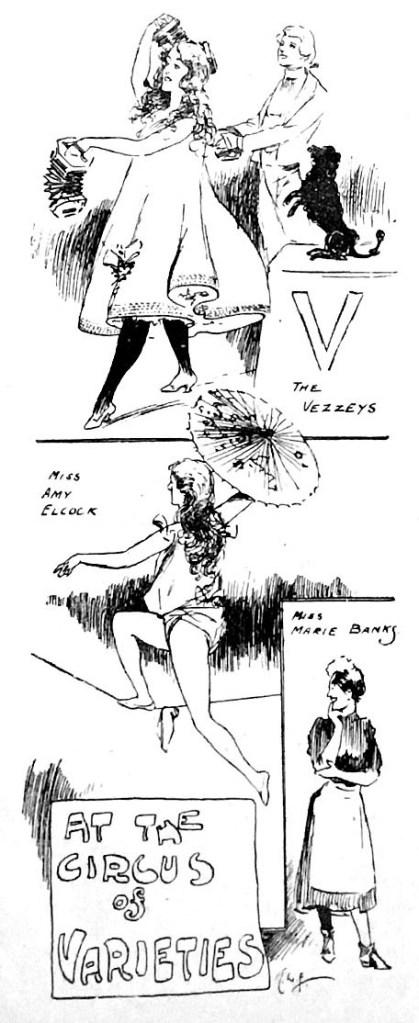
The next programme was virtually all singing, dancing, and comedy, with Marie Banks, Kitty Kennedy, Lily Lyons, Lizzie Villiers and the comedy of The Ludos, Eugene Brant and Mark Tyme. A bit of variety was provided by Harry Cosselly’s novelty monkey act, by Amy Elcock’s comedy act on the wire, and the acrobatic dancing of Little Florrie, possibly her sister.
Even the dogs sang. ‘The Vezzeys and their dogs are themselves alone sufficient justification for a visit to the Circus. The dogs are exceptionally smart’ (CG, 15 September 1900, p 7). Both the Vezzeys and one dog played concertinas. An earlier review was struck by the ‘intelligent Russian poodle, who, when the music plays, lifts up his voice in an obbligato which is bass and treble by turns. No record, we fear, has been made of the limits of the vocal compass of the canine, but this one certainly touches incredible heights and depths in his exercise on the chromatic scale, and laughter is loud and applause hearty during this novel performance’ (The Era, 16 December 1989, p 21).
As Askham transformed Tudor’s circus into a music hall, the Felicia Trio, The Two Flakeys, Three Gilberts, and Marie Banks (for a third week) all obliged with song, dance and burlesque on the circus boards. The reviewers were very taken with comely Mabel Comely, ‘a vocalist of unusual attractiveness’ (CG, 22 September 1900, p 7) who ‘does not belie her name’ (CDN, 18 September 1900, p 2). Dugarde returned with his conjuring but it was the circus girl and clown act of The Mays that was the most popular, their clever, comic burlesque sketch having the house ‘in a perfect roar for 25 minutes. Unlike so many sketches, that produced by The Mays is quite free from vulgarity’ (CDN, 18 September 1900, p 2).
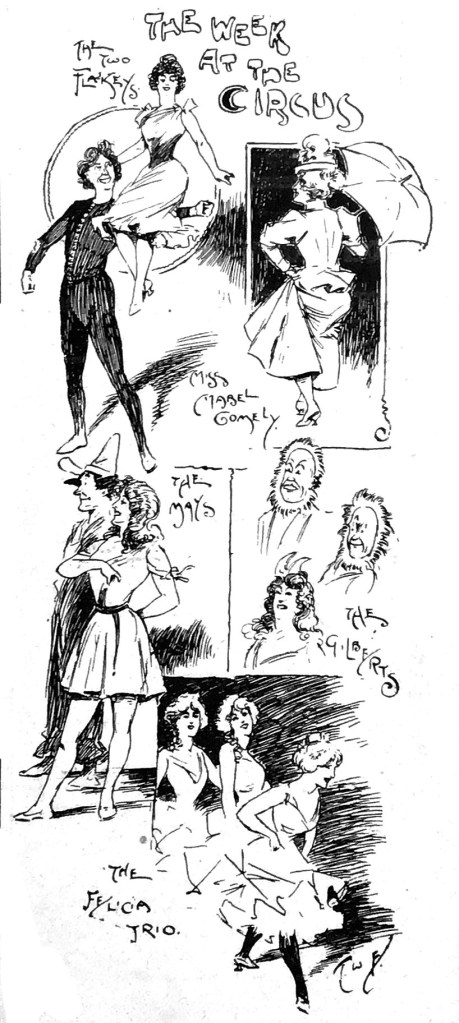
The comely Miss Mabel was retained for a second week, with Jennie Belmore, Jean Stanley and The Yams providing the music, dance and comedy fare.
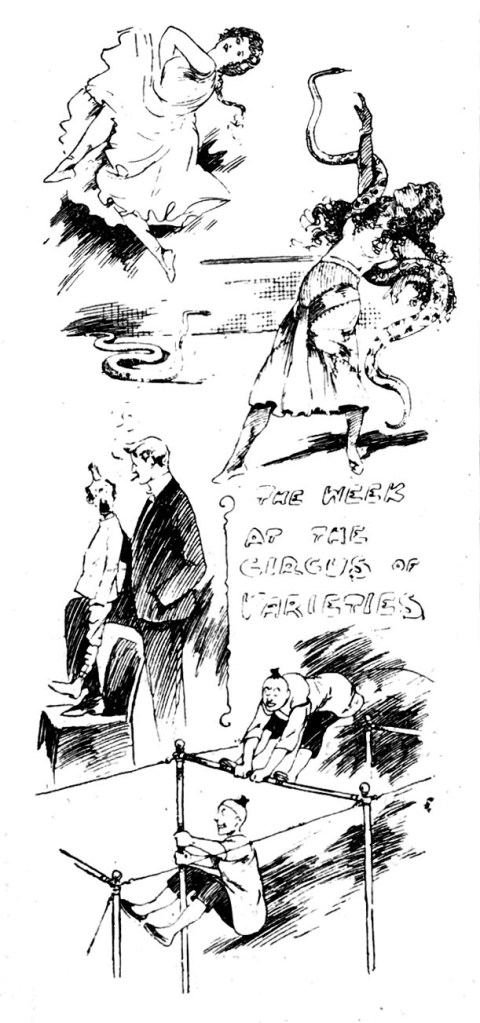
But there was some variety this week with three more bizarre acts. There was Mr George Gulliver, The Human Farmyard, and his ‘first rate’ ventriloquism act. And then Horton and Linder ‘in their grotesque act, “The Eccentric Chinese,” prove themselves accomplished gymnasts’ (CG, 29 September 1900, p 7). Although a Victorian definition of grotesque in this context could be ‘mysterious, strange, unusual,’ to modern audiences it seems offensive and racist. Walter Horton and Charles Linder combined clowning with their horizontal bar acrobatics, and for several years were ‘billed as Chinese Acrobats’ or ‘The Heathen Chinee’ (Turner, 1995).
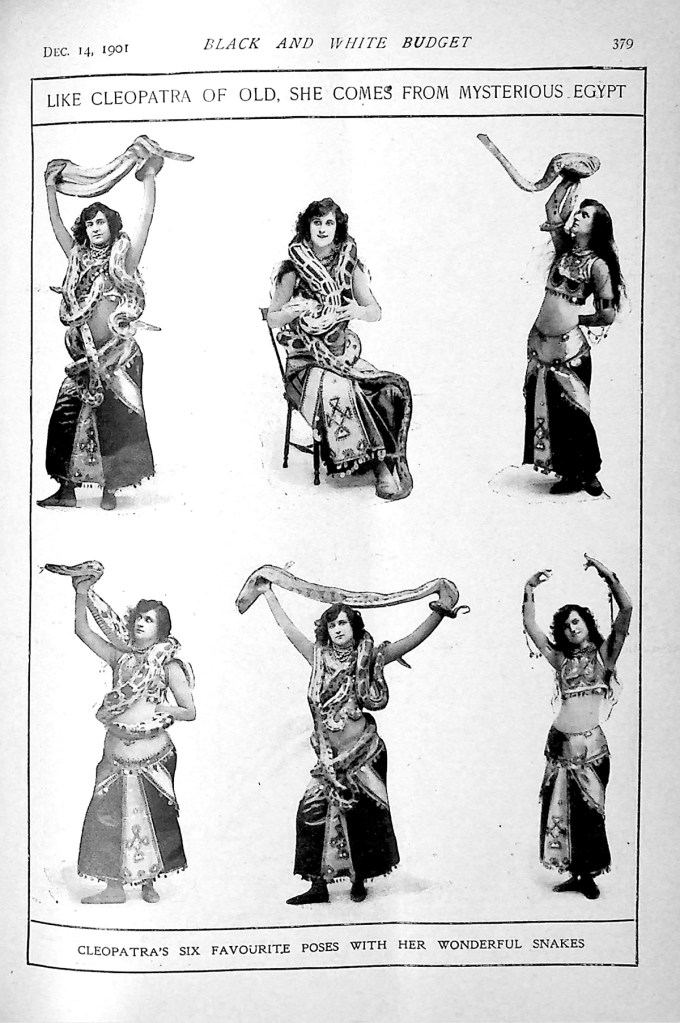
‘The Egyptian enchantress, Cleopatra, arouses amazement and admiration by her performances with serpents’ (CG, 29 September 1900, p 7). This ‘beautiful Egyptian . . . dark-skinned’ and ‘oriental’ (The Era, 28 Jan 1899, p 34, 20 Jan 1900, p 10, 22 June 1901, p 18) was Cleopatra Drescher, daughter of Carlos Drescher and sister of rifle-shot Bonita with whom she often shared a bill. She toured England, Australia and New Zealand for many years with her fourteen pythons and, later, two crocodiles. Described variously in The Era as a ‘marvellous bewitcher of serpents’ (13 August 1898, p 16) ‘performing with fourteen immense serpents’ (28 January 1899, p 34), ‘a supple and sinuous’ dancer (20 January 1900, p 10) she ‘manipulates her reptiles with a skill that is only exceeded by her nonchalance’ (13 May 1899, p 30).
October 1900
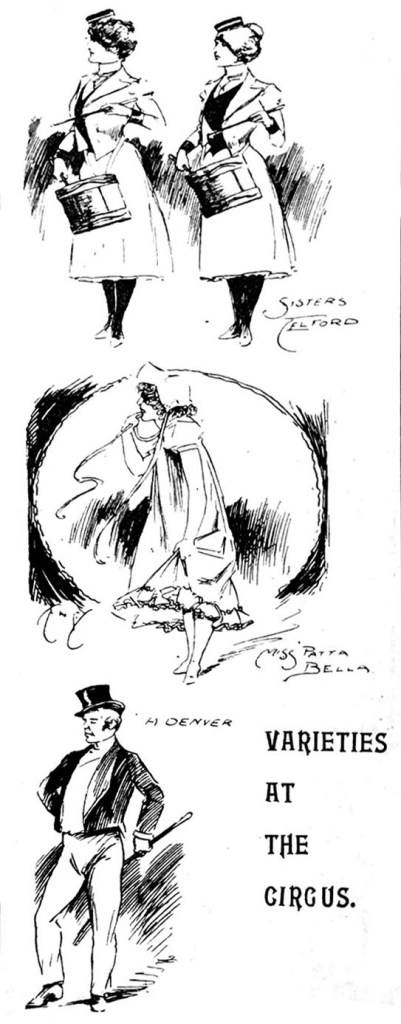
The Sisters Telford stood out from all the other song and dance acts the following week by adding drumming to their act with ‘a very pretty flower song, which gave them a chance to prove their Tyrolean ability’ (CDN, 2 October 1900, p 2). And The Denvers, from Colorado gave a very amusing comedy sketch.
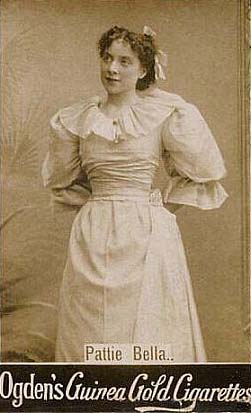
But it was Pattie Bella, charming, vivacious and chic singer of comic songs, making her fourth appearance in the Cambridge circus, who won premier honours. ‘She was met with a hearty welcome on Monday night and was enthusiastically encored’ and left the audience clamouring for more (CDN, 2 October 1900, p 2).
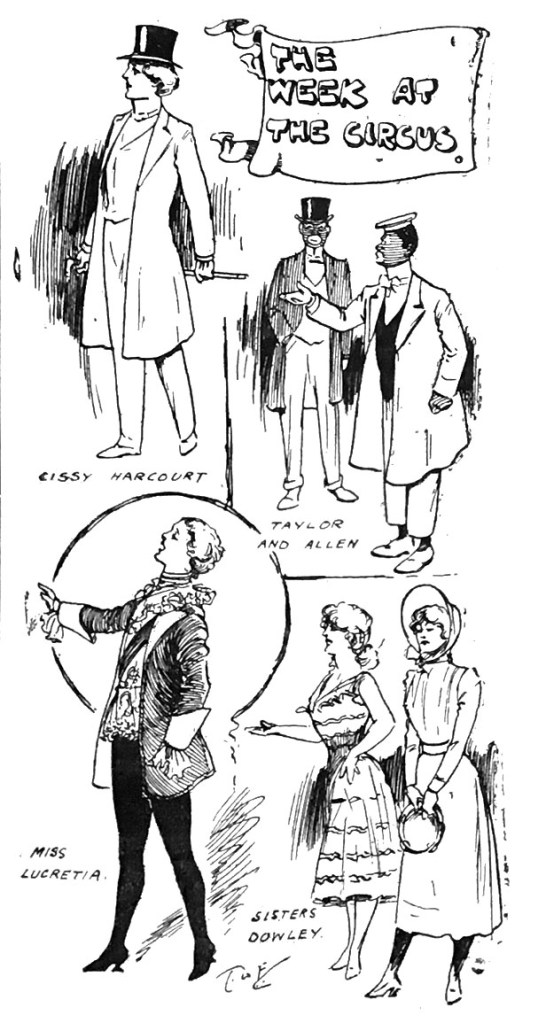
The next week’s ‘long and attractive programme’ was all variety artists which attracted a ‘fairly good house’ (CDN, 9 October 1900, p 2). The Felicia Trio and Rosie Le Roy returned and new acts the Sisters Dowley all sang and danced with Miss Lucretia as the main attraction.
Taylor and Allen were two black singers and comedians, who, like Bob Gates earlier in the season, wore blackface and called themselves ‘Two Real C—ns’ (The Era, 27 October 1900, p 25), and ‘caused much laughter in their clever and novel sketch’ (CDN, 9 October 1900, p 2). Howard’s Diograph showed pictures of the second Boer War and the Boxer Uprising in China.
‘An excellent voice and a capital dancer’ was the verdict on Cissie Harcourt, male impersonator, (CG, 13 October 1900, p 11) although she soon concentrated on her singing and toured Britain, and later China, Japan and India as a mezzo-soprano and soubrette, as shown in the 1911 photograph.
The next week’s programme was thought ‘average good’ with less serio, ‘but the audience may, perhaps regard this as a little relief’ (CDN, 16 October, 1900 p 2). The Four Rosaires, a troupe of daring but also amusing American acrobats, also doubled as The Boleros, on the triple bar, and generated hearty applause with both turns as ‘they climb and collapse with the greatest agility, and elevate tumbling and somersaults to something of a fine art’ (The Era, 29 July 1899, p 27).
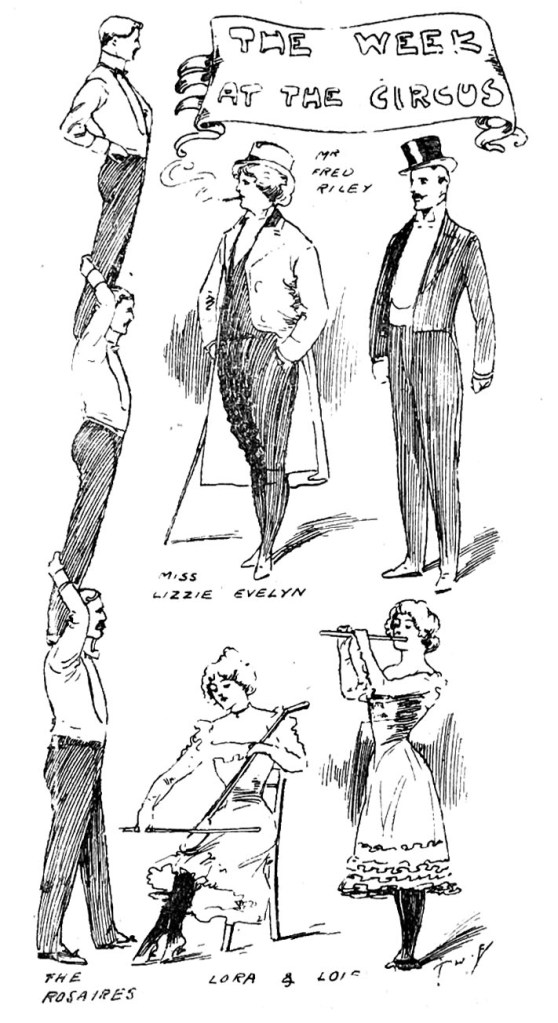
Two acts familiar to Cambridge were Fred Riley, comic vocalist, who was known from summer performances in Great Yarmouth, and Harry Ciyo and Rose Rechelle, who had performed before at Arcadia in Cambridge. Lora and Loie, the Lednar Sisters, showed their exceptional talent by manipulating a ‘small warehouse’ of musical instruments including ‘a delightful violin solo and a well-executed selection on the piccolo’ (CDN, 16 October, 1900 p 2). Even in downmarket Barnwell an audience could appreciate ‘a refined musical act’ (The Era, 4 August 1900, p 12).
Lena Collins, Edie Julia, Dolly Western and the Three Sisters Kemble provided the usual song and dance fare the following week, as did The Beckwith Sisters. Daughters and members of the Beckwith family of tank swimmers, they proved they could sing and dance as well as swim. Comic Eugene Brant returned from July, and Robzat was ‘the best juggler that has been in Cambridge for some time’ (CDN, 23 October 1900, p 3).
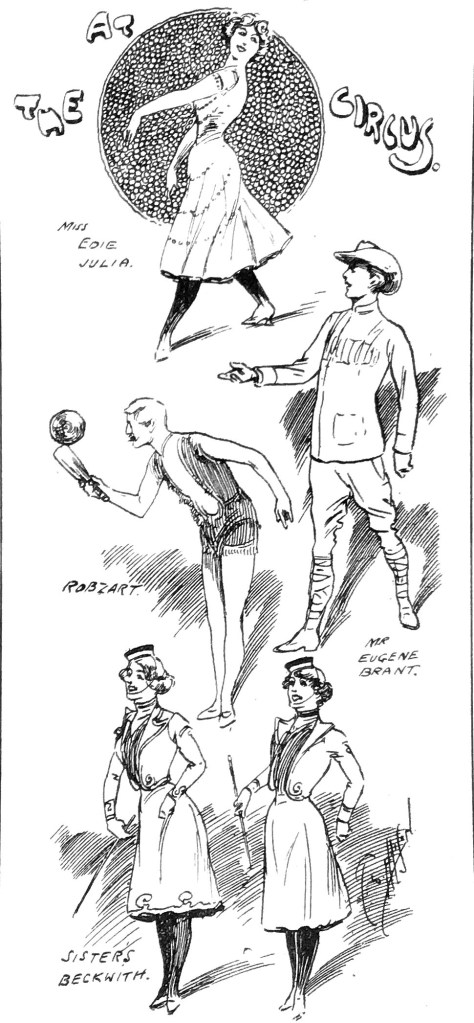
But the most popular act were the returning strongmen, the Saxon Trio, whose ‘manipulation of barbells and weights as if they were feathers must be seen to be believed’ (CDN, 23 October 1900, p 3). A contest for the strongest man in Cambridge was held on Wednesday 24 but sadly we can find no record of the winner.
November 1900: less than ever like a circus
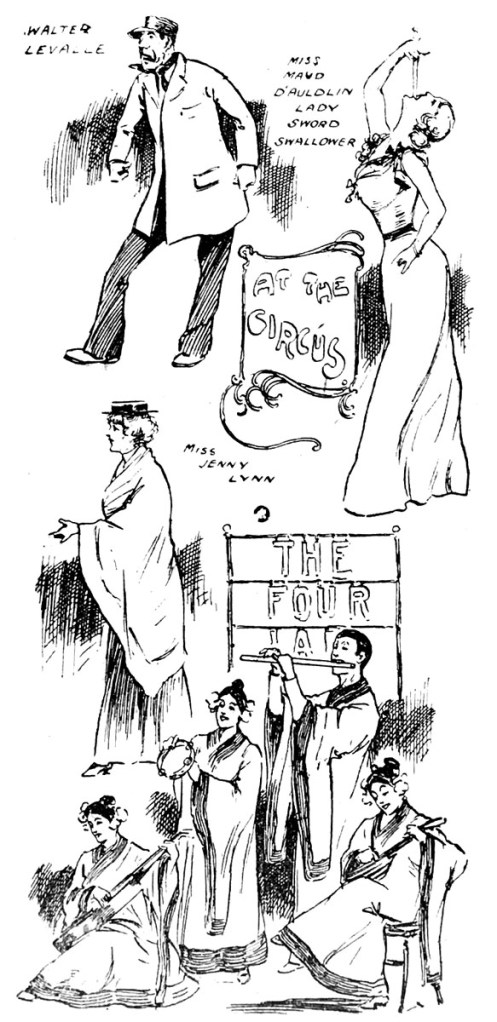
An exciting diversion who provoked ‘much admiration’ (CG, 3 November 1900, p 11) were the sword-swallowers Scottish Maud D’Audlin and her American husband Delno Fritz, who went on to appear in Hollywood films. The ‘Four Musical Japs (Violet, Fred, Florence, and Sylvia), in their grand Japanese Illuminated Bazaar’ (CDN, 1 November 1900, p 2) were exceedingly clever, appropriating the Victorian fascination with Japanese art and design with their oriental novelties. Our controversial singer Jenny Lynn was back again, with three other song and dance acts and two comics.
And then the circus closed between Saturday 3 and Monday 12 November ‘during which period it is intended to make several alterations in the interior’ (CDN, 3 November 1900, p 2). We do not know what these alterations were but hope it included some kind of heating as the circus remained open until the end of the month. During this period John Sanger’s massive circus visited Cambridge for one day on 7 November.
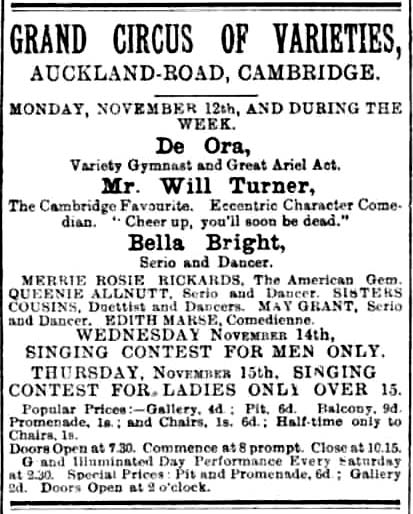
There was dreadful weather the next week but there were fair audiences and an excellent programme at the circus. ‘Of the nine artists engaged no fewer than seven are ladies, and all serios and dancers’ reported the CDN reviewer, who then concentrated on Mr Will Turner, a comic singer and ‘genuine comedian’, who had ‘already established a reputation in Cambridge’ though we do not know where. ‘He soon grasps the taste of his audience, and sings in an irresistible manner songs that at once catch on,’ such as Cheer up, You’ll Soon be Dead! (CDN, 13 November 1900, p 2). De Ora’s gymnastics completed the bill.
The Cambridge Daily News lamented the change of emphasis in Auckland Road:
The entertainment is less than ever like that to be seen in a circus. It is almost as though Cambridge possessed a music hall, for the programme is, to all intents and purposes, a facsimile of those to be found in music halls. Male and female vocalists succeed each other in quick succession up to the last item, which is that of De Ora, who has been re-engaged in consequence of his really clever entertainment on the trapeze. His daring feats thrill those present.
CDN, 20 November 1900, p 2.
The audience had to provide their own thrills from contests for conundrums, recitations and the best rope climber, hand over hand. Four days later an advert appeared in The Era for ‘Artistes of all Lines’ for the circus so perhaps Askham was becoming aware that his choice of acts was lacking in the variety he advertised (The Era, 24 November 1900, p 24).
The final programme of the season opened with Vinnie Terry and the Cora Sisters, the popularity of whose comedy, singing and dancing meant their retention from the previous week. There was comedy also from Taylor and Elson. There were no reports of the results of two contests for the audience, one for the longest jump and a silver bracelet for the lady with the smallest waist. Perhaps the ladies demurred from having their waists manhandled.
But the stars of the show were the clown Professor Hilda and his Musical and Acrobatic Dogs, who had entertained Cambridge at the end of August.
Prof. Hilda’s dogs must be seen to be believed, or even understood. The dogs turn somersault, skip, dance (serpentine), and perform in many other ways. They are exceedingly clever and reflect much credit on the training abilities of Prof. Hilda. Some marvellous leaping by the greyhound ‘Peter the Great’ concludes an excellent entertainment.
(CDN, 27 November 1900, p 2)
And that also concluded the Circus of Varieties for 1900, ending on a high leap, if not, for once, on a high note.
 William Tudor's Circus