April: Pachyderms and a pickpocket.
CDN, 28 March 1899, p 2
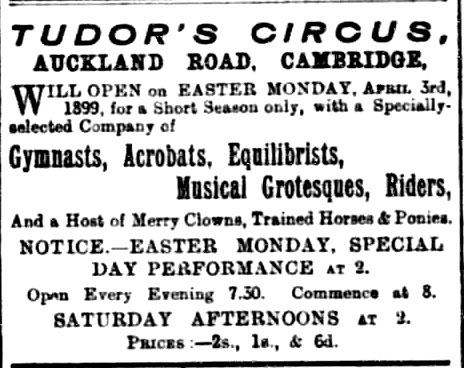
In late March 1899 advertisements began to appear for a new season of Tudor’s Circus. It was a short season and an early start, opening on Easter Monday 3rd April. With much enthusiasm the Cambridge Express said ‘the popular Auckland Road place of amusement rings nightly with the merry jest of the clowns, the crack of the ringmaster’s whip, and the peals of laughter from the crowded audiences’. Mr Albino ‘who has many friends in Cambridge’ was the ringmaster. ‘Mr Tudor’s stay, he said, was limited to eight weeks but during that time he would introduce some of the best talent procurable’ (CE, 8 April 1899, p 8). Tudor’s return was greeted by a packed house and a programme ‘free from vulgarity’ (CDN, 11 April 1899, p 2).
Regular equestrienne Rebecca Daniels opened to a hearty welcome and deserved applause for her graceful trotting act and Hugo Jackaway was back after two years in the Newmarket Jockey act. Jackaway, who combined trick riding with acrobatics and clowning, had appeared for many years at Tudor’s, Cooke’s and Newsome’s circuses. Charles Clifford had been seen in 1896 with his songs and harp, but all the other acts were new. The ‘exceedingly humorous’ Miserable Jim Cooke must have been the replacement clown for the late Fred Hall, and he gave several very funny turns. (CE, 8 April 1899, p 8).
Alma Brunton captivated all with charming, sentimental songs including the Scottish song of 1798 Caller Herring. There was more funny stuff from Comical Dent, and more singing and dancing from the Sisters Rowan. And even more from the clown O’Velo with a boxing rooster and a vocalist donkey Tommy who, apparently, sings Let ‘em all come and Home, sweet home. Other talented animal performers were the trained horse Baby, of Mr H Rogers, a riding dog Teddy, and riding goat Peter the Great was back in his native town.
Intriguingly all the reviewers unite in their opinion of the Moxon family, ‘one of the best turns’, a ‘truly wonderful act’, ‘phenomenal wonders of the world’, ‘must be seen to be believed’ who give a ‘a performance that is quite unique in Cambridge’ but do not tell us what it is! But this long-running circus family were known as foot equilibrists, musicians, acrobats and contortionists so presumably it was a combination of these, a more traditional circus act among the music-hall turns.
CE, 8 April 1899, p 4
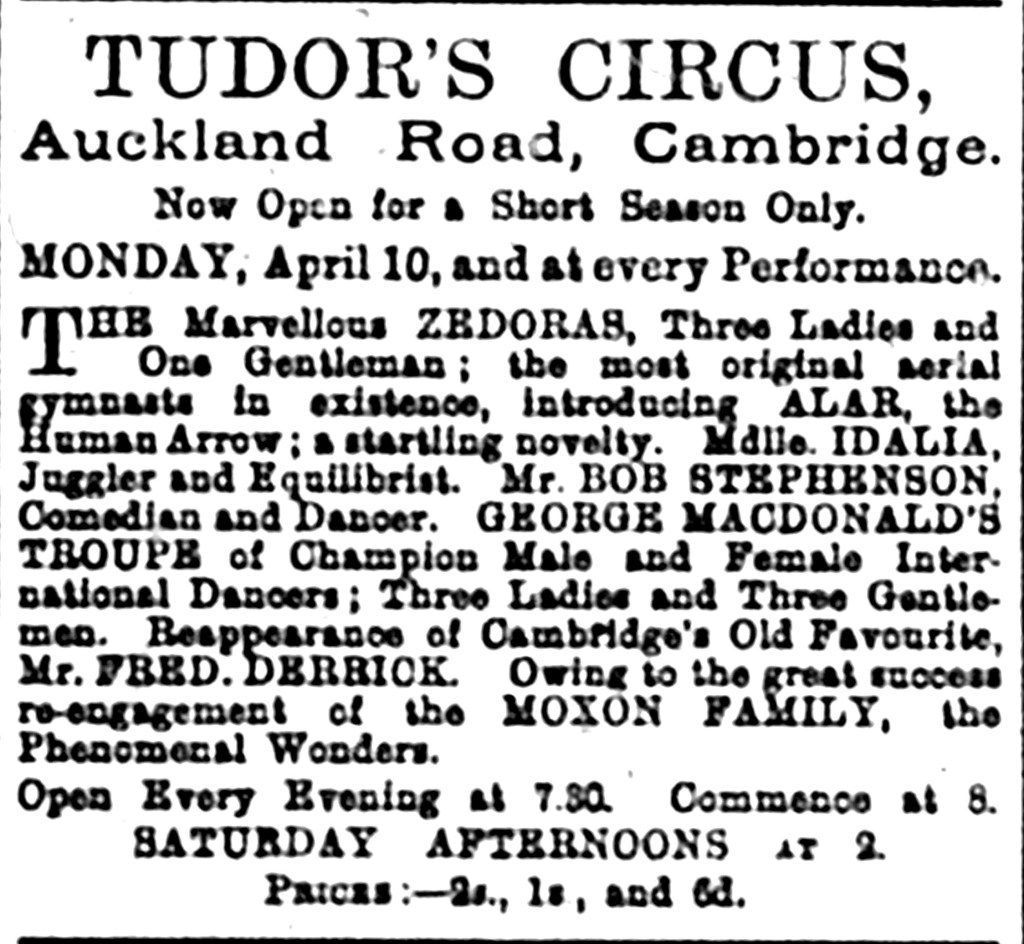
The early start to the season had not put the crowds off and large audiences filled the circus each night, showing their ‘keen satisfaction and appreciation of the programme’ (CIP, 14 April 1899, p 5). ‘Goatic equestrian’ Peter the Great opened the second week and the mysterious nature of the Moxon Family continued to bamboozle the reviewers with their unique performance of all-round skills. ‘The Moxon family gave another of their phenomenal displays, some of the performances they executed seemingly utterly impossible from an ordinary observer’s point of view’ (CIP, 14 April 1899, p 5) and also impossible to describe! And Cambridge’s favourite horseman Fred Derrick was back with his dashing bareback act, though only for a short season.
The Flying Zedoras
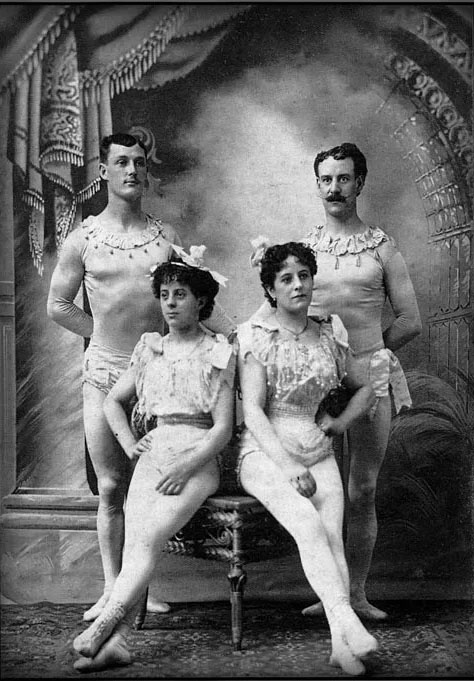
There was juggling from Mdlle Idalia, jokes and dances from Bob Stephenson, and more dancing from George Macdonald’s Troupe. But the big draw was the return of the Marvellous Zedoras, billed on this occasion as three aerial ladies and one gentleman. Once more Alar the Human Arrow, was shot from a large bow to a trapeze at the far end of the circus. Their sensational act drew loud applause.
CDN, 14 April 1899, p 2
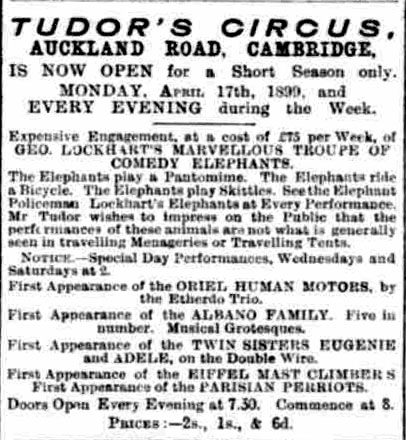
On 14 August the Circus advertised George Lockhart’s marvellous troupe of three comedy elephants. Both reviewers and a large audience were enthusiastic.
The premier turn is, of course, that by George Lockhart’s elephants, and too much cannot be said in praise of these gigantic performers. The instinct of the ponderous brutes is wonderful, and the manner in which each answers to its name elicits rounds of applause from the audience. Besides waltzing, playing various musical instruments (including bugles), walking with their hind and front legs, eating, drinking, and officiating variously as cook, waiter and policeman, “Boney” an elephant of a smaller growth than his companions, actually cycles, mounting, pedalling and steering his tricycle without any outside assistance.
(CE, 22 April 1899, p 8)
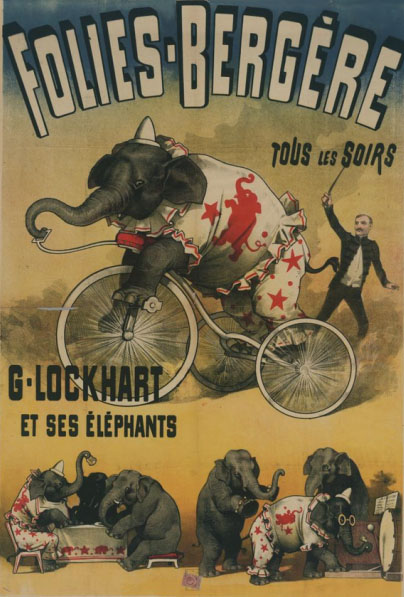
This was a famous, and expensive act for one week only. Their next engagement was at the Alhambra Music Hall, London, at a cost of £125 per week.
The Cambridge public appreciate to the full the thorough training by which the elephants are brought to perform so many clever tricks. They are under perfect control, and obey their master as readily and implicitly as well-trained dogs. They are made to perform a species of gymnastic exercises, and strike a series of attitudes comic and otherwise. The smallest of the three rides a tricycle around the arena; the other two waltz to slow music, and the three combine in a short – happily, short – concert, and perform other diverting tactics.
(CDN, 14 April 1899, p 3)
George Lockhart toured Britain, Europe and America with his three elephants, Boney, Molly and Waddy. For more about Lockhart’s elephants see Circus Animals. Lockhart’s perfect control was not always in evidence as the final story in this year will show.
There was a return to more traditional circus acts with trapeze artists, the Etherdos, twins Eugenie and Adele on the highwire, gymnasts and mast climbers, and the clever, curious and comical Parisian Pierrots. O’Velo’s singing donkey Tommy was still in good voice but the CDN reviewer, who had previously praised the lack of vulgarity in the circus, felt that the act was ‘scarcely in good taste’. Whether he meant the man or the donkey we do not know! (CDN, 14 April 1899, p 3).
For the next weeks all that Cambridge wanted to see and hear about were a very special circus troupe – The Colibris Midgets.
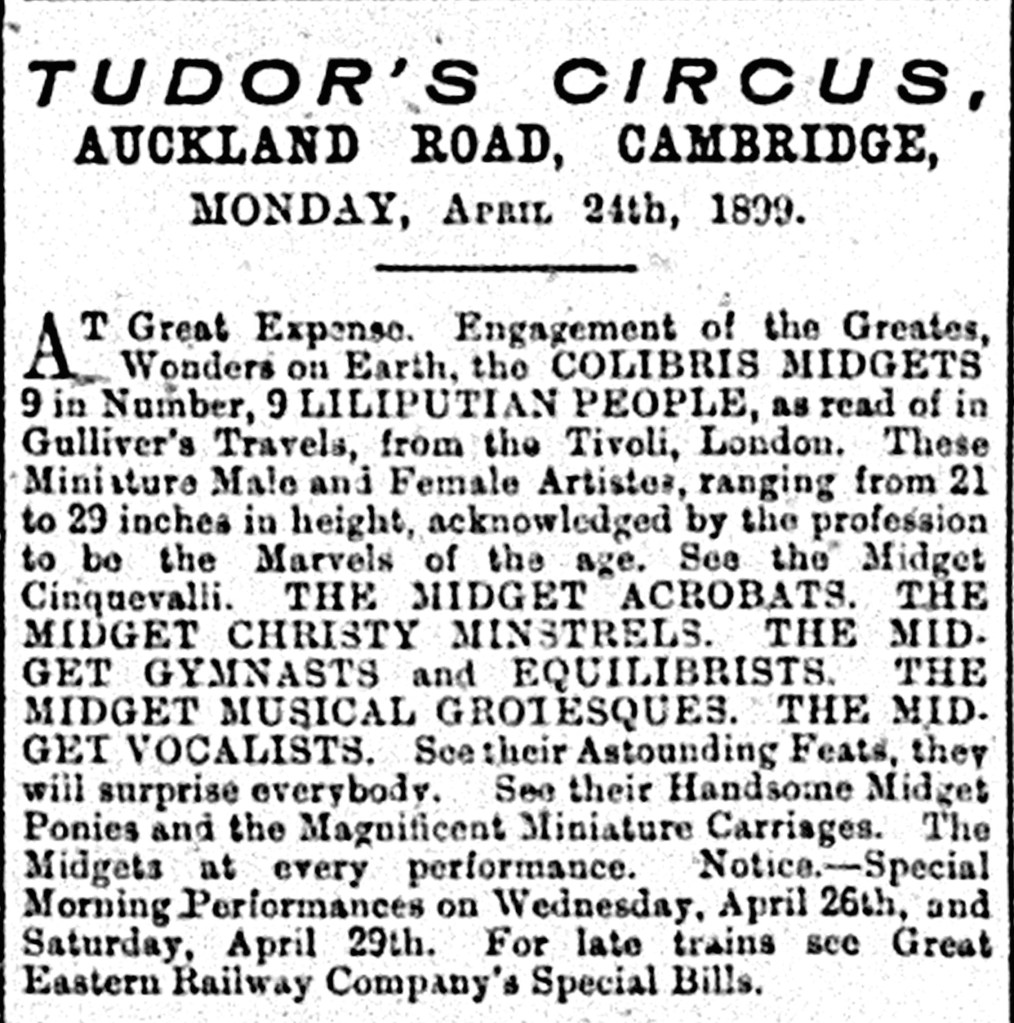
(CDN, 21 April 1899, p 2)
The language used is of its time.
Disability and short stature was no hindrance to circus performers and was generally not seen as cause for mockery but as a reason to be impressed by their extra skills. In 1893 Tudor’s circus had hosted Little Flip, the Midget Clown, who assisted contortionist Adeline. In 1897 and 1898 there were dancers with one leg and a musician with one arm. There was no element of the ‘freak shows’ found mainly in the American circuses such as the Ringling Brothers or Barnum & Bailey, although in the 1880s and 1890s an English showman Tom Norman had held similar travelling exhibitions. Some of his artists were fakes and, briefly, one was Joseph Merrick, the ‘Elephant Man’.
The arrival of the Colibris was not quite up to that of Barnum & Bailey the previous year but it was still eagerly anticipated.
A great attraction is in store for the Cambridge public at Tudor’s Circus, Auckland Road, next week at which the Colibris Midgets have been specially engaged to appear . . . The Lilliputians arrive in Cambridge to-morrow by special first-class saloon, and two wagons containing their wardrobe, luggage, ponies and carriages, by the 4.55 p.m. train. Mrs Moyes, of the Lion Hotel, Petty-cury, has taken the contract to look after these wonderful little people, therefore the suite of rooms is going under extensive alterations to accommodate these small people.
(CDN, 22 April 1899, p 2)
Originally from France and Belgium and successful for many years in Europe, the troupe provided a complete circus entertainment by themselves,
The Colibris are nine in number – nine good-looking miniature men and women . . . Three of the midgets performed some very smart acrobatic and gymnastic feats . . . four of them appeared as musical artistes, one of the small women as a serio-comic singer, one man as a wire walker, one as a ladder equilibrist, one as a juggler, two as acrobats, and four as a minstrel troupe. Their feats drew forth many expressions of wonder and delight, and each turn was finished amidst great applause. There is even a funny man of the party, and his eccentricities excite any amount of laughter. The midgets are worth going far to see.
(CDN, 25 April 1899, p 2)
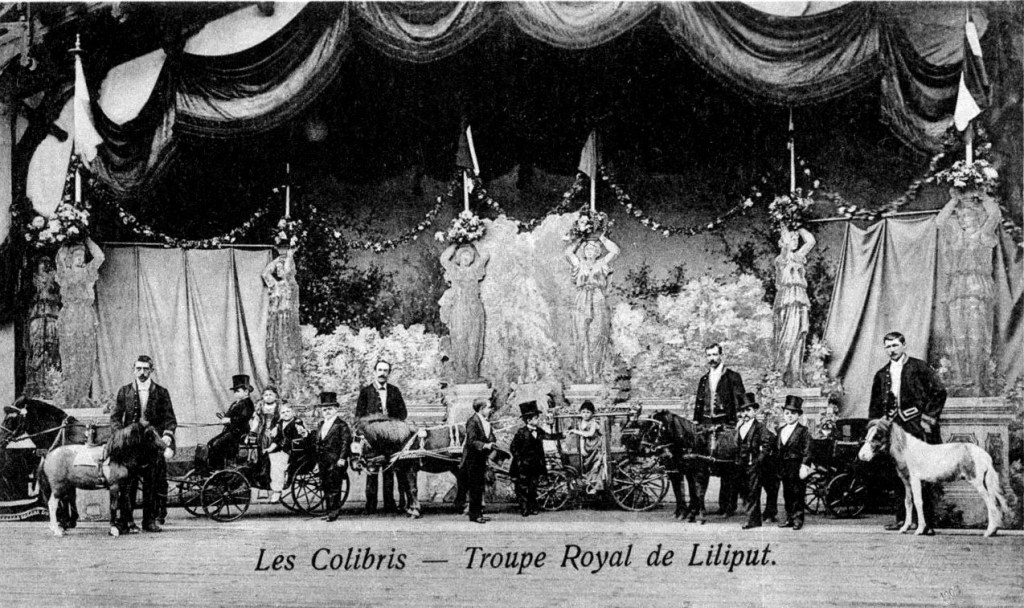
The CE said they were the talk of the town, were ‘perfect marvels, and put many of their larger confreres into the shade in the acrobatic and juggling line’. Their ‘high-class and talented performance’ lasted over an hour (CE, 29 April 1899, p 8).
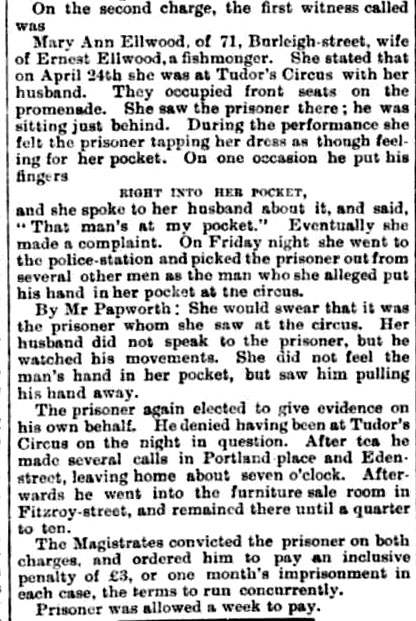
At the end of April Tudor’s circus featured incidentally in a court case. John Henry Bareham, an insurance company agent of 41 Ainsworth Street was charged with attempting to pick the pockets of ladies window shopping in Regent Street. He was seen in a crowd gathered round the spectacle of a motor car in St Andrew’s Street, and another group watching a monkey in a shop window, feeling for purses in the ladies’ back pockets. There was a second charge at Tudor’s Circus on the night of 24 April. Here is the first part of the lengthy account of his trial in the Cambridge Daily News, 29 April 1899, p 3:
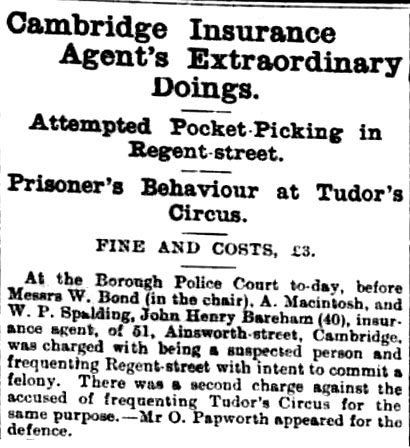
Bareham denied all charges and no purses were found on him. Here is the Cambridge Daily News account of his trial on the second count, at the circus:
May: the Colibris stay on and the circus ends
The Colibris were so popular that Tudor re-engaged them for another week (CDN, 28 April 1899, p 2) and they were described as ‘Performers of rare merit’ (CDN, 2 May 1899, p 3). In 1910 a film was made showcasing the Colibri Midgets, called The Unlucky Fisherman. Sadly no trace of this film exists.
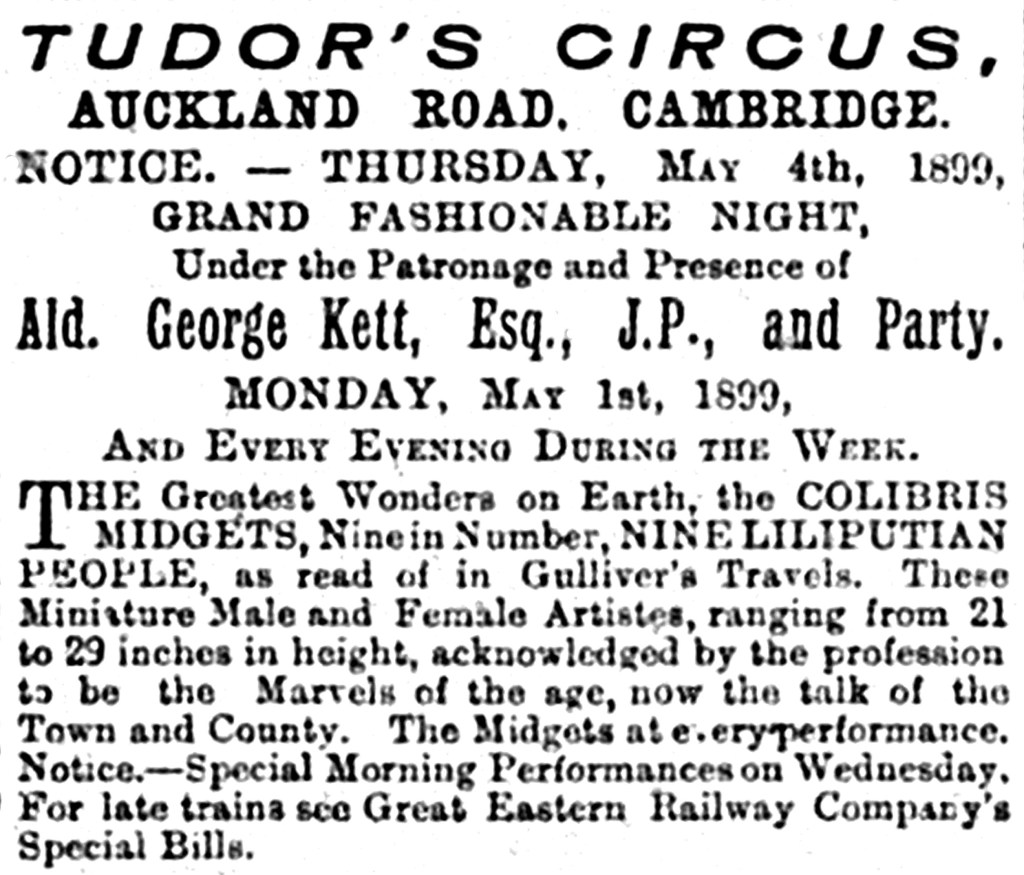
CDN, 28 April 1899, p 1
A Grand fashionable Night was held with Alderman George Kett attending. George Kett, one of the Ketts of the Cambridge building firm Rattee and Kett, was on the council for over thirty years and was Mayor of Cambridge three times.
Was the circus beginning to lose popularity? Certainly the CDN reviews are shorter and more critical, sometimes just a paragraph in the Daily News section, though the CE continued to praise. On 8 May the circus was ‘by no means crowded’ when the new programme opened (CDN 9 May 1899, p 2).
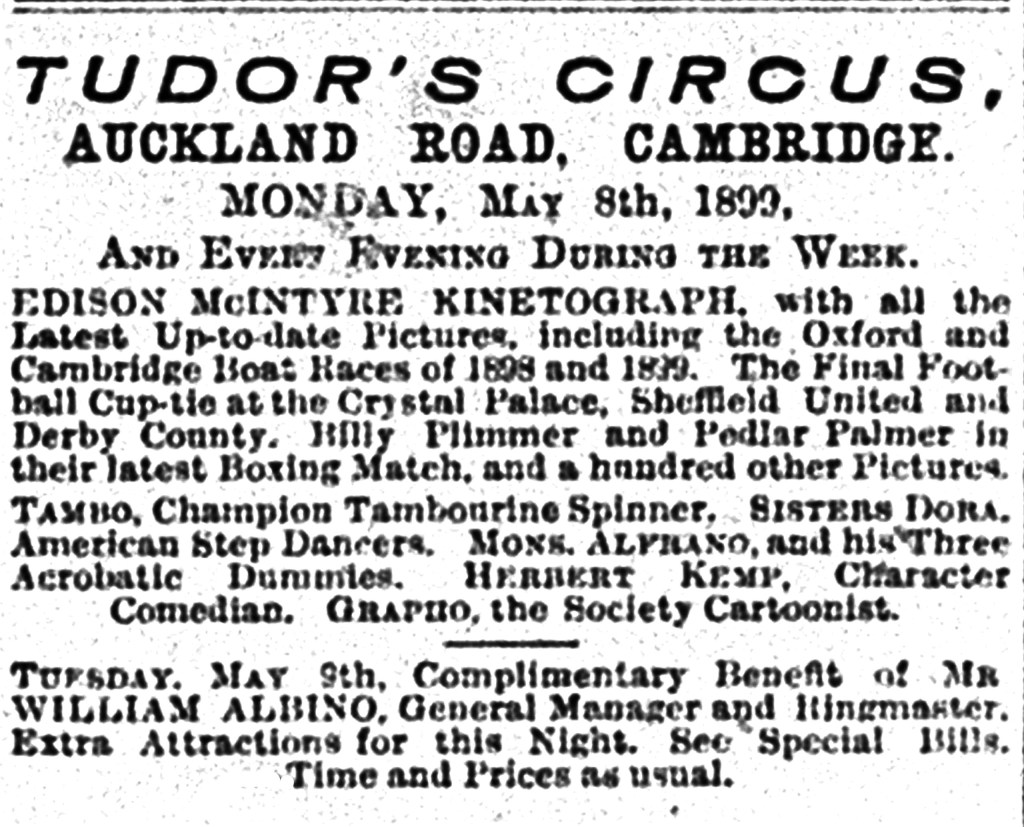
However, according to page 8 of the Cambridge Express, 13 May, there was ‘intense interest’ in the ‘great attraction’ of the Edison McIntyre Kinetograph, especially the film of the FA Cup Final (Sheffield United 4, Derby County 1, to save you looking it up). In contrast the CDN thought the animated pictures shown were of ‘somewhat variable merit’ though his criticism demonstrated he had not quite grasped the concept and difficulties of filming.
The boat race was good, although the Cantabs were apparently rowing about 100 strokes to the minute. Still, it was a capital representation, and was, of course, immensely popular. ‘The Phantom train’ was good, what there was of it, but there was evidently something wrong, as the audience were one moment in the train and the next out of it. The best of all the pictures, however, was ‘The Bull Fight’.
(CDN, 9 May 1899, p 2)
The Astronomer’s Dream, the famous trick film by George Méliès, was shown as was a film of the Bishopgate fire.
Other acts were the clever and amusing comic character actor, singer and dancer Herbert Kemp who also appeared as Grapho the cartoonist, drawing statesmen such as Bismarck and Gladstone; Jack Alfrano, clown and flying ring acrobat who came with three mechanical and acrobatic dummies; the singing and dancing Sisters Dora and Tambo with his spinning tambourines.
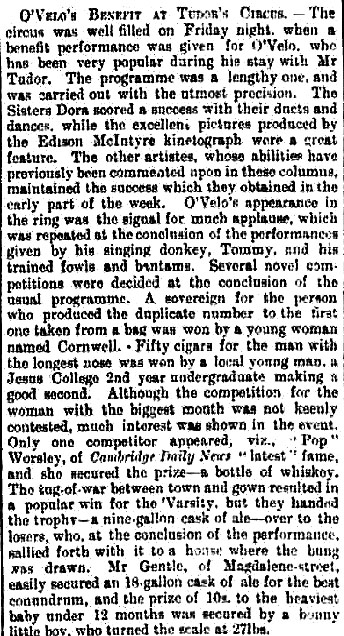
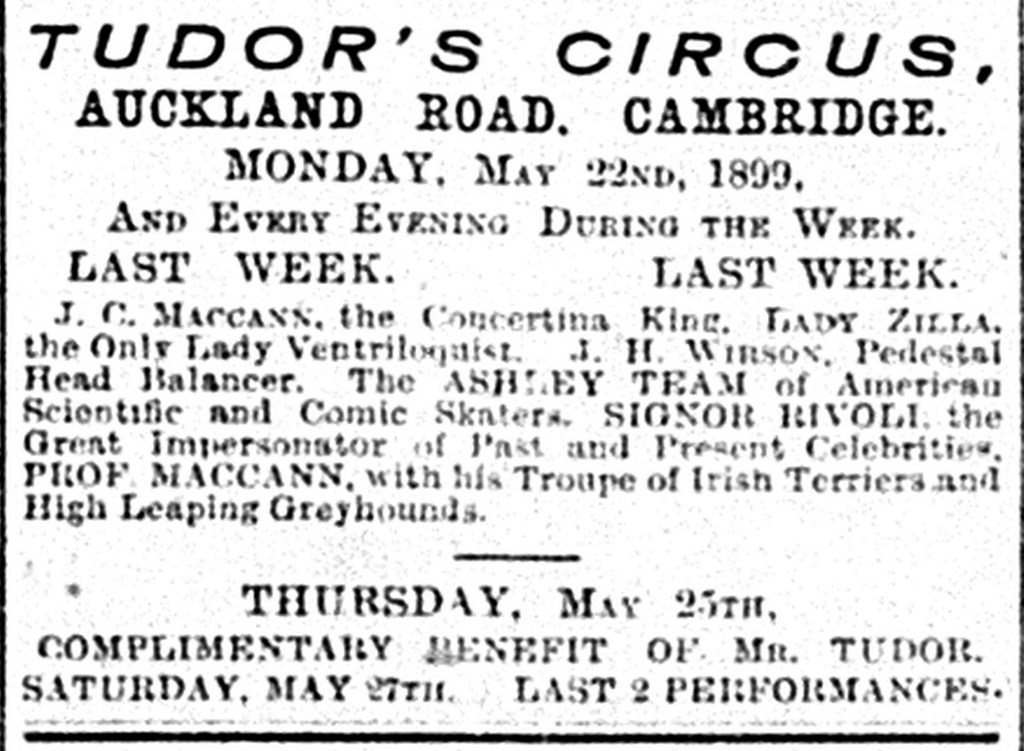
May 9 was a benefit night for ringmaster Mr Albino, signalling the approaching end of the season. A benefit for O’Velo with his singing donkey Tommy and his trained fowls and bantams was on the 12th, benefits for Rebecca Daniels and clown Miserable Jim Cooke followed shortly and on the 25th it was William Tudor’s benefit night.
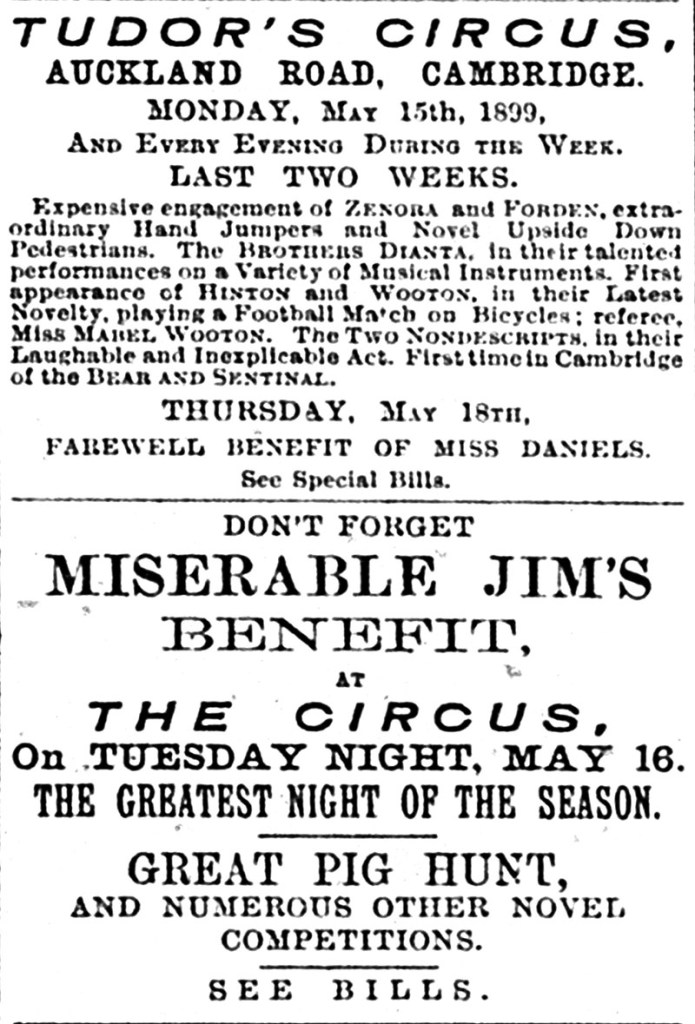
CDN, 13 May 1899, p 2
The end of the season also meant competitions for the audience with a bizarre collection of events and a Town and Gown tug-of-war.
CDN, 13 May 1899 p 2
And, as always, Tudor invited the children from the Chesterton Workhouse to a performance on 12 May. Comic musicians the Dianta Brothers, who were August and Fortuny from the Dianta Troupe, caused considerable laughter. The trick cyclists Hinton and Wootton played an ‘exceedingly clever’ football match on their bicycles (CE, 20 May 1899, p 8).
Zenora and Foden, known as The Child of the Sun and The Man in the Moon, performed extraordinary hand-jumping feats, climbing up and down ladders, stairs and jumping on and off chairs, all upside-down on their hands. The finale was the comic equestrian scene, called The bear and the sentinel, or McGinty’s trouble on the Prussian frontier, a ‘short extravanganza’ featuring a night in Russia during the Crimean War and involving the whole company, including Mr Albino, the ringmaster (CE, 20 May 1899, p 8).
CDN, 19 May 1899, p 2
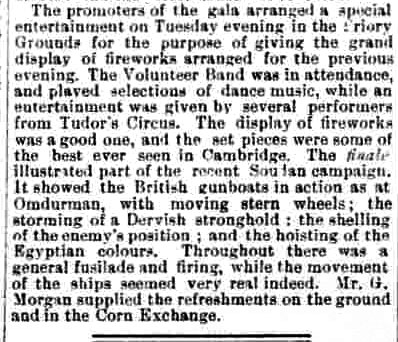
A special fete and gala was held on the bank holiday Whit Monday May 22 in Barnwell Priory grounds in Newmarket Road and several marquees were erected. There would be bands, pipers and dancers and a number of the circus acts would appear, the clowns playing a cricket match, ventriloquism and Professor Maccann’s leaping dogs, and the gala would finish with fireworks. At the same time there would be another gala on Midsummer Common when ‘old English sports and pastimes are promised’ (CDN, 20 May 1899, p 2). Unfortunately Whit Monday was a day of incessant drizzle and the gala adjourned to the Corn Exchange where nearly all the circus performers appeared, twice! The fireworks were moved to the Tuesday evening in the Priory grounds, and several of the circus performers obliged once more. Presumably there was a lot of to-ing and fro-ing between the Corn Exchange, the Priory and Auckland Road on those days.
CIP, 26 May 1899, p 5
Tudor’s circus had entered its final weeks with a programme so attractive it was felt ‘he has saved his best entertainments until the last’ and ‘the circus was packed from floor to ceiling on the Monday night’ (CE 27 May 1899, p 6).
Fred Derrick was already bareback riding at Cleethorpes Circus, but in Cambridge Professor MacCann’s team of high-leaping greyhounds and terriers ‘performed marvellous feats and gave fine exhibitions of canine sagacity‘ (CIP, 26 May 1899, p 5), including leaping an 18 foot high gate. The only lady ventriloquist, Lady Zilla ‘caused considerable wonderment with her voice-throwing capabilities’ (CE, 27 May 1899). There was a head balancer, an impersonator and a revisit of the American scientific and comic roller skaters from 1897.
Saturday night was to be the last night and numerous prizes were to be offered to those who visited the end of the season show. Suddenly the season was over, and Tudor’s circus had left Cambridge for good. William went off to Boscombe where, on 17 June, after only three weeks, he closed a planned eight-week season which didn’t draw an audience. In August he was performing at the Grand Circus in Cleethorpes, and then opened his own circus in Darlington in September, which ran until spring 1900.

CDN, 6 June 1899, p 2
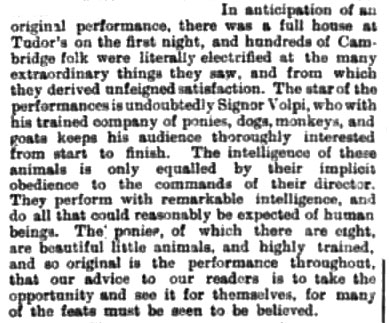
For one week only Livermore Brothers’ Royal Italian Circus occupied the Auckland Road building, making its first appearance in the town. The Cambridge Daily News gave it an enthusiastic review though alarmingly the Cambridge audience were ‘literally electrified at the many extraordinary things they saw’.
CDN, 6 June 1899, p 2
In 1906 and 1907 the Italian Circus returned to Auckland Road. The images below from the programmes, from Cambridge University Library Rare Books collection, give some idea of what it may have been like in 1899.
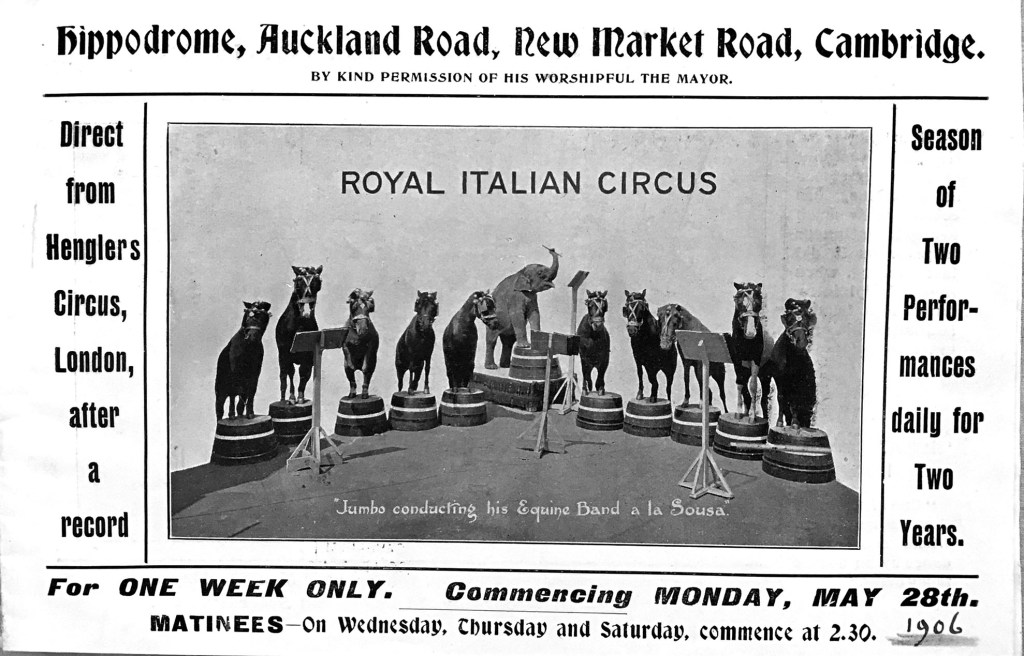
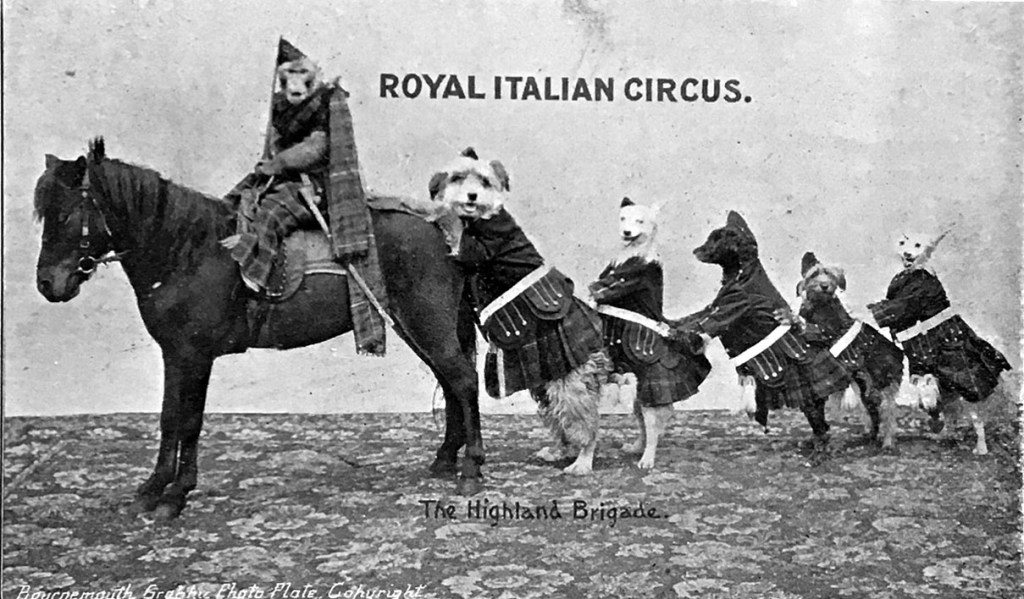
Tudor’s circus was closed but his name made a brief appearance in the CDN a week or so later with an ‘extraordinary story of an elephant’. It seems that a number of elephants from Mr Tudor’s Circus (presumably Lockhart’s elephants) were passing through Christchurch when they broke into the yard of a corn store. A larger elephant broke open the door but was too large to enter. A smaller elephant was able to get in and started feeding on a stock of dog biscuits. ‘He was not selfish, however, for he tossed a number of the biscuits out into the yard for the benefit of his more ponderous companions who had been unable to effect an entrance. The unrehearsed performance was brought to a conclusion by the arrival of a keeper, who had been detained in hurrying along a laggard elephant’ (CDN, 14 June 1899, p 2).
On 23 August Tudor’s music and dancing licence was renewed at the annual Licensing Sessions (CIP, 25 August 1899, p 6) and in 1900 the Auckland Road building re-opened as the first of a series of new entertainment incarnations. Although Tudor’s name was retained for a few weeks in that year (and in 1913 William brought his ponies to Auckland Road where the circus had become the Gaiety Theatre), Tudor’s Circus was never to return.
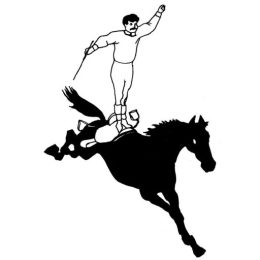
 William Tudor's Circus