A warm welcome for William and Funny Fred
After successful seasons at Ipswich, Macclesfield and Rotherham, the circus re-opened for its 1898 season, on Monday July 11 with Mr Harry Baring as Ringmaster. There was a ‘rousing first night’ as ’directly on the stroke of eight Mr Tudor and his staff stepped into the ring and the crowded house cheered him lustily, renewing their applause as the familiar figure of that lithe young rider, Fred Derrick, dashed into the ring holding onto his horse’s back apparently with the toe of his boot’ (CDN, 12 July 1898, p 2). The clowns Funny Fred Hall and Jolly Jim Cook were there, with Funny Fred’s return being greeted with a loud cheer. His ‘abilities as a clown are not only told in Cambridge, but also in a far wider circle’ (CE, 16 July 1898, p 5).
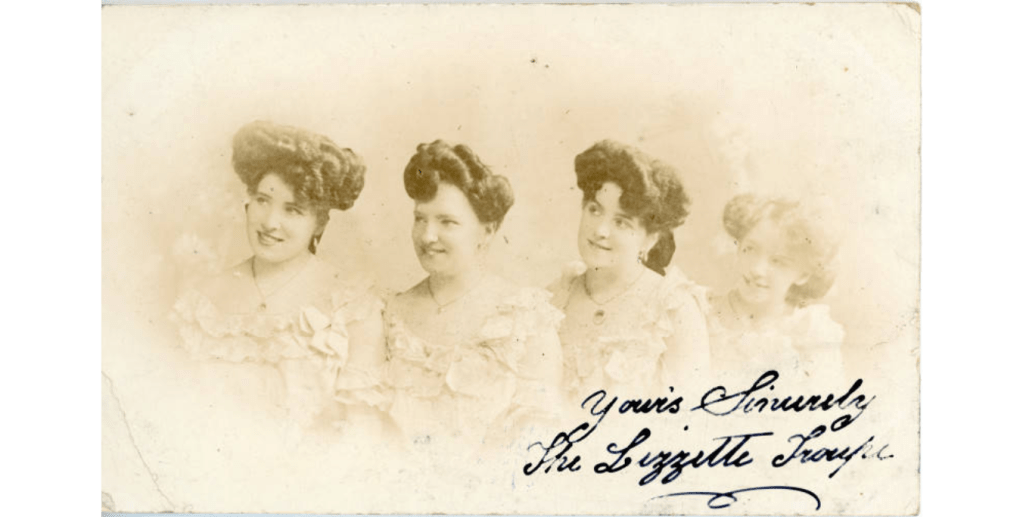
The Lizzette Troupe, reproduced with permission of the University of Sheffield
Tudor’s advertised colossal equestrian and variety programme consisted of horse-riders with the welcome return of Rebecca Daniels, as well as Mdlle Montero and Mdlle Rose. More women artistes were the Lizzette Troupe of four lady acrobats and Bijou on the highwire. There were the Three Charms on trapeze, the contortionist Rowe known as the Silver Eel, bellringers, comics and Permane’s Royal Troupe of Performing Bears.
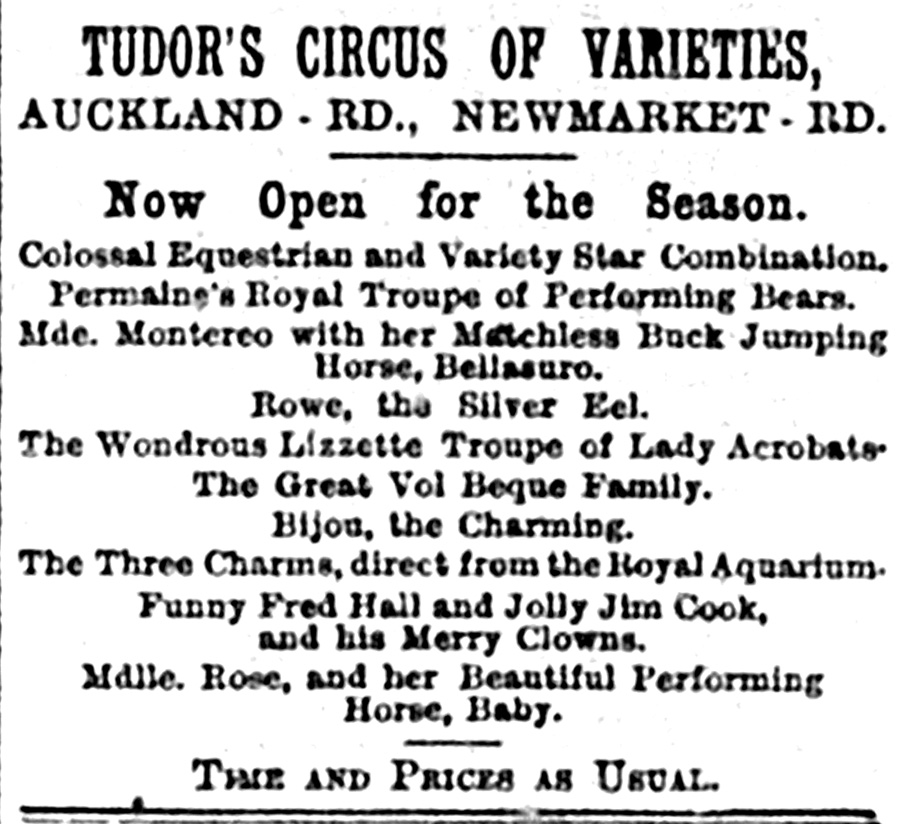
CDN, 12 July 1898, p 1
Wiliam Permane, (1864-1939), the equestrian son of a gymnast, stood in for a bear-trainer while travelling with a circus in Russia, and then turned his hand to training bears himself. His bears, usually three female Siberian bears, performed in Sweden and Spain before coming to Covent Garden in London in 1889/90 when ‘people were astounded to see bears standing on their heads, walking a narrow pole, barrel rolling, riding a tricycle and even seated at a table, enjoying a meal. Two of the bears were named Wodki and Sasuski’ (Turner, 1995). The Cambridge audience were amused by the clever if ungainly antics of the three bears who apparently drank beer and rolled logs. For more on Permane’s Bears and animal cruelty see Circus Animals.
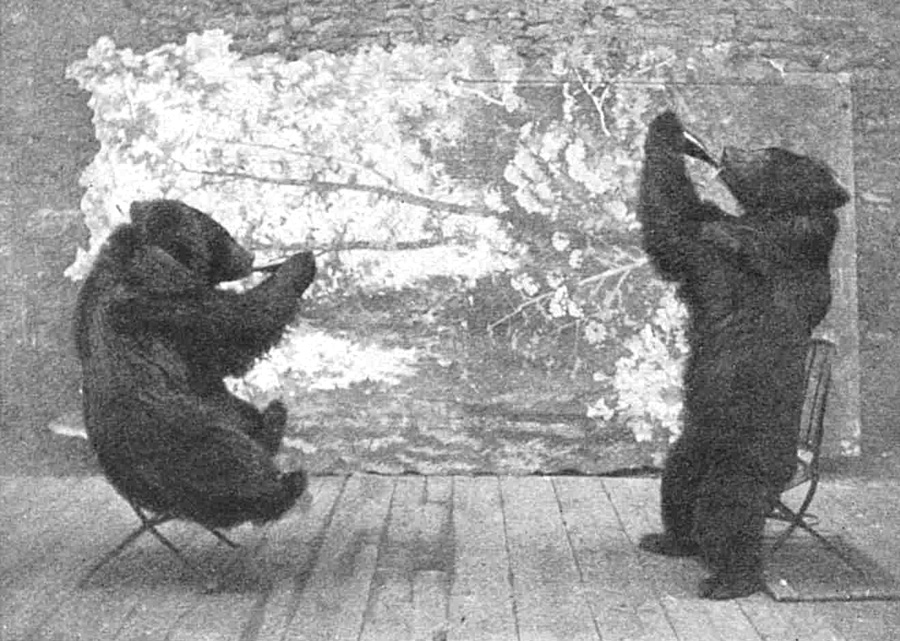
William Permane’s performing bears in action, The Sketch, 4 January, 1899, p 28
The next programme was full of music, with duettists George Saphrina and Ada Montrose, a comic singer Johnny Osborne, and the musical Rigaldes on banjo, mandolin and bells.
But the star was the fire fiend Rivalli who made the Cambridge Express reviewer ‘twitch uneasily’ as he licked a white-hot iron bar ‘with as much gusto as a child licks a bar of toffee; he spits fire, bends hot rods with his feet, in fact he seems simply to revel in fire’ (CE, 23 July 1898, p 8). The CDN reporter was even more impressed as Rivalli’s finale was to stand inside a large cage of interwoven hay, soaked in oil. We suspect Tudor wouldn’t have put him in the ring in one of his wooden circuses and we don’t know why he didn’t singe his splendid moustache.
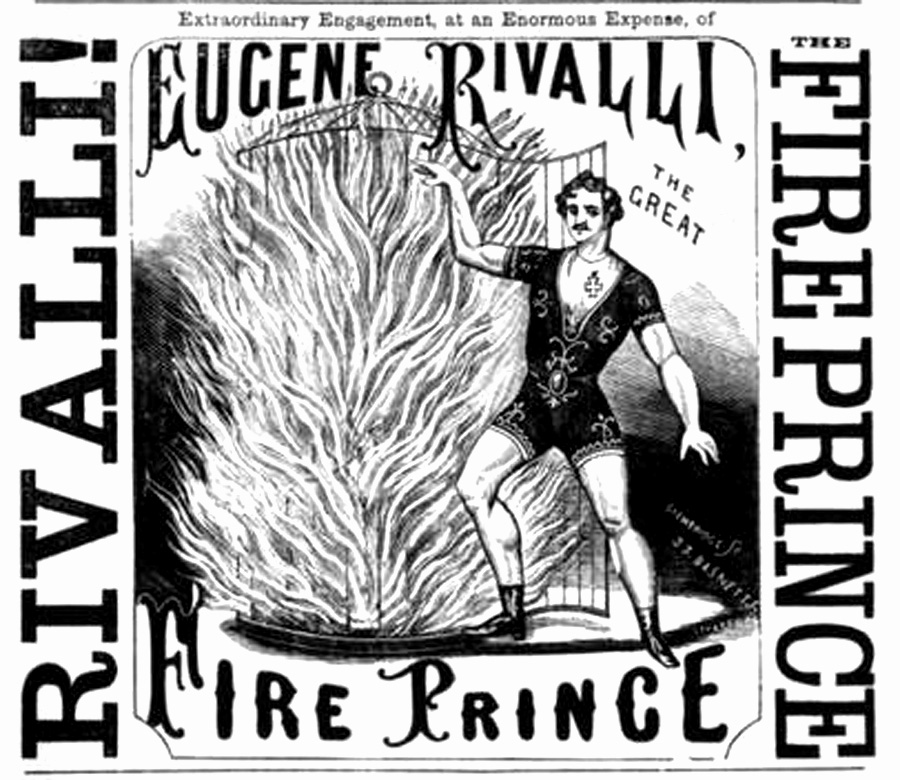
The erection blazes to the roof of the building while inside this very fire fiend is to be seen with the flames licking all over his body, his only care apparently being to protect his eyes with his hands. As the fire dies down he opens the door, still glowing, and stands unhurt before the applauding house.
CDN, 19 July 1898, p 2
Rivalli, or The Brazilian Fire Prince, was born John Watkins in 1853. An orphan, he was apprenticed to a licensed victualler, but an interest in chemistry and in fire led to his later career as the Human Salamander, and he was to tour most of the cities of Europe, with the cage of fire his most famous trick. He died in Berlin in 1900.
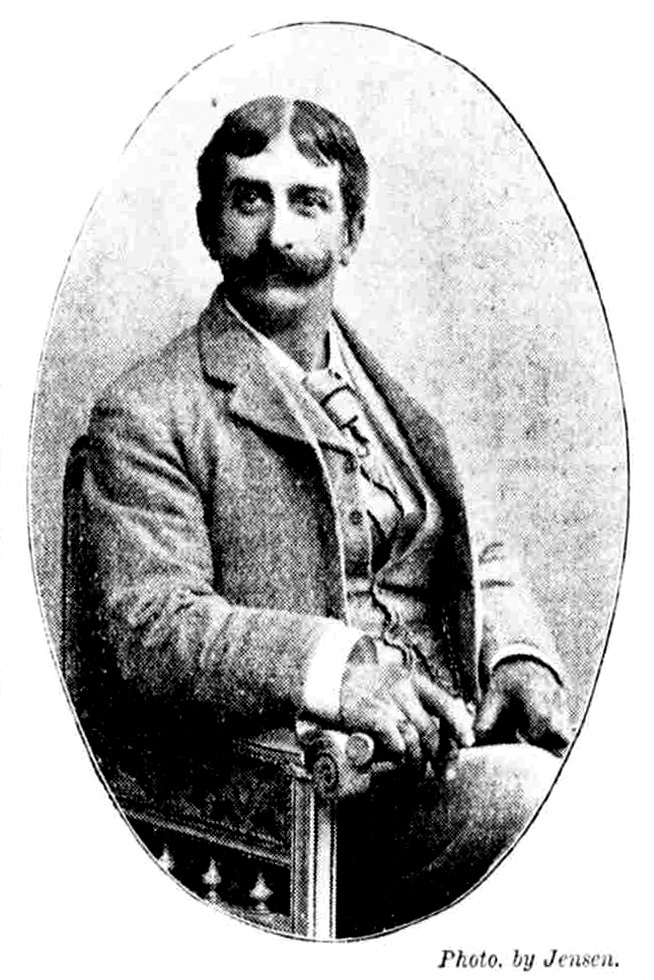
As usual Tudor invited sick and older people and the children from the Chesterton Workhouse to the Saturday performance and gave them a hamper of gooseberries. Next week the six Royal Welsh Glee Singers performed ‘at great expense’ to large houses each night (CDN, 25 July 1898, p 1). They had already performed by royal command before Queen Victoria, that great circus fan, at Windsor Castle, where she highly complimented them. The return of Peter the Great, the one and only Riding Goat, who kept his seat on horseback with great assurance must have been a bizarre contrast. Miss Flora Lington sang, as did the returning Patta Bella, and Eleonora on the high trapeze completed the female performers, while Carson, the one-man-band continued the musical acts.
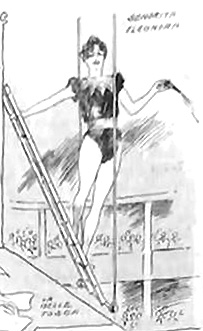
Eleanora on the high trapeze, Cambridge Graphic, 23 June 1900, p 11
The ‘irresistibly idiotic and curiously contrasted clowns Frisky Freddy and Jolly Jim, the sad and silent and the gay and garrulous’ were also on hand to entertain the Mayor, Mr S R Ginn, when he attended on Friday 29th (CDN, 26 July 1898, p 3).
August: giddy merrymaking and the tragedy of a clown
The Bank Holiday that year was full of ‘merry bustle, according to the CDN with a ‘giddy crowd of thoughtless merry-makers, who, ‘from early morn to dewy eve’ were making the most of the fine weather. On Fenner’s cricket ground Cambridgeshire played the MCC, the Ornithological Society held a ‘capital exhibition’, the Working Men’s Cottage Garden Society held its large garden and produce show in the grounds of Peterhouse and Thurston’s Fair was pitched on the Common while Tudor’s Circus was ‘packed with enthusiastic patrons’. Miss Frederica was back after three years’ absence with her performing toy terriers, and the Faues returned with their Risley balancing act. Mr Faue lay on his back and tossed two small boys, (probably his sons) on his feet. The finale was a demonstration of a Biograph, showing pictures of Gladstone’s funeral, and a Musaphone. The Musaphone, or loud-speaking phonograph, was a delight to all except when marred by noise from the Bank Holiday fair when ‘Hoarse strains of “Lost, Stolen or Strayed” became weirdly intermingled with the thin notes of a piccolo solo’ (CDN, 2 August 1898, p 2).
The next week saw the first appearance of Miss Minnie Mario, well-known burlesque singer who ‘trills like a thrush’ (CDN, 9 August 1898, p 2).
Her trilling required several encores. Tudor’s advertisement describes her as Principal Boy at the Drury Lane pantomime for six years.
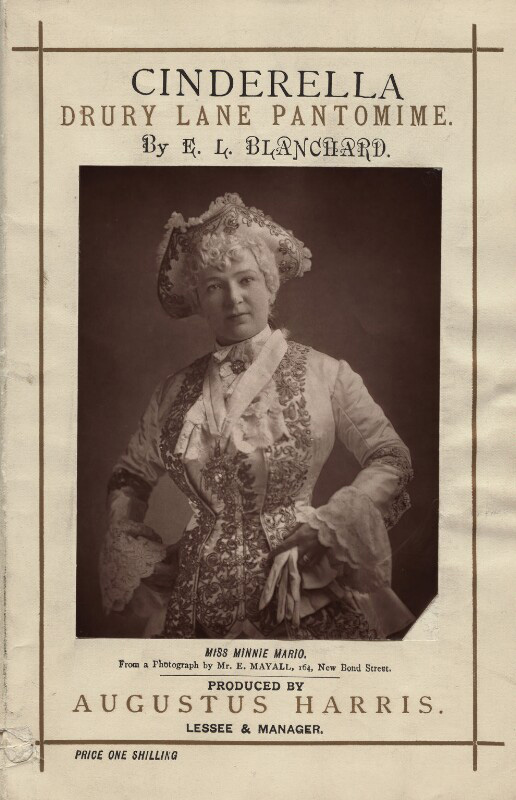
Minnie Mario in E.L. Blanchard’s ‘Cinderella’, by John Jabez Edwin Mayall, 1883-1884, National Portrait Gallery x135811
The Laurence Troupe of Lady Cyclists had performed in 1896 and now were back ‘as much at ease on anything that will roll as most people are on Parker’s Piece’ (CDN, 9 August 1898, p 2). Equestrian art was demonstrated by Fred Derrick and Becky Daniels, as usual, and Madame Fedora with her horse General Grant, but this week Peter the riding goat was supplanted by Billy the riding dog who ‘goes through his performance on the back of his equine partner charmingly’ (CDN, 9 August 1898, p 2). One wonders what the equine partner thought of the variety of two and four-legged riders on its back. Not to be outdone, Madame Frederica’s terriers with their cycling, perpendicular walking and skipping brought the house down.
On Sunday 14 August, William Tudor nearly met an untimely end in the river Cam on his day off but Albert Scales, the Cambridge brewer who had paid tribute to him in an end-of-season speech in 1893, saved him. It’s worth remembering that Cambridge discharged all its sewage into the river until 1895. Real disaster was to follow exactly two weeks later.
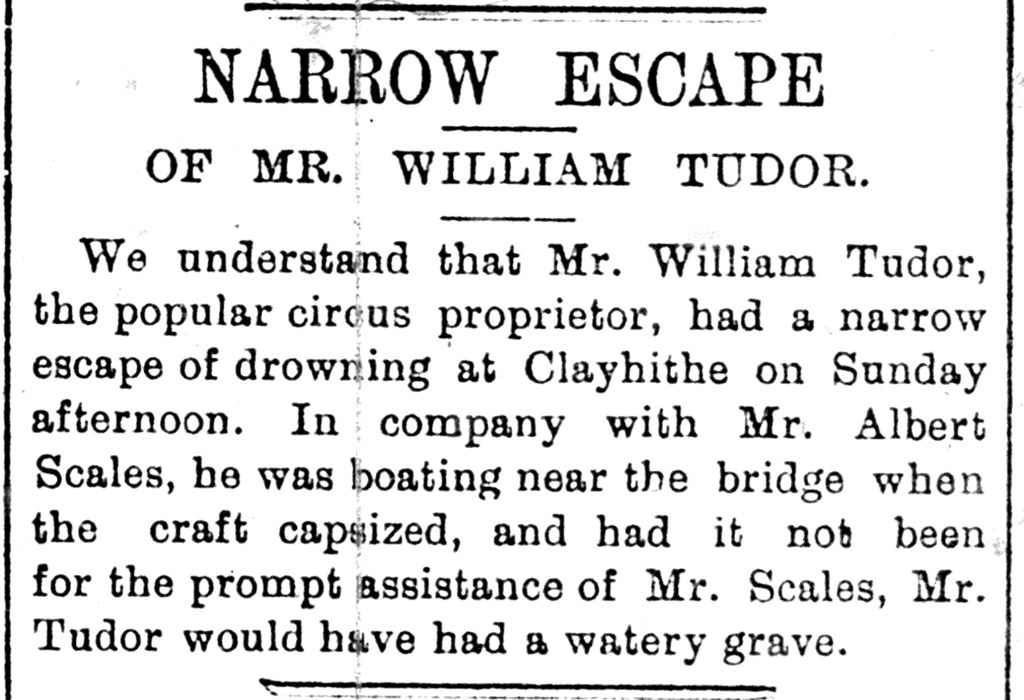
Cambridge Daily News, 15 August 1898, page 2, noted by Mike Petty in his Circus Chronicle (Cambridgeshire Collection, Cambridge Central Library)
The sisters and brother act, Flying Fitzroys, had performed their daring aerial gymnastics in 1893, 1895 and 1896 and were back in Cambridge again. A newcomer was the one-armed cornet and post-horn player, W D Watson, whose clear and unwavering playing took the CDN reviewer back to the ‘good old days’ of the rattling coach and its four galloping horses with ‘the post-horn screaming out its note of jubilation’ (CDN, 16 August 1898, p 2). The three male Ladderites ran up and down ladders while the Zarac Brothers combined humour with horizontal bar acrobatics. Funny Fred continued to amuse and Fred Derrick to impress with his bareback riding, as did Tudor’s pony Billy who bossed the circus owner around and eventually out of the ring.
Perhaps the silly season was sapping the enthusiasm of both circus and press. An International Congress of Zoologists took up much of the Cambridge news with the town full of ‘strange tongues from all parts of the globe’ (CIP, 26 August 1898, p 5). The CDN circus review was unusually luke-warm, calling the acrobatic Four Aces ‘novel in many parts’, Virto’s song ‘passable’, and Smiler and Droll Rabbit ‘while away the time with their mimic absurdities’ (CDN, 23 August 1898, p 2). Funny Fred Hall is much in evidence with a mysterious package, but we are not told what it contains. In complete contrast the CE cannot get enough of ‘dashing Fred Derrick’, ‘marvellous’ Salmon, the Demon cyclist, the ‘most accomplished’ Virto and ‘although every turn is of the highest order, the Four Aces certainly eclipse all the previous endeavours’ (CE, 27 August 1898, p 8).
The sudden death of Funny Fred
But in the meantime a tragedy struck the circus. We never do hear the contents of the mysterious package of Funny Fred Hall, Tudor’s brother. On Saturday 20 August he had gone to London after the performance and had caught a chill. He was performing in the ring on Tuesday 23rd, but became ill with inflammation of the lungs and died at his lodgings at 13 Willow Walk in Cambridge the following Sunday. He was only 42. He was an immense favourite with the Cambridge audiences and ‘His many witty mannerisms, so essentially his own, will long be remembered, and his decease will be regretted by both young and old patrons of the circus‘ (Newmarket Weekly News, 2 September 1898, p 7).
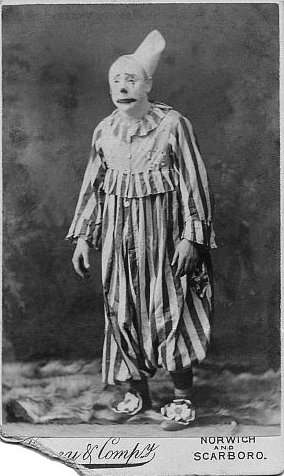
Fred Hall’s carte de visite
A death notice and thanks from his widow appeared in the trade magazine The Era. For more on this popular character, whose grave is in Mill Road Cemetery, see Frederick Tudor Hall.
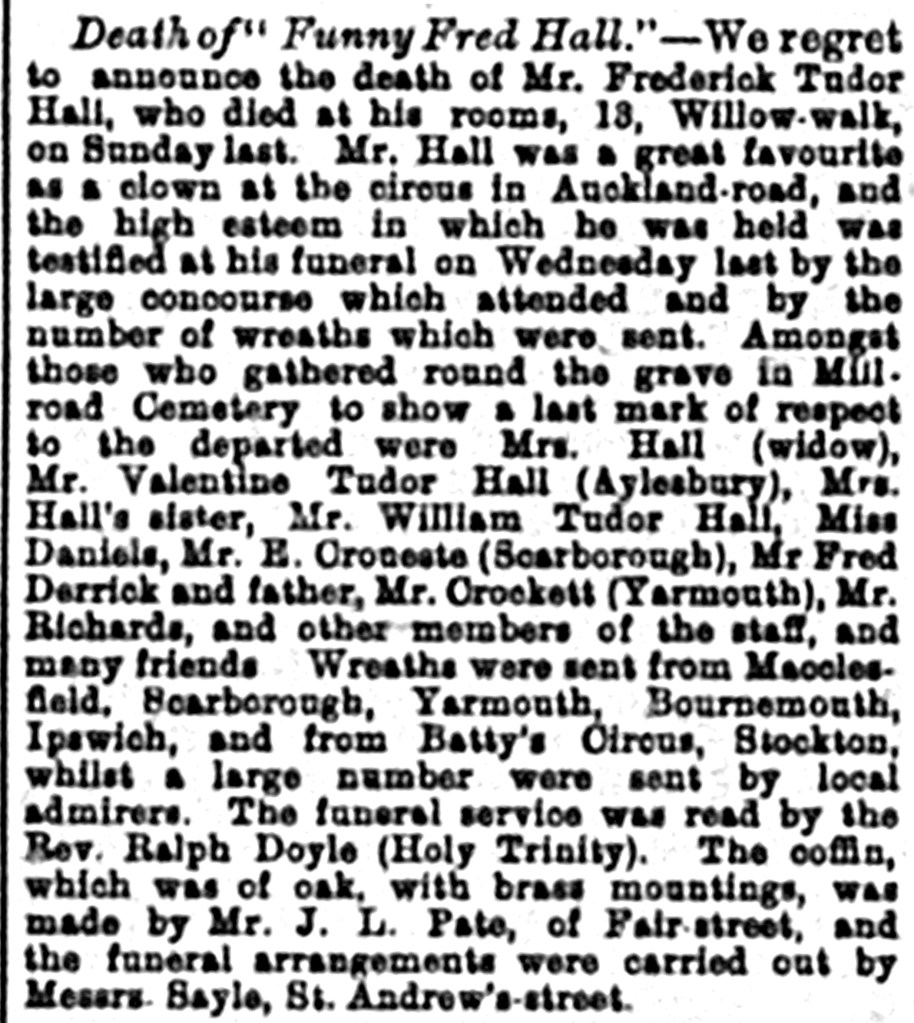
(CE, 3 September 1898, p 8).
The show goes on
But the show must go on, and it did, and only the two clowns Rabbit and Funny Frisky are mentioned in the next reviews.
But despite his successes in Cambridge, Tudor may have realised that the tide was turning against circuses in favour of the music hall. On the 29 August he applied to the City ‘through Mr. A. J. Lyon for a music and dancing licence for premises known as Tudor’s Circus, Auckland Road. Mr Lyon said the applicant was well known, and recently the circus had been patronised by the Corporation’ (CIP, 29 August 1898, p 6).
At the end of August appeared a very young singer who was to go on to fame and fortune. Cassie Walmer was described as ‘a dusky little maiden, apparently about eleven years old, who sings . . . and dances with a with a delicate grace seldom to be found in dancing ladies of a mature age’ (CDN, 30 August 1898, p 2). For the CE ‘Cissie [sic] Walmer, a coloured little girl, is a great favourite with plantation melodies’ (CE, 3 September 1898, p 8).
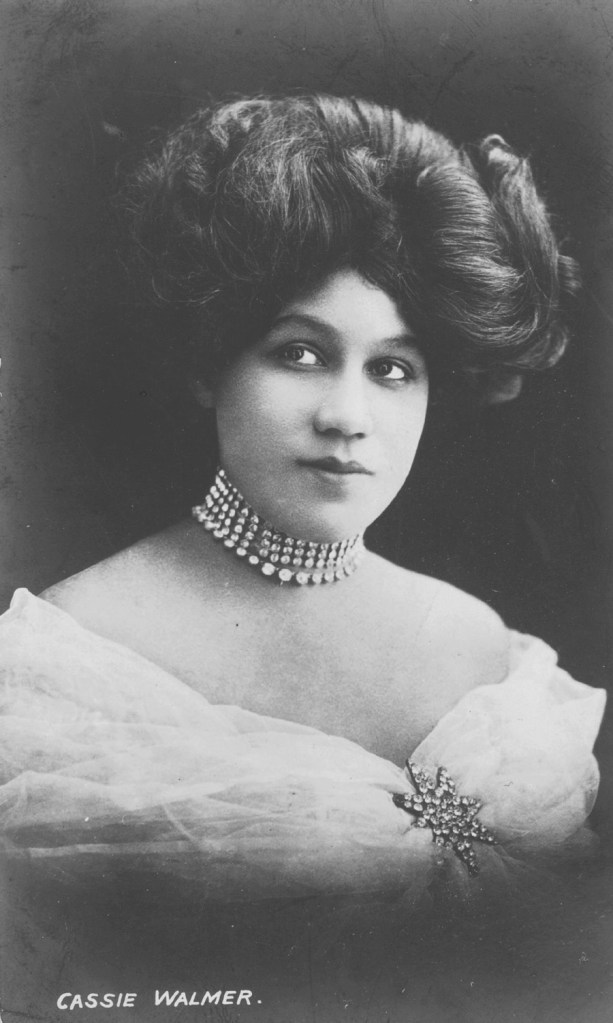
Cassie Walmer, about 1905 (from Find a Grave)
Cassie Walmer was born in Camden, in London, in 1888, with no connection to the American plantations. She was to become a glamorous music hall singer, dancer and comedienne. Stephen Bourne, in Black Poppies (2019), describes how Cassie had first performed on stage with her father, the African-American actor and musician George Walmer, in theatrical performances of Uncle Tom’s Cabin, first appearing with him at three years old. After her father’s death in 1897 her mother encouraged her to continue a stage career.
Three years after delighting the Cambridge audience, Cassie sang and danced at the Birmingham Hippodrome and came back to Auckland Road in 1901. In 1906 she performed in Australia at the Tivoli Theatre, Sydney, later touring New Zealand. She became a ‘favourite of music hall audiences in the Edwardian era’ (Bourne, 2022, p 170), touring Britain to full audiences, and continued performing throughout the First World War. She was known for her fine contralto voice and her artistic dancing, including an ‘eccentric sand dance’ (Bourne, 2022, p 171). After the war she continued to tour extensively, performing at times under the name Janice Hart, in a double act with Frank O’Brien, and later on BBC Radio, until retiring in 1947.
Further information about this remarkable and popular singer appears in her Oxford Dictionary of National Biography entry (2023) by Stephen Bourne and you can hear her singing in this recording from the University of California Santa Barbara Library archive.
Among other performers on the bill were the returning Leopold Leglere Acrobats, Atroy the equilibrist who had come every year from 1895, and Kitty Fairdale, born Kate Hill, who was the sister of Charlie Chaplin’s mother and a well-known music hall singer.
September: The Greatest Show on Earth arrives but Peter the Great is stoical
All the next week’s acts were new, apart from the Brothers Leotard, and there was comedy and music with numerous singers including Frank Coyle the Rattler, who ‘rattles off his songs at the speed of an express train’ (CDN, 6 September 1898, p 2), the Musical Palmers playing a military medley on brass instruments, Miss Ethel Beresford, a mezzo-soprano from the Emilie Melville Colonial Opera Company in Australia. And last ‘but by no means the least attractive were the Sisters le Graham, three charming duettists and dancers’ (CDN, 6 Sptember 1898, p 2).
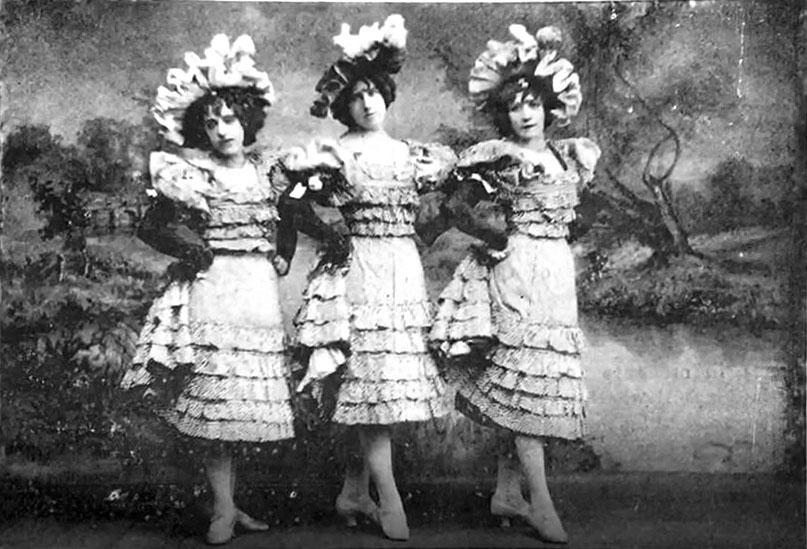
The Sisters Le Graham, Cambridge Graphic, 23 June 1900, p 11
Those old hands, the Leotards, were ‘par excellence in their great hand balancing and Arab tumbling feats. They also execute the “hat trick” nightly, and stimulate no small amount of laughter with their “comic boxing act”’(CE, 10 September 1898, p 8). The clowns Rabbit and Frisky Freddy were in great form and there is no mention of the absence of Funny Fred. On the 17 September the CE reports that ‘the vacancy in the troupe occasioned by the lamented death of Funny Fred Hall has been satisfactorily filled, and Bob Anderson, the old Cambridge favourite, nightly keeps a “college” to the evident amusement of an enthusiastic gallery. Another entertaining droll is Fred Verne’ (CE, 17 September 1898, p 8).
On 27 August a large, illustrated advertisement had appeared for the great travelling circus of Barnum and Bailey.
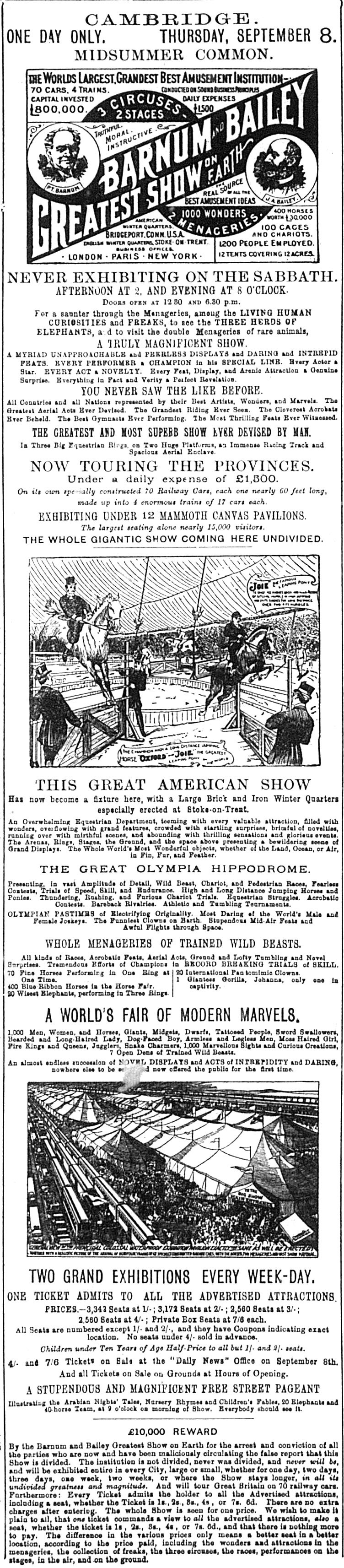
Click on this advertisement from the Cambridge Express (27 August 1898, p 4) to see the full image.
Barnum & Bailey’s mammoth three-ring circus was to arrive at Cambridge on Thursday September 8 and perform on Midsummer Common for one day only, with a city centre procession, 12 pavilions, hundreds of animals, 300 performers, 2 menageries and a ‘Stupendous collection of living freaks’ (CDN, 5 September 1898, p 1). It was a wonder that Tudor was able to compete, but having been ousted from his usual front page slot on the 1st, by the 5th he was back on the front page next to Barnum & Bailey, nothing daunted by The Greatest Show on Earth. The bill owes more to variety and music hall than to the circus, there being no horses or clowns but plenty of song, dance, and comedy. On the night of the 8th he advertised free admittance for any lady accompanied by a gentleman. Let us hope this diverted some locals from the Barnum prices of 1/- to 7/6d.
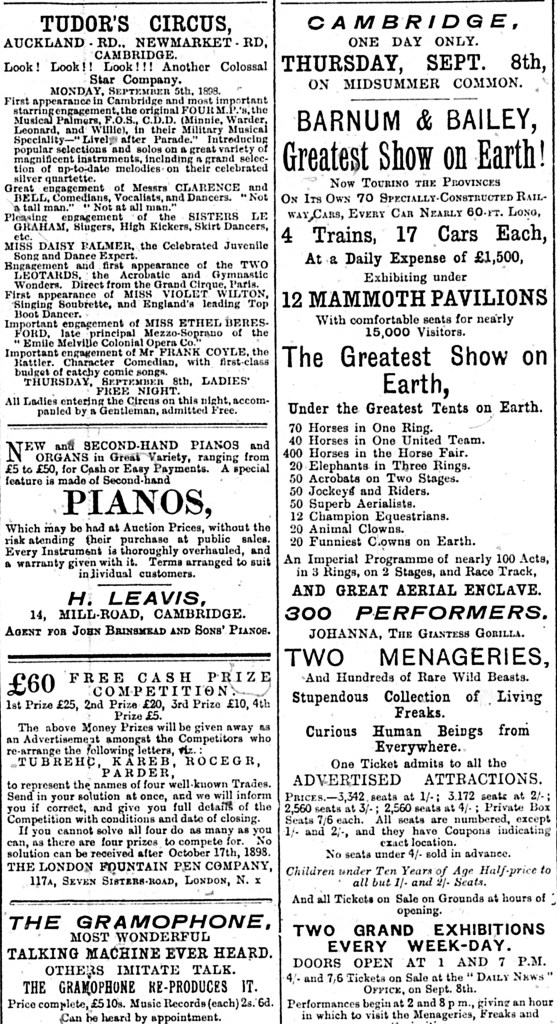
CDN, 5 September 1898, p 1
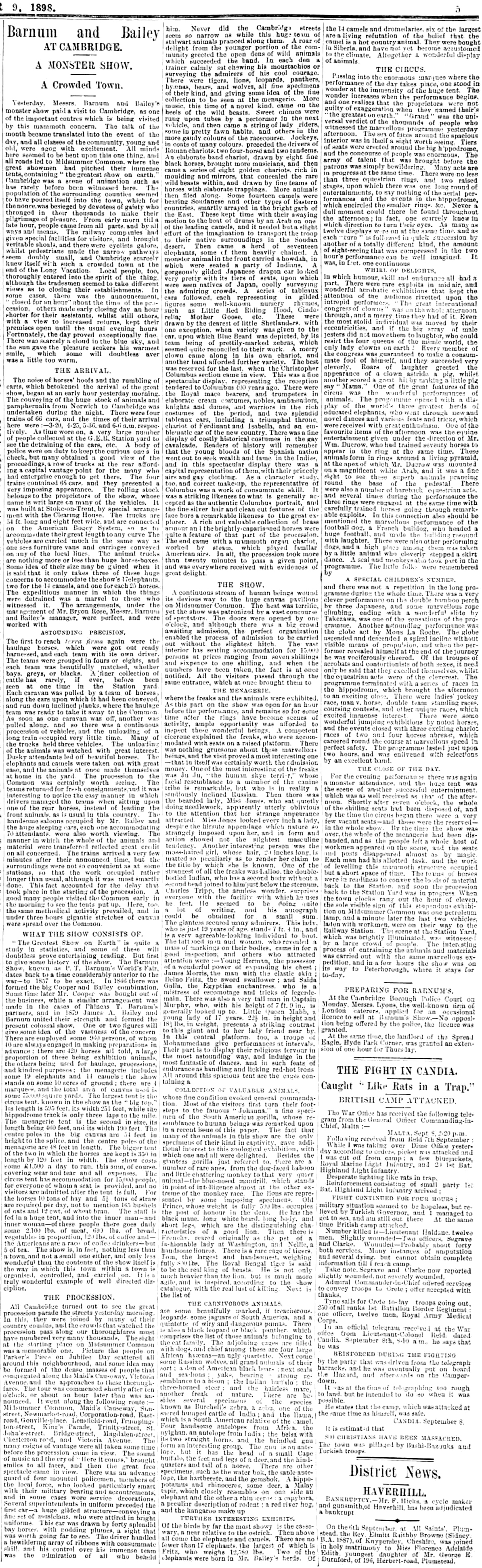
The four specially-built railway trains carrying the circus began arriving at Cambridge Station from Norwich at 3.20 in the morning. According to the Cambridge Independent Press, 960 people, 420 horses, vehicles, carriages, coaches, tents, furniture, equipment, with 19 elephants, 12 camels and a huge menagerie of other animals were offloaded and installed in only two hours on a ten-acre site on Midsummer Common. The big top with its three rings could seat 15,000 people. Then a great procession wound along the city streets, crossed Magdalene Bridge, went along Chesterton Road and returned to the common by Victoria Avenue. Thousands of people had come from neighbouring towns and villages to see this free spectacle, which took nearly half an hour to pass.
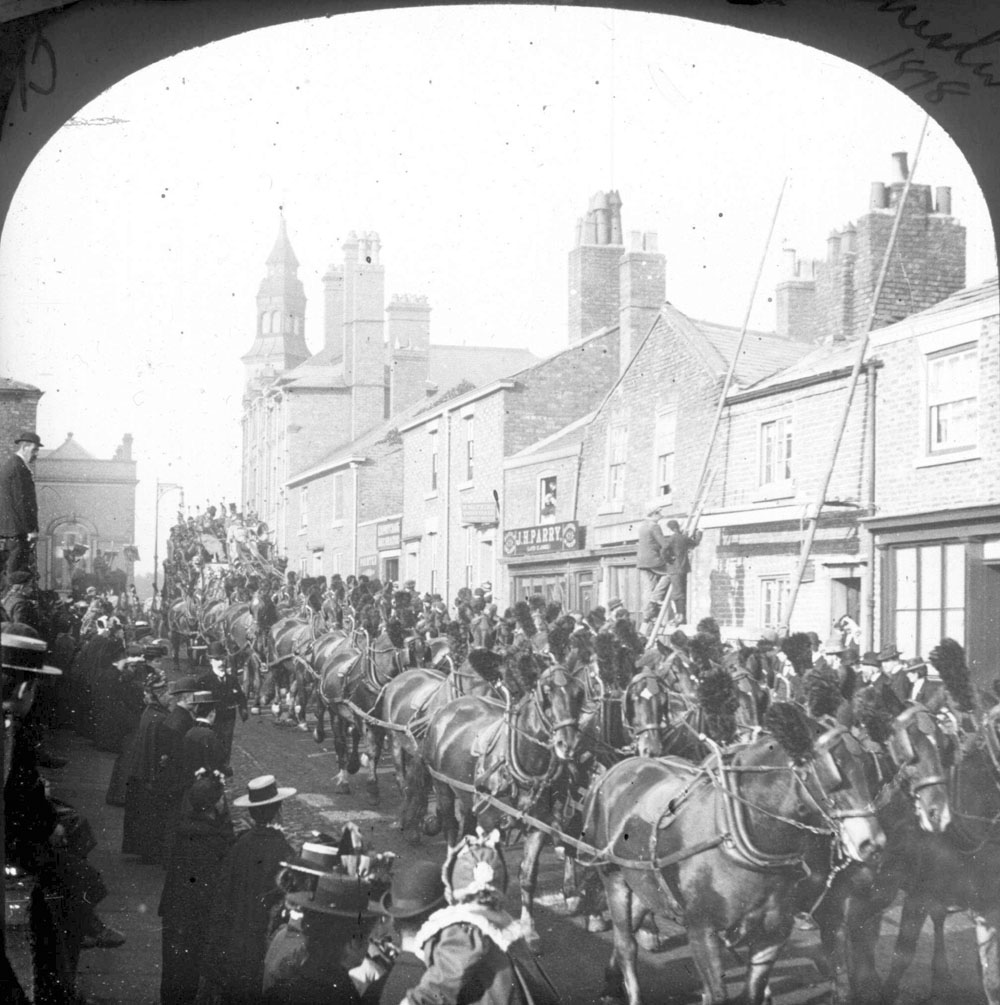
Barnum & Bailey’s Greatest Show on Earth paraded through Chester a few weeks after visiting Cambridge
Back at the Common there were two performances as well as the menagerie of wild animals and the ‘freak show’. Four lady clowns performed and the drawing in the advert almost certainly depicts Evetta, who performed at Tudor’s Cambridge circus in 1893, though she is not named. At the end of the day the whole show was packed up and returned to the station for the next performance in Peterborough, and by 11 pm the Common was empty again. For a full and fascinating description of this extraordinary event see the article from page 5 of the Cambridge Independent Press of 9 September 1898 by clicking here.
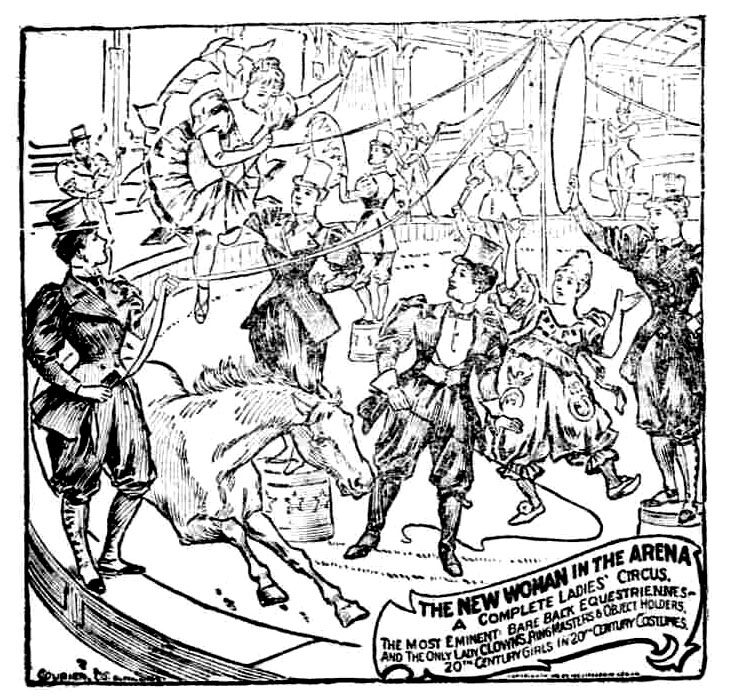
Evetta the Lady Clown (right, in conical hat) is shown in this detail from an advertisement from the Cambridge Independent Press, 2 September 1898, p 4, although she is not named.
So the competition from Barnum & Bailey had passed, but looming on the horizon was the New Theatre’s winter season, though a play about Oliver Cromwell may not have appealed to the regular circus audience. The next week’s programme included Mdlle Adelina, impersonator of celebrities and politicians of both sexes, Hal Croueste, actor, singer and comedian, who often appeared on the same bill as Flora Gaunt, burlesque singer and actress. For variety there was Fred Verne, the Irish comedian, acrobats The Andys and the Valdo knockabout instrumentalists. There was a benefit night for those two hard-working horse-riders Fred Derrick and Becky Daniels. Another equestrian, Billy the horse-riding goat, showed Mr Tudor’s skills as a trainer according to the Cambridge Express. As the following week our old friend Peter the Riding Goat was advertised, and performed ‘right stoically’ (CDN, 20 September 1898, p 2), we can assume Billy was in fact Peter, unless Tudor had two horse-riding goats!
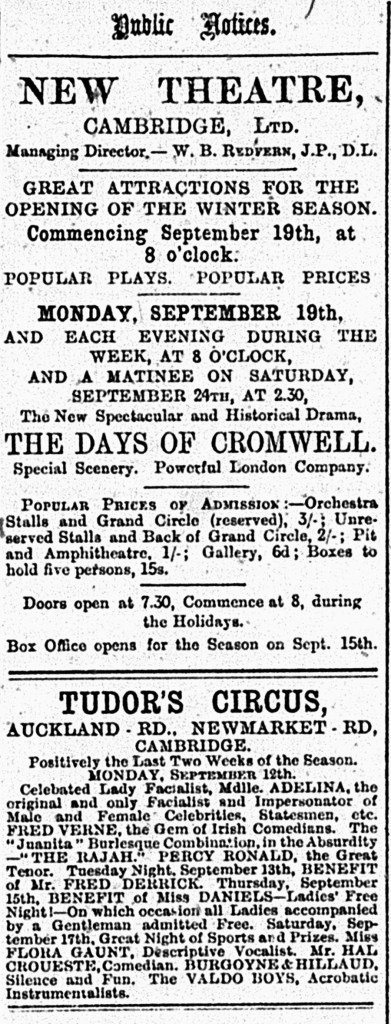
CDN, 12 September 1898, p 1
As the circus entered the last weeks of the season it put on ‘A right good programme’ and the finale, as usual, was the re-enactment of the hippodrama Dick Turpin’s Ride to York with Mr Tudor as Dick Turpin and Harry Baring as Tom King, with the highwayman’s dramatic ride ‘cleverly adapted to the exigences of the ring’ (CE, 24 September 1898, p 8). There were benefits this week both for Tudor and ringmaster Mr Harry Baring.
But first there was impersonator Mr J H Woodhouse, Nimble Nip, one of Tudor’s regular clowns, returned and Alice Fontainbleau was back after five years with her horse and her performing dogs and, we hope, her twinkly boots. And we meet her once more in Cambridge in 1900. Fred Coombes sang the songs Cabby knows his fare and The road to Kimberley to enthusiastic applause and encores, and Becky Daniels’ and Fred Derrick’s horse-riding feats were as impressive and popular as ever, as Derrick ‘leaping from the ground as the horse goes at top speed, he at once stands up on one foot on the horse’s back and goes round and round’ (CDN, 20 September 1898, p 2).
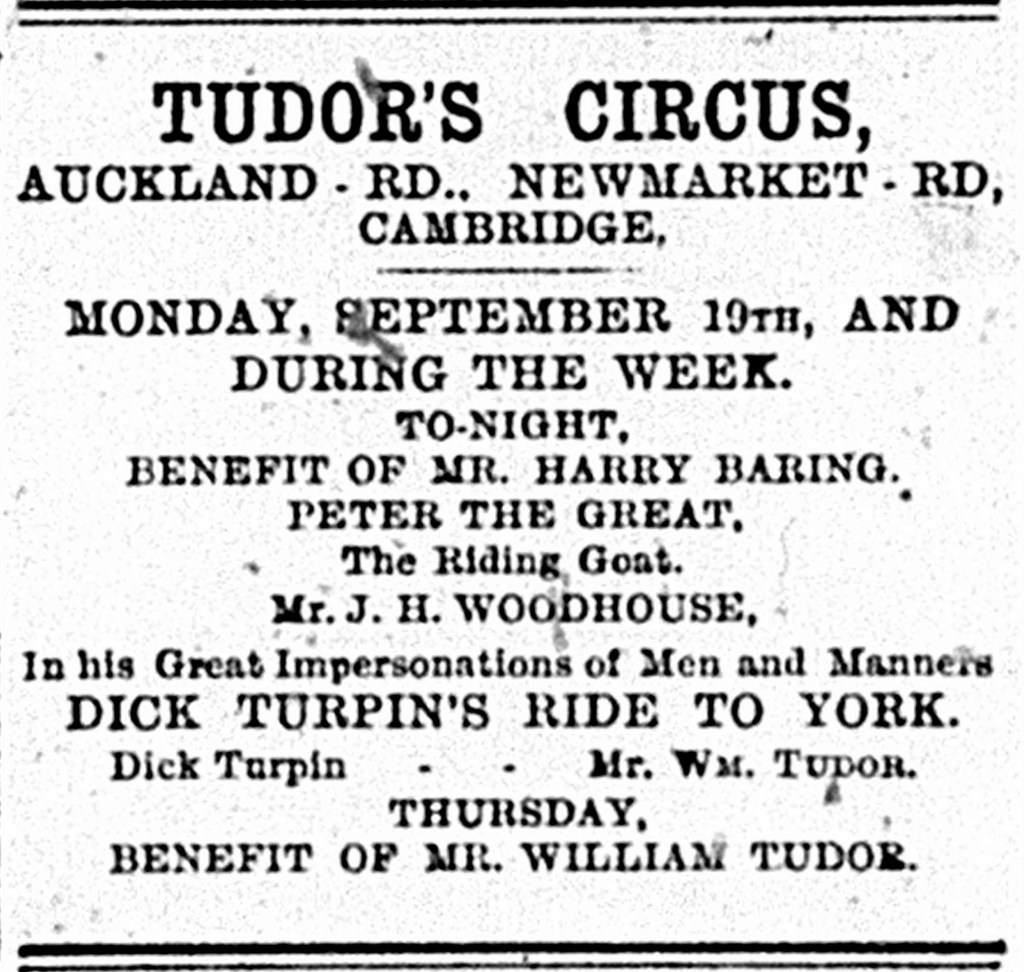
CDN, 20 September 1898, p 1: Black Bess’s hooves would pound the Great North Road yet again
The final CDN review says ‘Seldom have we enjoyed Tudor’s Circus as much as last night. The programme was full of good things and the circus building a perfect storehouse of laughter’ (CDN, 20 September 1898, p 2). The Cambridge Express on 24 September, the final day, announces a night of sports and reports that Mr Tudor will shortly re-open his Auckland Road place of amusement as a music hall. The application for the music and dancing licence earlier points to this development. But never fear, there was one more year of the circus in the Auckland Road building yet to come (CE, 24 September 1898, p 8).
On the following Monday Tudor’s Circus was open in Ipswich (running until 4 March 1899) with Fred Derrick and Miss Daniels galloping away without a break. Macclesfield had already re-opened, on 29 August. There was no peace for the busy circus owner who may well have been glad to leave the scene of brother Fred’s death.
Go to next section: 1899: Amusement for all and all were amused
 William Tudor's Circus