A Springtime Treat
William Tudor and his company must have been pleased to return to their new circus building in Auckland Road, instead of having to erect a temporary building on Midsummer Common.
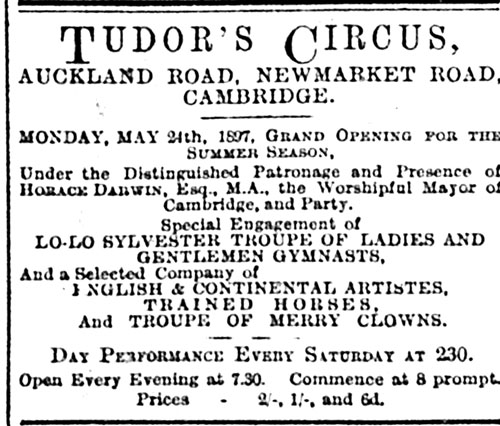
CDN, 21 May 1897, p 1
The second season at the New Circus opened on Tuesday 25 May in the presence of Mayor Horace Darwin who arrived a little late. (He was probably dealing with important council business or running the Cambridge Scientific Instrument Company, which he had founded in 1881.) He was nevertheless greeted by the band playing God Save the Queen and the assembled audience standing, interrupting the equestrian skills of Mademoiselle Caroline.
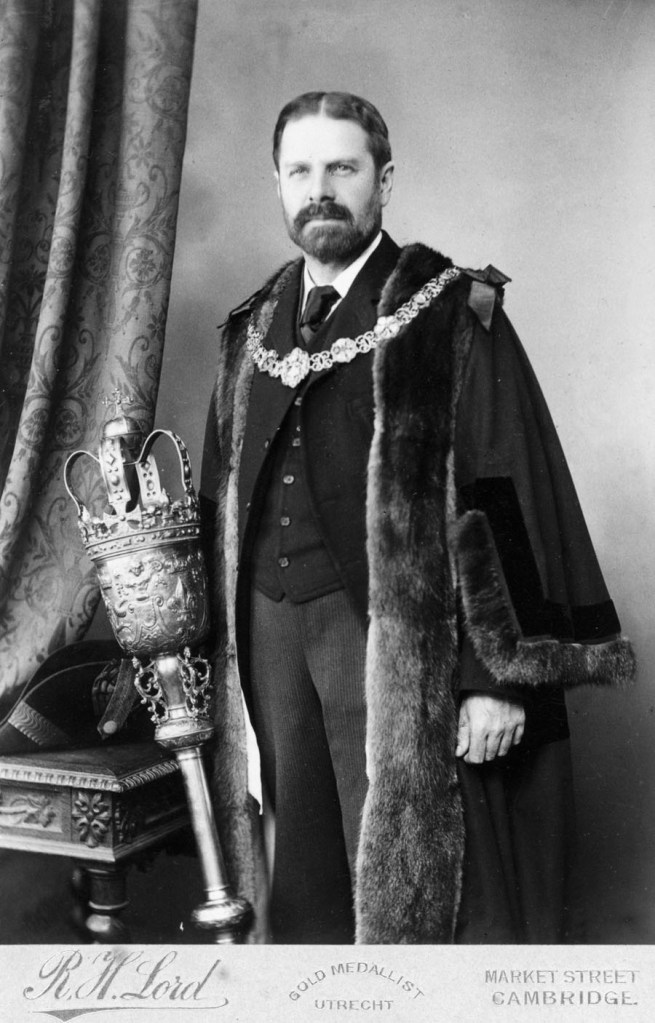
Horace Darwin, son of Charles Darwin, Mayor of Cambridge, 1896-1897 (Cambridgeshire Collection, Cambridge Central Library)
The band conductor was John Cronin and Mr Albino returned as usual as ringmaster. Since horses were the staple of the circus there were two other equestriennes, the returning Virginie Coralie Newsome, with her horses Duchess and Mornington, and Miss Rebecca Daniels. Rebecca had been trained by Tudor, first appearing in her bareback rider act in Blyth [Blyth hyperlink] in 1894 when she was just 14, and was one of his regular company, performing at Cambridge every year from 1895 to 1899.
So the circus was off to a lively start and the turn that received the most applause was Douglas and Douglas the intrepid feet equilibrists. The Brothers Leonard were ‘bewildering in their rapidity’ on the horizontal bar, the Lo-Lo Sylvester Troupe were on trapeze and there was ‘musical melange’ from Harland and Rollinson. The clowns were Armstrong the Fool, Funny Walker and Pete Simple whose role was to be ‘a general nuisance and perpetual torment to all the other members of the staff’ (CE, 29 May 1897, p 5).
The following week the daring, bareback lady-riders returned and the animal theme was expanded by The Brothers Leonard’s performing donkey Albert, though the CDN reviewer was not fooled.
The Bros. Leonard, who last week won great praise for their feats on the horizontal bar, this week appear as eccentric clowns, with their performing donkey. The latter animal causes a dreadful suspicion to occur to the mind of the spectator, for shortly before its introduction to the expectant circle of on-lookers, one of the brothers leaves the ring and never enters again, at least, in the garb of the human species. Albert the donkey makes his appearance, after some enticement from the brother Leonard, and after displaying his various accomplishments is finally carried out on the shoulders of his confrere, if so he be. CDN, 1 June 1897, p 3.
Jocko and Jinnie, two performing monkeys, showed themselves to be two of the Four Grovinis, tumblers and acrobats. The humans Alvantee, on the highwire and Titan, strongman, completed the bill. A week later the animal impersonations continued with a performance by the clowns which may have reflected Tudor’s attitude to wild animals in the ring.
An item which creates much amusement among the juveniles is the introduction by Funny Walker of a cage of forest-bred lions in the shape of four members of staff. Walker having secured his unwilling human lions in a cage, well leathers them, and having all the ammunition, ‘corners’ each one. The other side of the picture is seen when Walker in a venturesome spirit enters the cage and is in turn subjected to similar treatment.
CCJ, 4 June 1897, p 4.
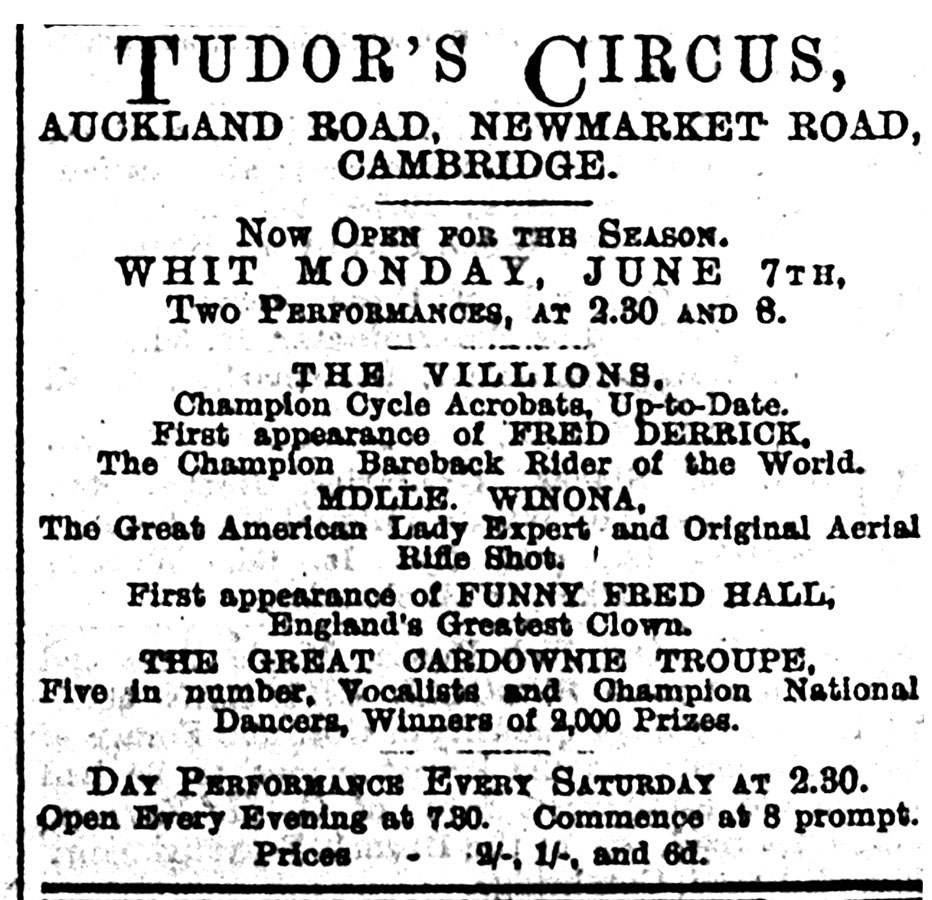
CDN, 5 June 1897, p 1
The advertisement for the Whit Monday week included the first appearance of two people who played a big part in Tudor’s circus – Funny Fred Hall, England’s greatest clown, and rider Fred Derrick.
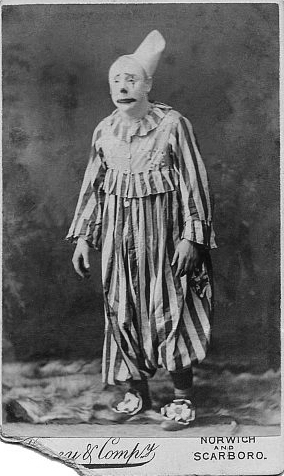
Funny Fred Hall’s carte de visite, photo by
Taney & Company, found online here
Fred was William Tudor’s brother. ‘Fred Hall is gifted with an extraordinary expression of countenance, and with droll remarks keeps the house in a continuous state of uproar’ (CDN 8 June 1897, p 2). He had often worked with William before and did so throughout this season, appearing again in 1898 when, it is our melancholy duty to relate, he died. There’s more about Fred here.
On 1 June we also see the first appearance of Mr Fred Derrick whose spectacular horsemanship was to delight audiences over the next three seasons, as he leapt on and off his galloping horse. Soon he was giving ‘a running jump over his fleet steed’ (CE, 26 June 1897, p 8). In following weeks he was to balance on the rolling globe and also to give feats of juggling. A week later he was juggling while on horseback. Such a multi-talented performer was invaluable to Tudor and it was no surprise that he was a member of the stock company for so many years. He was not above dressing as a wild man, and as an Indian chieftain, and performing a humorous act with the clowns. In the early 20th century he was to tour with Barnum & Bailey in America, achieving great success and performing with Ella Bradna, equestrienne. He eventually returned to the UK, dying in 1955.
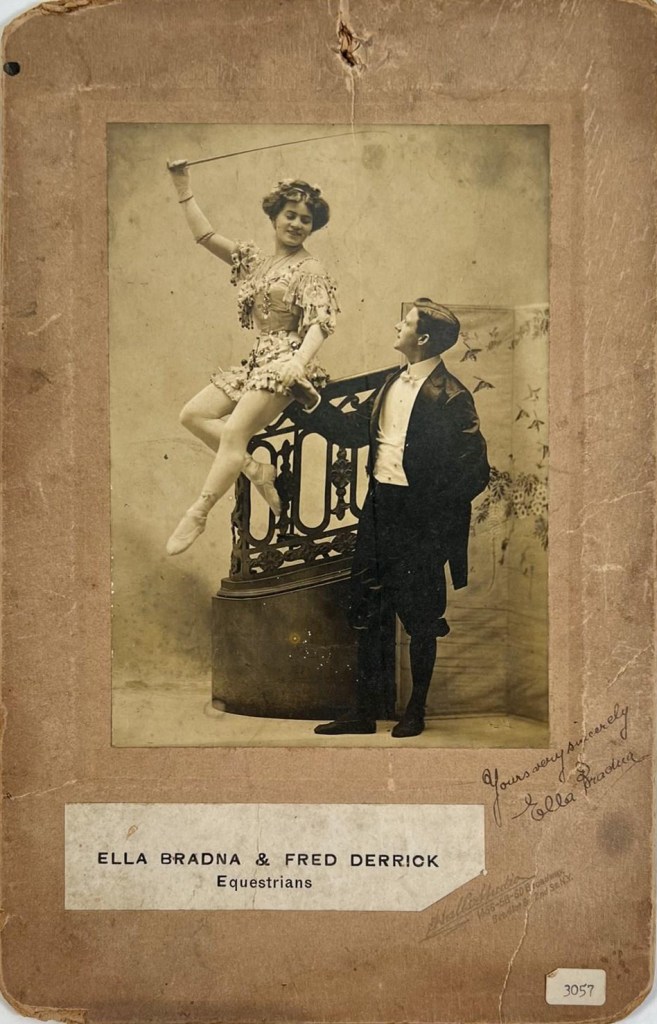
Ella Bradna and Fred Derrick, picture sourced here
Not to be outdone, Mademoiselle Caroline appeared as Joan of Arc, changing her costume on horseback at full speed.
The dashing equestrienne appears as Joan of Arc, and in this character is certainly seen at her best. First of all as the country shepherdess with crook and peasant’s dress; then as the maiden warrior, with shield, sword and coat of mail, while, by a slight anachronism, the orchestra plays the stirring strains of the Marseillaise, and, last of all, as the doomed fanatic with dishevelled hair and manacles, riding to the stake CDN, 8 June 1897, p 2
The shooting performance of American rifle shot, Miss Winona, had the audience holding its breath so let us hope the cycling Villions and the Cardownie Troupe of Vocalists and Dancers with their highland reels, and sailors’ hornpipes, let them recover from all the equine excitement.
On 15 June the audience were impressed by the variety of the programme which included a comic ballet, the Valoise Brothers on concertinas, the Leopold Leglere Acrobats and Mazzawattee, in a Japanese costume, who juggled expertly (but disappointed the CDN by not selling tea). The Canadian Troupe of comic and scientific roller-skaters were just as entertaining, especially the skater who dressed in a policeman’s costume ‘inflated to bursting point. His many tumbles and his bounciness when on the ground do not fail to convulse the spectators’ (CDN, 15 June 1897, p 4).
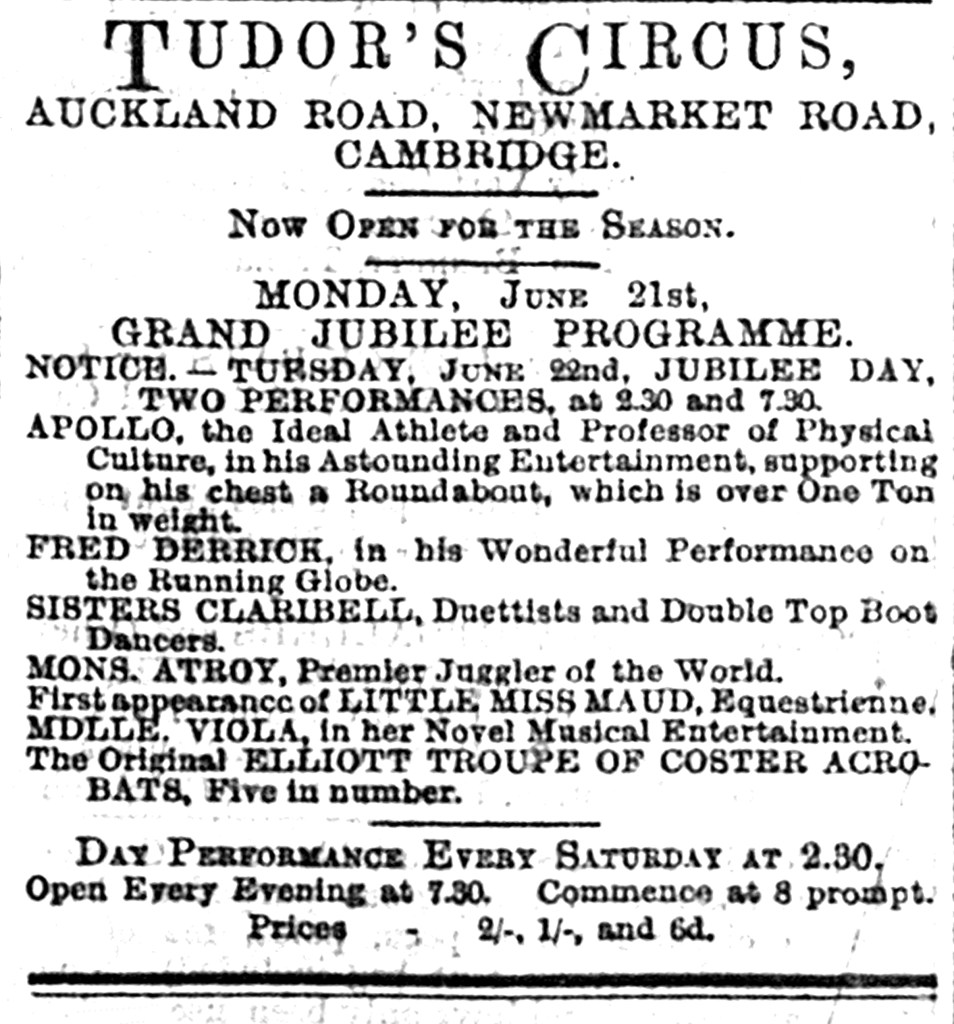
CDN, 19 June 1897, p 2
Queen Victoria’s Diamond Jubilee fell on 22 June. No paper was published on that Tuesday when circus reviews usually appeared and the Wednesday issue was full of the town’s celebrations so that there was little mention of the circus’s own Grand Jubilee programme. The crowded streets of the city were decorated and illuminated, there were fireworks, the release of 1,000 pigeons, a cyclists’ fancy dress parade, a procession of decorated floats, lunches, dinners, concerts and speeches. On Midsummer Common there was a sports competition and a water carnival between Jesus Lock and Victoria Bridge.
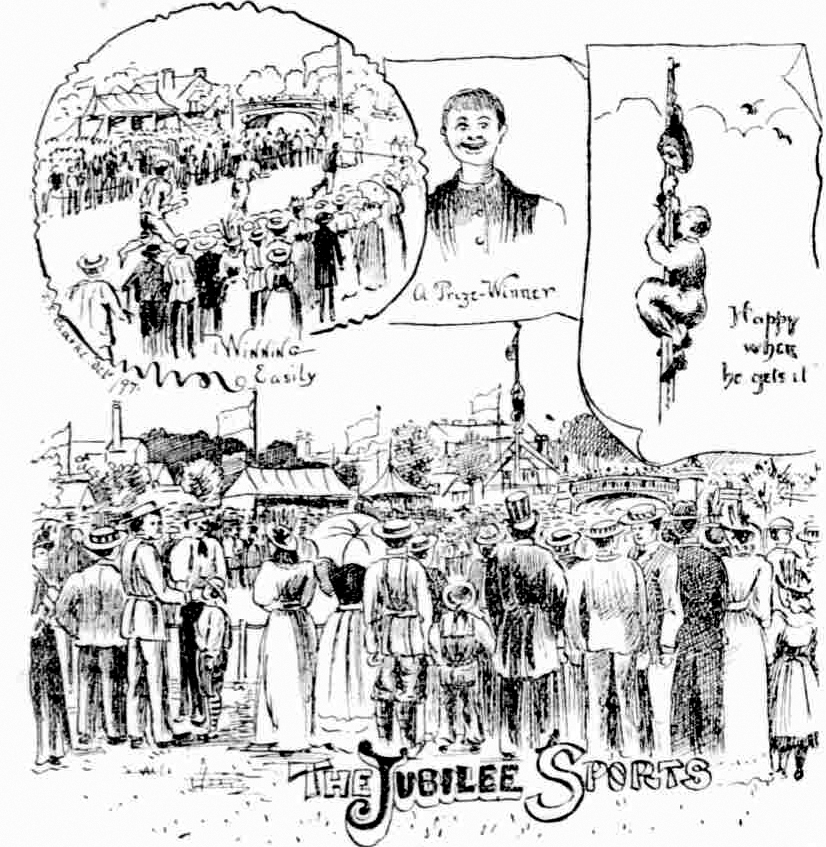
CDN, 23 June 1897, p 3
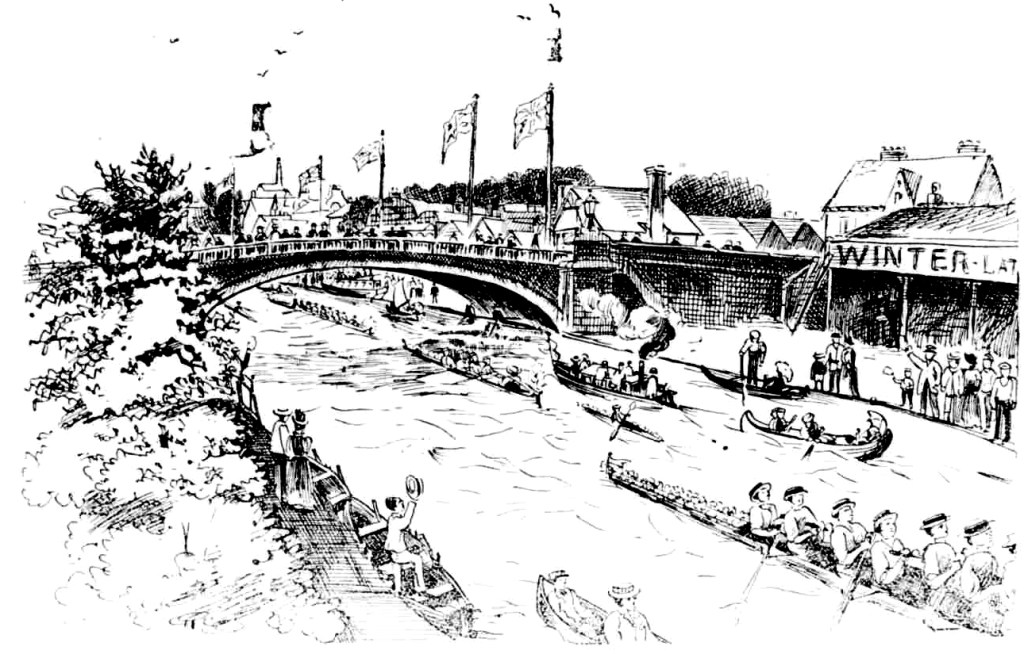
CDN, 23 June 1897, p 2. Jubilee Water Carnival on the Cam.
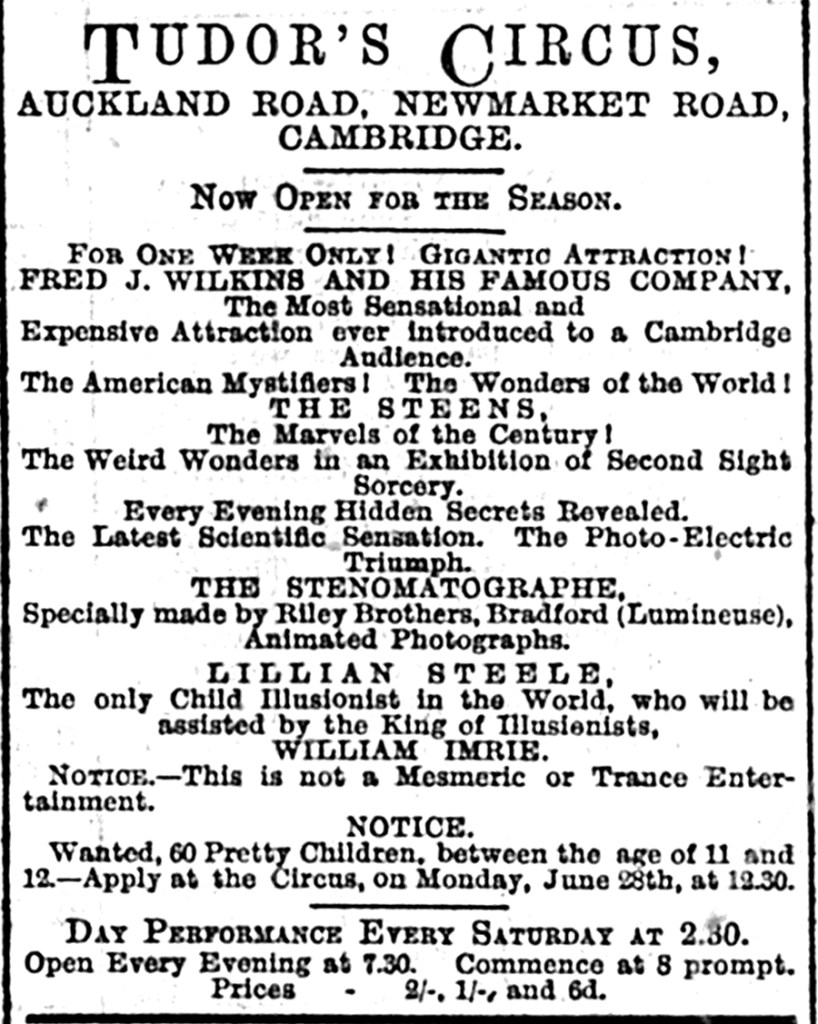
Unsurprisingly, there were smaller audiences at the circus and a reduced Midsummer Fair, but the circus programme was still ‘first class’ with Atroy the juggler, a Tudor regular, Apollo the strongman, rider Little Miss Maude, who was to stay for the season and the Elliott Troupe of acrobats (CE, 26 June 1897, p 8). But next week’s programme promised The Steens, the marvels of the century.
CDN, 25 June 1897, p 2
Almost the entire review was taken up with their performance, as the blindfolded ‘mystifier’ Mrs Steen guessed, correctly, questions from the audience and Mr Steen showed animated pictures through the Stenomatographe (CDN, 29 June 1897, p 2).
For the following two weeks the 60 pretty children requested in the advertisement above, appeared in a spectacle Bonnie Scotland.
A hundred children have been drilled by the Selkirk family with great perfectness, and go through many military evolutions with great precision and soldierly carriage. Choruses of patriotic Scotch songs are sung in unison with great gusto, and after marches, counter marches, songs, and dances of a very agreeable kind, the performance closed by a grand sham fight, in which cannon was used’ (CIP, 9 July 1897, p 8).
It was an event likely to guarantee an audience of admiring local parents who came and loudly applauded. The Pool Pelhams were back as was Kingsley with his handbell but the CDN reviewer was more impressed by Mr Duvalo, the Human Snake.

CDN, 13 July 1897, p 2
While a tented, touring circus could retain the same company, a permanent circus would have to ring the changes, with new performers every week or two. William Tudor’s skill was to keep the people of Cambridge happily entertained each week, as the CDN shows.
The popular little circus in Auckland Road has lost none of its wonted attractiveness, nor has Mr Tudor lost that happy knack, so necessary to all caterers for the public amusement, of never allowing his performances to drag from start to finish, or his audiences to suffer one twinge of ennui from the time they have taken their seats round his circus ring until their departure.
CDN, 20 July 1897, p 2.
And then there was the problem of illness or injury and sadly the Sisters Niagara did not appear due to the ‘sudden indisposition’ of one of the ‘happy tribe of mermaids’ (CDN, 20 July 1897, p 2). The Niagaras, Lolla and Thérèse, would have performed in a crystal tank of water. Lolla had already been to Auckland Road in 1896 with Oscar Dubourg, the Man-fish.
But the audience were compensated by Mr Harry Carsdale, accomplished farmyard mimic, whose imitations of ‘pigs, cocks, and hens, a cow and calf of conversational habits, cats on their nightly occupations on the rooftops and a somewhat ill-natured dog which appeared to reject his friendly advances . . . fairly brought down the house’ (CDN, 20 July 1897, p 2). The Cambridge Express agreed he was ‘the most accomplished artist in his line of business’ (CE, 24 July 1897, p 8).
The next week the Steens were back with the Stenomatographe, an animated cinematographe, which depicted the Jubilee Procession and the Ottoman-Greek War of 1897 with ‘the storming of a stronghold and the blowing down of a door by the Turks having a most realistic effect’ (CDN, 27 July 1897, p 3). People were now able to see the these ‘moving photographs’ of contemporary historic events, making the circus more than just entertainment.
The reputation of the circus was increasing. The Cambridge Express gave a long review for ‘Beyond any doubt, the best Company seen in a Circus in Cambridge in many years’ (CE, 31 July 1897, p 8). Kate King demonstrated Tyrolean yodelling and Apollo the Strongman acted his name by balancing a board on his chest and knees, on which stood Dan Leeson clog-dancing and seven band members playing the music.
August: a lady boxer and a mind-reading dog
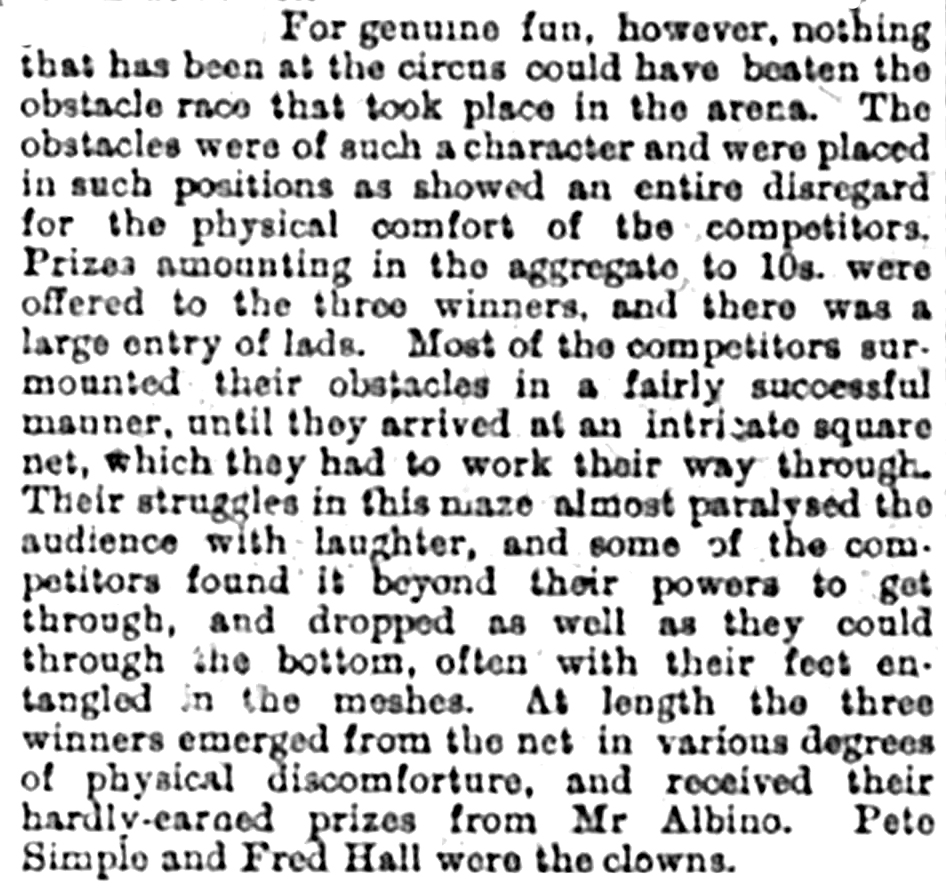
On 2 August the ‘popular little circus’ was packed and the CDN reviewer, arriving a little late, had to stand. In readiness for the holiday season the programme was completely changed, with singers, contortionists, performers on trapeze and on tight-rope, club-swinging and clog dancing, nearly all new to Cambridge. The audience much appreciated Mr Raymond, the champion one-legged dancer who performed very cleverly both with and without a crutch but it was the finale of the public obstacle race (prize 10 shillings between the three winners) that was to cause the audience the most amusement
CDN, 2 August, 1897, p 2
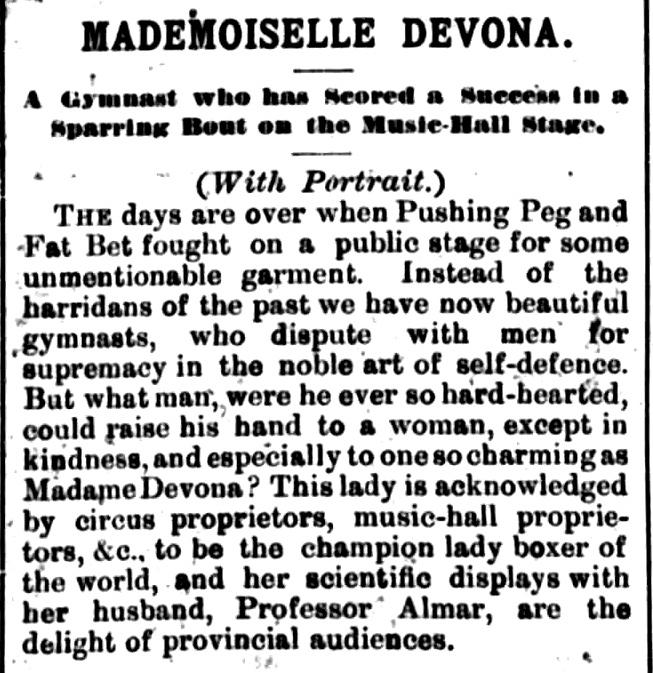
Another change of programme brought singer, dancer and comedienne Pansy Forrist, and also on the bill her mother the singer Maud Danvil. More bizarre turns were contortionist Gorge Rowe, the Silver Eel, from the Hippodrome, Paris, ‘gliding about in serpent-like fashion’ (CDN, 10 August 1897, p 3), who managed to sit upon his head several times, and Mademoiselle Devona and her husband Professor Almar, who fenced, single-sticked and boxed together, the professor completing the event by boxing with a game-cock. The Professor continued his martial act but by 1905 had changed to working with performing dogs.
Boxing World and Mirror of Life, 26 January 1895, p. 3
The somersaulting Dagmars were back after two years and Funny Fred Hall ‘provoked much laughter’ (CDN, 10 August 1897, p 3), which was as well as benefit nights for Pete Simple, Funny Fred and Fred Derrick were coming up.
But for the CIP reviewer the best shows were contests for audience members with some unusual prizes. The winner of a sack race was given three fowls, hurdle race prizes were a silver medal and a new hat. The oldest gentleman, aged 80, was given a bottle of whiskey and the oldest lady, aged 76, had a bottle of port.
Several lads entered the competition for standing on their heads, the one that stayed the longest to receive a purse of silver. One by one they dropped out until but two were left. These stayed up for five minutes 20 seconds, when they were told to give up. Peter Simple settled matters by giving a second prize. Mr Albino said he thought it was a record feat, for he had never heard of anyone staying on their head for so long a time.
CIP, 13 August 1897, p 8.
CDN, 13 August 1897, p 1
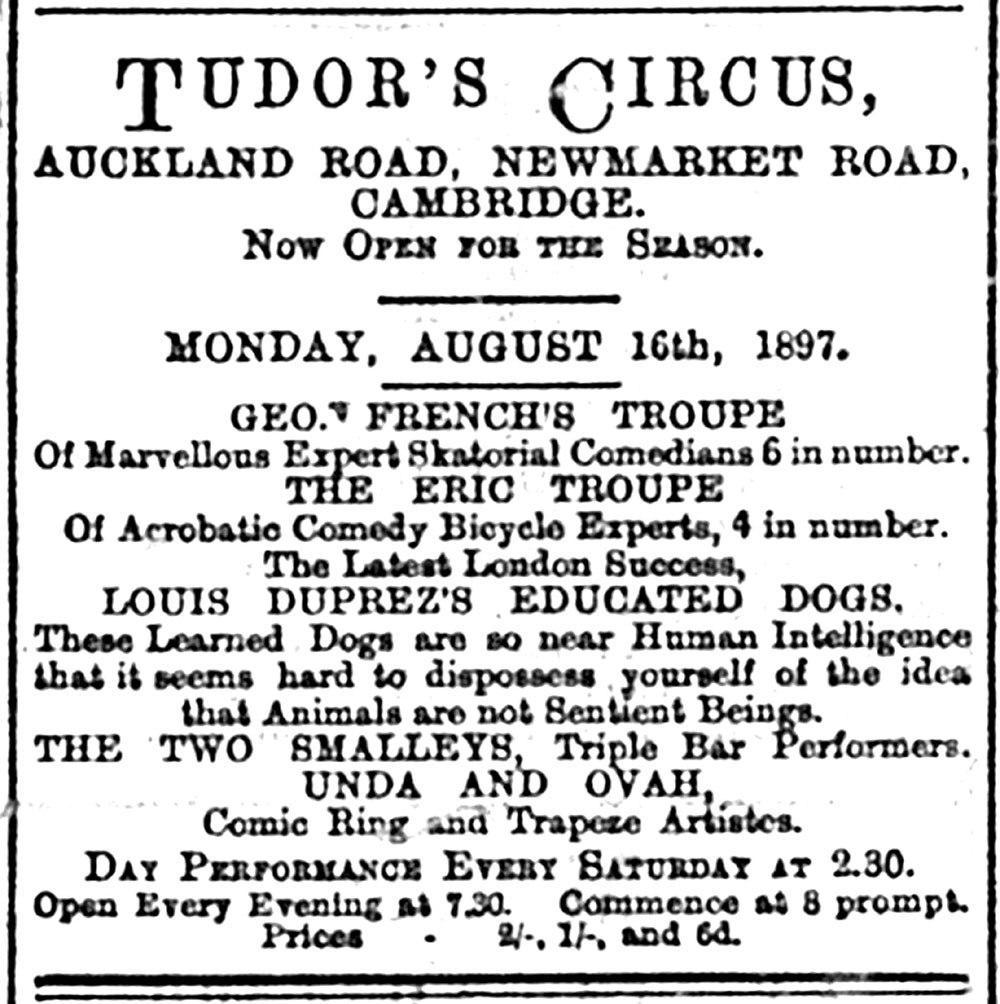
By mid-August bigger crowds than usual came to the circus to laugh at comic trapeze artists, comic skaters and comic cyclists. Fred Derrick’s riding skills had developed as he and fellow-equestrian Hugo Jackaway, performed the Rival Jockeys routine, copying the other’s daring bareback feats, including jumping on horseback at full gallop. And the educated dogs of Louis Duprez impressed the audience with their literacy:
These dogs, he says, are not trained; they are educated, and can read, write, tell the time of day, and play cards. All this they did and more on Monday night, and ‘Colonel’ easily won his round at nap with a gentleman ‘outsider’. The dogs even dabble in second sight, and numbers picked out by members of the audience are soon named by ‘Colonel,’ who appears to be the head of the intelligent family.
CDN, 17 August 1897, p 3.
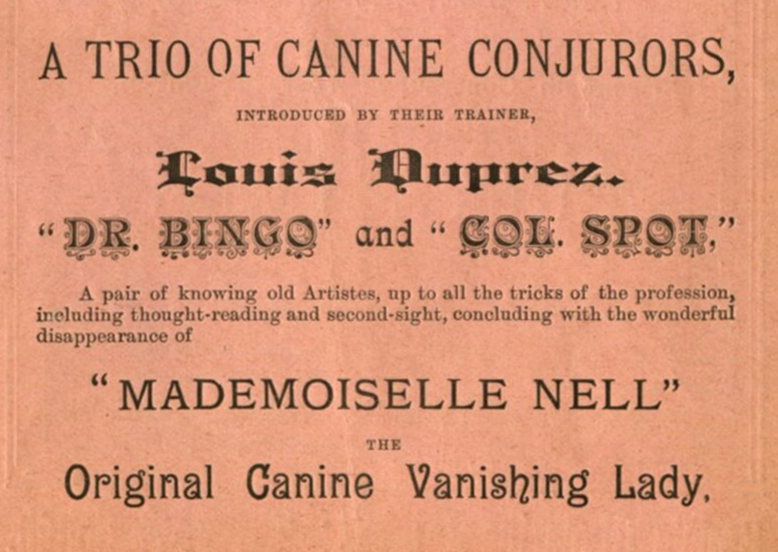
From a Maskelyne and Cooke’s programme of 1892 (The Davenport Collection)
Duprez was also known for the care he took of his canine family.
It had been a warm and sunny August in Cambridge and if those, including the CDN reviewer, ‘who have not fled to the seaside to revive their drooping spirits are wondering how to relieve the monotony of the already ominously lengthening evenings, Mr Tudor should experience little difficulty in attracting large audiences to his circus’ (CDN, 24 August 1897, p 3).
And reviving their spirits were the returning Zalva Trio on the high-wire, Pongo the man-monkey on his rope, and new acts the comic and musical Watson family and two Irish singers and dancers. ‘Mr Fred Derrick, that versatile gentleman, who gives a new turn – or rather usually two – every week, appeared in his wonderful performance on the rolling globe’ (CDN, 24 August 1897, p 3). The finale of the programme was a comic sketch, The Country Barber, staged by the whole company which caused ‘roars of laughter’ (CE, 28 August 1897, p 8). And the mayor, Horace Darwin was back, with Mrs Darwin and party, as patron of a Grand Fashionable Night on the 27th, the complimentary benefit of Mr Albino.
September: Miss Daniels has a fall and a theft is forestalled
The ringmaster, Mr Albino, was as much a mainstay of the circus as William Tudor and his popularity drew the biggest crowd yet on his benefit night. (CEX, 4 September 1897, p 4). The faithful CDN reviewer had made several references already to those who had enjoyed the glorious weather on holiday or by the seaside. Perhaps there was less news than usual, and left behind in the city, his reviews grew longer and more creative, written with such style and humour that it is worth reproducing this one in full.
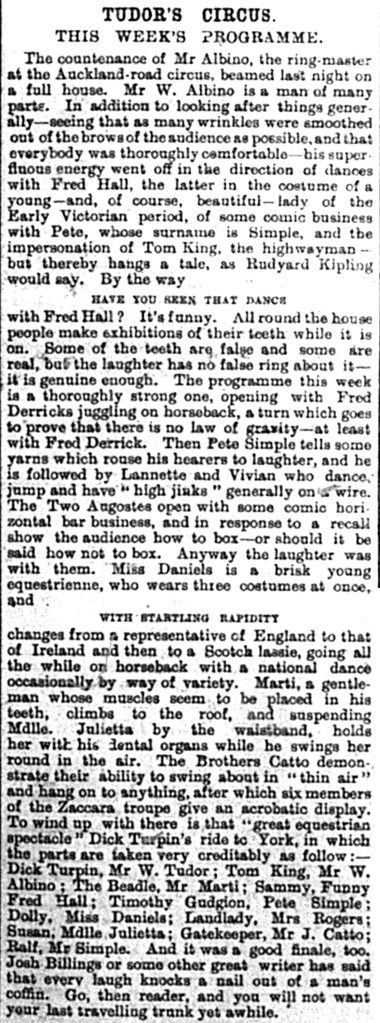
CDN, 31 August 1897, p 2
The favourite hippodrama Dick Turpin returned and once more it signalled the end of the season was approaching. The balancing Four Faues were back again, as was Patta Bella, burlesque actress. Victorian burlesque was a comic pastiche of popular songs and opera music, involving acting skits, dance and music.
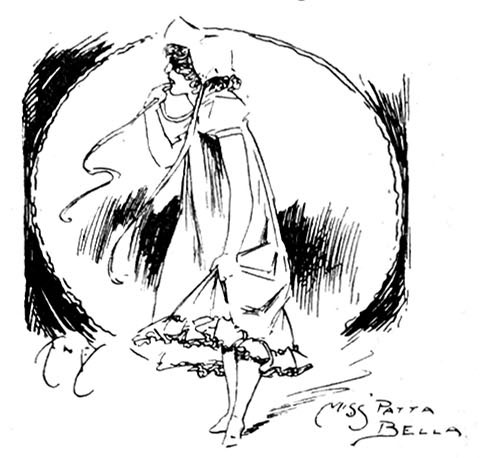
CG, 6 October 1900, p 11 (Artist: Talbot Ellison)
New to Cambridge were Mons. and Mdlle Brown, one-legged champion dancers. ‘Not only can it be called a novel performance, but a remarkable and exceedingly clever one’ (CE, 11 September 1897, p 8). Mr and Mrs Brown:
only possess TWO LEGS BETWEEN THEM, the gentleman being minus the right and the lady lacking her left. For all this they dance and jump with more ability than most of us who have the full complement of nether members. Mons. Brown jumps a height of four feet with ease, then jumps over the backs of six chairs in succession. The one-legged champions were received with loud applause on the first night of the week, and were recalled several times.
CDN, 7 September 1897, p 2.
A packed benefit night on the Tuesday was held for Miss Daniels who had gamely ridden throughout the season and she was presented with a silver watch and three bouquets. The following week in Cambridge she nearly came a cropper.
During Monday evening’s performance, in which this artiste had to jump over some broad ribands, she caught her foot in one and fell, spraining her ankle, but after a short rest she again made an attempt, and finished her turn amidst much applause
(CE, 18 September 1897, p 8).
Rebecca, or Becky, was to perform in Cambridge again in 1897 and 1898 and was with Tudor’s circus in 1902. She was to marry the juggler and equilibrist Eugene Gaertner in 1903 and travel with him to America. We glimpse her in Oneonta, New York State in May 1907, Ottawa, Canada, in June 1907, and then in Burlington, Vermont, USA, with Forepaugh and Sells Brothers’ circus where she is described as ‘the celebrated English beauty, who, by her equestrian skill, has won the foremost place in the ranks of the women riders of the world’ (Burlington Free Press, 31 July 1907, p 7).
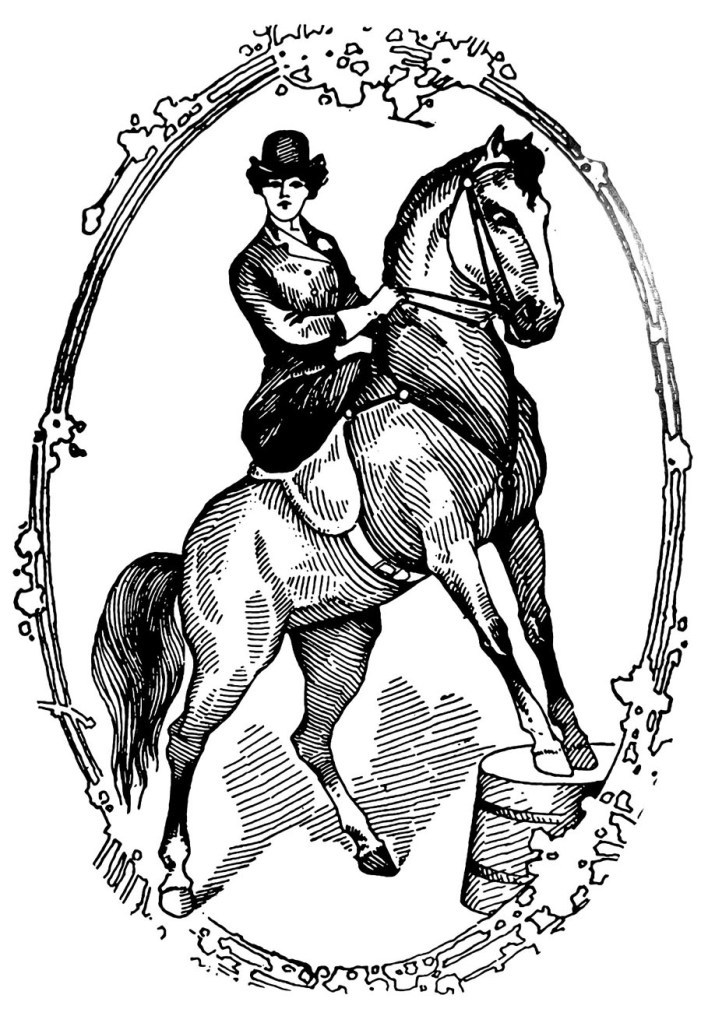
Unnamed equestrienne (Turner, 1995)
Back in Cambridge, a benefit night for Mr Tudor, with Mr Albert Scales as ringmaster, was on Friday 10th and the circus was so full there was barely standing room. And then the last week of the season arrived, ‘a matter of regret to many’ (CDN, 14 September 1897, p 3), while the Cambridge Express noted that though Mr Tudor’s stay sadly was drawing to a close, ‘the enthusiasm which prevails at each performance does not in the least diminish’ (CE, 11 September 1897, p 8).
There was a new bareback rider, trained by Tudor. He was a ‘knowing-looking goat’ (Ipswich Evening Star, 27 September 1897, p 2), a native of Cambridge, ‘who has managed to stick to the leather as well as a man’ (CE, 11 September 1897, p 8). We think this must have been the first appearance of that caprine equestrian Peter the Great, a stalwart of Tudor’s stable.
The Two Daniels, self-described negro musicians and dancers, performed on bones and banjo. While the elder Mr Daniels played solo bones and then banjo, the younger danced with machine-like precision and ease.
Indeed the young man has a facility for keeping going when he has once started, a facility which proves too much for the strings of his friend’s banjo, or it did so on Monday evening, when the strings declined the contest. But with music or without the dancer continued unconcerned the regular clatter of his dance, so that one began to conjecture whether he kept time to the accompaniment or the accompaniment kept time with him. His ceaseless activity drew forth much applause from the audience, who evidently greatly enjoyed the performance (CDN, 14 September 1897, p 3).
Blitz manipulated 15 spinning plates at once, while the Japanese Bale Korosko trio of jugglers (the two women were probably Louisa and Susannah Bale of the Bale juggling family) ‘did some very neat work with trained pigeons, balls, rings, knives and lighted torches’ (CE, 18 September 1897, p 8). Another troupe of performing dogs dressed in all kinds of comical costumes performed to the concertina of musical mimic Didie Godfrey. The audience roared with laughter but were they as impressed as they had been by Louis Duprez’s educated, mind-reading dog Colonel Spot?
The Thursday night promised contests and on the last Saturday afternoon show every child who came would be given a toy, and in the evening Mr Tudor would give away one hundred presents to the final show-goers. Saturday 25th saw the last two shows, the building was closed, and the circus was off to its Ipswich opening on September 27th.
Postscript
But that was not quite the end of the story. Shortly after it closed there was a break-in at the circus.
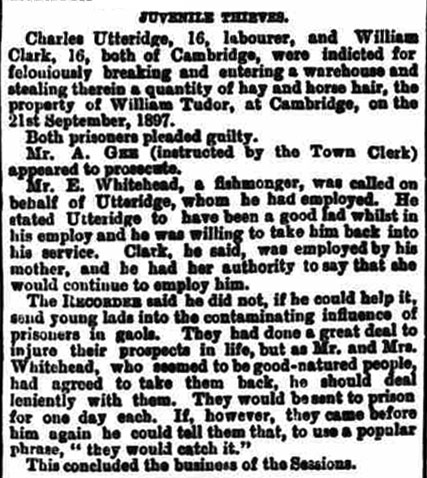
We have found no evidence that the buildings were used for other purposes in the absence of the circus, other than a store, in this instance, for some hay. The CDN for 23rd September 1897 reported that five Cambridge boys had appeared at Cambridge Borough Police Court ‘charged with breaking and entering Tudor’s Circus, on September 21st, and stealing therefrom a quantity of hay and horse hair’. A neighbour, Alfred Twinn, saw the boys open and remove a window and climb inside the building. They then opened the big doors and came out with the hay. A wheelwright in the employ of Thomas Askham was alerted and arrived to see three of the boys escaping over a fence. Various witnesses then testified to being offered, or purchasing, the hay from the boys who claimed Mr Tudor had shut the circus and given them the hay. Three were bound over and two were committed for trial at the next Quarter Sessions.
On October 22nd Charles Utteridge, 16, and William Clark, 16, faced the music
CCJ, 22 October 1897, p 2
In January 1898 Utteridge was witness against a thief stealing a piece of pork from Mr Whitehead’s stall. But sadly, in May he was back in the dock himself, fined two shillings and sixpence for playing pitch and toss in the road and his petty crimes continued with drunkeness on Parker’s Piece, making a noise, stealing lead and so on. ‘Catching it’ was no deterrent.
Go to next section: 1898: Drunken bears, a fire fiend and a great loss
 William Tudor's Circus