Going South: Macclesfield to Cambridge via Durham and Scarborough
Two days after closing in Macclesfield, Tudor opened a short season in Durham on 25 May. This closed after two weeks but may have been open again in the second half of June – the evidence in the Durham County Advertiser (12 June) and The Era (30 May) is unclear. But we do know that in The Era of 27 June he advertised for sale or rent his two circuses in Durham and Gateshead: ‘Reason for parting with same, going South’.

William had advertised for acts for his Durham circus in The Era on 16 May and rather tersely gave advance notice of the opening of the new building in Auckland Road.
There must have been plenty to do in Cambridge during July but that doesn’t seem to have stopped William from getting here via Scarborough, whence he advertised in the Era on 11 July (page 19) for acts to perform in Auckland Road at the end of August. Immediately below that, on the same page, Edwin Croueste was calling William and other acts now familiar to us to a rehearsal at his Scarborough circus on Monday 13 July. He must have been keen to pick up a fee as a hired hand whenever his many commitments allowed.
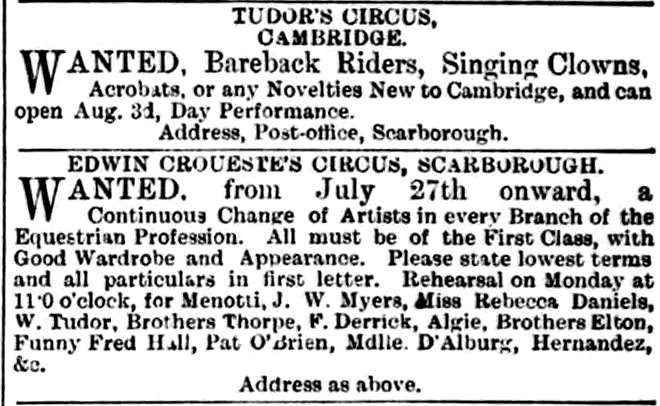
In mid-July William Tudor was in Scarborough planning week five of his Cambridge programme and appearing for Edwin Crouseste, who called him to rehearsal, along with brother Fred and regular colleague Rebecca Daniels, on Monday 13 July. (The Era, 11 July 1896, p 19).
William must have been confident that all was well in Cambridge and that the new circus would be ready. He was still advertising in the Era from Scarborough on 18 July but a week later was doing so from Causeway House on the corner of Maids’ Causeway and Short Street, next to the Four Lamps junction, where he had also lodged the previous year.
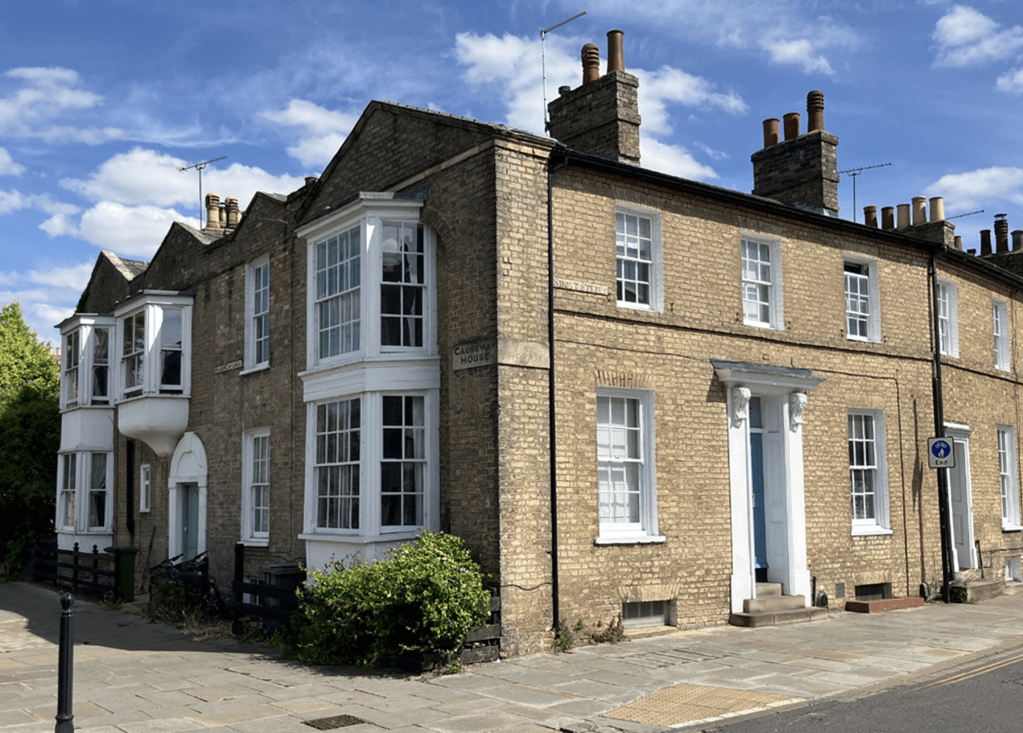
Causeway House, on the corner of Maids’ Causeway and Short Street, a handy lodging for William Tudor close to Butt Green and Auckland Road (David Smith)
And so, on 1 August an advertisement appeared on the front page of the Cambridge Daily News advertising the opening of Tudor’s New Circus in two days’ time with a ‘talented company’ of singers, performers, ‘Funniosities by the best of clowns’ and a ‘splendid stud of horses and ponies’ (CDN, 1 August 1896, p 1). This was not to be a tented circus, nor a temporary wooden building but family entertainment in a purpose-built, permanent circus building in Auckland Road, built by Messrs Thoday and Company. The well ventilated building was brick with a corrugated iron roof and was ‘admirably lighted’ by gas (CCJ, 7 August 1896, p 4).
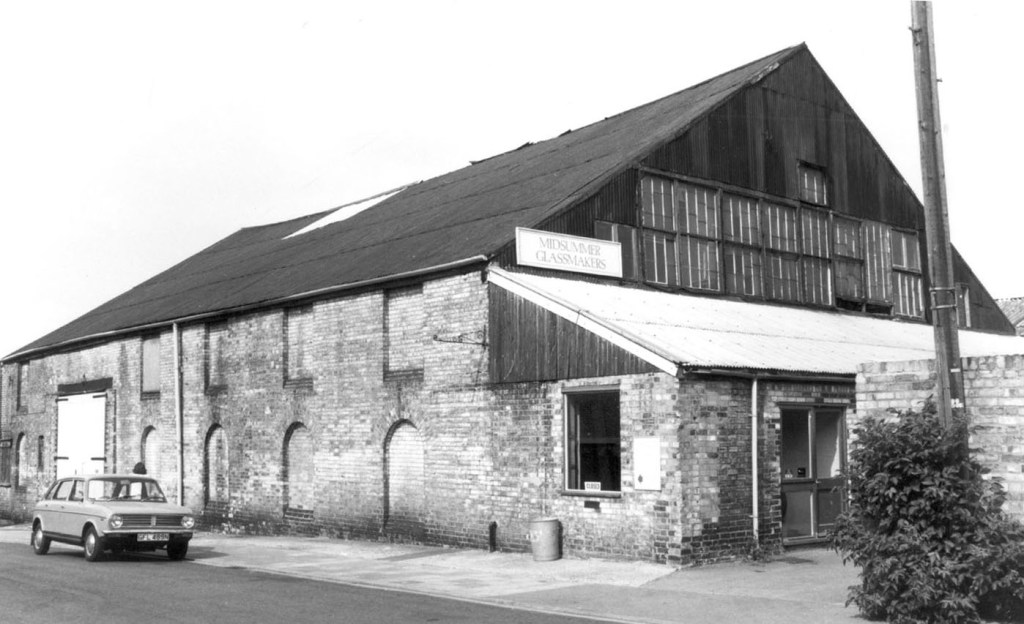
Tudor’s New Circus, Auckland Road, Cambridge, seen here in the 1980s (Cambridgeshire Collection, Cambridge Central Library)
On opening night on the 3rd, people poured into the ‘new and substantial building’ which is described here long before the fun began. Mr Albino was ringmaster; Herr Gething conducted the circus band and all was under the management of William Tudor.
The excited audience crowded every part of the building and ‘showed the greatest enthusiasm, especially, perhaps, at the drolleries of the crowns, Nimble Nip, Little Le Barr and Funny Frisky’. There were acrobatics, dashing bareback riding, gymnasts, music including Men of Harlech on handbells, and juggling. Mr Edward Hanneford was ‘heartily cheered for jumping backwards from the ground to the horse’s back’. Hanneford was an equestrian and circus proprietor who married Elizabeth Scott, eldest daughter of Sir Walter, who also rode, wire-walked and had trained pigeons.
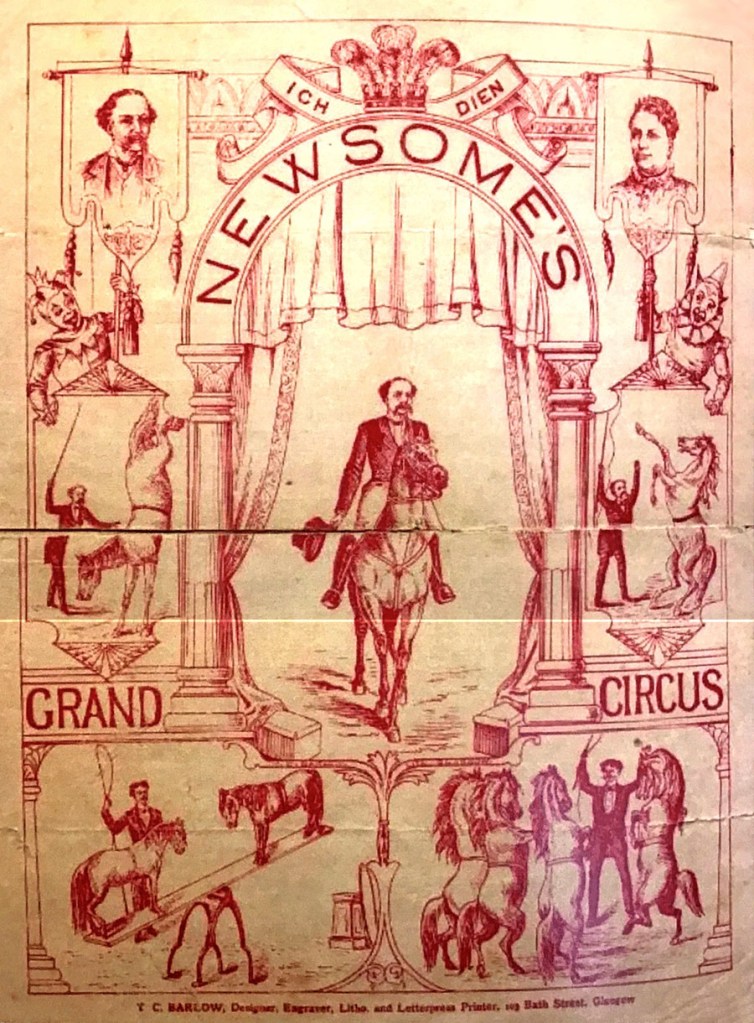
There was great admiration for 72-year-old Mr James Newsome who brought on his four trained Shetland ponies. One of the country’s most famous riders, he had run his own circus successfully for thirty-three years and had six daughters, all circus riders. One of them, Virginie Coralie Newsome, with her dancing mare Duchess and thoroughbred Mornington, was also on the bill. The talented Duchess could both waltz and perform a set of quadrilles. Miss Newsome was to return in May the following year.
Funny Frisky’s ‘giraffe’ caused roars of laughter (presumably not a real giraffe). And the finale was an invitation to anyone from the audience to ride either one of two mules, Punch and Judy (probably James Newsome’s regular performing mules).
A scene of wild excitement occurred as rider after rider was thrown. But an elderly man from the audience did ride one of the animals several times round the ring by holding it round the back with his feet and under the flank with his hands – riding with his head to its tail (CDN, 4 August 1896, p 2). There is no mention of whether he received any reward for this feat!
Advertissments for the new circus appeared daily on the CDN front page, with the new programme announced on Fridays and reviews published on Tuesdays. On 7 August the CDN proclaimed the special engagement at enormous expense of The Villions, champion cycle acrobats who had been complimented by Queen Victoria.
The CDN reviewer was impressed by the marvellous feats of the Villions, particularly enjoying their riding a bicycle while dismantling it, ‘finishing up by riding on the bare wheel, on which they seemed as at home as on mother earth’. But the greatest applause went to the lady and gentleman jockeys, Miss Scott and Mr Hanneford, whose horseback riding was ‘unanimously recalled’ (CDN, 11 August 1896, p 2).
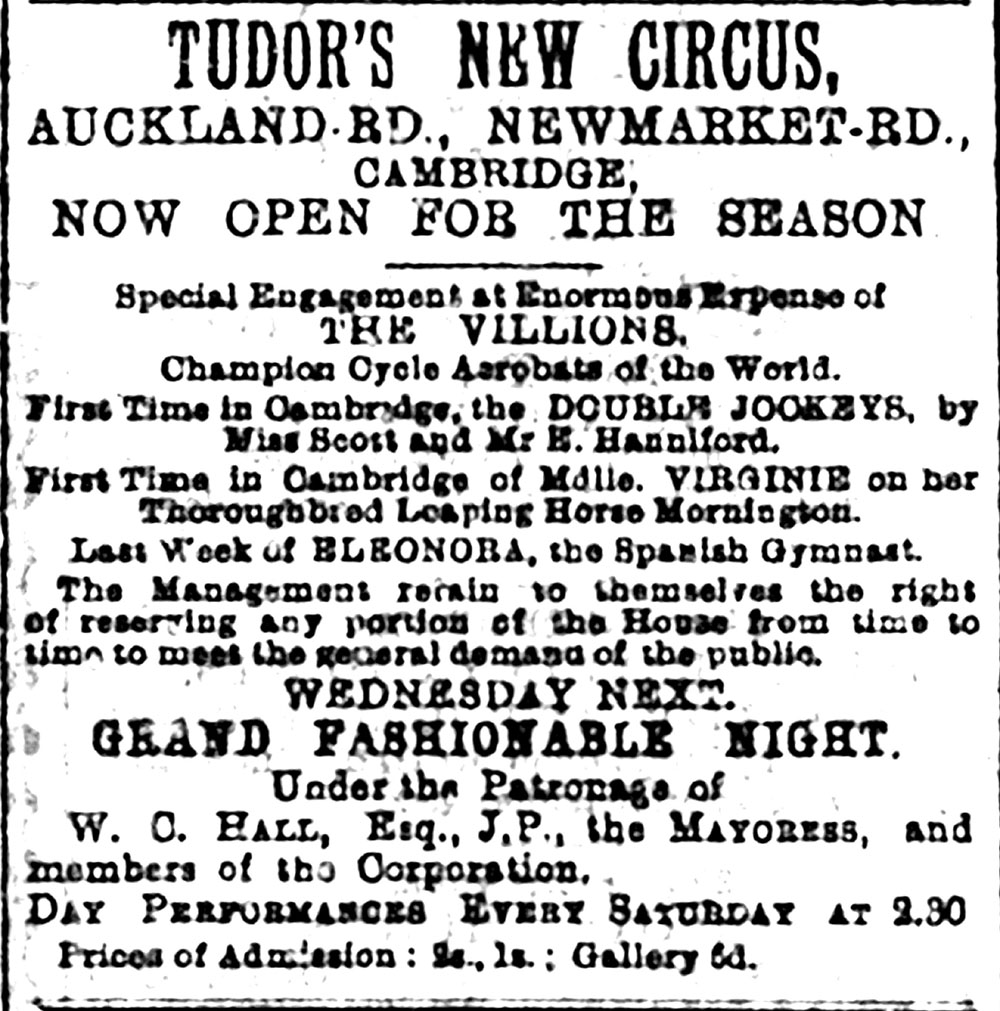
CDN 7, August 1896, p 1
The next week’s programme promised the greatest aerial artistes of the age, the Fernandez Wonders, two ladies and one gentleman. Our reviewer was suitably impressed but also applauded the Bedouin Arabian acrobats, Mons. Aseiky and Mlle. Annette, skilful tumblers, ‘the former turning double somersaults in the air with exact precision, at the same time holding pointed daggers to his throat’ (CDN, 18 August 1896, p 2). Bedouin Arab acrobats (often from Morocco) had become popular in Europe in the late 19th century and were known for human pyramid building and athletic acrobatic displays using rifles and daggers. Aseiky appeared in England from 1882 to 1904 and Annette Aseiky was still performing as a continental dancer some years later.
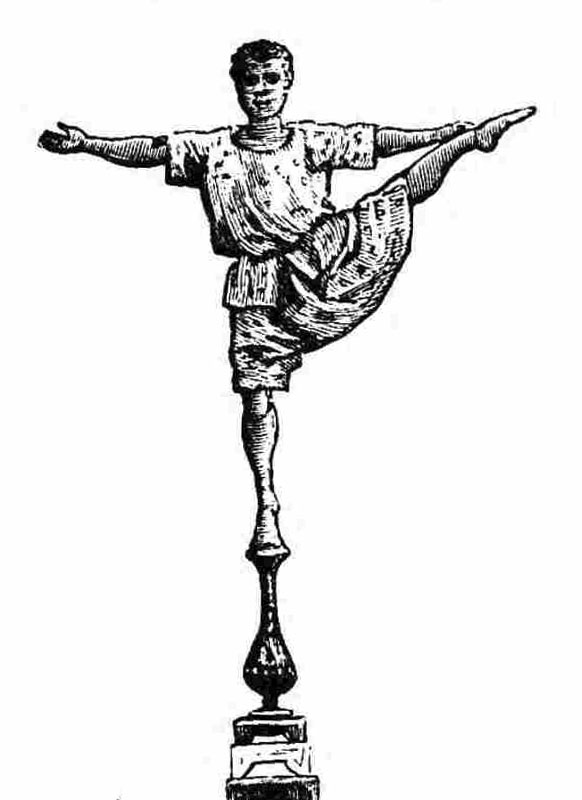
An Arab acrobat at Covent Garden (The Graphic, 9 January 1886, p 3.)
The Brothers Artois, (Jack and Alf Lilley) were triple-bar experts and eccentric contortionists and it was agreed that the new performers were ‘an improvement on those shown in the previous week’ (CEX, 22 August 1896, p 8).
Despite competition from the Arcadia music hall there was no falling off in Tudor’s popularity and the circus was completely full at the Monday evening show. Lively music from the band of four musicians under Herr Gething opened and Funny Frisky, Little Le Barr and Nimble Nip had the audiences in stitches with their sketch Old Joe’s Ghost. The equestrians Miss Scott and Mr Hanneford, and Mr Newsome with his ponies were as popular as ever, while the Gilleno Brothers, Albert and Tom, who with their father and nine siblings were part of the Gilleno Family Troupe, were able to ‘extract music from anything they handled’. Watching them play ‘bells and bellows, ducks and banjo’, had the CIP reviewer holding his sides with laughter (CIP, 28 August 1896, p 8). The star of the show was Victor Samson ‘the British Lion of athletes’ who, it was reported, held a 230-pound dumb-bell over his head with one arm while ‘raising four men, by means of a pole across his back, and swinging them round faster than they seemed to care for’ (CDN, 25 August 1896, p 3).
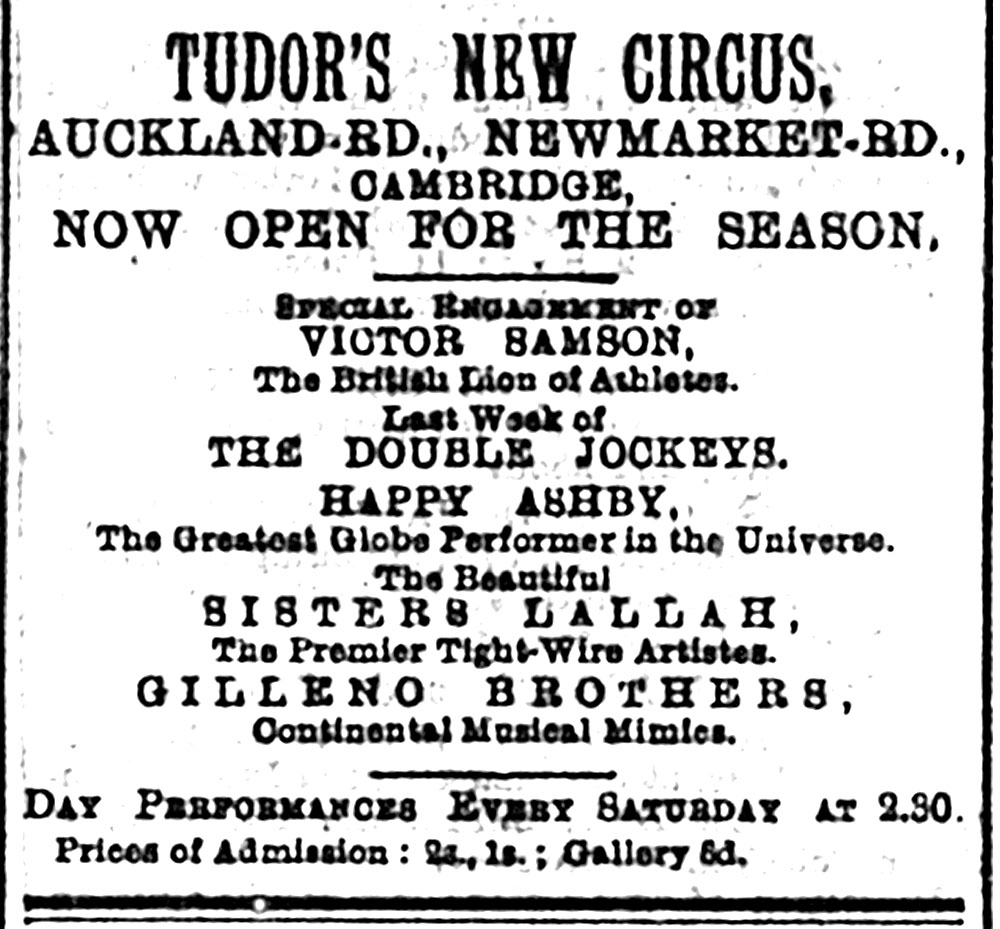
CDN 21 August 1896, p 1
September 1896: pythons, a princess and cross-dressing
On 28th August the circus announced the Cambridge debut of the Vienna Ladies’ Orchestra, under the direction of Herr Ullmann. Music (and cross-dressing) was a big feature of the programme as the band struck up with a march, United Service by Edwin Boggetti; L’Oiseau Du Bois, by Le Thiere, a piccolo solo by Mr T. Oakes and the overture Soir D’Automne by Bouillon. (CEX 5 September 1896 p 8). Tudor brought on his thoroughbred horse Black Eagle, who performed his routine solo to the orchestra’s music. Mr Arthur Farren, female impersonator, was back again in Cambridge and his rendition of Love’s Last Sweet Song had the audience fooled until they heard his gruff voice at the chorus. On the bill was his new protegee, Young Mackenzie, whose ‘international’ repertoire was of English, Scottish and Irish dances. The musical Gilleno Brothers performed. Then Herr Ullmann introduced the four lady musicians of the Vienna Ladies’ Orchestra.
Sundry bowings and other preliminaries over, the musicians get to work, but are soon interrupted, and from this point onward the ‘turn’ is a farce. Instrumentation is forsaken in favour of the dance, interspersed with somersaults, and high revelry is held (CEX 5 September 1896 p 8.)
After the revelry Herr Ullmann took off his wig and moustache and proved to be Mr Albino, the ringmaster, while the ladies revealed themselves as the regular clowns and the Gilleno Brothers all playing musical instruments. This one act alone shows the creativity of the circus performers, with sketches made up at every new programme, and the needs of each performer, particularly the clowns, to have a variety of skills.
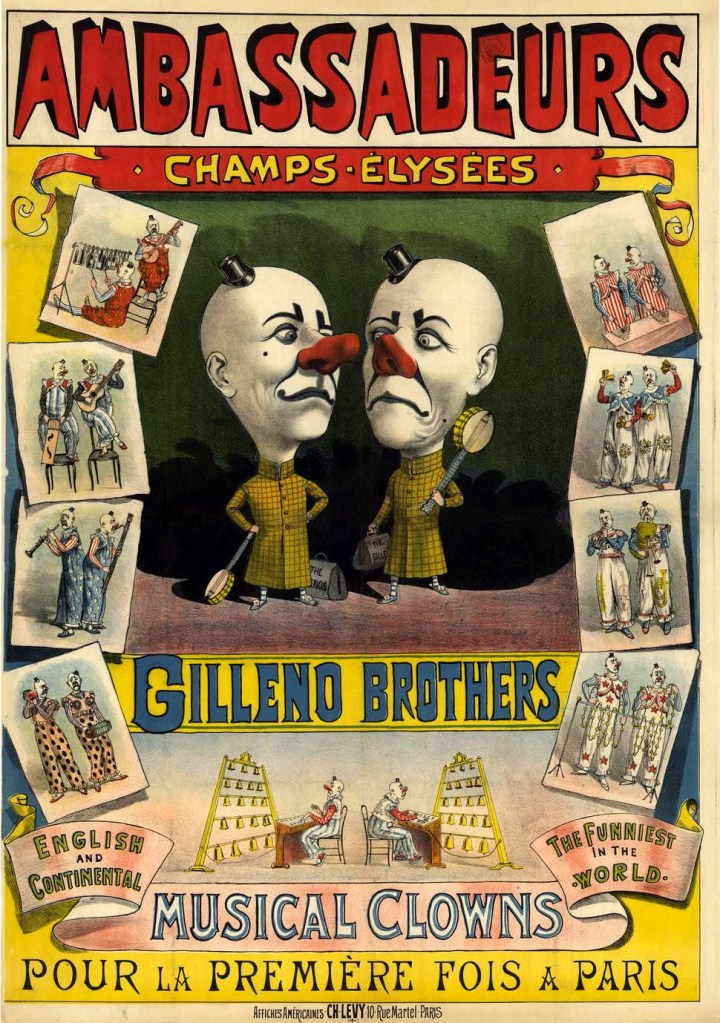
(Bibliothèque Nationale de France)
With few opportunities for travel and only books and newspapers for news and images, the Cambridge audience would be thrilled by sights of foreign peoples and cultures. The descriptions of the performers in the CDN advertisements were designed to transport the audience to a distant, exotic and amazing locale where unbelievable feats would be displayed. Some of these performers, like Aseiky, were from these distant countries, but many were British or European performers ‘exoticising’ themselves.
The Chinese juggler, the Bedouin acrobat, the Indian sword swallower, the American conjuror, and the German Hercules, for instance, provided visual proof of the ‘wondrous’ abilities of men from around the globe . . . these artists (many of whom were, in fact, Britons masquerading as foreigners) provided real or imaginary insight into other, more exotic worlds . . . therebye illuminating what some Victorians thought of as their developing empire, as well as areas they had not yet conquered, and all the curiosities in it (Assael, 2005, p 65).
Charlie Keith in his memoir remonstrates against this . . .
. . . false practice of announcing performers in assumed names that so injures the real foreign artists when he appears. I have known many English performers assume foreign names which they have been unable to pronounce – calling themselves Signor, and pronouncing it the same way as spelt, or writing their names in French, prefixing the word Mons., and often showing their ignorance of the French language by actually calling it Mons. when speaking, instead of monsieur. I was an English clown, and so I would remain – using my own legitimate name of Keith. (Keith, 1879, p 101).
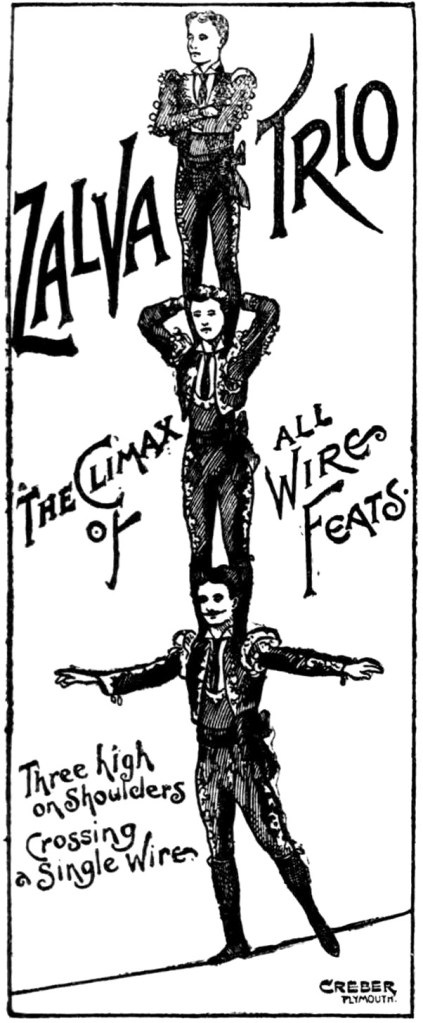
The Zalva Trio (The Era, 28 January 1899, page 34)
The Zalva Trio the ‘greatest high-wire artistes in existence’ (CDN, 4 September 1896, p 1), were actually George and William Cruikshank, with William L. MacAllister who called himself ‘Espana’ and later became Doodles the Clown. Les Frères Leotards may have been the sons of the famous French trapeze artist Jules Leotard (The daring young man on the flying trapeze from the 1867 song by George Leybourne). But Turner also suggests that they were in fact from Birmingham. Their advertised skills were certainly diverse if their origins were not. ‘Hand balancers, enchanted Staircase Upside-down pedestrians, Arab tumblers and comical hat manipulators’ (CDN, 4 September 1896, p 1).
But the audience was pleased particularly with Billy, the trick pony introduced en liberté by Mr Tudor:
This pony, when ordered to leave the ring, after showing off its numerous tricks, obstinately refused, in spite of the repeated cracks of the whip. The reason for this disobedience was, however, soon made clear, when the pony going up to Mr Tudor’s back, pushed him perforce from the ring, which display of affection was heartily cheered (CDN, 8 September 1896, p 3).
By Tudor’s seventh week the audience was being treated to ‘fun, frolic and venturesome feats’ (CIP, 18 September, 1896, p 8), by the new acts of Mef’s juggling of bats, balls and other sports equipment, the train impersonations of Edward Fielding and the shadowgraphics of Tregetour, who used his fingers, hands and head to create shadow images, using limelight and a sheet, of notables such as Gladstone and Lord Salisbury. The image of the Turkish Sultan was ‘both applauded and hissed’ as public feeling ran high over the recent atrocities against Armenians in Turkey (CEX, 19 September 1896, p 8).
Tudor’s circus was still full and crowds continued to ‘throng the building which he occupies off Newmarket Road’ (CIP, 11 September 1896, p 8) but how were the crowds of visitors getting to and from the circus? Cambridge’s horse-powered tramway was a few streets away in East Road, and for those north of the river Cam, the 1890 Victoria Bridge was a walk in the dark across Midsummer Common. Dant’s chain ferry (also known as Cutter Ferry, replaced by Cutter Ferry bridge in 1927) was small and sometimes had to be hand-operated by pulling the wet and weedy chain. Luckily the Cambridge Omnibus Company had just been set up with a more flexible horse-drawn omnibus service in competition with the Cambridge Tramways. So the Company began a ‘special service of ’buses from the Circus to Market-hill, to Old Chesterton, and to Mill-road, after the performances’ (CE, 19 September 1896, p 8).
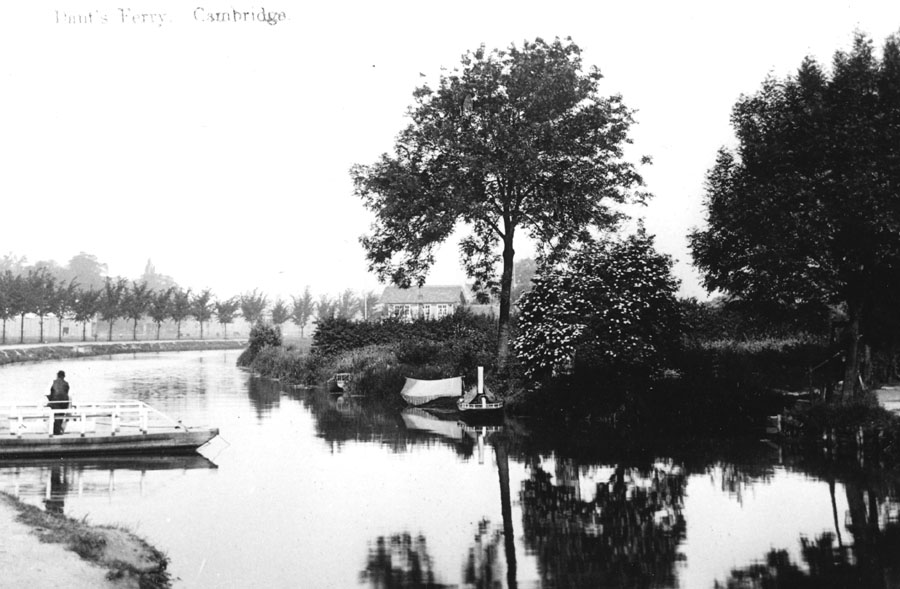
Dant’s Ferry was replaced by Cutter Ferry bridge in 1927. The photographer is near our Elizabeth Way bridge, looking towards Victoria Avenue, and Auckland Road is 130 yards away to the left. (Cambridgeshire Collection, Cambridge Central Library)
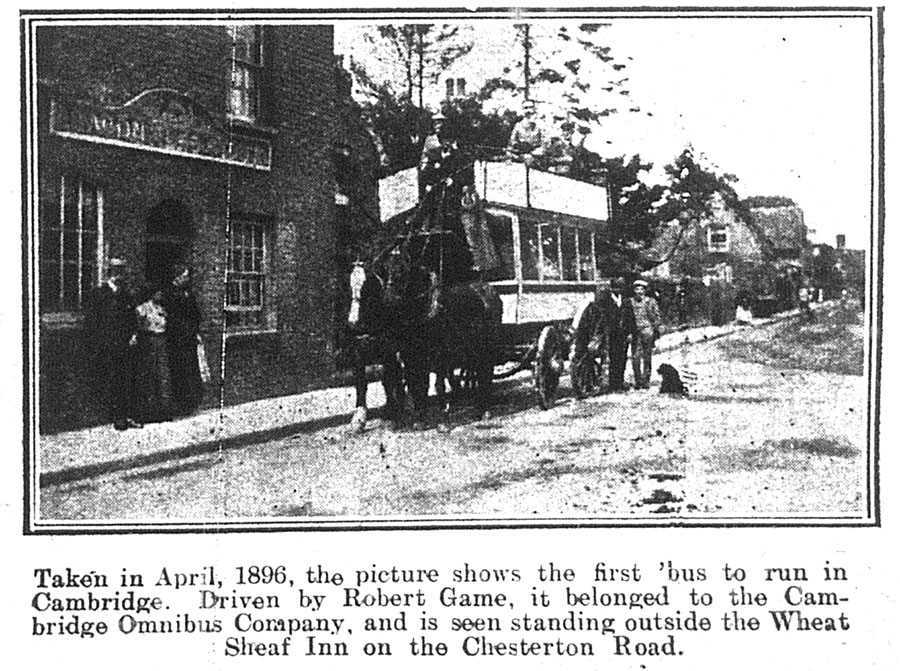
Cambridge Chronicle, 8 July 1925 – the Wheatsheaf was in what we know as Chesterton High Street, near the bottom of Union Lane (Cambridgeshire Collection, Cambridge Central Library)
Queen Victoria became the longest reigning monarch in Britain’s history on 23 September. In patriotic celebration the centre of the ring was decorated with the Queen’s image and other symbols in coloured sawdust, all the work of a Mr W Minks (CE, 26 September 1896, p 8).
The next programme saw the return, after a year, of the popular young lady aerialists The Flying Fitzroys, and of Frank Whiteley, a big item with his popular songs on the banjo and bones. A new act was contortionist Miss Adelina the Human Paradox, but a performer of particular interest was Nala Damajanti.
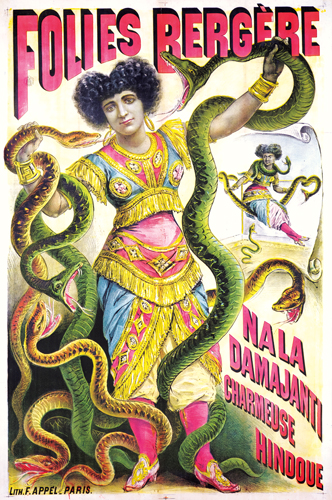
Nala Damajanti the ‘Hindoo princess’ with her snakes, from a Folies Bergère poster found here.
Another example of the self-exoticization of circus performers, Nala, who performed with pythons and boa constrictors, described herself as a Hindoo Princess. The reviewers seemed a touch sceptical of this claim, although the snake act itself was impressive.
The enchantress, Nala Damajanti, described as a Hindoo princess, charms serpents of huge proportions (CCJ, 25 September 1896, p 4).
Nala Damajanti is described as a Hindoo princess; certainly her pythons and boa constrictors, one of which is of exceptional size and length, seem ready to obey her. The hisses they emit and their darting tongues strike awe into most of the spectators, but this intrepid “Princess” is on the most friendly terms with them, though she occasionally teases one to awaken it from its torpor (CDN, 22 September, 1896 p 3).
On 20th April 1886, aged 24, Nala had married John Palmer in Walworth, Surrey, and the marriage certificate gives her name as Mathilde Marie Amelia Poupon, daughter of Xavier Poupon. Her husband was a ceiling-walking acrobat, and was known as Prodigious Palmer The Human Fly. Although there were suggestions, mostly by Emilie herself, that she was from French Pondicherry in India, or even Judea, Samoa or Borneo, a lawsuit revealed reported her to be Emilie Poupon, born in Nantey, in France, on 4th July 1861, (Le Gaulois: littéraire et politique, 17 March 1887, p 2).
The clown Funny Frisky, in reality Giles Gilleno, was replaced by Pete Simple, and the new acts were two more musical clowns, Cyrus and Maud, with their amusing donkey Bess. It does not say whether Cyrus and Bess performed their well-known parody of Dick Turpin’s Ride. Letts the hand-balancer spent most of his time upside down, while singer and dancer J H Wakefield impersonated the cricketer W G Grace while singing Down went the wicket. But all excitement was for the following week when Paul’s Theatographe would be demonstrated.
October 1896: the first films and Dick Turpin rides again
The marvellous arrival of Robert W Paul’s Theatographe (or Cenimatographe) is commemorated on a silk programme which may have been given to the Mayor of Cambridge who attended the Grand Fashionable Night on 6 October
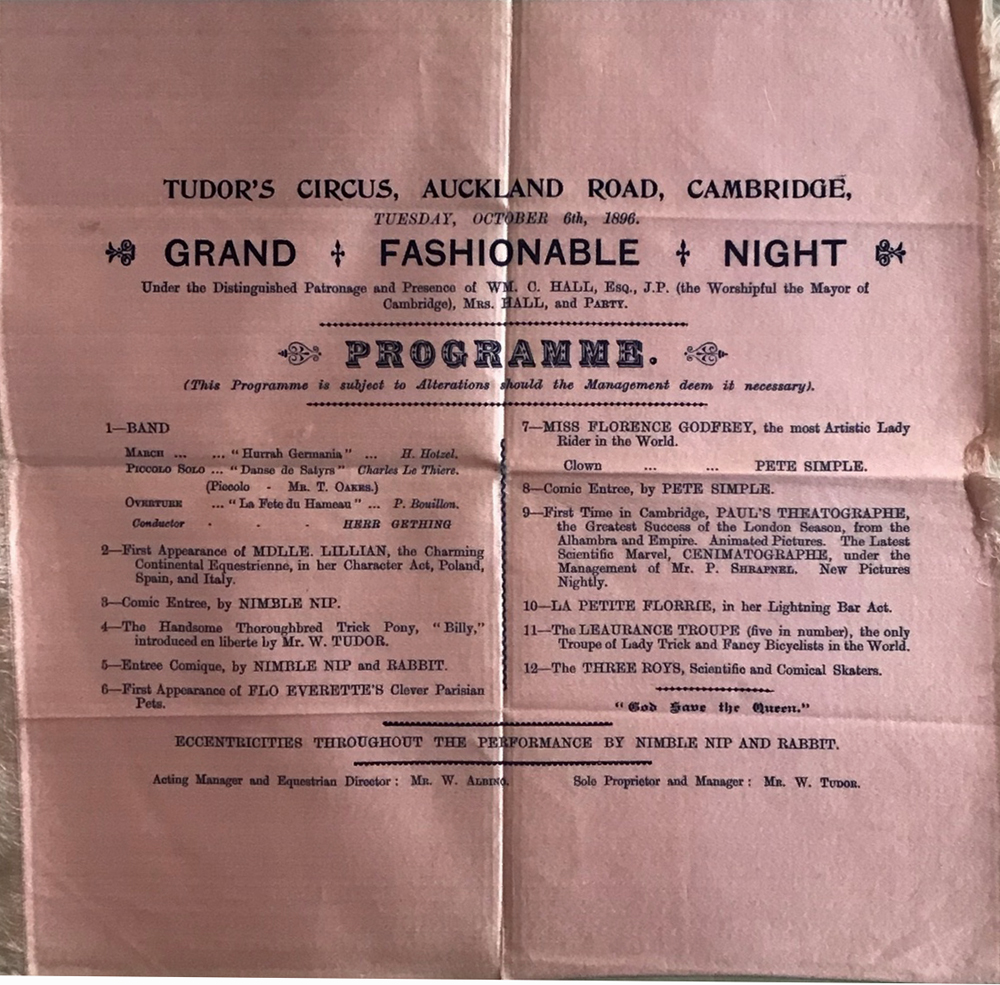
(Cambridgeshire Collection, Cambridge Central Library)
Great Success of Paul’s Theatographe
A most agreeable surprise awaited those who visited the Circus last (Monday) night, in the form of Paul’s Theatographe; for though most had heard of this marvellous invention, a very small number had any idea what it was, and the majority must have been surprised by the reality. The Theatographe or Cenimatographe, consists of pictures, or rather photographs which are reflected by means of limelight onto a sheet. Each one of these living pictures is depicted by means of a series of 1,000 or even 2,000 photographs which have been taken in such quick succession that that there is no perceptible break in the movements of the objects taken; in fact about 40 of the photographs must follow each other in a second. The effect is really marvellous. In a bathing scene at Trouville wave could be seen following wave and breaking on the beach in the fore-ground of the picture, seeming to splash right out of it. Other pictures on Monday were ‘London Bridge at 10 a m, ‘Train entering station,’ ‘Persimmon winning the Derby,’ ‘Parisian Street Scene,’ ‘Garden Scene,’ and others. These pictures, which are different each night, are displayed under the management of Mr P. Shrapnel and are now to be seen for the first time in Cambridge. They are well worth a visit.
CDN, 2 October 1896, p 3
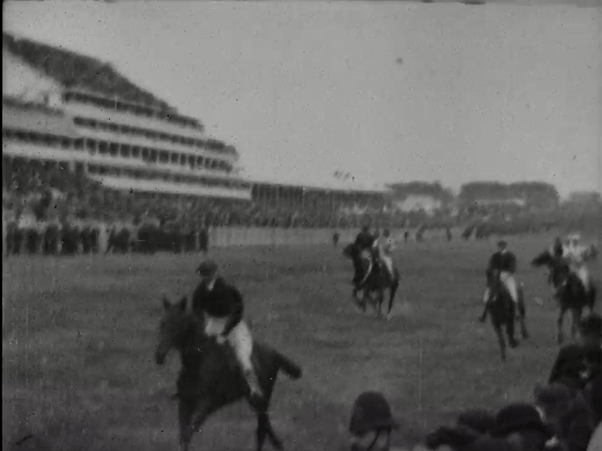
Robert W Paul’s 1896 film of the Derby at Epsom, won by the Prince of Wales’s horse, Persimmon
Some of those films may easily be found on a well-known video-sharing website and on a British Film Institute DVD. As well as a not-to-be-forgotten cinema pioneer, Robert W Paul was a scientific instrument maker of great importance with a significant Cambridge connection: you can read more about him here .
Flo Everette’s performing dogs, the Laurence Troupe of five lady trick-cyclists, comical skaters the Three Roys (two ladies and a gentleman) and the Riding Machine, all valiantly entertained and amused.
What makes the spectators shout with laughter is the ‘new riding machine,’ by means of which small boys are selected from the gallery and suspended on, or rather above, a horse and so carried round the ring as the horse trots, with the deluded impression that they are riding ; this impression, however, is soon removed when the horse breaks into a gallop leaving its rider far behind suspended in mid-air (CDN, 2 October 1896, p 3).
Tudor could do with this success. His thoroughbred horse Black Eagle, who had appeared in the ring as recently as 25th September, had died soon after and now his cream-coloured performing pony had lockjaw. All too soon, the season was drawing to a close and there was competition from both the New Theatre and Arcadia.
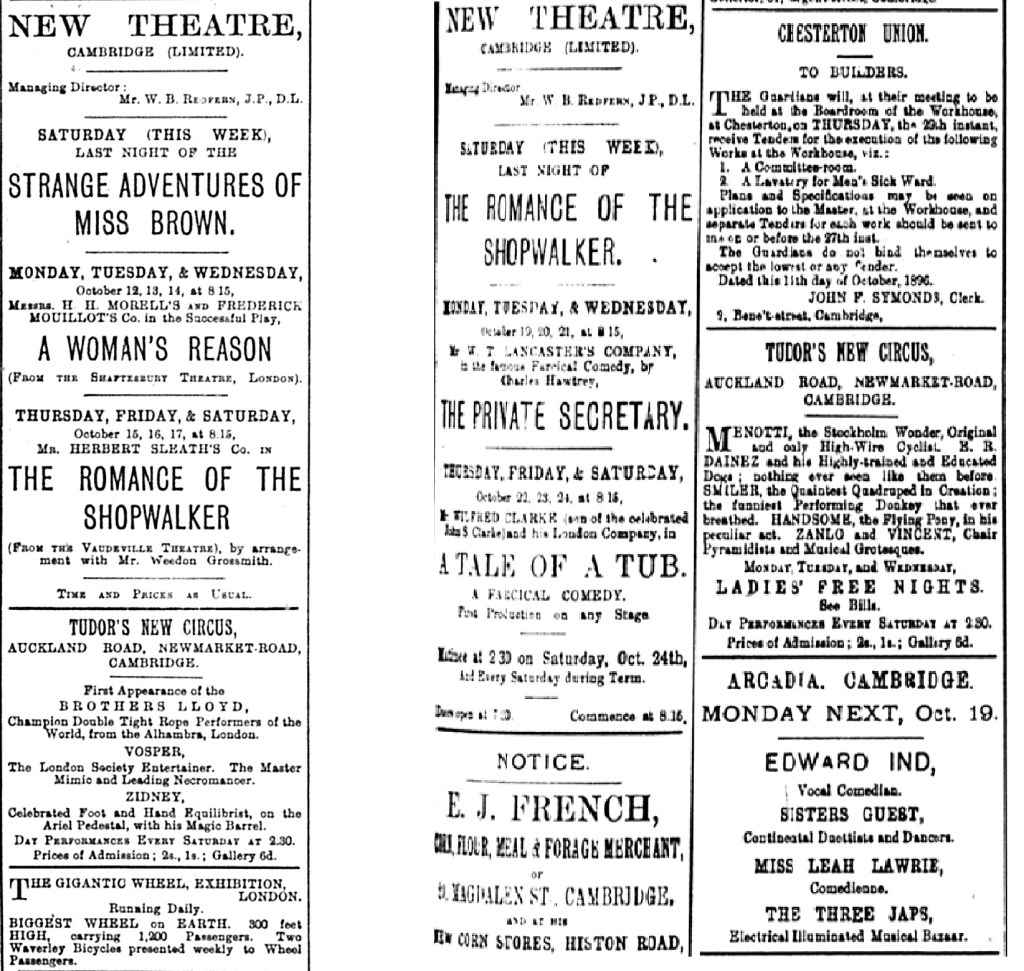
Competing attractions advertised in the Cambridge Express on 10 October, p 4 (left) and 17 October (p 5) 1896
But the show must go on and ‘there was a very fair attendance last (Monday) night, notwithstanding numerous counter-attractions’ now that Full term had started (CDN, 20 October 1896, p 3). Vosper the ‘leading necromancer’ was back again after his 1895 success doing impersonations, and the Brothers Lloyd, in naval uniforms, played ‘a violin duet while dancing and turning somersaults on the tight rope without any interruption’ (CDN, 13 October 1896, p 2).
Apart from the returning Menotti the Stockholm Wonder and highwire cyclist, and Zanlo and Vincent, chair pyramidists, the next week’s artists were mainly four-legged. Handsome the flying pony did everything except literally fly and then Mr Dainez came on with Smiler. This wonderfully precocious donkey, with a canine jockey, managed to walk a plank and to fire a pistol. More Dainez dogs appeared after Menotti and ‘dance, throw somersaults, box (with gloves) like men, and cause roars of laughter, and leap about 11 or 12 feet high’ (CDN, 20 October 1896, p 3). Tudor and “Professor” Dainez, with his goats, had performed together as partners in Tudor and Dainez’s Circus in 1890 in Llandudno.
Tudor was well-known for his care of his horses who were stabled under the raked seating of the circus. Domestic animals and pets such as horses and donkeys, dogs, cats, with the occasional goat were usually the only animals that appeared. We have noted Clemolo’s monkeys in 1895s, and Nala’s snakes, Permaine’s bears in 1898 and Lockhart’s three elephants in 1899, but exotic animals were not the norm. This was unlike the large tented circuses and menageries that toured where caged lions, tigers, elephants and more were on display. For more on animals in circuses see link to Animals in Circuses.
On 24 October a notice from Tudor appeared in The Era, regarding the closure of the circus.

The CDN suggested that ‘The many patrons of this popular place of amusement will probably regret to learn that this week is the last of Mr Tudor’s stay in Cambridge, at least in the capacity of circus proprietor, for this season’ (CDN, 27 October 1896, p 2). Benefit nights for Tudor and for the clowns, Nimble Nip and Rabbit, were announced and the regular end of season programme promised the excitement of Dick Turpin’s ride to York, and death of Bonny Black Bess.
The final acts were the Armytage Sisters whose skirt dancing was especially popular, the Cameo Troupe, (the Ward family group of acrobats and human pyramid-builders), and the high trapeze act the Zoes, (Pepito Lopes Perez, from Cadiz, with his wife Rose).
A strong net extending across the ring beneath them reassures the more timid among the onlookers, for though the gentleman fell no less than three times in his attempt to accomplish a feat of exceptional daring and difficulty, he seemed rather to enjoy his falls than otherwise. (CDN, 27 October 1896, p 2)
For Dick Turpin the ring was transformed to resemble a theatrical stage with three different scenes: outside an inn in London, and outside an inn, with drinking table and horse trough, on the Old North Road, and finally the road to York. Mr Tudor himself made ‘as good a Dick Turpin as one could hope to see on many a stage and one would never see a better Bonny Black Bess’. In the finale the horse, Black Bess, ‘sinks beneath her rider, who utters her eulogies in verse, and is carried along the road with the hero of the story, by gipsies and countrymen who mourn her death in pathetic silence’ (CDN, 27 October 1896, p 2), a sad finale to the end of the season. The CCJ felt that this Dick Turpin ‘would be impossible to improve upon’ (CCJ, 30 October 1896, p 8). The last two performances were on Saturday 31 October, the same day that Tudor was advertising in The Era, recruiting staff for his Macclesfield circus season.
On Monday 9 November Tudor’s Circus was open in Macclesfield with some familiar names (Mr Albino, Rebecca Daniels, James Newsome and Pete Simple, for example) and some new.
Tudor’s first season in his permanent circus building in Cambridge had finished but similar productions were advertised at Arcadia from then until early December. In April 1897 Fourpawr’s Great American Circus Hippodrome was to appear in the Priory Grounds, Newmarket Road, with a two-pole circus tent that seated 5,000 people, and advertising nearly 100 horses, mules and ponies, so on a rather larger scale than Mr Tudor and Black Bess, but for only two days, while Tudor would be back in Cambridge on 25 May 1897 for a whole summer season.
Go to next section: 1897: a May re-opening and Victoria’s Diamond Jubilee
 William Tudor's Circus