Keith and Palmyra, Midsummer Common, August to September 1890
It would be another three years before William Tudor came back to Midsummer Common. However, Charlie Keith’s intervening seasons tell us something about Borough/University relations, attitudes to the circus, and where the temporary buildings were on Butt Green around the time Victoria Avenue was built across the Common to Chesterton.
In The Era, 10 May 1890, Keith advertised for equestrians, gymnasts and acrobats and that he was ‘open to receive a Steady Partner with little money . . . Cambridge and Bournemouth secured . . . Plans passed and given.’ He advertised again on 5 July, offering engagement from 4 August for ten weeks. According to Fitzroy (1998, p 160), Keith reached a partnership agreement with Mr Palmyra soon afterwards and another advertisement appeared in The Era on 19 July, this time under both names.
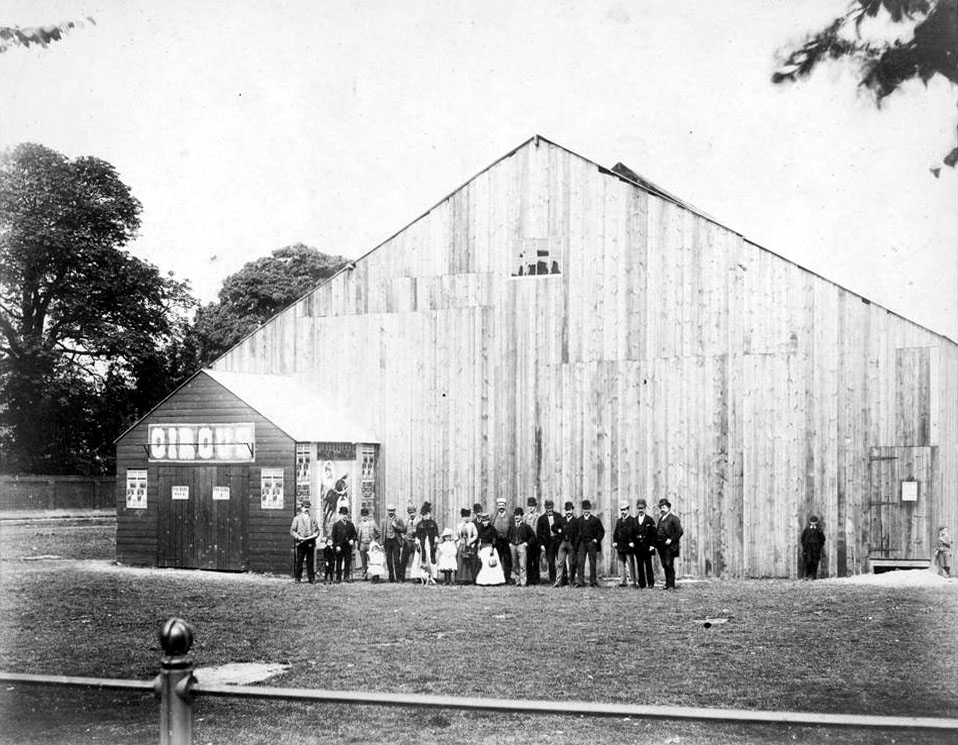
The ‘Splendid New Building erected by the eminent firm of Thoday and Son’. David Fitzroy (1998, page 161) tells us that this picture shows the Keith and Palmyra families in front of the the circus on Butt Green, Midsummer Common in the summer of 1890. The railings are of a design still familiar to us and there is evidence that this is the part of Butt Green west of Victoria Avenue (which was opened in December 1890) and north of Jesus Lane. That plot was enclosed by Jesus College in 1930 in an exchange of land with Cambridge Borough. (Victoria & Albert Museum)
On 29 July the usual advertisement appears in the Cambridge Daily News:
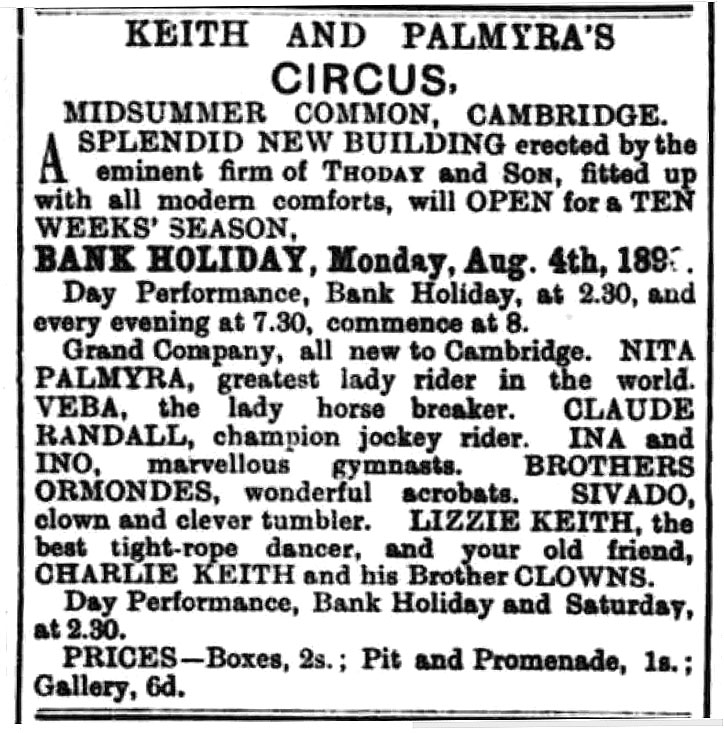
At the beginning of the second week Keith claimed in the CDN: ‘This SPLENDID NEW BUILDING From Original Designs of Charlie Keith . . . has surprised and delighted all Cambridge. THE BEST COMPANY EVER SEEN . . . and to keep up the excitement this famous Company has created, Four New Clowns will appear.’ Then, at the end of that week (15 August, page 2): ‘The Brightest, Most Refined, and Best Amusement that ever visited Good Old Cambridge . . . NO MORE REFINED OR BETTER ENTERTAINMENT WAS EVER SEEN IN THIS TOWN.’
The season continued through August and into September, when attractions included the usual production of Cinderella, played by ‘FIFTY PRETTY LITTLE CHILDREN of Cambridge’. But on 26 September, Keith advertised on page 5 of the Cambridge Chronicle: ‘FAREWELL PERFORMANCES, MONDAY AND TUESDAY, September 29th and 30th, 1890, and THE REST OF THE WEEK, providing the Vice-Chancellor’s permission is obtained up to the 11th of October, the given time originally agreed upon by the Mayor and Corporation.’
The Chronicle (26 September) and the Cambridge Daily News (27 September) published Keith’s long and trenchant (not to say bitter) letter about this. He hadn’t wanted to come in term time, but the ten weeks to 11 October were what the Borough offered him; he had lost £400; the Vice-Chancellor hadn’t answered his letters back in the spring (despite the stamped envelopes he had enclosed!); he had ‘never been treated with such scant courtesy by those in power as [he had] been in Cambridge’; and he questioned why the University had such power. Click on this image to read the full and lengthy text:

The Cambridge Daily News commented on this under the heading University Intelligence on 8 October:
Now the theatre is allowed to open at intervals during the whole term, but the Vice-Chancellor draws the line at the circus. [The University] absolutely refused to allow it to be open on a single day of term, and the season was brought to an unceremonious conclusion on September 30th, to the loss of the artistes and the irritation of the townspeople. This is one of the exceptional privileges of the University which many think ought to be swept away.
On 3 October the Cambridge Chronicle reported:
A really brilliant season was brought to a close on Tuesday last at the circus. The building has been crowded night after night . . . Mr. Keith has not been at all loath to express his opinion about the action of the Vice-Chancellor and certain members of the Town Council, owing to which he has been compelled to curtail his season. He again referred to the subject . . . when he thanked his audience for their patronage, and promised an early return visit.
Another year, another wooden circus on Midsummer Common
On 6 October 1890 Keith and Palmyra went off to Derby, where they opened a new building on 26 October (Fitzroy, 1998, page 162). In February 1891, the Cambridge Borough Commons Committee sought the advice of the full Council when considering Charlie Keith’s new application to rent land that summer. Councillor Bullock asserted that:
The circus last year was a great nuisance to Mr Morgan of Jesus College, and to many of the residents in the locality, and he hoped the Council would not permit any circus to be erected on the west side of the avenue. He had no desire to limit the amusements of the people; but he was anxious that there should not be a repetition of last year’s nuisance.
Cambridge Independent Press, 21 February 1891, p 5
It was agreed that the circus would not be located on the triangle bounded by Jesus College, Jesus Lane, and Victoria Avenue.
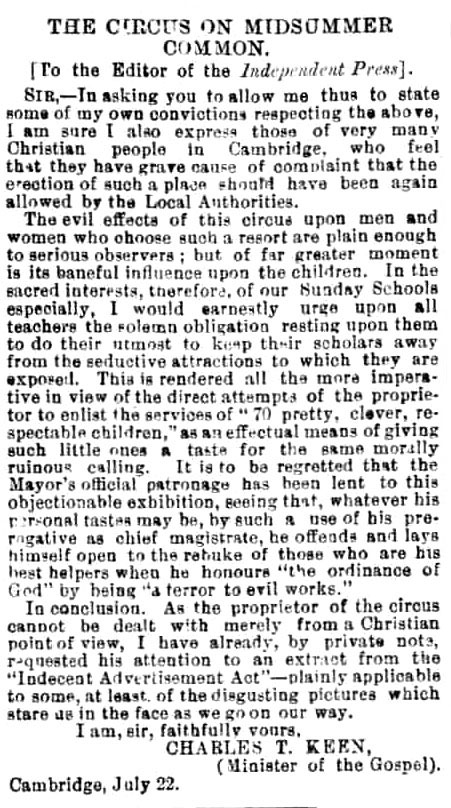
Despite the previous year’s dispute with the Vice-Chancellor, Keith was back on Midsummer Common in a new structure built by Thoday and Son on 5 July 1891 (Cambridge Chronicle and Journal, 3 July 1891, page 8). However, it wasn’t long before a new enemy of popular culture, Baptist minister Charles T Keen, wrote to the Cambridge Independent, (25 July 1891, page 8) with this attack on the circus:
As we would expect, Keith was not a man to take this lying down, and his reply was published in the Independent on 1 August (page 5):
The Circus
SIR, —The letter re the above in your last week’s paper is a libel on my character, my company, and profession. It is useless arguing with the writer: he seems to be one of those (to quote the words of Shelley), who say, ‘We have in our midst a bigoted, prejudiced, intolerant, conscientious, and tremendously powerful class, who believe that happiness is wrong.’ I was taught to believe the noblest purpose of life was to make others happy. In justice to myself, I ask you to insert the enclosed letters which have passed between your imaginative correspondent and yours truly.
Charlie Keith. July 29th 1891.
There followed Keith’s and Keen’s earlier private correspondence, beginning with Keen’s reference to the Indecent Advertisements Act, 1889 :
15, Hertford Street, Cambridge, July 11th 1891.
SIR, —Having noticed some of your indecent pictures of female equestrians, in the interest of the public morals I beg to draw your attention to the enclosed Act.
Yours truly,
C. T. Keen.
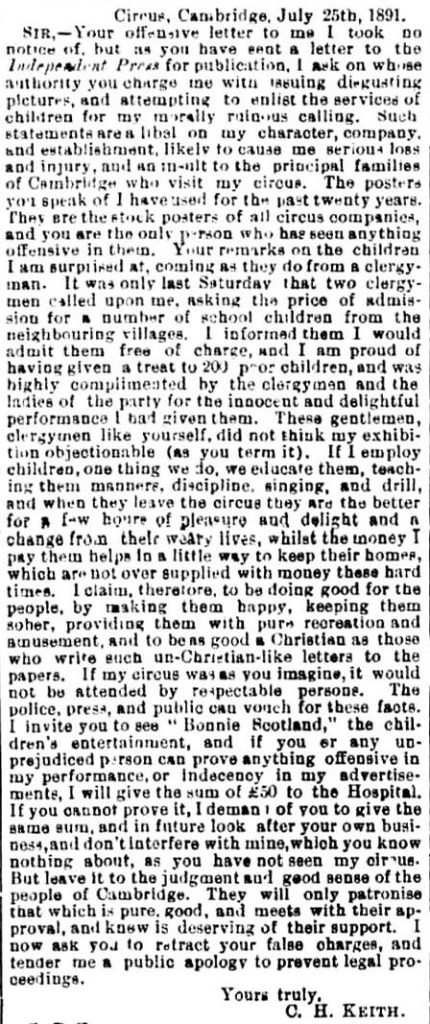
Keith’s lengthy response (read it here) was typically robust, demanded retraction of the charges and a public apology, and threatened legal action. We do not know the outcome, except of course that Charlie carried on to what he called on page 3 of the Cambridge Daily News, 25 September, ‘FAREWELL PERFORMANCES Of a Brilliant Season . . .’ on the 26th, having performed his civic duty (take that, Charles T Keen!) by dedicating the show on 18 September to the benefit of the hospital.
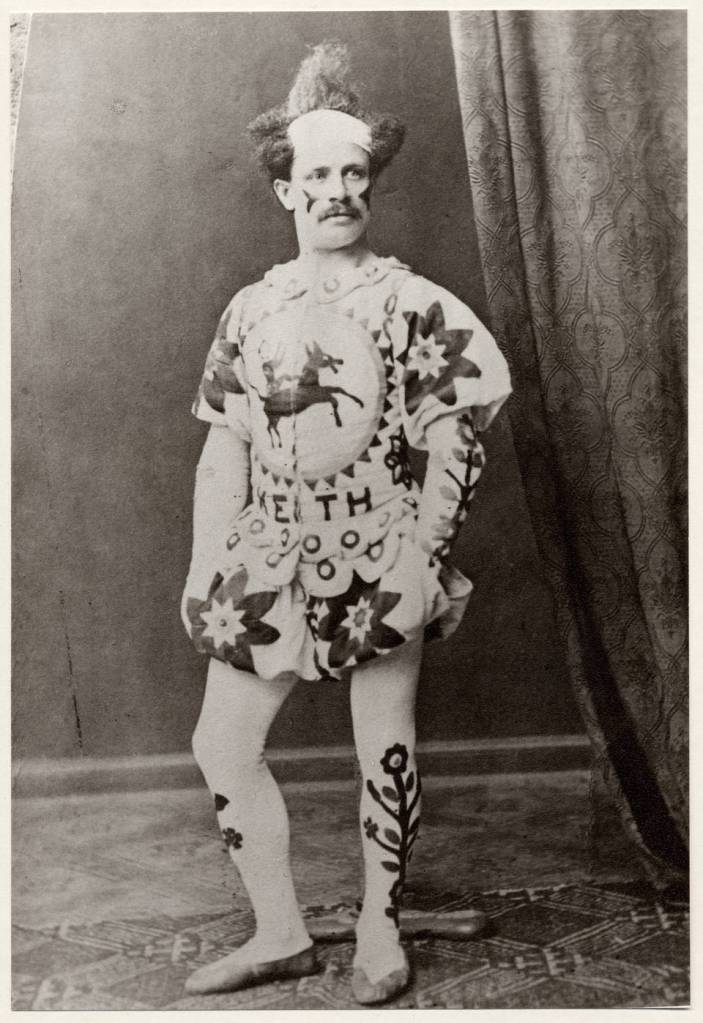
Charlie Keith, clearly unimpressed by Charles Keen’s attack on his ‘morally ruinous’ circus (Victoria & Albert Museum)
The Roving English Clown’s Last Cambridge Season
Back came Keith in 1892, the Commons Committee having agreed to let a portion of the common to him from 20 June to 30 September for £10 per week (Cambridge Independent Press, 19 February 1892, page 5). This time we know its exact location, ‘60 or 80 yards nearer the river than the previous one’, according to the Cambridge Chronicle, 8 April 1892, page 3, because we have the contract with its plan. The circus opened on 11 July. Once again eschewing puff, Keith declared:
— all Cambridge knows CHARLIE KEITH . . . I have erected a New Building, expressly built for the occasion by Thoday and Son. This is the 59th circus building I have erected—more than any other Circus Proprietor in England. You do not need puff, but pure amusement. I make no boast that my circus is superior to others. I simply open a New Circus Building, will return you worth for your money, and always provide a High-Class entertainment.
Cambridge Daily News, 2 July 1892, page 2
The last night was on 1 October, and that was it for Keith in Cambridge. Like so many of our characters (always excepting the long-lived Tudor) he didn’t reach old age, dying at 58 in Lancashire in March 1895.
Go to next section: Tudor’s progress, 1890-1893: from north Wales to north-east England
 William Tudor's Circus